Garage Conversion Value: What It Adds, What It Costs

A garage conversion can add value, subtract it, or do almost nothing, and the deciding factors are local: whether buyers in that neighborhood expect covered parking, whether the work was permitted, and how well the new space blends with the rest of the house. For an investor, the practical answer is to stop looking for a universal percentage and price the conversion from nearby sales. This guide shows how to do that, how to fold the conversion cost into your ARV and maximum allowable offer (MAO), and where Florida and Dallas–Fort Worth buyers tend to differ.
TL;DR
- A well-done conversion can return up to about 80% of its cost, but in markets where parking is scarce it can lower value. Realtor.com makes the same point.
- Appraisers do not use a fixed “garage conversion adjustment.” They adjust from what local buyers actually paid.
- Permits, heat and cooling, and finishes that match the house decide whether the space counts as living area in practice.
- Price the deal two ways: with the conversion counted as living space, and with it valued as a missing garage. Offer based on the lower number unless you have closed comps that prove the higher one.
Table of Contents
- Why garage conversion value is not one number
- What the evidence says about return on investment
- How appraisers and lenders treat a converted garage
- How to value a house with a converted garage
- What a conversion costs
- A worked example: pricing a flip with a garage conversion
- Florida and DFW: local factors to check
- Curb appeal decides how the conversion reads
- Our view on garage conversions
- Run both ARVs before you make the offer
- FAQ
- Sources
Why garage conversion value is not one number
Think of ARV the way you would think about a restaurant meal: you buy the ingredients (the house and the rehab), and you sell the finished plate. The buyer pays for the plate they can see and use, not for what you spent on ingredients. A garage conversion is a good test of that idea, because the money you spend and the value a buyer perceives can be far apart.
The conversion changes two things at once. It adds finished interior space, and it removes a garage. Some buyers value the extra room. Others see a house that has lost its parking and storage. Which group dominates depends on the neighborhood, the price tier, and the quality of the work.
Appraisers say the same thing. One hard money lender’s ARV guide notes there is no one-size-fits-all garage conversion adjustment: value depends on market acceptance, the quality of finishes, and whether buyers see a functional upgrade or a loss of essential utility.
When a conversion helps
- The new space is seamless: same flooring, ceiling height, trim, and HVAC as the rest of the house.
- It adds a bedroom or a usable office in a house that was short on both.
- Comparable homes nearby already have converted garages, so buyers expect them.
- It was built with permits and passes as legal living area.
When a conversion hurts
- Street parking is limited or the HOA restricts it.
- The garage door was simply framed in, with a visible patch on the facade.
- There is no permit, no permanent heat, or the space still feels like a garage.
- Nearby buyers want covered parking and pay a premium for it.
What the evidence says about return on investment
The most quoted figure is roughly 80%. Realtor.com says a well-done conversion that flows naturally with the home can return up to 80% of its cost, and Angi’s cost guide reports an approximately 80% ROI as well. Treat that as a ceiling for good work in a receptive market, not as a planning assumption.
The same Realtor.com article says a conversion may reduce value where dedicated parking is scarce and highly prized. That is the other half of the picture, and it is the half investors forget when they build a flip budget.
A real appraisal shows how this plays out. Sacramento appraiser Ryan Lundquist described a non-permitted garage conversion where the sales history indicated buyers paid about $15,000, or 6%, less than for otherwise similar homes with a garage. He used that market-derived figure as a downward adjustment and did not apply a formula. That is one case from one market in 2016, so do not copy the 6%. Copy the method: find what the market did, then adjust by that.
How appraisers and lenders treat a converted garage
Your exit buyer often needs a mortgage, so the lender’s appraiser sets the ceiling on your ARV. Four rules shape how they handle a conversion.
Measurement. Fannie Mae’s appraisal guidance requires a clear and accurate description of improvements, with above- and below-grade areas measured and reported under ANSI Z765-2021. It also says an addition without required permits must be addressed for its quality, appearance, and effect on value. Fannie Mae’s announcement SEL-2021-11 made ANSI Z765-2021 mandatory for applicable appraisals dated on or after April 1, 2022.
Adjustments follow the market. Fannie Mae’s Lender Letter LL-2015-02 says comparable-sale adjustments must reflect the market’s reaction to differences, not an arbitrary rule of thumb or a fixed dollar-per-square-foot amount. The HUD appraisal report guide for FHA loans asks the appraiser to identify car storage, garage capacity and type, and above-grade gross living area, and says garage adjustments must follow market acceptance and size.
Livability. One appraiser’s FHA overview says FHA does not categorically require permits, but it expects functional interior access, permanent heat, and finishes consistent with the rest of the dwelling. Local zoning may also make a conversion nonconforming. The same source flags drop-down attic stairs through a garage ceiling as a fire-safety concern, since they must respect the fire-rated separation between the garage and the living space.

Local treatment varies. In one Arkansas market, an appraiser reports that a finished, heated and cooled garage has been counted as living area, but treatment differs by appraiser, county, and lender. Do not assume your last deal’s treatment applies to the next one.
How to value a house with a converted garage
The method is a standard sales comparison, with extra care on the garage. Our guides on the sales comparison approach and on running 3 to 5 comps cover the basics. Here is the garage-specific version.
- Confirm what you have. Pull permits from the city or county. Check whether the space has permanent heat, a proper egress, and a ceiling and floor that match the house. Note how the garage door opening was closed.
- Look for converted comps first. Search closed sales within a half mile and six months with a similar conversion. If you do not have MLS access, see how to pull comps without MLS.
- If none exist, subtract the conversion. The lender guidance says to remove the conversion area and evaluate the property with the comps you can find. That gives you a conservative floor.
- Pair sales to find the market’s number. Compare otherwise similar homes with and without garages. The gap, not a rule of thumb, is your adjustment. Our workflow to adjust comps for repairs works the same way.
- Run two ARVs. One counts the conversion as living area, the other treats it as a home missing its garage. Use the ARV calculator and the comps analyzer to keep both versions side by side.
- Offer from the lower ARV unless closed, recent, nearby sales support the higher one.
When comps differ in garage configuration, remember what appraisers are told to compare. The Appraisal Foundation’s Valuation Advisory #4 covers the characteristics that determine comparability, and it is a useful checklist when your best comp has a two-car garage and your subject has none.
What a conversion costs
Cost matters for two reasons: it sets your rehab budget when you buy a house that is not yet converted, and it helps you judge whether a seller’s finished conversion was done cheaply.
| Scope | Typical cost | Source |
|---|---|---|
| National range, standard conversion | $9,659 to $51,659, averaging $30,659 | This Old House |
| Garage door converted to a wall | $16,665 average in 2025 | ADU Marketing Pros |
| Garage-to-apartment, national average | $60,000 to $70,000 | Honest Casa |
| Garage-to-apartment, lower-cost markets | $40,000 to $65,000 | Honest Casa |
| Garage-to-apartment, high-cost markets | $80,000 to $120,000 | Honest Casa |
These are guide-level averages. Plumbing, electrical, HVAC, windows, insulation, flooring, and drywall all move the total, and Angi puts permits at roughly $300 to $1,000. This Old House recommends detailed line-item bids from at least three contractors, and that advice is worth following before you write a number into your rehab budget. For a market-specific starting point, our Galveston rehab estimator shows how a local estimate is laid out.
Notice the gap between cost and value. If a $30,000 conversion returns 80%, you recover $24,000 and lose $6,000. If it returns 50%, you lose $15,000. Neither case counts the holding costs or the time.

A worked example: pricing a flip with a garage conversion
This is an illustration with made-up numbers, not a market report.
You are looking at a 3-bedroom house with a garage, in a neighborhood where most homes keep their garages. Three closed comps with garages average $300,000. You are considering converting the garage into a fourth bedroom for $30,000.
Scenario A: the market shrugs. Buyers value the extra bedroom but miss the garage. Your paired sales show homes with garages sell about 6% higher than similar homes without. The converted house is worth about $282,000, so you added no value and spent $30,000. Skip the conversion.
Scenario B: the market pays. Nearby converted homes with permits sold for $315,000. The conversion adds $15,000 over the garage version at a cost of $30,000. Still a $15,000 loss on that line item, though the total profit may hold up if the house had other gains.
In both cases the conversion fails on its own terms. It makes sense only when it is cheap, when it fixes a floor plan problem that blocks the sale, or when comps show a clear premium.
Now the MAO. Using the standard wholesale approach, take ARV, then subtract fixed costs, desired profit, your wholesale fee, and rehab costs:
| Line | Scenario: buy as-is garage, no conversion |
|---|---|
| ARV | $300,000 |
| Fixed costs (closing, holding, selling) | $24,000 |
| Desired profit | $35,000 |
| Wholesale fee | $10,000 |
| Rehab (kitchen, paint, floors, no conversion) | $45,000 |
| MAO | $186,000 |
If you buy a house that already has an unpermitted conversion, stress the ARV downward first. At a 6% haircut the ARV falls to $282,000, and the MAO falls by the same $18,000, to $168,000, before you add the cost of permitting or reversing the work. Our adjusted MAO article on condos versus houses shows how an ARV gap compounds through the formula.
Florida and DFW: local factors to check
The research on North Texas is clear that location decides. A Dallas Morning News report says conversions are common in the Park Cities, the M Streets, and Lakewood, but less common in Richardson and Plano. If you wholesale in DFW, that means a converted garage in an older in-town neighborhood may be an accepted feature, while the same conversion in a suburb of newer tract homes can read as a defect. Pull comps street by street, not ZIP code by ZIP code.
For Florida, check three things before you underwrite: whether the county or city issued a permit for the conversion, whether the lot’s setbacks and zoning allow the use, and whether an HOA restricts garage conversions. I did not find a single statewide rule that decides value, so treat each county’s building department as the authority. Insurance quotes on a converted house are also worth getting early, since they can affect your buyer’s monthly payment.
If the plan is to rent rather than sell, the question shifts from appraised value to income. Extra bedrooms can support higher rent, but only legal ones will hold up with a lender and an insurer. Run the numbers in the rental property calculator, and if you plan to refinance, model it in the BRRRR calculator, because the refinance depends on an appraisal that may or may not count the conversion.
Curb appeal decides how the conversion reads
The weakest part of most conversions is the front. A patched garage door opening that does not match the siding tells every buyer and appraiser that the work was done to save money. Matching materials, adding a window or a porch light, and finishing the paint well lets the facade look like the original design. Exterior work like this is covered in a guide on exterior upgrades that boost value, and the principle applies directly here: buyers judge value by what they see from the street before they ever step inside.
Our view on garage conversions
We look at conversions the same way we look at any rehab item: not by what it costs, but by what the next buyer will pay for it. Our calculators are built around that idea. The ARV tool starts from comparable sales, and the rehab tools price the work separately, so you can see whether the gap between them leaves room for profit.
Our honest take is that a garage conversion is rarely the item that makes a flip. It is more often the item that breaks a deal, because investors count it as living area they never verified. If you are buying a house with an existing conversion, ask three questions in this order: is it permitted, do closed comps back it up, and what is the ARV if the buyer sees it as a missing garage? If you are thinking of converting, prove the premium with paired sales before you pour concrete. When in doubt, offer from the lower number and let the seller prove the higher one.
— Michael
Run both ARVs before you make the offer
Our free calculators need no sign-up, so you can test a converted-garage ARV and an as-garage ARV in a few minutes. Start with the free tools, then move to the ARV calculator for your comps.
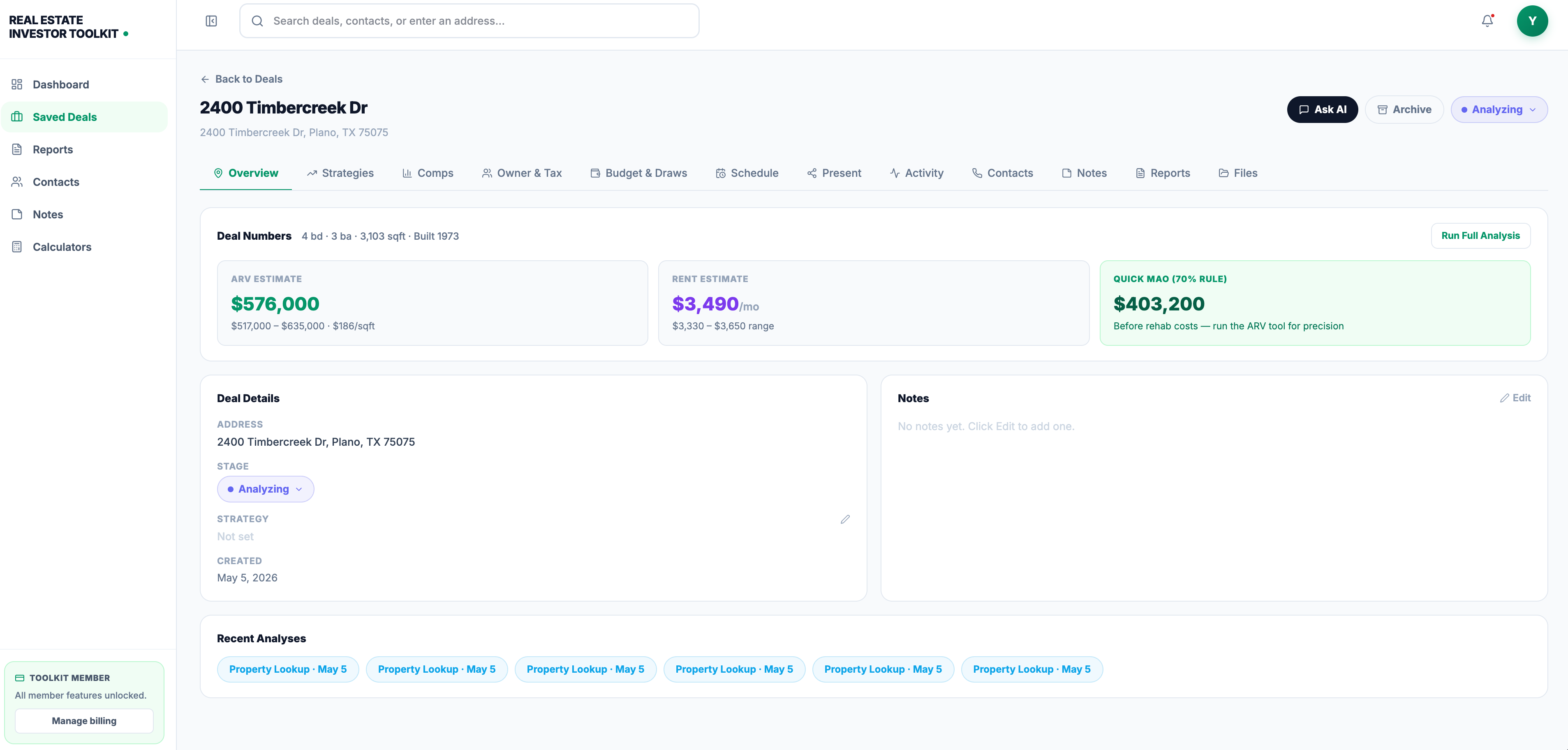
When you want unlimited reports, saved deal pipelines, advanced property data, owner-occupancy details, and AI deal insights in one place, the Real Estate Investor Toolkit plan is $39.99 per month. See the pricing page for what is included.
FAQ
Does converting a garage add value to a house?
Sometimes. A seamless, permitted conversion can return up to about 80% of its cost, according to Realtor.com. In markets where parking is scarce, it can lower value. Check closed comps in the neighborhood before you assume a gain.
How do you value a house with a converted garage?
Start with comps that have similar conversions. If you cannot find any, subtract the conversion area and value the house with the comps you have, then adjust using the gap between homes with and without garages. Appraisers are told to base adjustments on the market’s reaction, not a fixed dollar figure, per Fannie Mae.
Does an unpermitted garage conversion count as living area?
It often will not, or the appraiser may adjust it down. Fannie Mae says an addition lacking required permits must be addressed for its quality, appearance, and effect on value. Confirm permits with the local building department and ask the lender early.
How much does a typical garage conversion cost?
This Old House puts the national range at $9,659 to $51,659, averaging $30,659. Garage-to-apartment projects cost more, averaging $60,000 to $70,000 nationally. Get line-item bids from at least three contractors for your area.
Sources
- Garage Conversion: Thinking of Converting a Garage Into Living Space (Realtor.com)
- How I appraised a property with a non-permitted garage conversion
- How to Determine ARV with a Garage Conversion
- Angi: How Much Does a Garage Conversion Cost?
- Fannie Mae: Improvements Section of the Appraisal Report
- Fannie Mae Selling Guide Announcement SEL-2021-11
- Fannie Mae Lender Letter LL-2015-02
- HUD Appraisal Report and Data Delivery Guide
- Garage Conversions and Attic Stairs (Chief Appraiser)
- Garage Conversion Appraisal Value: The Mini-Split Math
- The Appraisal Foundation: Valuation Advisory #4
- This Old House: Garage Conversion Cost
- Honest Casa: DSCR Loans for Garage Conversions and ADUs
- ADU Marketing Pros: Garage Door Into a Wall
- Dallas News: Should you convert your garage to living space?
- Why transform exteriors: boost value and curb appeal