Adjusted MAO Reveals $18,700 Gap for Investors: Condos vs Houses

Single-family homes typically post higher ARV upside than comparable condos, driven by land value and a wider buyer pool. Condos can still win a bid when entry price is lower, the purchase comes as part of a packaged deal, or building fundamentals are unusually strong. The real answer depends on rehab scope, HOA reserves and special assessment risk, and how long the unit sits during carrying. Run comps and a conservative MAO before you assume either property type wins on paper.
TL;DR:
- Single-family homes generally have higher appreciation rates driven by land value, while condo ARV relies mostly on interior finishes and building condition.
- Condo rehabs cost 10% to 25% more per square foot due to elevator logistics, limited work hours, and HOA insurance requirements.
- Adjusting the 70% MAO rule for condos requires factoring in HOA reserves, longer carrying costs, and rehab premiums, often lowering the maximum offer price.
- HOA approval processes, warrantability issues, and insurance complexities can add weeks and costs, reducing profitability compared to traditional houses.
- Using specialized tools to compare condo and house scenarios helps accurately determine the adjusted MAO and mitigate overlooked hidden costs.
Table of Contents
- ARV Drivers: Land, Comps, and Buyer Pool Differences
- Per-Square-Foot Rehab Benchmarks and Condo Premiums
- How HOA Approvals Reshape Your Timeline and Contingency
- Warrantability, Insurance, and Appreciation Patterns
- MAO Adjustments: The Worked Numbers
- Where Real Estate Investor Toolkit Fits Into This Math
- Michael’s Rules for Choosing Between the Two
- Run Your Own Condo vs House Numbers Before You Bid
- Sources
- FAQ
ARV Drivers: Land, Comps, and Buyer Pool Differences
A house’s ARV rests on land plus structure. A condo’s ARV rests almost entirely on the unit’s finish quality and the building’s standing, because you’re not buying any dirt. That single distinction explains most of the ARV gap investors see between the two property types.
Land scarcity is the biggest long-term lever. National data on condo versus single-family appreciation shows single-family homes have appreciated roughly 4.2% annually since 2000, against about 3.1% for condos, largely because land supply is fixed and structures depreciate while the ground under them doesn’t.
Comparable sales work differently, too. Condo comps need to match unit size, floor level, view, and HOA fee structure inside the same building or a near-identical one nearby, since two units in different towers rarely compete for the same buyer. House comps pull from a wider geographic radius and tolerate more variation in lot size and layout.
Buyer pool and financing compound both effects:
- Condo buyers face lender scrutiny over building warrantability, owner-occupancy ratios, and litigation history before a loan even gets approved.
- House buyers face none of that, which keeps the financeable buyer pool larger and the eventual sale price less sensitive to a single building’s paperwork.
- HOA rules on rentals and pets, per Nolo’s analysis of condo versus house returns, can shrink the pool further by screening out investor buyers outright.
Per-Square-Foot Rehab Benchmarks and Condo Premiums
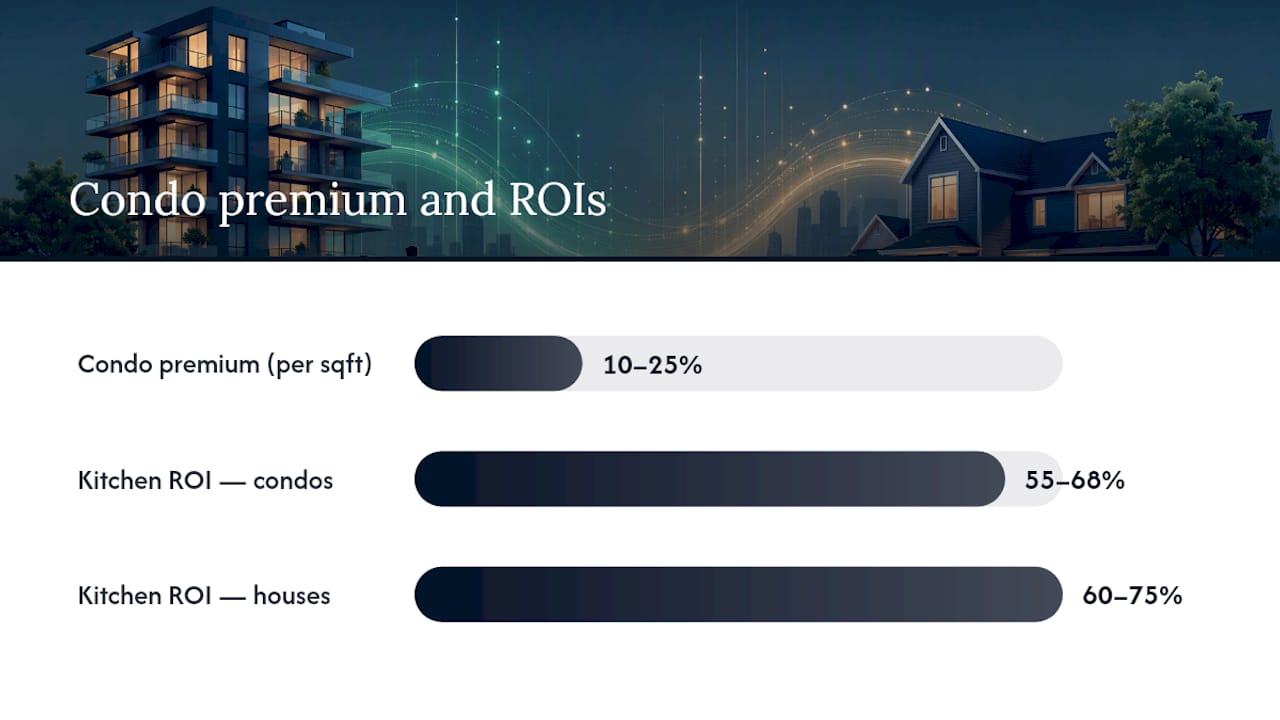
Condo rehabs cost more per square foot than house rehabs doing the identical scope, and the gap isn’t small. Market data on condo versus home remodel costs puts condo renovations 10% to 25% higher per square foot than comparable single-family projects in many markets.
Three factors drive that premium every time:
- Elevator and freight logistics. Materials and demolition debris move through a shared elevator on a schedule the building controls, not your contractor’s crew.
- Restricted work windows. Many associations limit noisy work to weekday business hours, which stretches a two-week job into three or four.
- Vendor insurance and deposits. HOAs often require certificates of insurance and refundable damage deposits before a contractor sets foot past the lobby.
Rehab cost callout: Cost Vs Value data shows renovations rarely return dollar-for-dollar at resale, with midrange kitchen remodels the closest exception. That gap widens for condos: kitchen remodel ROI runs an estimated 55% to 68% for condos versus 60% to 75% for houses in sample market analyses, which argues for restrained, mid-grade finishes over anything showroom-level.
Condos do dodge the two most expensive line items on a house rehab budget: roof and foundation. Those stay association property. But don’t celebrate that savings without reserving for the trade off, covered next.
How HOA Approvals Reshape Your Timeline and Contingency
A house rehab runs on a permit timeline you largely control. A condo rehab runs on a permit timeline plus a board approval process the association controls, and those two clocks rarely move in sync.
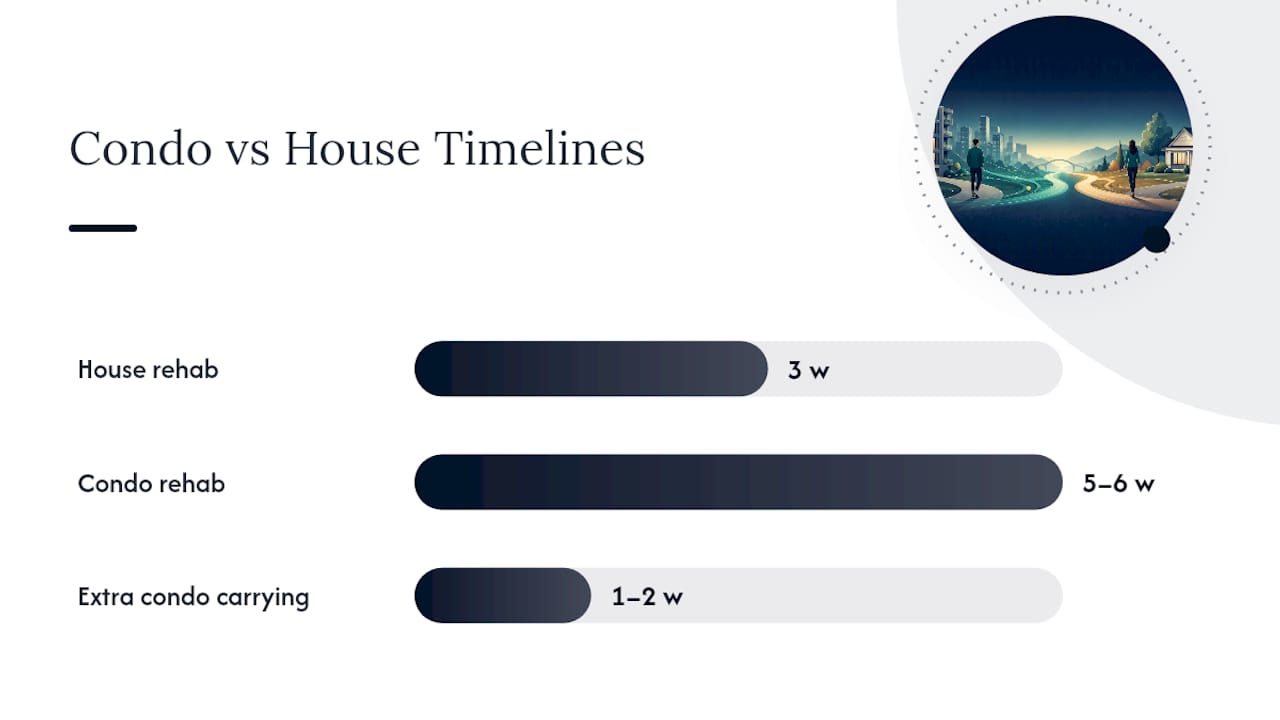
Board approvals, freight elevator bookings, and mandatory protective measures commonly add several weeks to a condo project before a contractor even starts, according to Nolo’s condo investment research. Layer restricted work hours on top and a job that would take three weeks in a detached house can stretch to five or six weeks inside a building.
That extra time isn’t free. Every additional week is a week of loan interest, insurance, and HOA dues you’re paying with no rental income and no sale proceeds offsetting them.
- Budget one to two extra weeks of carrying cost into any condo timeline versus an equivalent house scope.
- Size contingency at 10% to 15% of rehab budget for houses, and closer to 15% to 20% for condos given the approval and access friction.
- Confirm board meeting schedules before you close. Some associations only approve renovation requests monthly.
Pro Tip: Ask the HOA for its renovation approval turnaround time in writing before you go under contract, not after. A “usually two weeks” answer from the front desk can quietly become six weeks once your paperwork hits a committee that meets on the third Tuesday of the month.
Warrantability, Insurance, and Appreciation Patterns
Lenders sort condo buildings into warrantable and non-warrantable categories, and that label follows your exit buyer straight to the closing table. A non-warrantable building, one with high investor concentration, pending litigation, or a delinquent HOA, cuts off conventional financing and shrinks your buyer pool to cash purchasers and portfolio lenders willing to charge a rate premium for the risk.
Insurance works against condos in a subtler way. Master policies cover the building shell, but unit owners still need HO6 coverage for interior finishes, and buyers increasingly price that added cost into their offer. A house buyer faces one insurance decision; a condo buyer faces two, plus whatever the HOA’s master policy premium does to monthly dues.
- Confirm warrantability status before you underwrite, not after you’ve locked up rehab pricing.
- Price in buyer-side insurance friction when you’re modeling how aggressively a condo buyer will negotiate at the finish line.
- Location can flip the appreciation math. Dense urban cores with limited buildable land sometimes see condos appreciate closer to house-level rates, even against the roughly 4.2% versus 3.1% national average noted earlier.
MAO Adjustments: The Worked Numbers
The 70% MAO rule still works as a starting filter: ARV times 70%, minus rehab costs. But that textbook number gets you into trouble on a condo deal if you stop there, because it doesn’t account for HOA reserves, longer carrying, or the rehab premium already covered above.
Here’s how the same ARV plays out differently once you adjust for property type:
The $18,700 gap between these two adjusted MAOs comes entirely from HOA reserve, rehab premium, and extra carrying, not from any difference in ARV.
Before you bid on either property type, run this checklist:
- Confirm ARV against comps within the same building or block, weighted toward recent, similar-condition sales.
- Add a 1% to 3% ARV reserve line for special assessment risk on any condo purchase.
- Extend carrying-cost months by one to two for condo timelines versus house timelines.
- Check lender overlays for condo warrantability before finalizing your offer price.
- Hold your target profit margin constant. Adjust the offer, never the margin, when the numbers get tight.
Where Real Estate Investor Toolkit Fits Into This Math
Running these adjustments by hand on every deal gets tedious fast, which is exactly the gap the ARV calculator closes. Start with the ARV comp pull, then flip the rehab inputs between condo and house line items to see how the per-square-foot premium changes your ceiling before you write an offer.
The rehab cost calculator lets you model condo-specific line items separately from house-only repairs, so a roof replacement never sneaks into a condo budget where the association actually owns that cost. Pair that with the comps analyzer to weight sales inside the same building instead of pulling from a mismatched radius.
Every calculator runs with no sign-up required, so you can test a condo scenario against a house scenario for the same ARV in minutes and compare adjusted MAOs side by side before either deal reaches your desk.
Michael’s Rules for Choosing Between the Two
I lean toward condos when capital is tight, when a deal comes packaged with several units at once, or when local renter demand clearly favors walkable, low-maintenance units over yards and garages. I avoid them when the HOA’s reserve study looks thin or the building skews heavily toward investor owners, since that combination signals special assessment risk hiding just past closing.
Conservative comps and oversized contingency have saved more of my bids than any spreadsheet formula. When a condo deal only works on optimistic assumptions, it usually isn’t a deal worth pursuing.
— Michael
Run Your Own Condo vs House Numbers Before You Bid
Real Estate Investor Toolkit replaces the guesswork of manual ARV math with calculators built specifically for the condo-versus-house adjustments covered above, no subscription required to start.
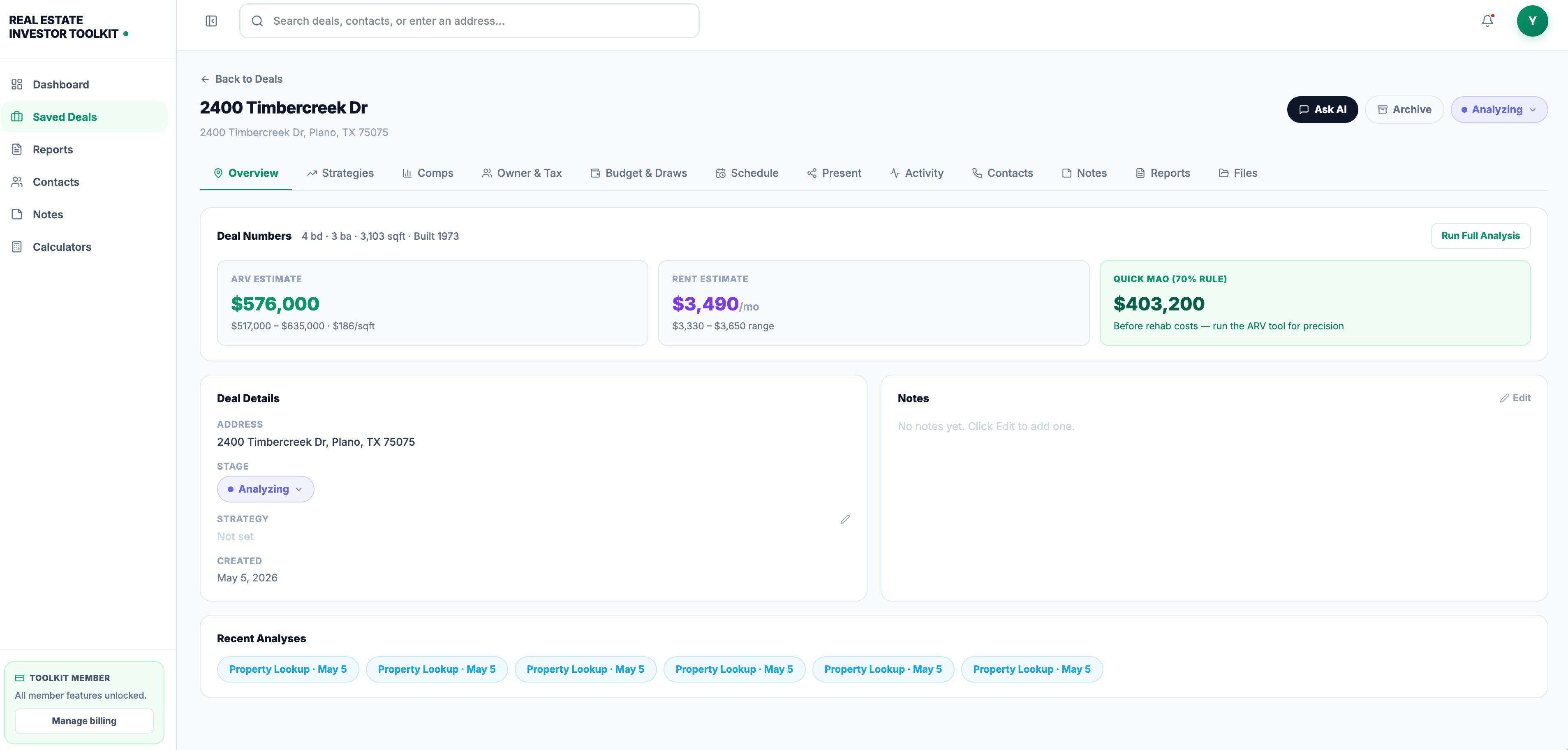
You can pull comps, test rehab line items, and compare a textbook MAO against an adjusted one for both property types in a single session using the free calculator suite. If you’re running enough deals to need saved pipelines, unlimited property reports, and owner-occupancy data alongside your ARV work, the full toolkit plan runs $39.99 a month and adds those features on top of every free tool. Start with a live condo deal on your desk right now, plug the ARV and rehab numbers into the calculator, and see where your adjusted MAO actually lands before you call the listing agent back.
Sources
- Condo vs Home Remodel Miami: Cost & ROI Guide (2026) - FABS Remodeling
- Condo Renovation Cost: HOA Rules, Permits, and Hidden Fees - LegalClarity
FAQ
Do condos or houses have higher ARV?
Houses typically show higher ARV growth over time because land value appreciates while condos rely mainly on unit finish and building condition. National data puts single-family appreciation near 4.2% annually versus roughly 3.1% for condos since 2000, though dense urban markets can narrow that gap.
Why do condo rehabs cost more per square foot?
Condo rehabs cost more mainly due to elevator logistics, restricted work hours, and HOA-mandated vendor insurance. Market data shows condo renovations running 10% to 25% higher per square foot than comparable house projects in many markets.
How should I adjust the 70% rule for a condo deal?
Start with the standard 70% MAO calculation, then subtract a 1% to 3% special assessment reserve and one to two extra months of carrying costs beyond what a house would require. That adjustment typically drops a condo’s real-world MAO several thousand dollars below its textbook figure.
What hidden costs are unique to condo rehabs?
Special assessments are the biggest risk, since associations can bill unit owners for building-level repairs like roofs or shared plumbing with little notice, as explained in detail in Gestione Manutenzione Immobiliare – Valore e Sicurezza. Thin HOA reserves are the clearest warning sign to check before you make an offer.
Can Real Estate Investor Toolkit help compare condo and house deals?
Yes. The ARV, rehab cost, and comps calculators let you toggle inputs between condo and house scenarios for the same address or market with no sign-up required.