Sales Comparison Approach for Appraisers & Investors: 3 Closed Comps

The sales comparison approach values a property by comparing it to similar properties that recently sold, then adjusting for differences to arrive at a supported opinion of value. It rests on the principle of substitution and works best in active markets with enough recent, verifiable sales of similar homes or land. When applied with documented adjustments and clear reconciliation, it produces one of the most defensible value conclusions available to appraisers and investor-analysts.
TL;DR:
- Comparable properties should have similar location, size, condition, and legal use to ensure reliable adjustments and accurate valuation.
- Adjustments must follow a logical order, be supported by documented data, and focus on true market differences to avoid red flags and over-adjustment.
- Paired-sales extraction is preferred when data allows, but widening the time window slightly can help if recent comparables are scarce.
- The most relevant comparables are those most similar physically, most recent, verified through reliable sources, and with minimal required adjustments.
- Most FHA and GSE guidelines recommend using at least three recent, verified sales within six months, with documented explanations for older sales or broader markets.
Table of Contents
- What the sales comparison approach is and the principle of substitution
- Selecting comparable properties and defining the market area
- Adjustment categories: what to adjust and practical rules
- How to extract and support adjustments
- Reconciliation and weighting: forming the final value opinion
- Limitations and common pitfalls in sales comparison analysis
- Regulatory and GSE expectations for sales comparison reports
- A step-by-step workflow for a defensible sales comparison analysis
- How professional calculators and verified data support a defensible analysis
- Defending adjustments under review
- Tools that speed up comps work for investors
- FAQ
- Sources
What the sales comparison approach is and the principle of substitution
The sales comparison approach treats recent transactions as direct evidence of what buyers in a given market will actually pay. The logic comes from the principle of substitution: a rational buyer will not pay more for a property than the cost of acquiring an equally desirable substitute. That is why comparable sales, not opinions or formulas, drive the conclusion.
This approach works best, and is often the primary method, in active-sales markets for single-family homes, condos, and vacant land, where enough recent transactions exist to support a reliable pattern. It carries less weight for unique or special-purpose properties where no real substitute market exists.
Comparables need to share, at minimum:
- A similar location within the same or a comparable market area
- Comparable size, room count, and site characteristics
- Similar condition, age, and quality of construction
- The same or a reconcilable zoning and legal use
Selecting comparable properties and defining the market area
Choosing the right comps starts with a tight physical and legal match, then widens only when the data demand it—this process is detailed in our practical guide for evaluating comparable properties. Look for alignment on:
- Site size and configuration, including usable versus unusable land
- Gross living area and room count within a reasonable range
- Condition and effective age relative to the subject
- Zoning and permitted use, including any flood or FEMA zone designation
The market area is the geography where competing properties draw the same pool of buyers. Fannie Mae’s guidance on comparable sales allows pulling from competing neighborhoods when the appraiser documents why those areas serve the same buyer pool, and it generally calls for at least three closed comparables. When closed sales are thin, active listings and pending sales can supplement the analysis, but they describe asking behavior rather than confirmed market reaction, so they support rather than replace closed-sale evidence.
Adjustment categories: what to adjust and practical rules
Adjustments follow a logical sequence so each one reflects a true market difference rather than double-counting. The typical order moves from property rights, to financing and concessions, to condition of sale, then market conditions or time, then location, then physical features.
- Property rights: fee simple versus leasehold or other partial interests
- Financing and concessions: seller credits, below-market financing, or closing-cost assistance
- Condition of sale: distressed, related-party, or non-arm’s-length transactions
- Market conditions: time-related shifts between the comp’s sale date and the effective date
- Location: differences in site, view, or proximity to nuisances
- Physical features: size, condition, quality, and amenities
Adjustments can be expressed in dollars or percentages, but either way they need a traceable basis rather than a round-number guess. Reviewers typically flag any single line-item adjustment or cumulative net adjustment that strays far outside local norms without explanation, a benchmark HUD’s appraisal guidance reinforces by expecting commentary whenever adjustments exceed typical practice.
For concessions specifically, the adjustment should reflect how the market reacts to that concession, not a dollar-for-dollar subtraction of the credit amount, a distinction Freddie Mac’s guidance on financing and sales concessions makes explicit for appraisers. Our guide to adjusting comps for repair items walks through how to size condition adjustments without overstating them.
How to extract and support adjustments
Empirical support beats intuition every time a reviewer pushes back on a number.
- Use paired-sales extraction first when the data allow it: find two sales that differ in essentially one feature, then isolate the price difference attributable to that feature.
- Turn to regression or automated valuation tools when the comp pool is large enough to reveal a statistically stable pattern, and document the model inputs so the result can be checked later.
- Cross-check with a cost or income approach when either is available, since agreement across methods strengthens the final number and disagreement flags a problem worth investigating.
Appraisal Foundation guidance on declining markets treats paired-sales extraction as the preferred technique whenever adequate pairs exist, precisely because it reflects actual market reaction rather than mechanical cost.
Pro Tip: When paired sales are scarce, widen the time window slightly before abandoning the technique entirely. A six-month-old pair is still more defensible than a cost-derived guess.
Reconciliation and weighting: forming the final value opinion
Once comps are adjusted, the final step is weighing them, not averaging them blindly. Give more weight to comps that are:
- Most similar physically and locationally to the subject
- Most recent relative to the effective date
- Most reliably verified through direct source documentation
- Closest in condition, so smaller adjustments carry less risk of error
Reconciliation can lean on the comp requiring the fewest and smallest adjustments, a simple average across adjusted prices, or a weighted average that favors the strongest comps. A simple average works when all comps are closely matched; weighting fits better when one or two comps clearly outperform the rest on similarity and verification quality. Whatever method you choose, the narrative should state plainly why the comps carrying the most weight earned that position, not just that they did.
Limitations and common pitfalls in sales comparison analysis
The approach weakens fast when the market thins out. Custom or luxury homes, rural parcels, and neighborhoods with very few recent sales all strip away the comparables this method depends on.
- Heavy reliance on scarce or unreliable comps raises subjectivity, a weakness Investopedia’s overview of the sales comparison approach identifies as the method’s primary disadvantage.
- Over-adjustment, where cumulative adjustments exceed a large share of the sale price, is a common reviewer red flag.
- Unsupported condition or location adjustments that read like guesses rather than extracted figures invite rejection.
Mitigation means expanding the search radius or time window with a documented reason, leaning harder on paired-sales extraction, and bringing in a cost or income cross-check when sales data alone cannot carry the conclusion.
Regulatory and GSE expectations for sales comparison reports
Fannie Mae, Freddie Mac, and HUD each set expectations that shape how a sales comparison section gets written, not just what number it produces.
- Sales used as comparables should generally fall within six months of the effective date, with explanation required when the report reaches to twelve months.
- Appraisers must verify each comparable sale and document the verification source, a requirement HUD’s valuation guidance spells out alongside data and adjustment standards.
- Concessions, distressed sales, and non-arm’s-length transactions need specific commentary rather than silent exclusion, consistent with how Freddie Mac addresses concessions.
A step-by-step workflow for a defensible sales comparison analysis
A consistent sequence keeps the analysis reproducible and easy to defend under review.
- Define the assignment and market area, including the property type and the geography where competing buyers shop.
- Collect candidate comps from MLS, recorder, and tax records, then verify each sale through closing documents or a direct interview.
- Rank and screen comps for physical, legal, and locational similarity, discarding anything outside the defensible market.
- Extract and apply adjustments in order, documenting the source and rationale behind each one.
- Reconcile the adjusted prices into a final opinion and explain why the leading comps carry the most weight.
At each step, record the data source, the name of whoever verified it, the date of verification, and the rationale behind any adjustment. For concessions, a closing statement line item is strong support; for condition adjustments, dated photos or a contractor estimate do the job. Our guide to pulling comps for investment properties covers sourcing techniques that fit directly into step two.
Pro Tip: Build your workfile as you go rather than reconstructing it at the end. A reviewer’s first question is almost always “where did this number come from,” and a live log answers it instantly.

How professional calculators and verified data support a defensible analysis
Comps analyzers and ARV calculators do not replace an appraisal, but they speed up the early screening and documentation work that feeds into one.
- A comps analyzer pulls candidate sales quickly and keeps a record of where each figure came from.
- An ARV calculator applies adjustments against verified market data, reducing the chance of an unsupported guess.
- Saved verification fields create an audit trail that mirrors what a reviewer expects to see in a formal report.
These tools work best as a supplement for investor-analysts and early-stage screening, not as a substitute for a licensed appraiser’s final opinion.
Defending adjustments under review
The adjustments a reviewer challenges are rarely the biggest ones, they are the ones with no paper trail behind them. Pair every market-based conclusion with a plain rationale a stranger could follow without asking a single question.
— Michael
Tools that speed up comps work for investors
We built our Real Estate Comps Analyzer to pull and compare comparable sales quickly, with verified market data behind every figure instead of a guess. Pair it with our ARV Calculator and Rehab Cost Calculator to size condition adjustments and after-repair value in the same workflow.
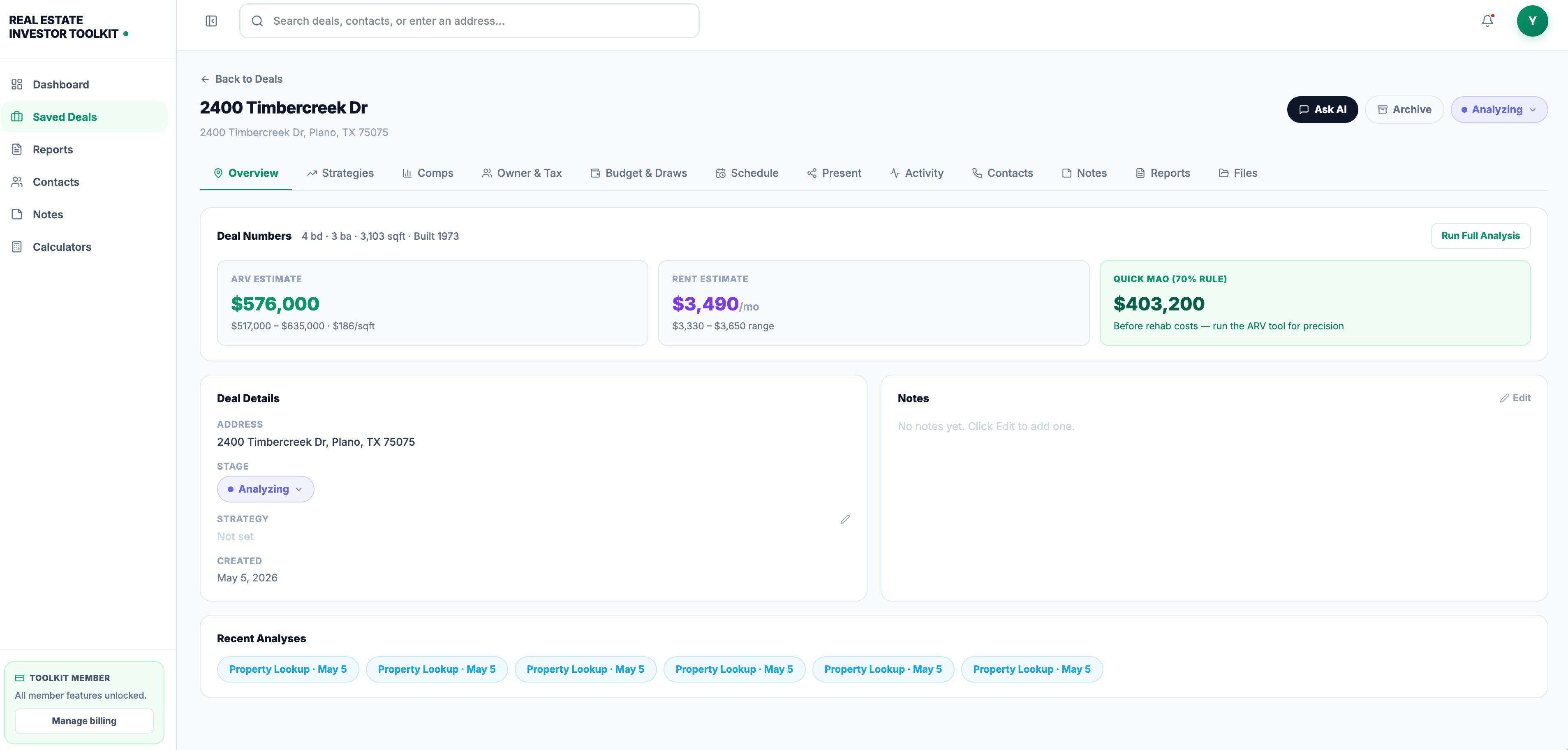
These calculators are free to use with no sign-up required, and our Real Estate Investor Toolkit plan at $39.99 per month adds unlimited reports, saved deal pipelines, and an AI deal advisor for investors who want to track comps across an entire pipeline. Start with the comps analyzer on your next deal.
FAQ
How do you perform a sales comparison approach?
Start by defining the market area and collecting recent, verified sales of similar properties, then adjust each comp for differences in rights, financing, condition, timing, location, and physical features. Reconcile the adjusted prices, weighting the most similar and best-verified comps most heavily, into a single supported value opinion.
What is a disadvantage of the sales comparison approach?
Its biggest weakness is dependence on scarce or unreliable comparable sales data, a limitation Investopedia notes as the method’s primary disadvantage. In thin or unique markets, the lack of good comparables raises subjectivity and adjustment risk.
What is the basic principle behind the sales comparison approach?
The approach rests on the principle of substitution: a knowledgeable buyer will not pay more for a property than it would cost to acquire a similar property with comparable utility. Recent comparable sales serve as direct market evidence of that ceiling.
What should you avoid telling an appraiser?
Avoid pressuring an appraiser toward a target number or suggesting which comps to use or exclude, since that undermines the independence the valuation depends on. Share factual property details and recent documented improvements instead, and let the verification and adjustment process stand on its own.
How many comparable sales does an appraisal typically need?
Most residential assignments call for at least three closed comparable sales, a baseline Fannie Mae’s guidance sets for many standard reports. Active listings or pending sales can supplement that minimum when closed data are limited, though they do not replace it.
Sources
A comp is only as strong as the records behind it. Appraisers and analysts typically pull from MLS listings, county deed and recorder offices, tax assessment records, closing statements, and vendor data platforms that aggregate public filings.
- Understanding the Sales Comparison Approach in Real Estate Appraisals
- HUD: The Valuation Process and Sales Comparison Approach
- Comparable Sales | Fannie Mae
- Considering financing and sales concessions: a practical guide for appraisers (Freddie Mac)
Documentation matters as much as the number itself. HUD guidance on the sales comparison approach expects appraisers to verify comparable sales and record where that verification came from, since an unverified comp carries little weight under review.
On timing, sales within the prior 6 months are generally preferred, and sales up to 12 months old are acceptable when clearly explained in the report, consistent with GSE and HUD expectations for recency and documentation.
Pro Tip: Keep a standing verification log with source, contact name, and date for every comp; it turns a reviewer’s question into a thirty-second lookup instead of a scramble.