Rental Yield Calculation: Six Steps to Replace Guesswork

Gross rental yield is (annual rent ÷ purchase price) × 100, and net rental yield is (net operating income ÷ total investment) × 100. Use gross yield for a quick first screen when comparing listings, then switch to net yield once you have real expense numbers and need a figure you can actually underwrite.
TL;DR:
- Net yield depends on effective rent after vacancy, less taxes, insurance, management, maintenance, dues, utilities, service contracts, and routine capital reserves.
- Divide NOI by total investment, including closing costs and initial repairs; exclude mortgage payments, and track depreciation separately from operating cash expenses.
- Verify rent, tax, and insurance figures against independent records, then test current rent, realistic stabilized rent, and a downside case before offering.
- Use cap rate to compare current valuations and leveraged cash returns to assess financing; loan terms affect the latter, but not NOI or yield.
Table of Contents
- Definitions and formulas you must know before calculating
- Step-by-step calculation workflow you can follow with your own numbers
- Expense checklist: what to include in operating expenses and what to exclude
- Worked example: run the numbers step-by-step so you can follow along
- How to interpret rental yield and common pitfalls to avoid
- When to use yield vs cap rate vs cash-on-cash return
- Michael’s practical note on input quality and scenario testing
- Try the Real Estate Investor Toolkit’s free rental calculator
- FAQ
- Sources
Definitions and formulas you must know before calculating
Annual rent is your total expected rental income for the year. If you only have a monthly figure, multiply it by 12, but check whether that number reflects a realistic, collectible rent rather than an optimistic listing price.
Purchase price is what you pay for the property itself. Total investment is broader: it adds closing costs, initial repairs, and any other cash you put in before the first tenant moves in, which gives you a more honest picture of your actual return as a buyer.
Net operating income (NOI) is effective gross income minus operating expenses. Effective gross income is your annual rent after subtracting a vacancy allowance, since a unit may have periods of vacancy. NOI never factors in your mortgage payment: it measures what the property earns before financing costs, which is why it works for comparing properties regardless of how each one is financed.
Step-by-step calculation workflow you can follow with your own numbers
Once you have the definitions straight, the calculation itself follows a consistent order. Work through these steps with your own property’s numbers using the comprehensive Houston Rental Property Evaluation Guide for Investors.
- Gather your inputs: rent roll, property tax bill, insurance premium, HOA dues, management fee, a routine maintenance estimate, and a vacancy allowance.
- Annualize any monthly figures and add up the recurring annual expenses into one total.
- Calculate gross yield first: divide annual rent by purchase price, then multiply by 100.
- Calculate NOI by subtracting your operating expenses (including the vacancy allowance) from annual rent.
- Calculate net yield by dividing NOI by your total investment, then multiplying by 100.
- Double-check each input against real documents rather than estimates before trusting the result.
Leave mortgage principal out of this calculation. An unlevered net yield measures the property’s own performance, not your loan terms. If you want to see how financing affects your actual cash returns, that’s a cash-on-cash calculation, a separate metric from yield.
Expense checklist: what to include in operating expenses and what to exclude
Underwriters and lenders expect a specific set of costs in your operating expense line, and leaving one out inflates your yield on paper without changing what lands in your bank account.
- Property taxes, based on your current assessment or tax bill.
- Property insurance premiums.
- Property management fees, even if you plan to self-manage at first.
- Routine repairs and maintenance.
- HOA or condo association dues, where applicable.
- Landscaping or other recurring service contracts.
- Any utilities you pay as the landlord rather than the tenant.
- A vacancy and collection allowance to account for turnover.
- A reserve for routine capital expenditures like roof and HVAC replacement.
Mortgage principal stays out of this list, and mortgage interest is typically tracked separately from operating costs when calculating an unlevered yield. IRS Publication 527 treats depreciation as a capital-cost recovery deduction rather than an operating cash expense, which means your tax return and your yield calculation are answering two different questions.
Pro Tip: Keep your operating yield spreadsheet and your tax schedule in separate tabs so a depreciation deduction never accidentally lowers the cash yield you report to a lender or partner.
Worked example: run the numbers step-by-step so you can follow along
Consider a rental property with a purchase price, closing costs, total investment, and rental income. Use these details to work through the calculation.
- Gross yield: divide annual rent by the purchase price.
- Apply a vacancy allowance to annual rent to calculate effective gross income.
- Add up annual operating expenses, including property taxes, insurance, management fees, routine maintenance, and any capital expenditure reserve.
- NOI: subtract operating expenses from effective gross income.
- Net yield: divide NOI by total investment.
Increasing the vacancy allowance or adding an unexpected repair can reduce net yield, which is why the gross figure alone can mislead a buyer comparing listings.
How to interpret rental yield and common pitfalls to avoid
There’s no single number that defines a “good” yield across every market. A yield that looks strong in a slower-growth region might be mediocre in a market with higher appreciation and lower cash flow expectations, so treat yield as one input among several rather than a pass-fail test.
The biggest pitfall is trusting an advertised yield without checking the vacancy and expense assumptions behind it. A listing that quotes gross yield off a seller’s optimistic rent projection can look dramatically better than the property will actually perform once real turnover and maintenance costs show up.
Freddie Mac’s appraisal guidance recommends underwriting against more than one rent assumption, since modeling 100% market rent can understate lease-up time, marketing costs, and vacancy risk. Run three scenarios before you commit to an offer: current in-place rent, a realistic stabilized rent, and a downside case with higher vacancy or lower rent. If the downside case still works, you’ve found a resilient deal.
When to use yield vs cap rate vs cash-on-cash return
Cap rate is NOI divided by property value, which looks similar to net yield but uses current market value instead of your original purchase price or total investment. That distinction matters when a property has appreciated since you bought it: your net yield on cost stays fixed to what you paid, while cap rate moves with the market.
Cash-on-cash return measures your leveraged return: annual pre-tax cash flow after mortgage payments, divided by the actual cash you invested. It’s the metric that reflects financing decisions, since two buyers with different loan terms on the same property will see different cash-on-cash numbers even though NOI and yield stay identical.
A practical rule: use rental yield for a quick income-focused screen, cap rate when comparing valuations across properties, and cash-on-cash when deciding how a specific loan structure affects your return. Our cap rate calculation guide walks through the valuation side in more detail.

Michael’s practical note on input quality and scenario testing
The formulas are simple. What trips up most buyers is trusting a seller’s pro forma instead of verifying rent and expense comps themselves. Pull your own comparable rents, check recent tax bills and insurance quotes, and run current, stabilized, and downside scenarios before you make an offer. A calculator only gives you a yield worth trusting when the numbers going in are real.
— Michael
Try the Real Estate Investor Toolkit’s free rental calculator
Running gross yield, NOI, and net yield by hand works, but running three scenarios on five properties in one afternoon is where a spreadsheet starts to slow you down. Our rental property calculator helps you analyze rental properties.
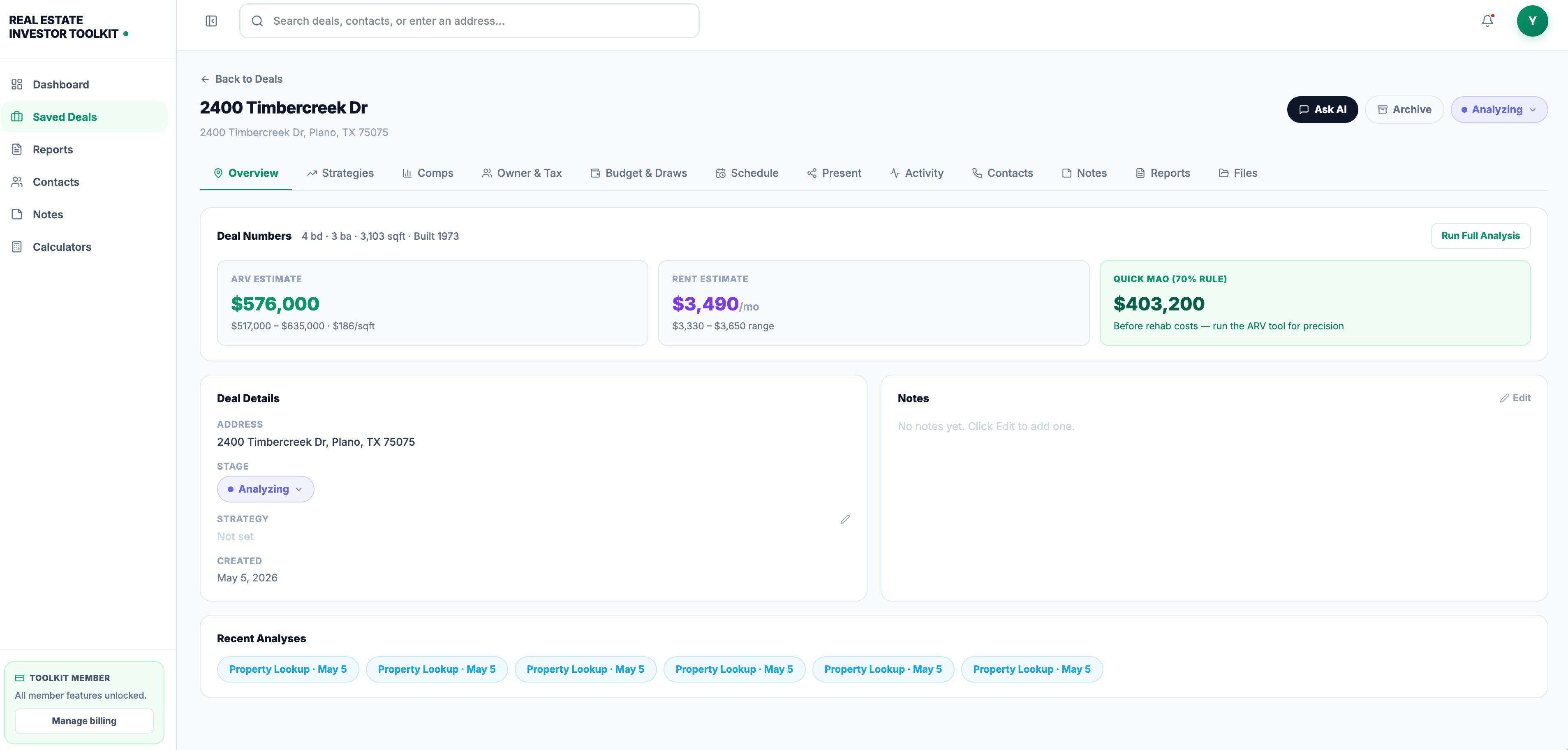
- Enter your rent, price, and expense checklist once, then test multiple scenarios without rebuilding a spreadsheet.
- Pull comparable rents first using our rental comps guide so your inputs hold up to scrutiny.
Start with our free tools to run your first yield calculation at no cost, and find current pricing for the Real Estate Investor Toolkit on our pricing page.
FAQ
How do you calculate the yield on a rental property?
Divide annual rent by purchase price and multiply by 100 for gross yield, or divide net operating income by total investment and multiply by 100 for net yield. Net yield gives a more accurate picture because it accounts for property taxes, insurance, management fees, and a vacancy allowance, as outlined in IRS Publication 527.
What does a 6% yield mean for a rental property?
Whether a net yield is attractive depends on your market, financing costs, and what comparable properties in the area are yielding.
How do I calculate my own rental yield?
Start with your annual rent, subtract a vacancy allowance to get effective gross income, then subtract your operating expenses listed in your expense checklist to get NOI. Divide NOI by your total investment and multiply by 100 for net yield, or skip straight to dividing annual rent by purchase price for a faster gross yield estimate.
Is 3.5% considered a good rental yield?
There’s no universal cutoff, so compare a property’s net yield against similar properties in the same area and your own investment goals before judging it.
What’s the difference between rental yield and cap rate?
Rental yield typically uses your purchase price or total investment as the denominator, while cap rate uses the property’s current market value. The two numbers often diverge once a property has appreciated, since yield stays anchored to what you originally paid.