Zoning Due Diligence: A Checklist for Property Investors

Zoning due diligence is the process of confirming, before your contingency period ends, that the use you plan for a property is legal there and that the buildings on it are legal too. You identify the parcel’s zoning, read the code that applies, check permits and open violations, and put a dollar figure on anything that does not line up. Skip it, and a flip, rental conversion or wholesale assignment can stall on a problem you could have found in an afternoon.
This guide walks through the steps in order, shows what each one costs, and explains how to carry the findings into your offer and your numbers.
TL;DR
- Verify zoning with the planning authority that actually governs the parcel. Do not rely on the mailing address, the listing, or what the property is used for today.
- Read the use table, not just the district name. A use can be permitted, allowed by administrative permit, or require a discretionary approval that takes months and may be denied.
- Check permits, certificates of occupancy and open enforcement cases. A buyer can inherit a seller’s violations.
- Fees are small compared with the risk: a county zoning determination can cost around $125, and a third-party report often runs $500 to $1,200.
- Put zoning findings into your MAO, rehab budget and hold timeline, and tie your offer to a due diligence contingency.
Table of Contents
- What zoning due diligence actually verifies
- Step 1: Confirm the parcel and who governs it
- Step 2: Read the use table and development standards
- Step 3: Get the zoning confirmed in writing
- Step 4: Audit permits, violations and the certificate of occupancy
- Zoning red flags that should change your offer
- How to carry zoning findings into your numbers
- Structure your contract to match what you do not yet know
- Our perspective on zoning and deal math
- Run the numbers once zoning checks out
- A quick zoning due diligence checklist
- FAQ
- Sources
What zoning due diligence actually verifies
At its core, the work answers four questions:
- What is the parcel zoned?
- Is your intended use allowed there, and on what terms?
- What development standards limit what you can build or change?
- Is the property as it exists today legal?
The first two are the ones most investors think of. The fourth is the one that causes the most surprises. One practitioner guide on commercial purchases notes that zoning due diligence means determining the zoning, reviewing the code, and checking whether the use is allowed or needs a permit, and it warns against assuming that an existing use is compliant.
Think of zoning as the recipe card and the permit file as the receipt. The card says what you may cook on this lot. The receipt shows that what is already there was approved. You need both to match before you pay.
Allowed uses come in more than one flavor
A use is rarely just “yes” or “no.” Los Angeles County’s planning department explains that a use may be permitted outright, accessory, subject to administrative review, or require discretionary approval such as a Conditional Use Permit. Other counties use similar tiers. One Florida county’s guide, for example, says its zoning charts label uses as prohibited, permitted, administrative permit, or special exception.
The tier matters because it sets your timeline. The same Los Angeles County guide says a Conditional Use Permit can take substantially more time and money than a site plan review, and approval is not guaranteed. If your plan only works with a discretionary approval, you are not buying a property. You are buying an option on a hearing.
Step 1: Confirm the parcel and who governs it
Start with the parcel number from the county assessor, not the street address. The mailing address can name one city while the parcel sits in unincorporated county land, or the reverse. Los Angeles County’s planning department tells buyers to verify the actual jurisdiction and zoning with the responsible planning authority rather than relying on the mailing address or the existing use.
Then:
- Find the city or county GIS zoning map and note the district code.
- Pull the current zoning ordinance, not a summary or a cached copy.
- Note any overlay districts on the parcel.
A district name alone tells you very little. One zoning lookup publisher makes the point that permitted uses, setbacks, height, density, lot coverage and parking all matter beyond the label. Two parcels both zoned “R-2” in neighboring towns can allow quite different things.
Do not skip overlays
Overlay districts add rules on top of the base zoning. A law firm’s zoning guide lists examples such as historic, design, airport-noise or corridor standards. A historic overlay can dictate window and siding choices on a rehab. An airport-noise overlay can affect residential conversions. Your base-zone reading can be perfectly right and still miss these.

Step 2: Read the use table and development standards
Open the ordinance and find the use table for your district. Look up your exact use, using the code’s own terms. Zoning classifications can differ within the same broad category, so “multifamily” in your head may be a different defined term in the code.
Then collect the standards that cap what you can do with the lot:
| Standard | Why it matters to an investor |
|---|---|
| Setbacks | Limit additions, ADUs and garage conversions |
| Lot coverage | Caps how much of the lot structures can occupy |
| Height and floor-area ratio (FAR) | Limits added stories or square footage |
| Parking minimums | Can block a unit-count increase or a change of use |
| Density (units per acre or lot size per unit) | Decides whether a duplex or fourplex conversion is possible |
| Short-term rental and occupancy rules | Often sit outside the base zoning, in separate ordinances |
Parking, setbacks and height are also the items an El Campo, Texas development guide flags as common redevelopment risks, along with unapproved site changes and expiring certificates of occupancy. Short-term rental rules are my own addition to the list. Many cities regulate them separately, so look at the city code and any registration requirement, not just the zoning district.
Step 3: Get the zoning confirmed in writing
A map and a phone call are a starting point. For a deal that matters, get a written statement.
Zoning verification letter. Many jurisdictions issue one. A Florida county’s planning manual describes it as a formal determination of requested planning or zoning information for a property, which prospective purchasers may request. Fees vary by place. Louisa County, Virginia, for instance, charges a $125 application fee for a zoning determination request. Check your own jurisdiction’s current fee schedule.
Know what the letter does not cover. In some places the municipality confirms only the current zoning and does not verify that the existing use is compliant, as one M&A real estate diligence article points out. A clean letter is not a clean bill of health for the building.
Third-party zoning report. For commercial and larger residential deals, a consultant’s report can go further than a municipal letter, covering items such as parking and setbacks. Pricing varies with the property and the jurisdiction. One provider of certified reports cites $500 to $1,200 per report, which is a reasonable planning range to check against local quotes. In commercial deals, it is usual for the buyer to pay, though who bears the cost is negotiable.
For a single-family flip with an obvious residential use, the free map check plus a call to the planning counter is often enough. For a duplex-to-fourplex conversion, a mixed-use building or anything with a use change, pay for the letter or report.

Step 4: Audit permits, violations and the certificate of occupancy
This is where deals quietly go wrong. A property that looks fine and has operated for years may have an unpermitted addition, an illegal unit, or a lapsed certificate of occupancy.
Los Angeles County’s guide is blunt on this: an existing use is not proof of legality. The county does not inspect a property just because it is being sold, and a buyer may inherit responsibility for correcting violations. It tells buyers to check for open enforcement cases with zoning enforcement and the local building department, and to verify that existing structures have permits.
Your records checklist:
- Permit history from the building department, including final inspections signed off.
- Certificate of occupancy (or equivalent). A real estate law practice’s overview says that if one is unavailable, a zoning report or other investigation should confirm the permitted use.
- Open code enforcement cases and unpaid fines or liens.
- Approved site plans, compared against the survey and what you see on site. One firm’s guidance warns that unapproved changes can become the buyer’s problem.
- Title report and survey. The title work shows recorded restrictions. A survey shows encroachments and, with optional items, zoning and parking information.
If you wholesale, this audit protects your end buyer too. An assignment that fails because the building has an unpermitted unit costs you the fee and your reputation with that buyer.
Zoning red flags that should change your offer
Not every flag kills a deal. Each one should change the number or the terms.
Your use is not allowed by right
If the use needs a variance or special use permit, expect a public process. One city’s development guide says these typically involve public hearings before a planning commission and city council. If you are not already experienced with that process locally, either walk away or write the purchase so you can exit if approval fails.
The same practitioner guidance says that if the use is not allowed, you should find out the permit process, documents and fees, and consider whether a rezoning is realistic, ideally after a preapplication meeting. That meeting is free in many places and tells you how staff see your plan.
The property is legally nonconforming
A legal nonconforming use, often called grandfathered, complied with the rules when it was established but no longer matches current code. One commercial zoning explainer notes these properties often face restrictions on expansion, intensification or rebuilding after damage. It also notes that New York City’s rules include a two-year discontinuance provision with exceptions, a reminder that a vacant building can lose its grandfathered status if it sits idle. A long rehab on a vacant nonconforming building is exactly the situation to check.
Insurance and financing follow. Fannie Mae’s multifamily guide requires lenders to evaluate whether a legally nonconforming property can be rebuilt after a casualty, including rebuilding costs and insurance coverage. If you plan to refinance a multifamily property in a BRRRR strategy, a nonconforming status can shape the lender’s view. Ask your insurance agent and lender about it before closing, not after.
Open violations or unpermitted work
The buyer corrects the violations. Price the cure: permit fees, possible demolition or legalization, inspections, and the delay. If the seller will not fix it or credit you, treat it as a rehab line item at a conservative number.
Parking, density or setback shortfalls
These rarely stop you from owning the property. They stop you from changing it. If your pro forma depends on adding a bedroom count, a unit or square footage, confirm those standards before you finalize the number.
How to carry zoning findings into your numbers
Zoning is not a separate checklist. It feeds every number in your deal analysis.
ARV. Your after repair value assumes the finished property is legal and marketable as described. If your comps include a legal fourplex and your subject is only legally a duplex, the comparison is wrong. Use comps with the same legal use and unit count, and run them through a comps analyzer so the adjustments are visible.
Rehab budget. Add lines for permit fees, legalizing unpermitted work, architect or engineer drawings, and any required site improvements such as added parking. Add contingency for slower inspections.
MAO. Your maximum allowable offer should drop by the expected cost of curing any issue plus the holding cost of the extra time. A discretionary approval can add months of loan interest, taxes and insurance to your hold.
Rental cash flow. If rent assumptions rely on an extra unit or short-term rental use, confirm both are allowed before they enter your rental property calculator inputs. A rental that is legal as a long-term single-family home and not as a short-term rental has a very different income line.
Financing. Lenders and appraisers care about legal use. Run your scenarios in the investment property financing calculator with a delayed-closing or delayed-refinance case if approvals are uncertain.
An example, with made-up round numbers for illustration only: you find a house you plan to flip with a legally permitted use and an ARV of $300,000. Discovering an unpermitted addition that must be legalized might add $12,000 in permits, drawings and corrective work, and two months of carrying costs. That is a reduction to your offer, a renegotiation, or a pass. Without the check, it becomes a surprise out of your profit.
Structure your contract to match what you do not yet know
Diligence costs time. Protect it:
- Negotiate enough days. Zoning letters and records requests can take longer than inspection ordering. Ask for the period to be long enough, with an extension right if the municipality has not responded.
- Make zoning a named contingency. Tie your right to terminate to confirming that the intended use is permitted and that no open violations exist.
- Request seller documents. Ask for permits, certificates of occupancy, prior violation notices and any variance approvals.
- Agree who pays. Buyers normally cover diligence costs, but the cost is negotiable, particularly on larger deals.
- Involve counsel for discretionary approvals. A local real estate attorney or land use attorney knows how your jurisdiction’s hearings really go. For a use change, hire one before you waive your contingency.
If you buy off-market, the seller may have little paperwork and no urgency to find it. Our guide to finding off-market investment properties covers sourcing, and the same discipline applies: the less the seller can document, the more you verify yourself.
Our perspective on zoning and deal math
We build deal calculators, and the pattern we see is simple. Investors are careful about the purchase price and the rehab scope, then treat zoning as a yes-or-no box to tick. It is not. Zoning decides which comparable sales are valid, which improvements you can legally add, how long you hold, and what a lender or insurer will accept. Those are exactly the inputs to an ARV, an MAO and a cash flow projection.
Our advice is to do a quick zoning screen early, before you spend time on a full analysis. Confirm the district and the use, check permits and open cases, and only then run the numbers. If the screen turns up a question, put a cost and a time delay on it in your calculator instead of hoping it resolves. A deal that still works with a pessimistic zoning assumption is a deal worth pursuing. If it only works with a perfect outcome, it is a gamble.
We also want to be clear on what a calculator can and cannot do. It can show you what a zoning problem costs once you estimate it. It cannot tell you what your city’s ordinance says. For that, you need the planning department’s written word and, in complex cases, a local attorney.
— Michael
Run the numbers once zoning checks out
Once you have confirmed the use and the permits, speed matters. Our free calculators work with no sign-up, so you can test ARV, rehab and rental scenarios while your zoning letter is in the mail. Start with the free investment property calculators to stress-test the deal with your zoning costs included.
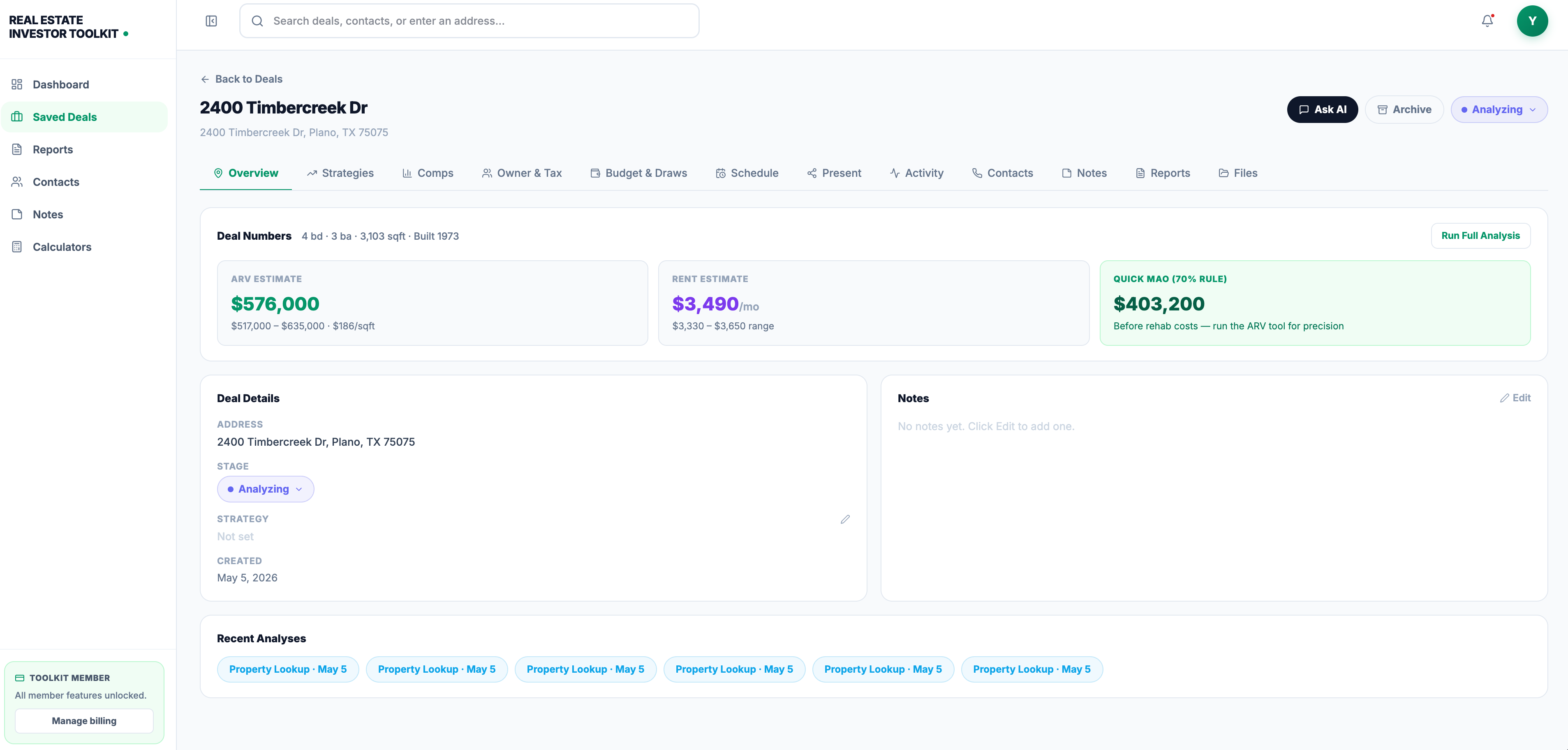
If you analyze several deals a month and want unlimited reports, saved deal pipelines, property data with owner details and an AI assistant in one place, the full Real Estate Investor Toolkit plan is $39.99 per month. See the pricing page for what is included. If you are new to running a full analysis, our walkthrough on analyzing your first deal is a good place to start.
A quick zoning due diligence checklist
- [ ] Parcel number and governing jurisdiction confirmed
- [ ] Zoning district and overlays identified on the official map
- [ ] Current ordinance read for use table and development standards
- [ ] Written zoning verification or third-party report ordered where the use matters
- [ ] Permit history, certificate of occupancy and approved plans obtained
- [ ] Open code enforcement cases and liens searched
- [ ] Survey and title reviewed for encroachments and restrictions
- [ ] Legal nonconforming status checked, with insurance and lender questions asked
- [ ] Costs and delays added to ARV, rehab, MAO and hold assumptions
- [ ] Contract contingency and timeline cover the open items
FAQ
How much does zoning due diligence cost?
It depends on the depth. A municipal zoning determination can be inexpensive, such as the $125 application fee one Virginia county charges. Third-party reports for commercial work are often priced in the $500 to $1,200 range. Your local planning office’s fee schedule and a few quotes will give you the real figure for your market.
Who pays for zoning due diligence?
The buyer usually covers it as part of transaction costs. It can be negotiated, so on larger deals ask the seller to share the cost or provide existing reports. Put the agreement in the purchase contract.
Is a zoning verification letter enough?
Not always. It tells you how the property is zoned and may confirm requested items, but some municipalities confirm only the current zoning and do not verify that the existing use or structures are compliant. Pair the letter with a permit history and enforcement search.
What are the biggest zoning red flags for a flip or rental?
A use that needs a discretionary permit, open code violations, unpermitted additions or units, a missing or expiring certificate of occupancy, and a legal nonconforming status that restricts rebuilding or expansion. Each one should change your offer price, your timeline or your decision to buy.
When should I hire an attorney?
Hire a local real estate or land use attorney when your plan needs a variance, conditional use permit or rezoning, when the building is legally nonconforming, or when the seller cannot produce permits and the use is unclear. Do it before your due diligence period ends.
Sources
- Due Diligence for Zoning in a Commercial Real Estate Purchase
- Buying Property? Los Angeles County Department of Regional Planning
- Planning and Development Manual, Indian River County
- Planning and zoning issues in the United States, DLA Piper Real World
- Zoning Due Diligence for Commercial Property in VA and NC
- El Campo Development Guide
- Fannie Mae Multifamily Selling and Servicing Guide
- Louisa County zoning determination request form
- Zoning research reports and pricing
- Commercial zoning: Uses, FAR and due-diligence checks
- Free Zoning Lookup by Address
- Owned Real Estate Due Diligence in M&A
- Handbook for Commercial Real Estate Due Diligence