5–10 Minute Defensible Wholesale Deal Analysis for Wholesalers

The fastest defensible wholesale deal analysis runs on one formula: MAO equals ARV times 70%, minus repairs, minus holding and closing costs if you’re being precise. Your assignment fee is simply the gap between that number and your contract price with the seller. With three to five solid comps and a decent set of photos, you can run this entire wholesale deal analysis in under 10 minutes and hand a buyer numbers they don’t have to second-guess.
TL;DR:
- Using a 70% MAO formula, the maximum allowable offer on a $250,000 ARV house ranges from $132,000 to $175,000, depending on market demand.
- Repair costs should be estimated based on condition tiers, with light rehabs costing about $15 to $25 per square foot and heavy rehabs exceeding $45 per square foot.
- Confirm ARV with three to five recent, renovated sales within half a mile and avoid relying on active listings or automated estimates like Zestimates.
- Ensure accurate square footage, current photos, and a contractor’s assessment of repairs before finalizing an offer to prevent costly surprises.
- A comprehensive buyer-ready deal packet includes ARV details, itemized repairs, MAO calculations, fee scenarios, and supporting photos, organized for quick buyer review.
Table of Contents
- What Is the Quick Checklist for Analyzing a Wholesale Deal?
- How Do You Estimate ARV for a Wholesale Deal?
- How Do You Estimate Repair Costs Quickly and Accurately?
- How Do You Calculate MAO With a Real Example?
- What Due Diligence Changes the Numbers on a Wholesale Deal?
- What Should a Buyer-Ready Deal Packet Include?
- What Are Your Exit Options Besides Assigning the Contract?
- What Legal and Contract Issues Matter Most in Wholesaling?
- Author perspective: habits and common mistakes that cost wholesalers deals
- Run Your Next Wholesale Deal Analysis in Minutes, Not Hours
- Sources
- FAQ
What Is the Quick Checklist for Analyzing a Wholesale Deal?
A reliable wholesale property evaluation follows the same six steps every time, in the same order, so you never miss an input that changes the offer.
- Gather seller info and photos (1 to 2 minutes) — address, square footage, bedroom/bath count, and a full interior/exterior photo set.
- Pull 3 to 5 comps (2 to 4 minutes) — recently sold, renovated, similar size and layout.
- Set ARV (30 to 60 seconds) — median $/sqft from those comps times the subject’s square footage.
- Choose a repair tier (1 to 3 minutes) — light, medium, or heavy, based on photos and stated condition.
- Calculate MAO (30 to 60 seconds) — plug ARV and repairs into the formula.
- Set your target offer below MAO and prep the buyer packet.
Insist on two non-negotiables from every seller before you start: accurate square footage and current photos. Without both, pause and get a contractor walk-through before you commit to a number.
How Do You Estimate ARV for a Wholesale Deal?
ARV is the price your renovated house would fetch on the open market. Getting it right means anchoring to real sales, not guesses.
Pull three to five comparable renovated sales within roughly half a mile, sold recently, and use the median price per square foot as your baseline. In dense urban markets, tighten that radius; in rural areas, you’ll need to widen it and lean harder on adjustments.
Pro Tip: Never anchor ARV to an active listing or a Zestimate. Listings reflect what a seller hopes to get, and automated estimates miss renovation quality entirely. Only closed sales tell you what buyers actually paid.
When comparing comps, check three things before you trust the number:
- Photos confirming the comp was genuinely renovated, not just staged well.
- Sale date within your market’s typical window (90 to 180 days, tighter in fast-moving areas).
- Size and layout fit — a comp with an extra bedroom or a finished basement needs a downward adjustment, not a straight average.
Write your comp list and adjustment logic into the deal packet. If a buyer questions your ARV six weeks from now, you want the paper trail sitting right there, not a fuzzy memory of “it felt about right.” Running this math through the ARV calculator keeps every comp and adjustment documented automatically.
How Do You Estimate Repair Costs Quickly and Accurately?
Repair estimating doesn’t require a contractor for every deal. Condition tiers with per-square-foot ranges get you close enough to make a defensible offer in minutes.
- Light rehab (cosmetic only: paint, flooring, fixtures): roughly $15 to $25 per square foot.
- Medium rehab (kitchen/bath updates, some systems work): roughly $25 to $45 per square foot.
- Heavy rehab (full gut, major systems, structural work): $45 to $75+ per square foot.
On a 1,500 square foot house, that’s the difference between a $30,000 light rehab and a $100,000+ heavy one. The tier you pick moves your MAO by tens of thousands of dollars, so don’t guess from a listing description alone.
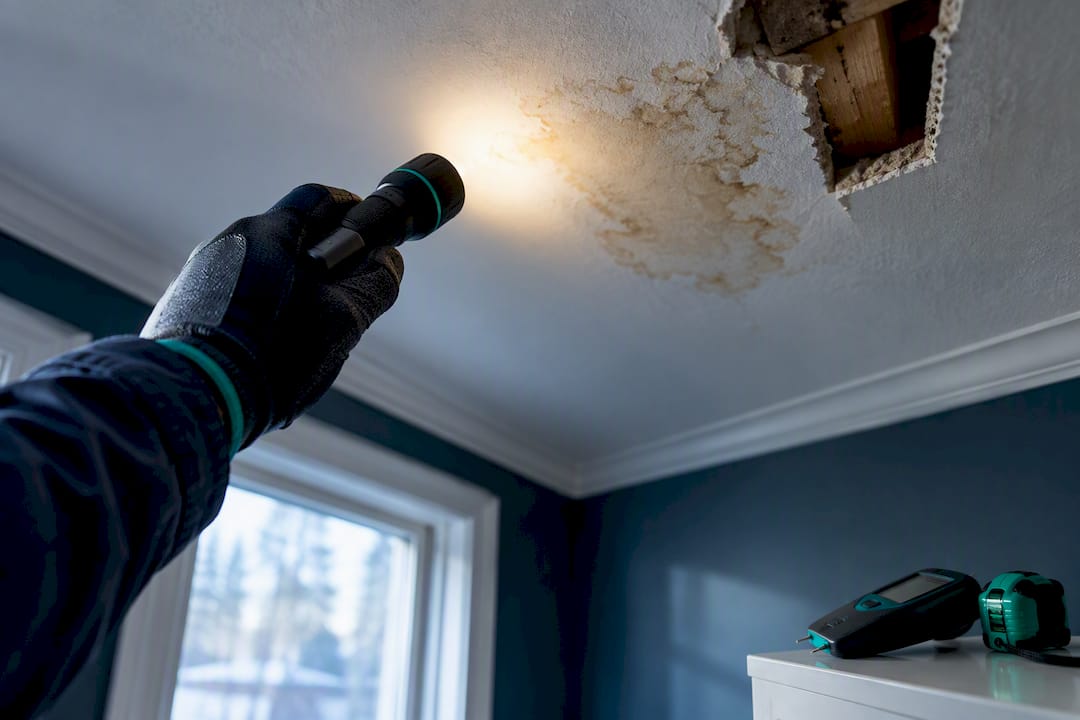
Certain items blow past tier averages and need their own line item: a failing roof ($8,000 to $15,000), an aging HVAC system ($5,000 to $10,000), foundation cracks or settling ($10,000 and up), active water damage, and outdated electrical panels. Water intrusion in particular tends to hide behind drywall until demo starts, so treat any musty smell or ceiling stain as a flag worth a closer look, and a property manager’s leak-detection checklist is a useful reference for spotting the signs early.
Pro Tip: Ask sellers for photos of the roof, HVAC unit, electrical panel, kitchen, every bathroom, and the crawlspace or basement. That six-photo set is usually enough to place a house in the right tier without a single site visit.
When a red flag shows up, but the photos aren’t conclusive, pause and get a contractor bid before you finalize your offer. Guessing on a foundation issue is how wholesalers lose money on their assignment fee.
How Do You Calculate MAO With a Real Example?
The formula is: MAO = (ARV × percentage) − repairs − holding/closing costs. The 70% figure is a starting point, not a law. In hot markets with fast buyer demand, some wholesalers push it to 75%. In slower markets or on heavier rehabs, 65% protects the buyer’s margin better.
Here’s a full-worked example on a house with a $250,000 ARV:
- ARV: $250,000
- Apply 70%: $250,000 × 0.70 = $175,000
- Subtract estimated repairs (medium tier, $35,000): $175,000 − $35,000 = $140,000
- Subtract holding and closing costs (roughly $8,000 for taxes, insurance, and closing fees): $140,000 − $8,000 = $132,000 MAO
- Set your contract price with the seller below MAO, say $118,000
- Your assignment fee is the spread: $132,000 − $118,000 = $14,000
Presenting a buyer with two or three fee scenarios (higher offer, lower fee versus lower offer, higher fee) builds more trust than a single take-it-or-leave-it number, since it shows you understand their return requirements, not just your own.
What Due Diligence Changes the Numbers on a Wholesale Deal?
Math on paper means nothing if the property has a lien nobody caught or a timeline nobody planned for. A few checks separate a clean wholesale deal from one that falls apart at closing.
- Photo set: interior of every room, kitchen and bathrooms, mechanicals (HVAC, water heater, panel), roof from the exterior, and crawlspace or basement.
- Title and lien search: run this in the first day or two, not the week before closing, since unresolved liens can kill a deal outright or add unplanned holding time.
- Timeline: every extra week on the calendar adds carrying costs, so factor your expected closing window into holding cost estimates rather than using a flat guess.
- Market speed: in a hot market, buyers accept a tighter MAO percentage because inventory moves fast; in a slow one, they’ll want more margin, which pushes your allowable offer down.
Any undocumented structural issue, an unresolved lien, or a seller who can’t produce clear title history is a reason to widen your discount or walk away entirely.
What Should a Buyer-Ready Deal Packet Include?
A calculator does the math. A buyer-ready packet is what actually gets a wholesale deal sold, and it needs a consistent set of outputs every time.
- ARV estimate with the comps that support it, not just a final number.
- Itemized repair estimate, broken down by tier or by system, not a lump sum.
- MAO math, shown line by line so a buyer can check your work in thirty seconds.
- Two or three assignment fee scenarios, giving buyers room to choose their entry point.
- Title notes, seller disclosures, and photos, organized so nothing requires a follow-up call.
Running comps, rehab tiers, and MAO math through the rehab cost calculator and exporting a PDF report turns this from a spreadsheet exercise into a document a cash buyer can act on immediately.
Pro Tip: Save every version of your calculation, along with screenshots of the comps and photos you used. When a buyer asks “how did you get this number,” you want to answer in one email, not a scramble.
What Are Your Exit Options Besides Assigning the Contract?
Assignment is the fastest exit, but it’s not the only one, and knowing the alternatives protects you when a buyer backs out or a title issue surfaces late.
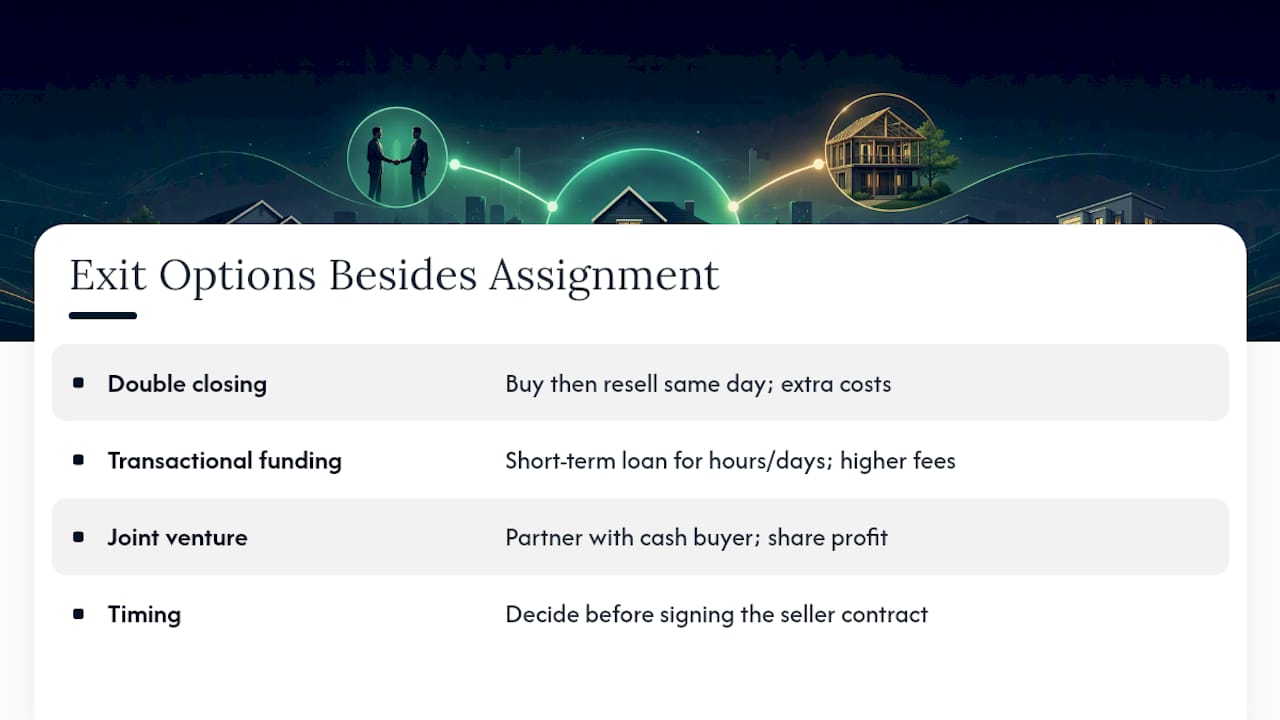
Double closing means you actually purchase the property, then resell it to your end buyer in a separate, back-to-back transaction, often on the same day. It keeps your assignment fee private from the seller and the eventual buyer, and it sidesteps states or contracts that restrict assignment clauses. The tradeoff is cost: you’ll typically pay two sets of closing costs instead of one, and you need funds, even briefly, to close on your end.
Transactional funding solves the cash problem in a double closing. A short-term lender funds your purchase for a matter of hours or days, secured by the simultaneous resale to your buyer, and you repay it the moment that second closing happens. Fees run higher than a conventional loan, but you’re borrowing for a day, not a year, so the total cost is usually manageable against the size of the deal.
Some wholesalers also structure a joint venture with a cash buyer on tougher deals, sharing the eventual flip profit instead of taking a flat fee upfront. This works best when a property needs more rehab knowledge than a straight assignment buyer wants to take on alone.
Whichever exit you choose, decide before you sign the seller contract. Scrambling to figure out your exit after you’re already under contract is how deals stall past their closing date.
What Legal and Contract Issues Matter Most in Wholesaling?
The purchase agreement you sign with the seller needs an assignment clause explicitly permitting you to assign your rights to another buyer. Without it, you can’t legally pass the contract along, and you’re stuck negotiating an amendment under time pressure.
Several states have tightened rules around wholesaling specifically, some requiring real estate licensure for anyone marketing a property they don’t own, others limiting how assignment contracts can be advertised. Rules vary enough by state that checking your local requirements before you market a deal isn’t optional. What’s routine in one market can trigger a licensing complaint in another.
Your assignment agreement with the end buyer should spell out the fee, the deadline for them to close, and what happens to your fee if they fail to perform. Vague language here is where wholesalers lose money on deals that otherwise looked clean.
Disclosure matters too. Sellers should understand they’re signing a contract that may be assigned to another party, and many states require that disclosure in writing. Skipping it doesn’t just risk the deal falling through. It can expose you to a legal claim after closing.
None of this replaces an attorney reviewing your contract templates before you use them at scale. A single flawed clause repeated across fifty deals is a expensive problem to fix retroactively.
Author perspective: habits and common mistakes that cost wholesalers deals
The costliest habit I see isn’t bad math, it’s optimistic ARV paired with a repair estimate that ignores what the photos actually show. Wholesalers who document every assumption, insist on photos before quoting a number, and keep a running file of comps and contractor notes rarely get challenged by buyers. The ones who skip title checks or forget holding costs are the ones whose deals unravel at the closing table. If you’re scaling past a few deals a month, build a template and train someone else to run the checklist exactly as you do. Consistency, not speed, is what keeps buyers coming back.
— Michael
Run Your Next Wholesale Deal Analysis in Minutes, Not Hours
Real Estate Investor Toolkit replaces the spreadsheet-and-guesswork approach with calculators built specifically for the ARV, repair, and MAO math this article just walked through, and you don’t need to create an account to use them.
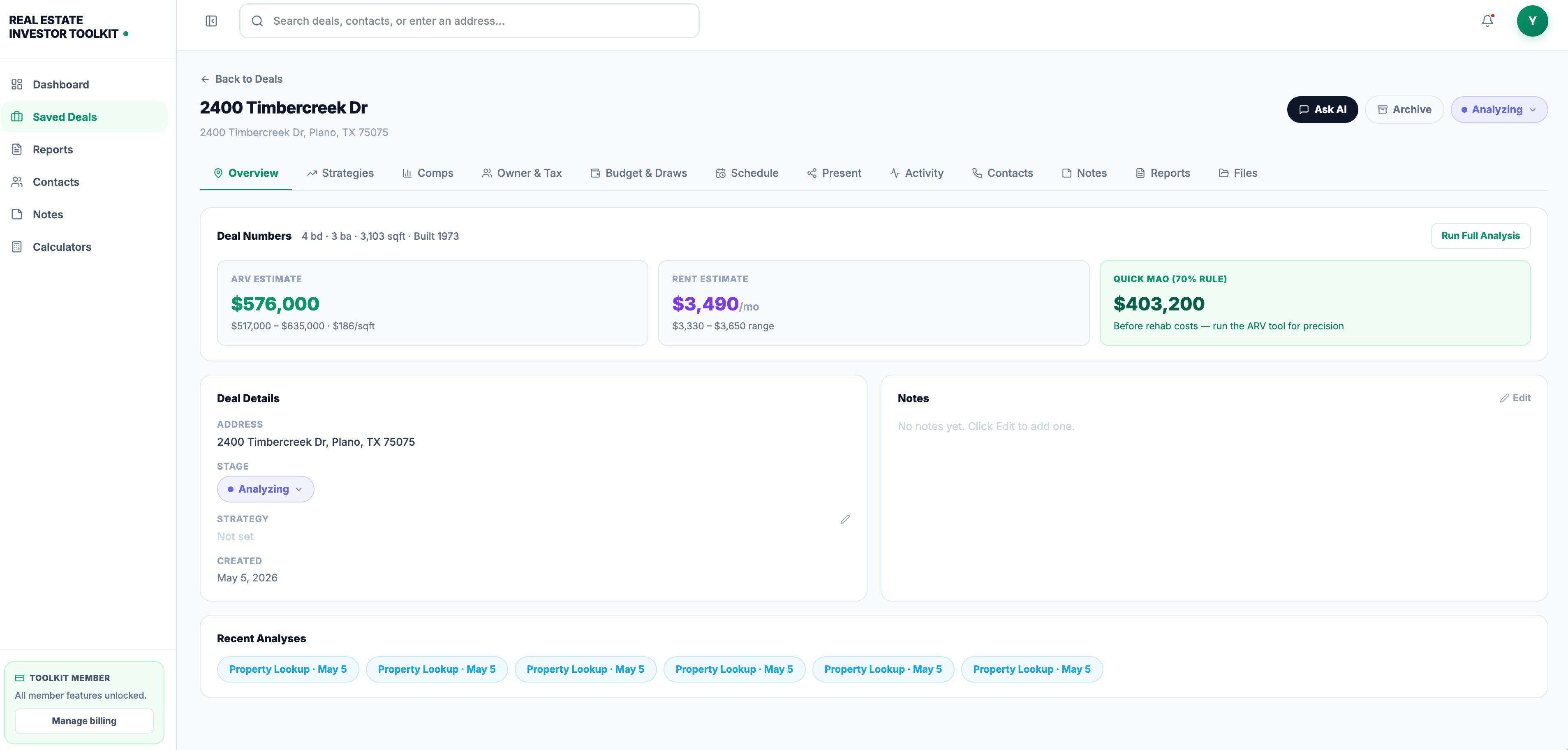
The ARV calculator pulls comps and computes your median $/sqft anchor automatically, while the rehab estimator applies condition-tier per-square-foot ranges so you’re not eyeballing repair costs from a photo. Both outputs feed directly into MAO math you can export as a report, the same buyer-ready packet format covered above with comps, itemized repairs, and multiple assignment fee scenarios attached. If you’re running several deals a week, the paid plan at $39.99 per month adds unlimited saved reports and advanced property data on top of the free tools. Start with the free calculators on your next deal and see how fast a defensible offer comes together.
Sources
- ARV formula guidance — The Motley Fool
- How to Analyze a Wholesale Deal in Real Estate — LinkedIn Learning
- Wholesale Deal Analysis: How to Run Numbers in 5 Minutes | KDS Development
FAQ
What Is the 70% Rule in Wholesaling?
The 70% rule sets your maximum allowable offer at 70% of the after repair value, minus repair costs.
What Is the Formula for Wholesale Pricing?
Your assignment fee is the difference between that MAO and the contract price you negotiate with the seller.
What Does a Wholesale Deal Mean?
A wholesale deal means you put a property under contract with a seller, then assign or sell that contract to a cash buyer for a fee, without ever taking ownership yourself in most cases. The exception is a double closing, where you briefly purchase the property before reselling it, often using transactional funding to cover the gap.
How Long Should a Wholesale Deal Analysis Take?
With comps and photos in hand, a full wholesale deal analysis runs 5 to 10 minutes using a standardized checklist. Tools like the ARV calculator and rehab estimator on Real Estate Investor Toolkit cut that time further by automating the comp and repair math.
How Much Does Real Estate Investor Toolkit Cost?
The core calculators are free with no sign-up required at Real Estate Investor Toolkit. The paid plan, which adds unlimited reports and advanced property data, is $39.99 per month.