What Is a Wholesale Assignment Fee, and How Much Should You Charge?

A wholesale assignment fee is the cash payment a wholesaler collects at closing for transferring their contract rights to buy a property to another buyer. You never take title, and the end buyer pays the fee, usually as a separate line item disbursed to you at the closing table. Most residential assignment fees fall between $5,000 and $20,000, though higher-value properties can push that ceiling much further.
The rule of thumb starts with the buyer’s Maximum Allowable Offer. You calculate MAO using the 70% rule, then work backward from there to find your maximum possible fee, and finally set your actual ask lower than that ceiling so the buyer still has room to profit.
You’ll typically see two fee structures in practice:
- Flat fee: You negotiate one number with the seller, then charge the buyer that price plus your fee as a disclosed add-on.
- Spread: You lock a low contract price with the seller, then assign to the buyer at a higher price. The difference is your fee, often undisclosed as a separate line but visible in the two contract prices.
Quick math: If ARV is $200,000 and rehab runs $30,000, your MAO ceiling is $110,000 ($200,000 × 0.70 − $30,000). If you locked the seller at $90,000, your theoretical max fee is $20,000.
Key Takeaways
| Point | Details |
|---|---|
| Know your typical range | Most assignment fees run $5,000 to $20,000, with a national average near $13,000. |
| Calculate before you contract | Use MAO = ARV × 0.70 − Rehab to find your ceiling before setting any fee. |
| Leave buyer margin | Target 70% to 80% of your maximum fee so the buyer keeps a real profit incentive. |
| Disclose in writing | Get seller acknowledgment of your assignment rights to avoid disputes later. |
| Validate with a calculator | Real Estate Investor Toolkit’s ARV, rehab, and offer calculators let you confirm net fee math before you present numbers to a buyer. |
This article is general information, not a substitute for advice from a qualified financial advisor. Consult a qualified financial professional about your own circumstances before acting on anything here.
Table of Contents
- How to Calculate an Assignment Fee, Step by Step
- What Is a Typical Wholesale Assignment Fee Range?
- Should You Assign the Contract or Double Close?
- What Contract Language and Disclosures Protect Your Fee?
- How Are Assignment Fees Taxed?
- How Do You Set an Assignment Fee Before You Make an Offer?
- What Mistakes Cost Wholesalers Their Assignment Fee?
- How Can You Validate Your Assignment Fee Math Before You Commit?
- A Wholesaler’s Take on Fair Fees and Repeat Buyers
- Validate Every Assignment Fee Before You Sign Anything
- Sources
How to Calculate an Assignment Fee, Step by Step
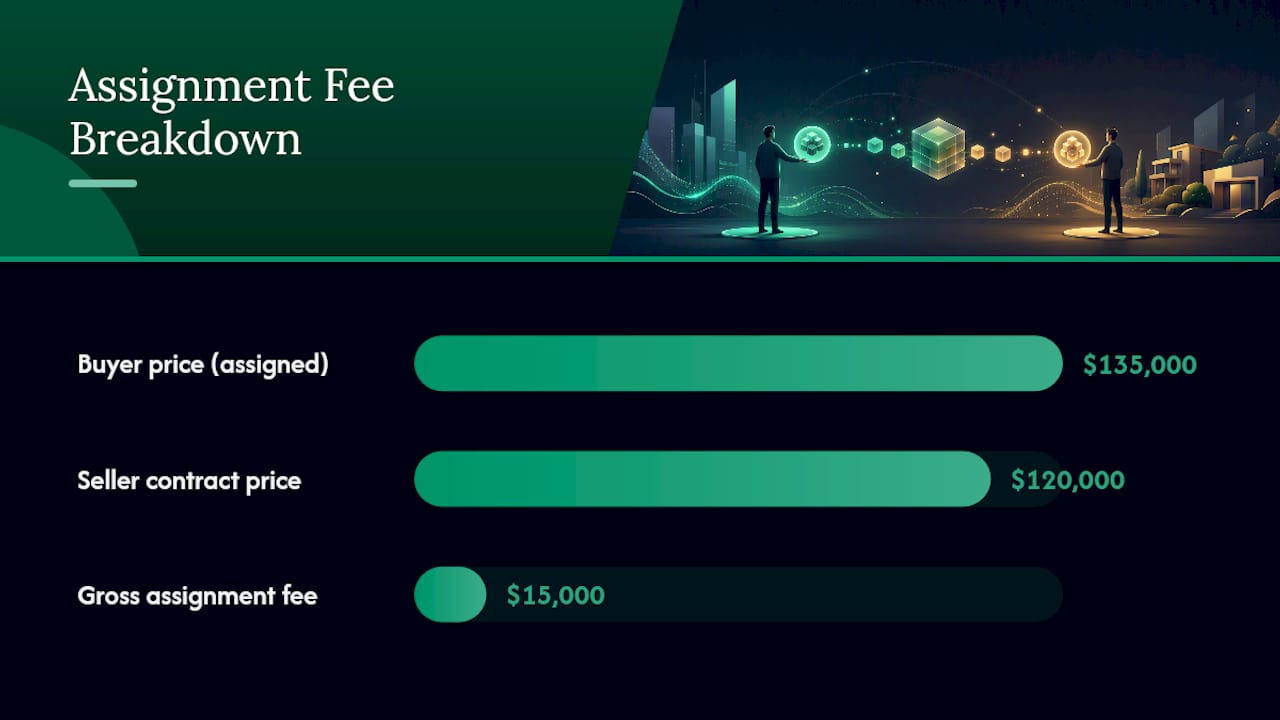
The core formula is simple: buyer price minus seller contract price equals your gross assignment fee. If you tied up a house at $120,000 and assigned it to an investor at $135,000, your gross fee is $15,000. The harder part is figuring out what that buyer price should be in the first place, and that starts with the 70% rule.
MAO = (ARV × 0.70) − Rehab Costs
That formula tells you the most a rehabber can pay and still have room for profit and holding costs. Once you know MAO, your maximum possible assignment fee is:
Max Fee = MAO − Your Contract Price With the Seller
Gross fee isn’t what lands in your pocket, though. You still need to subtract transaction costs before you know your real take:
- Earnest money you put down and might have at risk if the deal falls through.
- Title and escrow fees, which vary by state and sometimes get split or absorbed depending on your negotiation.
- Any double-close costs if you’re using that structure instead of a straight assignment.
- Marketing or referral costs tied to sourcing the buyer.
Here’s how that plays out across three deal sizes:
Notice that gross fee and net fee aren’t the same number, and the gap widens as deal size grows. A calculator that includes earnest money, escrow costs, and transaction fees in the same worksheet saves you from quoting a number you can’t actually collect.
Pro Tip: Run your MAO and net-fee math before you ever put a property under contract, not after. Committing earnest money on a deal where the math doesn’t support a real fee is one of the fastest ways to lose money on a “won” contract.
What Is a Typical Wholesale Assignment Fee Range?
Most fees land between $5,000 and $20,000, though national survey data pegs the average closer to $13,000 with real variation by state and city. Rural markets with lower price points tend to cluster near the bottom of that range. Coastal and high-demand metro markets, where ARVs run higher, regularly support fees well above the national average.
Several factors push your fee up or down beyond raw property value:
- Buyer pool depth. A market with dozens of active cash buyers competing for deals lets you charge more, because demand absorbs the fee without buyers walking.
- Deal quality. A property under contract at a steep discount to ARV gives you more room, since the buyer’s spread stays healthy even after your fee.
- Speed to close. Buyers who need a fast close for portfolio deployment or auction reinvestment often accept a higher fee for certainty.
- Repair complexity. The murkier the scope of work, the more skittish buyers get about paying a premium fee on top of rehab risk they can’t fully price.
A higher assignment fee is reasonable on larger, cleaner deals but may not be feasible on lower-value or riskier properties because of limited buyer margin. The fee has to scale with the deal, not with what you personally want to earn that month.
Market liquidity matters more than most new wholesalers realize. In a market flooded with wholesalers competing for the same buyer list, fees compress fast, sometimes down to $3,000 to $5,000 on smaller deals just to keep buyers engaged. In a market where serious cash buyers are scarce, a well-vetted deal can support a premium well above the typical range, because you’re solving a sourcing problem for the buyer, not just flipping paper.
Should You Assign the Contract or Double Close?
The structure you pick affects both your privacy and your bottom line. Assignment is faster and cheaper, but it exposes your fee (or at least your contract spread) to the buyer, title company, and sometimes the seller. Double closing costs more but keeps your numbers private and works around contracts that prohibit assignment outright.
Here’s how to decide between them:
- Check the purchase contract first. If it contains an anti-assignment clause, assignment is off the table regardless of preference, and you’ll need to double close or renegotiate the clause with the seller.
- Weigh fee size against exposure. A modest fee on a straightforward deal rarely justifies the extra cost of double closing. A large spread on a high-value property often does, since privacy protects you from seller pushback or buyer renegotiation attempts.
- Confirm your funding source for the double close. You’ll need transactional funding or your own capital to briefly own the property between the two closings, and that funding carries its own fees.
The trade-offs run both ways:
- Assignment typically adds a small assignment fee at closing but skips a second full round of title and closing costs.
- Double closing involves two separate closings, meaning two sets of title fees, recording fees, and potentially two rounds of transfer taxes, which can run into the thousands depending on your state.
- Earnest money follows you through either structure; if you double close, you’ll want that money released back before or at your own closing, not left exposed through both transactions.
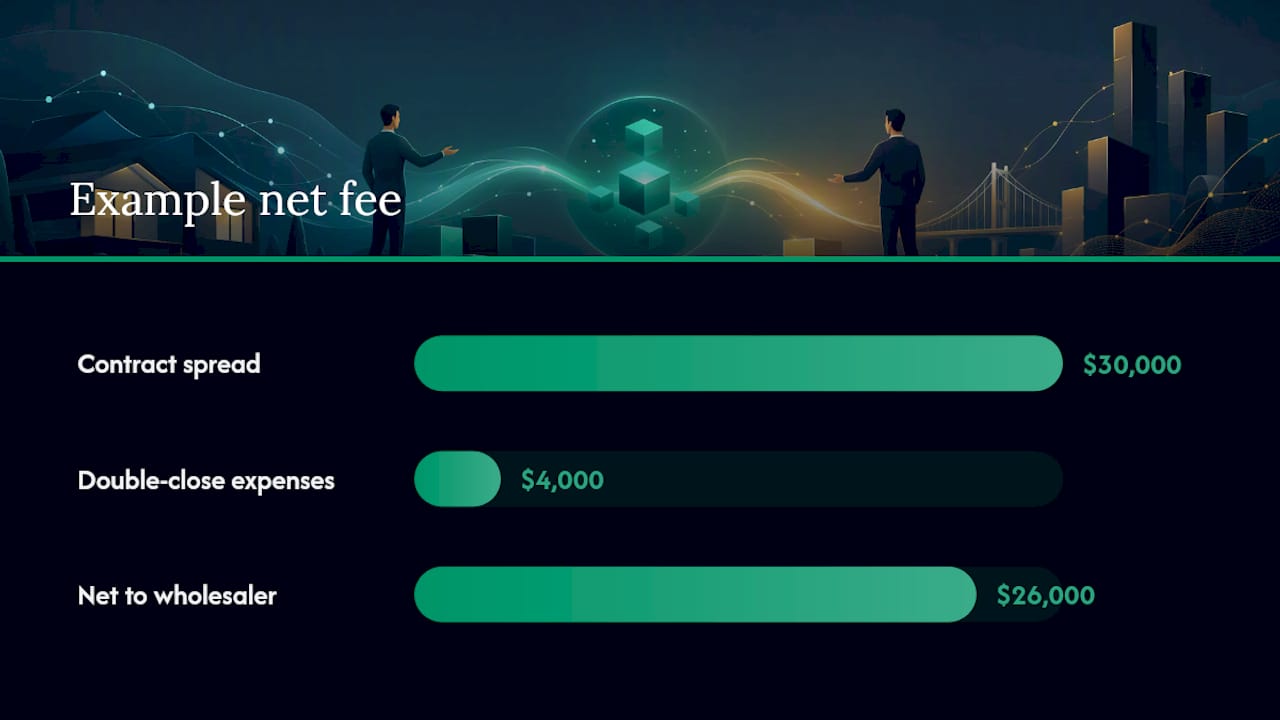
Whichever path you choose, run the full cost stack through your net-fee math before you commit. A $30,000 spread that costs $4,000 in double-close expenses is still a strong deal. The same spread eaten by disorganized funding costs and delayed closings is not.
What Contract Language and Disclosures Protect Your Fee?
Your Assignment of Contract needs unambiguous language stating that you hold equitable interest in the property and are assigning your rights, not the deed itself, to the end buyer. Vague or missing language here is the single most common reason assignment fees get challenged after the fact.
Build these elements into every deal:
- An assignability clause in your original purchase agreement that explicitly allows you to assign the contract “and/or assigns” language attached to your name.
- A written Assignment of Contract that states the assignment fee amount or method, the parties involved, and the effective date of transfer.
- Disclosure to the seller that you may assign the contract to another buyer, ideally in plain language at the time of signing rather than buried in boilerplate.
- Disclosure to the end buyer of any known property condition issues you’re aware of, since misrepresentation exposure lands on you if you conceal defects to protect your fee.
Transparent, upfront disclosure about your role and your fee structure is what keeps a deal from turning into a legal dispute months later. Sellers who feel blindsided by a wholesaler’s profit margin are far more likely to challenge the contract or refuse to close.
Regulatory risk varies significantly by state. Some states now require wholesalers to hold a real estate license once they assign contracts with any regularity, others cap the number of assignments allowed per year without licensure, and several require specific disclosure language in marketing materials. Before you scale a wholesaling operation, check your state’s guidance directly. Sources like the Pennsylvania Association of Realtors’ wholesaling overview illustrate how differently states can treat the same transaction.
Pro Tip: Keep a signed disclosure acknowledgment from every seller stating they understand you may assign the contract for profit. It costs you nothing to collect and it’s the single best piece of paper to have if a deal ever gets questioned.
How Are Assignment Fees Taxed?
Assignment fees are ordinary business income, not capital gains, because you never held the property as an investment asset. That distinction matters at tax time: ordinary income gets taxed at your marginal rate, and if you’re operating as a sole proprietor or through a pass-through entity, self-employment tax applies on top of that.
Plan around these realities:
- Set aside money for quarterly estimated tax payments rather than waiting until April, since the IRS expects self-employed income to be paid as it’s earned.
- Keep every closing statement, Assignment of Contract, and wire confirmation. These documents substantiate both your income and your basis for any deductions.
- Track deductible expenses separately, including marketing costs, mileage to properties, earnest money forfeited on deals that fell through, and any subscription tools you use to run comps or MAO math.
- Reconsider your entity structure once volume increases. An S-corp election can reduce self-employment tax exposure once fee income reaches a level where the administrative cost is worth it.
A wholesaler closing one or two deals a year can often manage taxes with basic bookkeeping software and a year-end review. Once you’re closing multiple deals a month, especially across state lines, hiring a CPA familiar with real estate income stops being optional. Multi-state deals in particular raise questions about where income is sourced and taxed that a generalist preparer may miss.
How Do You Set an Assignment Fee Before You Make an Offer?
A repeatable pricing workflow keeps every deal defensible, whether you’re negotiating with a first-time seller or presenting numbers to a skeptical cash buyer.
- Pull comps and estimate ARV. Use a dedicated ARV calculator rather than guessing off a Zillow estimate, since accurate comps are the foundation every other number depends on.
- Estimate rehab and holding costs. Run the scope of work through a rehab cost estimator and don’t forget holding costs like taxes, insurance, and utilities during the renovation window.
- Compute MAO and set a buyer profit target. Apply the 70% rule, then sanity check that the buyer still walks away with roughly 15% to 25% profit after rehab, holding costs, and resale expenses.
- Calculate your maximum fee, then discount it. Subtract your seller contract price from MAO to get the theoretical ceiling, then target 70% to 80% of that number as your actual ask.
- Confirm contract and title acceptance. Verify your purchase agreement allows assignment, confirm the title company will process an Assignment of Contract without friction, and present your buyer with the full numbers, not just the price.
Pro Tip: Show your buyer the same ARV, rehab, and MAO numbers you used to set your fee. Buyers who can verify your math themselves close faster and negotiate less, because you’ve already answered their first question before they ask it.
Skipping any one of these steps is how wholesalers end up with a fee that looks good on paper but falls apart the moment a buyer runs their own numbers.
What Mistakes Cost Wholesalers Their Assignment Fee?
The most common failure point is skipping MAO math entirely and picking a fee number that feels right instead of one that’s grounded in ARV and rehab reality. A close second is ignoring transaction costs until after the deal closes, only to discover the net fee is thousands less than the gross number that looked good on the contract.
Watch for these patterns:
- Quoting a fee before verifying repair costs, then having to renegotiate down when the buyer’s own contractor walks the property.
- Failing to disclose known property issues to the buyer, which invites disputes even when the fee itself was fair.
- Treating every buyer the same instead of offering a modest discount for buyers who can close in seven days versus thirty.
- Working with a title company unfamiliar with assignments, which causes closing delays that spook buyers and sellers alike.
The wholesalers who get repeat business and referrals are the ones who present transparent numbers every time, flag repair uncertainty honestly, and occasionally leave a little money on the table for a buyer who’s closed with them three times before. That reputation compounds faster than any single oversized fee ever will.
Pro Tip: If a title company hesitates or seems unfamiliar with processing an Assignment of Contract, that’s a signal to find a different company before you have five deals in the pipeline, not after.
How Can You Validate Your Assignment Fee Math Before You Commit?
Running your numbers through dedicated calculators removes the guesswork that leads to overpriced offers or fees that leave zero margin for your buyer. Real Estate Investor Toolkit’s calculators let you plug in real inputs and see the full chain of math instead of estimating in your head.
Use them in this order for every deal:
- Start with the ARV calculator using recent, comparable sales.
- Run the rehab cost estimator against the actual scope of work, not a rough guess.
- Feed both numbers into your MAO and wholesale offer calculation to find your ceiling.
- Enter your seller contract price, earnest money, and expected transaction costs to see your true net fee before you present anything to a buyer.
Publishing a visible profit projection for your buyer, built from these same calculator inputs, makes negotiation smoother because the buyer can self-validate your spread instead of taking your word for it.
A Wholesaler’s Take on Fair Fees and Repeat Buyers
The wholesalers who last past their first year aren’t the ones who squeezed the biggest fee out of one deal. They’re the ones whose buyers pick up the phone on the next call because the last three deals matched what was promised on paper. A fee that looks impressive but leaves a buyer underwater on rehab costs isn’t a win, it’s a one-time transaction with someone who will never work with you again.
Always double check your state’s assignment and licensing rules before you scale volume, since requirements shift and vary widely by jurisdiction. Run your numbers through a reliable calculator before you ever present a fee, not after a buyer questions it.
Validate Every Assignment Fee Before You Sign Anything
Real Estate Investor Toolkit gives you the exact calculators this guide walks through, all free to use with no sign-up required, so you can check your MAO, rehab estimate, and net assignment fee in the same amount of time it takes to read a contract twice.
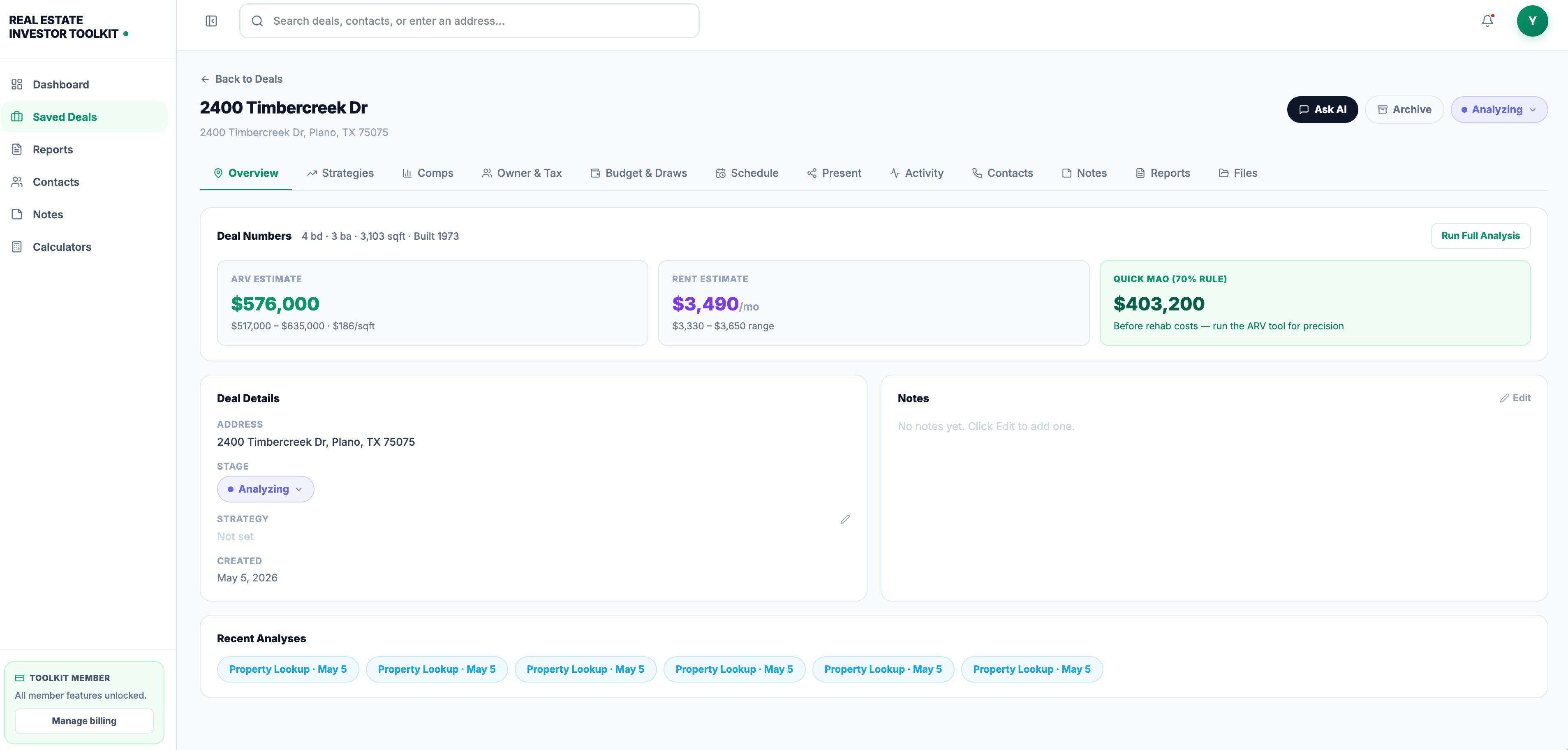
Instead of estimating ARV off memory or guessing at rehab costs, you run the actual numbers before you ever present an offer to a seller or a fee to a buyer. Say you’re evaluating a property with a rough ARV of $180,000: plug it into the ARV tool, run the repair scope through the rehab calculator, and you’ll see your MAO and maximum fee ceiling in minutes instead of guesswork. That’s the difference between a fee you can defend and one a buyer walks away from.
Start with the wholesale offer and assignment fee guide to see the full formula in action, then run your next deal through the calculators before you lock in a price with either side of the table.
Sources
- What Is an Assignment Fee? Legal Rules and Taxes - LegalClarity
- Average Wholesale Assignment Fee 2026 Statistics
- Free Wholesale Assignment Fee Calculator (2026)
Recommended
- What Is MAO (Maximum Allowable Offer)? — Real Estate Investing Guide | Real Estate Investor Toolkit
- How to Estimate Holding Costs Before They Kill the Flip Spread — Real Estate Investing Guide | Real Estate Investor Toolkit
- How to Pull Comps in Non-Disclosure States Without Fooling Yourself — Real Estate Investing Guide | Real Estate Investor Toolkit