Model Seller Financing Terms: U.S. Benchmarks and a 25% Median Note

Typical seller-financed deals carry 10 to 30% down, with the seller financing 15 to 30% of the purchase price at rates in the mid 5% to high 7% range over three to seven years, often ending in a balloon payment. The biggest trap isn’t the math. It’s the IRS Applicable Federal Rate and loan-originator rules under the SAFE Act, both of which can turn a handshake deal into a tax or licensing problem fast.
TL;DR:
- Seller-financed deals usually involve 10 to 30% down payments, with financing covering 15 to 30% of the purchase price at rates around 5% to 7%.
- Most seller notes have short terms of 3 to 7 years and often end with balloon payments, requiring buyers to plan for refinancing.
- The choice of structure—land contract, deed of trust, wraparound mortgage, or second lien—affects ownership transfer and default protections.
- Federal and state rules, especially the SAFE Act and IRS Applicable Federal Rate, can create legal or tax issues if not properly managed.
- Careful modeling of payments and refinance scenarios before signing helps buyers avoid surprises and ensure the deal aligns with their financial plans.
Table of Contents
- What Are Typical Seller Financing Terms in a Real Estate Deal?
- Which Seller Financing Structure Fits Your Deal?
- What U.S. Rules Govern Seller Financing?
- How Do You Negotiate Seller Financing Terms?
- What Documents Close a Seller Financing Deal?
- Can Seller Financing Work Alongside an SBA Loan?
- How Do You Model a Seller Note Before You Sign?
- When Does Seller Financing Actually Make Sense?
- Model Your Seller Note Before You Negotiate
- Where to Verify Seller Financing Rules and Rates
- Sources
What Are Typical Seller Financing Terms in a Real Estate Deal?
Seller-financed deals vary by property type, but the numbers cluster tighter than most first-time buyers expect. On residential and small commercial deals, sellers commonly finance a moderate portion of the purchase price, with the buyer covering the rest through a down payment or a blended mortgage. Interest rates typically fall in the mid 5% to high 7% range, tracking a few points above prime, and the median seller note runs around 25% of the sale price with a five-year term and roughly 6% interest in many small transactions.
Term length is where structure starts to matter. Most seller notes run several years, well short of a 30-year mortgage, and many end in a balloon payment rather than full amortization. That combination means buyers need a refinance plan before they sign, not after.
Here’s how the terms typically break down by deal profile:
- Small residential resale: 10 to 20% down, seller finances 20 to 30%, rate around 6%, 5-year term with balloon.
- Investment property or fix-and-flip: 15 to 25% down, seller finances 15 to 25%, rate 6 to 7%, 3 to 5 year term.
- Owner-occupied small business real estate: 20 to 30% down, seller finances up to 30%, rate 5.5 to 7.5%, 5 to 7 year term.
Quick math: a $300,000 note amortizing over 25 years at 6% runs about $1,933 a month. Structure the same note as interest-only at 6% and the payment drops to $1,500 a month, with the full $300,000 due at the balloon date. That gap is exactly why buyers need to model a refinance exit before agreeing to a short-term balloon, since the monthly cost swings by more than $400 depending on which structure the seller accepts.
Which Seller Financing Structure Fits Your Deal?
Not every seller-financed deal transfers ownership the same way, and that difference changes what happens if a buyer stops paying. Four structures show up most often in owner financing agreements:
- Land contract (contract for deed): Seller keeps legal title until the note is paid off; buyer holds equitable title and possession. Faster to unwind if the buyer defaults, but weaker protection for the buyer in many states.
- Deed of trust / mortgage note: Buyer takes legal title immediately; seller holds a security instrument, similar to a bank loan. This is the most common structure for buyer seller financing on residential deals.
- Wraparound mortgage: Seller keeps an existing underlying loan in place and finances the buyer for the full price, collecting a spread between the two rates. This only works if the original mortgage allows it.
- Second lien or assumable loan: Seller finances a portion behind a buyer’s new first mortgage, or the buyer assumes the seller’s existing loan directly, where the loan terms permit assumption.
Existing mortgages almost always carry a due-on-sale clause, which lets the lender call the loan due if title transfers without permission. Wraparounds and land contracts both carry real risk here unless the seller’s lender has agreed in writing.
What U.S. Rules Govern Seller Financing?
Seller financing sits at the intersection of real estate law, consumer lending rules, and federal tax code, and all three can bite a seller who treats the deal as a private handshake.
The biggest licensing risk is the SAFE Act. The National Association of REALTORS® notes that a seller financing one property in a year usually avoids loan-originator licensing, but sellers who finance multiple properties annually risk being treated as a “creditor” subject to mortgage-originator rules. Clear documentation of one-off status matters more than most sellers realize.
The CFPB’s loan-origination rules also touch private-party lending in certain circumstances, particularly around ability-to-repay expectations. Keeping a simple income and asset file on the buyer, even informally, protects the seller if the deal is ever questioned.
On the tax side, the IRS sets a minimum Applicable Federal Rate each month. Price a note below that rate and the IRS treats the shortfall as imputed interest, creating phantom taxable income for the seller. Installment-sale treatment under Form 6252 lets sellers spread gain recognition across payment years, but only if the note is documented correctly from closing.
A few numbers worth remembering:
- Seller notes commonly finance a moderate portion of the purchase price.
- Rates typically range a few points above prime.
- Terms commonly last several years and often include a balloon payment.
State law also drives foreclosure timelines and title mechanics, so a land contract in one state can behave very differently from the same structure across a state line.
How Do You Negotiate Seller Financing Terms?
Every seller note is a trade between five levers: down payment, interest rate, term length, security position, and personal guarantees. Push one lever and the others usually move in response. A buyer offering a bigger down payment can often negotiate a lower rate or a longer term, while a seller wanting the full price financed will usually demand a stronger security instrument or a guarantee.
Prepayment penalties are common but rarely fixed. Step-down penalties that shrink each year of the loan are a standard middle ground, giving the seller some return protection early while letting the buyer refinance penalty-free after a set point.
Use this sequence when structuring the offer:
- Set the down payment first; it anchors everything else.
- Price the rate against the current AFR, not just “a few points above prime.”
- Pick a term that matches the buyer’s realistic refinance timeline.
- Decide the security instrument and whether a personal guarantee is required.
- Draft standby or subordination language now if SBA or bank financing might follow.
Pro Tip: Negotiate the prepayment penalty and the balloon date together. A shorter balloon with no penalty often costs the seller less in real terms than a longer balloon with a rigid penalty clause, because it forces a refinance conversation before the buyer’s finances or the market can drift.
What Documents Close a Seller Financing Deal?
A seller-financed closing needs the same rigor as a bank closing, just executed by different parties. Skipping a step here is what turns a smooth deal into a lawsuit two years later.
- Promissory note: Principal, rate, term, payment schedule, late fees, default triggers, and prepayment terms.
- Security instrument: A deed of trust or mortgage recorded against the property, giving the seller a recovery path if the buyer defaults.
- UCC-1 filing: Required when personal property or business assets secure the note, with a precise collateral description to avoid disputes later.
- Purchase agreement clauses: Should explicitly reference the note and security instrument rather than leaving financing terms informal.
- Tax and escrow setup: Confirm who escrows for property taxes and insurance, and how payments get serviced or tracked month to month.
Confirm the due-on-sale question with the seller’s existing lender before closing, not after, especially on wraparound structures.
Can Seller Financing Work Alongside an SBA Loan?
Seller notes often sit behind SBA financing rather than competing with it. The SBA typically requires 12 to 24 months of standby on a seller note before it counts toward buyer equity in a 7(a) or 504 deal, meaning the seller collects no payments during that window.
- Sellers commonly accept subordination because it’s often the only path to closing when the buyer needs SBA leverage.
- Splits vary, but seller notes covering 10 to 20% of the price alongside SBA debt are common in small business real estate deals.
- Get an attorney-reviewed subordination agreement in writing and disclose the seller note to the primary lender before underwriting begins, not during it.
How Do You Model a Seller Note Before You Sign?
Run the numbers before you agree to anything. Plug the note amount, term, amortization schedule, balloon size, down payment, and rate into a calculator, then watch how the monthly payment, total interest, and balloon amount shift. Compare an amortizing $300,000 note against an interest-only version, and the refinance break-even point becomes obvious fast.
When Does Seller Financing Actually Make Sense?
Seller financing works best when the buyer has thin credit but strong cash flow, the property is hard to finance conventionally, or the seller wants installment-sale tax treatment. Watch for red flags: no title search, no written AFR check, or a seller financing several properties without documenting one-off status.
— Michael
Model Your Seller Note Before You Negotiate
Running these numbers by hand invites mistakes, especially when comparing an amortizing note against a balloon structure with a different rate. The Investment Property Financing Calculator from Real Estate Investor Toolkit lets you build both scenarios side by side, no sign-up required, so you see the monthly payment, total interest, and balloon exposure before you agree to terms.
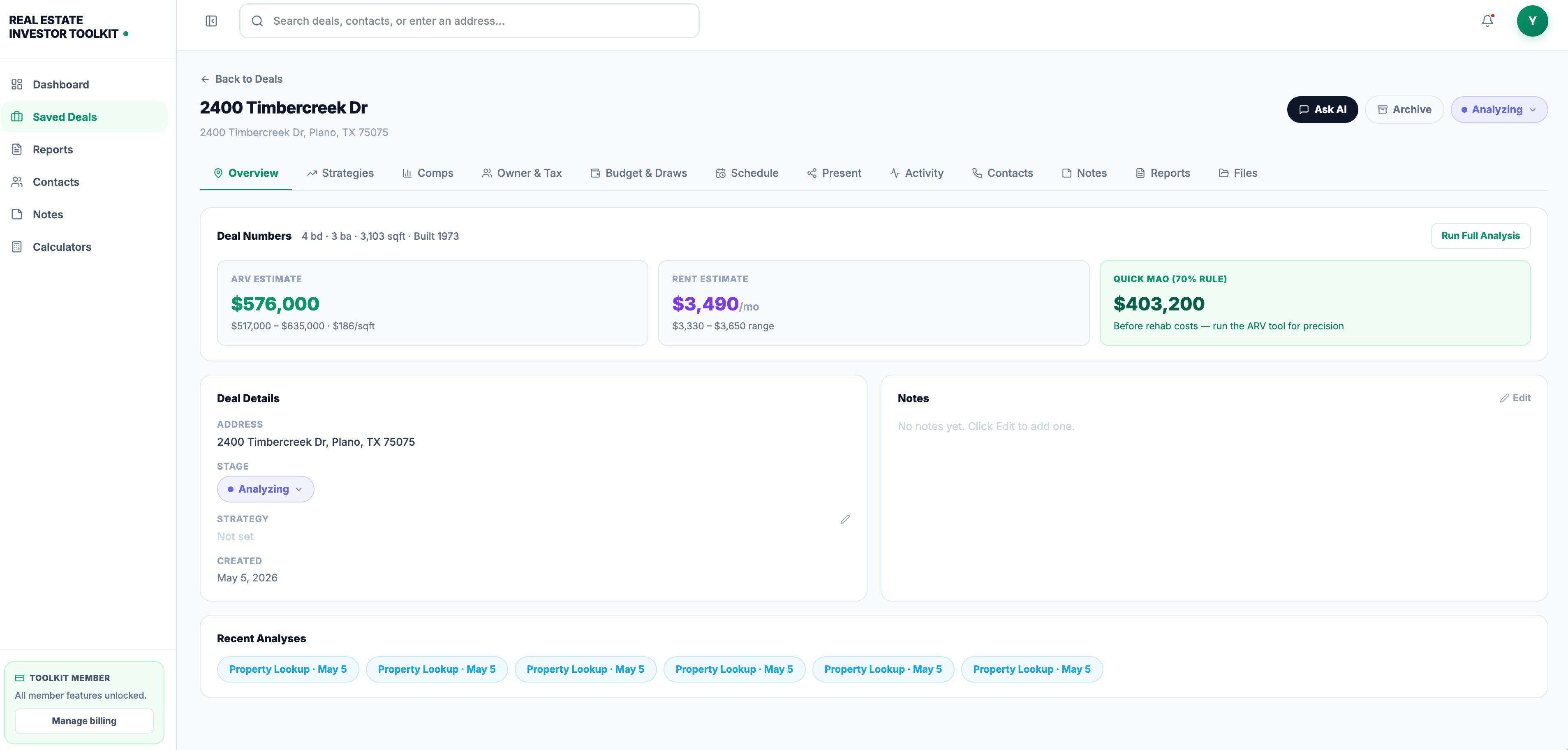
Change the down payment, stretch the term, or swap in interest-only payments, and watch the refinance break-even point move in real time. Pair it with the rental cash flow calculator if the property will carry tenants during the note period, so you know whether the rent covers the seller payment with room to spare. Run your own numbers now and walk into the negotiation knowing exactly what a fair seller-financed offer looks like for your deal.
Where to Verify Seller Financing Rules and Rates
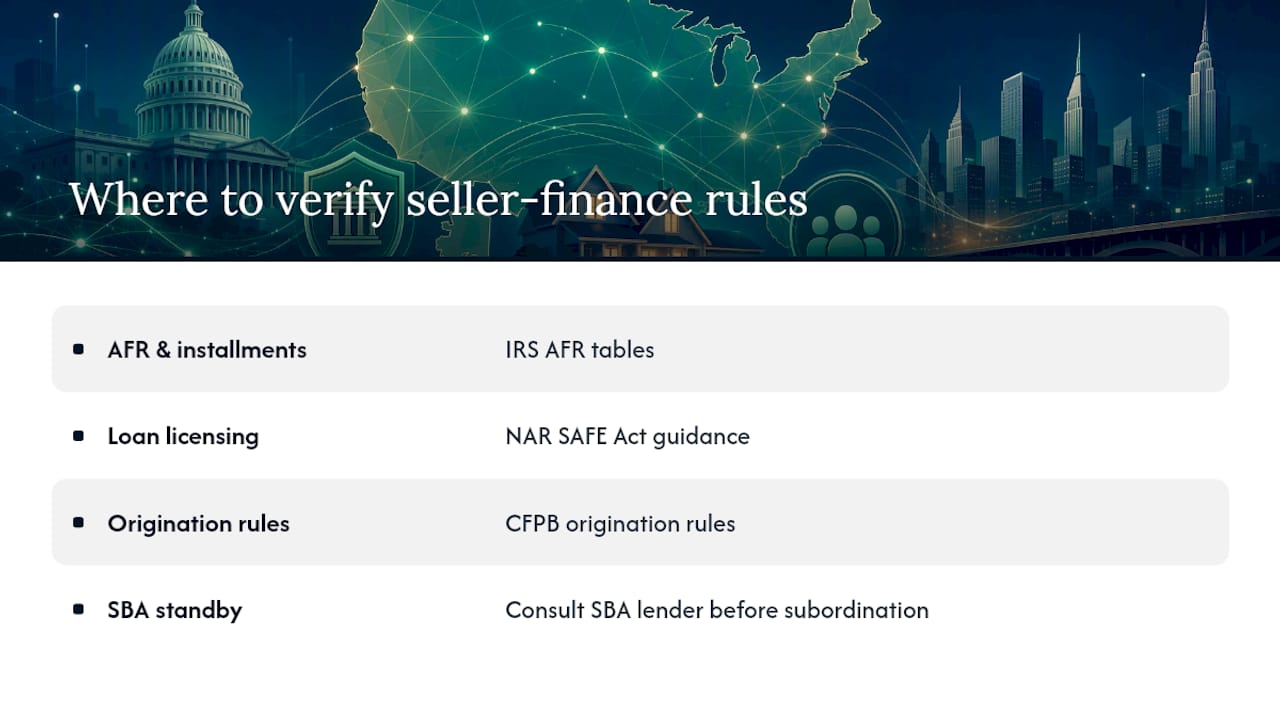
For current Applicable Federal Rates and installment-sale mechanics, check the Irs AFR tables directly. For loan-originator licensing questions, review NAR’s SAFE Act guidance and the CFPB’s origination rules. For SBA standby requirements on seller notes, consult your SBA lender directly before drafting subordination language.
Sources
- Loan originator compensation and related rules — CFPB
- Seller Financing Guide: Terms, Negotiation & Structure — The Deal Sheet
- Business seller financing: Structure, taxes, and documents — LegalClarity