6 Months or Day One: BRRRR Seasoning Rules by Loan Type

Conventional cash-out refinances typically require six months of title seasoning before a lender will fund against your property’s new value. If you paid cash at acquisition, Fannie Mae’s Delayed Financing Exception lets you refinance immediately, though only up to your purchase price plus documented closing costs. DSCR and private lenders set their own ranges, often zero to six months, in exchange for higher rates. Your move: pick a target refinance lender before you close, then spend the seasoning window building the document file, not waiting on it.
TL;DR:
- Conventional and agency lenders require six months of title seasoning, with LTV caps around 75%, unless utilizing the Delayed Financing Exception for cash buyers.
- Value seasoning affects the accepted property value during refinance, with most lenders basing it on purchase price plus repairs until seasoning is complete, not on appraised ARV.
- Shortening or bypassing seasoning is possible via the Delayed Financing Exception, rate-and-term refinancing, DSCR loans with early ARV approval, or bridge loans, each with specific eligibility criteria.
- Preparing a comprehensive refinance file with documents like invoices, lease agreements, and bank statements before the seasoning window ends accelerates funding, avoiding delays.
- The actual refinance timeline usually spans four to eight months, depending on rehab duration, lease-up, and seasoning requirement adherence, impacting how much cash is recoverable.
Table of Contents
- What Are the Seasoning Requirements for BRRRR Refinancing?
- Title Seasoning vs. Value Seasoning: What’s Actually Being Measured?
- How Can You Shorten or Bypass Seasoning Requirements?
- What Documents Do Lenders Want Before Refinancing?
- What Does a Realistic BRRRR Refinance Timeline Look Like?
- How Do Seasoning Rules and LTV Caps Affect Your Recoverable Cash?
- How Should You Choose a Refinance Path at Acquisition?
- Model Your Refinance Before You Commit to a Deal
- A Pragmatic Take on Seasoning Discipline
- Sources
- FAQ
What Are the Seasoning Requirements for BRRRR Refinancing?
Every loan type treats seasoning requirements for BRRRR refinances differently, and the gap between them can determine whether your capital sits idle for six months or gets redeployed in six weeks.
Conventional and agency loans hold the tightest line. Fannie Mae’s guidelines require six months of title seasoning before a cash-out refinance, and LTV caps on investment property typically sit around 75%. Freddie Mac follows a comparable structure through its own conforming guidelines. This is the benchmark every other lender measures against, even when they aren’t bound by it.
The Delayed Financing Exception is the one carve-out worth knowing cold. If you bought the property all-cash, with no liens recorded at any point, you can refinance immediately and recoup your purchase price plus eligible closing costs. It does not let you pull out equity created by your rehab. You’re recovering cost basis, not cashing in on ARV.
DSCR lenders operate on their own clock, often ranging from zero to six months depending on the program, and they underwrite against the property’s rental income rather than your personal debt-to-income ratio. The tradeoff is real: expect higher rates and lower proceeds than an agency refinance would offer.
Portfolio and local banks can move faster than agency rules suggest, especially when you already have a relationship and the property type fits their book. Hard-money and private bridge lenders impose no seasoning at all on the rehab loan itself, but their exit LTVs run lower and their rates run higher, which is the price of speed.
- Conventional/agency: 6 months, ~75% LTV cap
- Delayed Financing Exception: immediate, capped at cost basis
- DSCR: 0 to 6 months, higher rate for flexibility
- Portfolio/local bank: variable, relationship-dependent
- Hard-money/private: no seasoning, lower takeout LTV
Title Seasoning vs. Value Seasoning: What’s Actually Being Measured?
Two different clocks run inside every refinance, and confusing them is where most BRRRR investors get blindsided.
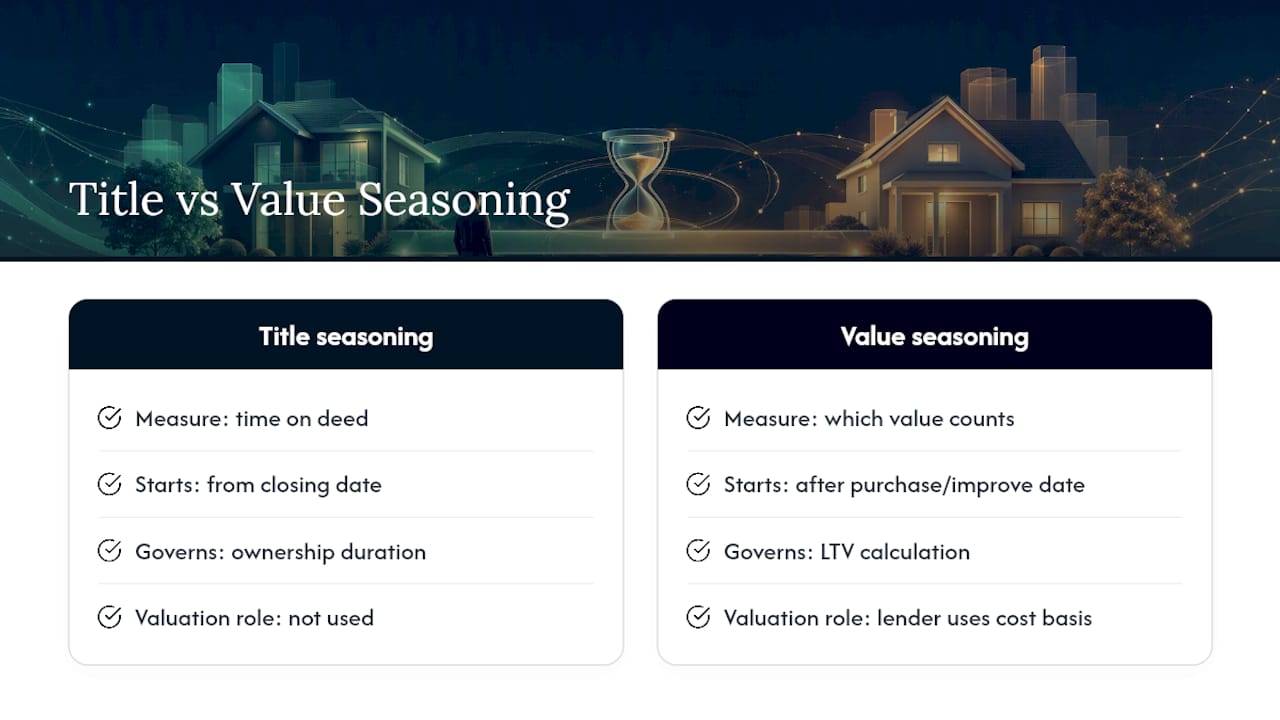
Title seasoning is simple: it’s how long your name has been on the deed. Six months means six months, full stop, counted from your closing date.
Value seasoning is the one that actually stalls deals. It governs which value the lender will accept when calculating your loan-to-value ratio. Inside the seasoning window, most lenders won’t take your contractor’s word, or even an appraiser’s opinion, that the property is now worth $220,000 after a $220,000 property became a $260,000 asset. Instead, they fall back to your cost basis: purchase price plus documented, verifiable improvements. The appraisal might say $260,000. The lender’s math might still start closer to $235,000 until enough time has passed or enough seasoned comps exist to support the higher number.
This is why cash-out refinances get scrutinized so much harder than rate-and-term refinances. A rate-and-term refi just swaps one loan for another at roughly the same balance, so the lender has little incentive to second-guess your property’s value. A cash-out request asks the lender to hand you money based on a number that didn’t exist six months ago. That’s the exact scenario seasoning rules were built to slow down, and it’s the single biggest reason BRRRR investors run into refinance friction that flippers and buy-and-hold landlords rarely see.
How Can You Shorten or Bypass Seasoning Requirements?
Four levers control how fast you get your capital back, and each one comes with a specific eligibility test and a specific cost.
- Delayed Financing Exception. Available only if you bought entirely with cash and no lien touched the property at any point, including a hard-money loan you paid off before closing. The refinance amount is capped at your documented purchase price plus eligible closing costs, generally landing near 75% LTV in practice. You’ll need the settlement statement, proof of funds source, and a clean title report showing no interim liens.
- Rate-and-term instead of cash-out. If you don’t need to extract cash immediately, a rate-and-term refinance sidesteps most value-seasoning scrutiny because you’re not asking the lender to lend against new equity. The catch: it doesn’t recycle your capital, which defeats the point of the BRRRR model in the first place.
- DSCR takeout loans. Some DSCR programs will underwrite to ARV well before six months, provided you can show a signed lease, rent deposits hitting your bank account, and a debt-service coverage ratio the lender considers conservative, often 1.0 or higher. You pay for that flexibility in rate.
- Bridge or short-term rehab financing. A bridge loan buys you time between rehab completion and refinance eligibility, letting you stabilize the property without racing the seasoning clock. It’s a cost center, not a solution, so plan the exit before you draw on it.
Pro Tip: Verify lien history before you count on delayed financing. If any hard-money or private debt touched the title at acquisition, even briefly, the exception is off the table and you’re back on the standard seasoning schedule.
What Documents Do Lenders Want Before Refinancing?
The refinance file, not the calendar, is usually what determines whether your loan funds on day one of eligibility or drags into a second round of underwriter questions.
Lenders typically want a specific stack: your closing disclosure or HUD-1 from acquisition, current mortgage statement, homeowner’s insurance declaration page, the executed lease, three to six months of bank statements showing rent deposits landing on schedule, property management statements, itemized receipts and permits for rehab work, the current property tax bill, HOA documents if applicable, entity formation paperwork and EIN if you closed in an LLC, and your personal tax returns and financial statements.
The step most investors skip is reconciliation. Underwriters typically want a three-way match between the lease, the property management statement, and the actual bank deposit before they’ll count rent as qualifying income, according to BRRRR refinance readiness research. If your lease says $1,650 but your deposit shows $1,580 after a management fee, that gap needs an explanation attached before the underwriter asks for one.
- Closing disclosure/HUD-1 and current mortgage statement
- Insurance declaration and executed lease(s)
- Bank statements showing rent deposits
- Property management statements
- Rehab receipts, invoices, and permits
- Property tax bill and HOA documents
- Entity docs, EIN, and personal tax returns
Organize these into labeled folders by category during seasoning, not after your rate lock, so the whole package is submission-ready the day your window opens.
What Does a Realistic BRRRR Refinance Timeline Look Like?
A typical BRRRR deal runs four to eight months from purchase to refinance close, and the seasoning clock only starts ticking once you close on the property, so every week you save elsewhere is a week closer to refinancing.
- Weeks 0 to 4: Acquisition. Close the purchase, secure the title, and start collecting your cost-basis documentation immediately.
- Weeks 4 to 20: Rehab. Budget six to sixteen weeks depending on scope. Photograph every stage and save every invoice as you go.
- Weeks 16 to 24: Lease-up. Two to eight weeks is typical for a turnkey unit in a decent rental market. Get the lease signed and rent deposits flowing before you count on that income.
- Remaining balance of six months: Seasoning. Use this stretch to reconcile bank deposits against your lease and PM statements, and to line up your appraisal order in advance.
- Weeks 22 to 26: Application and underwriting. Expect 30 to 45 days of lender processing once you submit, according to DoorVault’s BRRRR timeline analysis, so submit your complete package the moment you’re title-eligible rather than waiting for a “perfect” file.
By months one through three, your rehab should be substantially finished. By months three through five, your lease should be signed and your document folder should already be organized. In the final six weeks before eligibility, schedule your appraisal and confirm your target lender’s exact submission requirements so nothing stalls at the finish line.
How Do Seasoning Rules and LTV Caps Affect Your Recoverable Cash?
Run the same BRRRR deal through two different lenders and the seasoning rule alone can change your recoverable cash by tens of thousands of dollars.
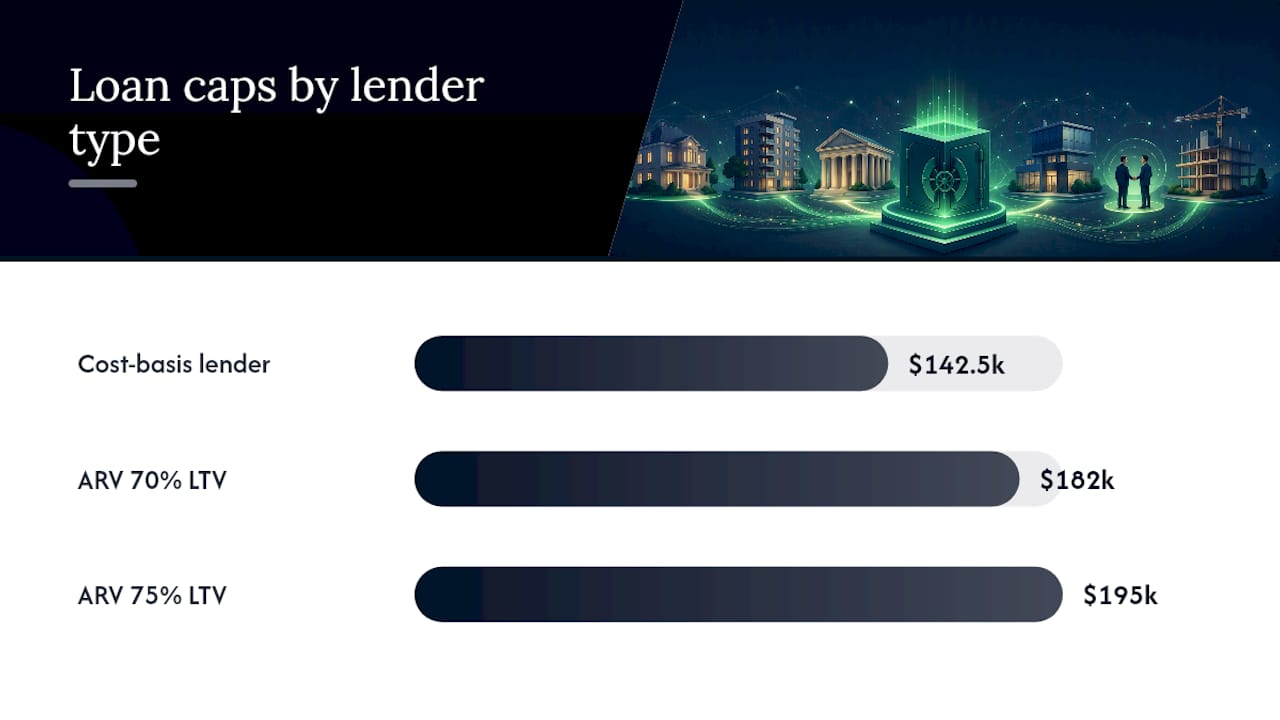
Example A: Cost-basis lender, inside the seasoning window. You buy a property for $150,000 and put $40,000 into rehab, giving you a documented cost basis of $190,000. A lender using delayed financing or a conservative in-seasoning valuation caps your loan near 75% of that $190,000 basis, or about $142,500. After paying off any existing acquisition debt, your recoverable cash is limited to what’s left above your basis, which in a cash-purchase delayed-financing scenario is close to your closing costs only.
Example B: ARV-based lender, fully seasoned. The same property appraises at $260,000 after rehab. A lender willing to underwrite to ARV at a 70 to 75% LTV cap lends up to $182,000 to $195,000. After paying off the original $150,000 plus rehab financing, you could recover a meaningfully larger share of your invested capital than in Example A.
- Cost-basis lending caps you near what you spent, not what you built
- ARV-based lending at 70 to 75% LTV captures the equity your rehab created
- Conservative appraisals narrow this gap even after seasoning clears
Documentation quality moves the needle here more than most investors expect. A well-supported rehab file with permits and paid invoices gives an appraiser more confidence to support a higher ARV, which matters just as much once you’re through the seasoning window as it does during it.
How Should You Choose a Refinance Path at Acquisition?
Decide your exit before you buy, not after your rehab crew finishes, because the loan you pick at acquisition quietly sets your seasoning clock.
Weigh three things against each other: how fast you need your capital back to fund the next deal, how much extra rate or fee cost you’re willing to absorb for speed, and how confident you are that your documentation will hold up without follow-up questions. An investor doing one deal a year can afford to wait out conventional seasoning. An investor trying to recycle capital every quarter usually can’t.
Watch for red flags before you commit: comps that are thin or dated, a rental market where lease-up could stretch past eight weeks, missing permits on structural work, or a chain of title that reads like a flip to an underwriter even when it isn’t. Any of these can push your refinance past your target date regardless of which loan type you chose.
Before closing on the purchase, prequalify with your target refinance lender and get an actual term sheet, not a verbal estimate. Document your rehab budget and start saving receipts from the first invoice. If your numbers are tight, build a bridge-loan or reserve-fund contingency into your offer price rather than discovering the gap after you’re already holding the property.
Model Your Refinance Before You Commit to a Deal
Running the numbers from Examples A and B by hand is doable once. Doing it for every deal you’re evaluating is how good opportunities slip through while you’re still in a spreadsheet.
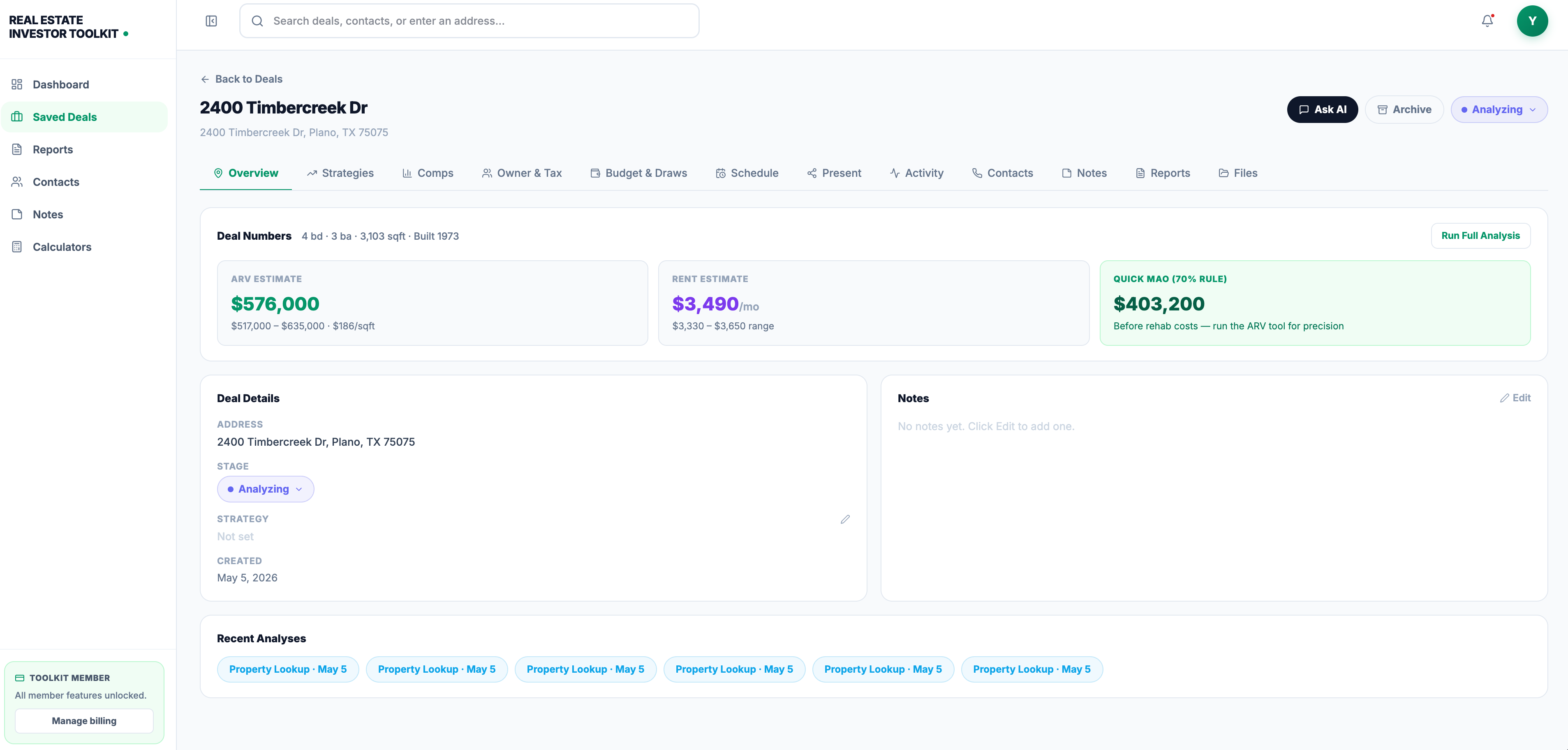
The BRRRR calculator at Real Estate Investor Toolkit lets you plug in purchase price, rehab budget, and target LTV to see recoverable cash under both a cost-basis scenario and an ARV-based scenario side by side, without creating an account first. Pair it with the ARV calculator to build a defensible, comp-backed value estimate before you ever talk to an underwriter, since a conservative, well-supported ARV is what actually gets a value-seasoning conversation to go your way. For the document side, the BRRRR method guide walks through building a refinance-ready file while you’re still in the seasoning window, so nothing is missing when your eligibility date arrives. Run your next acquisition through the calculator before you make an offer, not after you close.
A Pragmatic Take on Seasoning Discipline
Seasoning is an operational constraint, not a legal obstacle. Match the lender to your timeline before you buy, prepare the file during the wait, and treat paying for speed through DSCR or bridge debt as a legitimate business decision when the math supports it. Refinance readiness belongs in your rehab budget from day one, not bolted on afterward.
— Michael
Sources
FAQ
What Is the 70% Rule for BRRRR?
The 70% rule caps your all-in purchase and rehab cost at 70% of the after-repair value, leaving a margin that protects your refinance proceeds even if the lender’s seasoned valuation runs conservative.
What Is the 3-3-3 Rule in Real Estate?
It’s a rough BRRRR pacing guideline: roughly three months to acquire and start rehab, three months to finish rehab and lease up, and three months to season and close the refinance, though actual timelines vary widely by lender and market.
What Are the Requirements for the BRRRR Method?
You need a property priced enough below ARV to leave rehab and refinance margin, a rehab plan with documented costs, a signed lease generating verifiable rent, and a refinance lender whose seasoning rules, whether six months, delayed financing, or a DSCR program, match your capital-recycling timeline.
What Is the 7% Rule for Rental Property?
There’s no standardized industry return rule. If you’re weighing a rental against a target return threshold, running the numbers through a rental cash flow calculator against your actual cap rate and cash-on-cash return gives a more reliable answer than any flat percentage rule.
Does Every Lender Require Six Months of Seasoning?
No. Six months is the conventional agency default, but DSCR lenders often range from zero to six months, portfolio banks vary by relationship, and cash buyers using the Delayed Financing Exception can refinance immediately, though only up to documented cost basis.