Scope of Work Estimate: Templates & BoE Guide

A scope of work estimate must define measurable deliverables, exact quantities, explicit exclusions, acceptance criteria, and a pre-approved change-order path so that any estimator can produce a defensible, reproducible bid. Without those five elements locked in writing before pricing begins, you are not estimating a project — you are guessing at one.
Three facts worth knowing before you open a spreadsheet:
- Approximately 50% of construction project cost overruns are attributed to poorly defined scope of work, making the SOW the single highest-leverage document in your cost control stack.
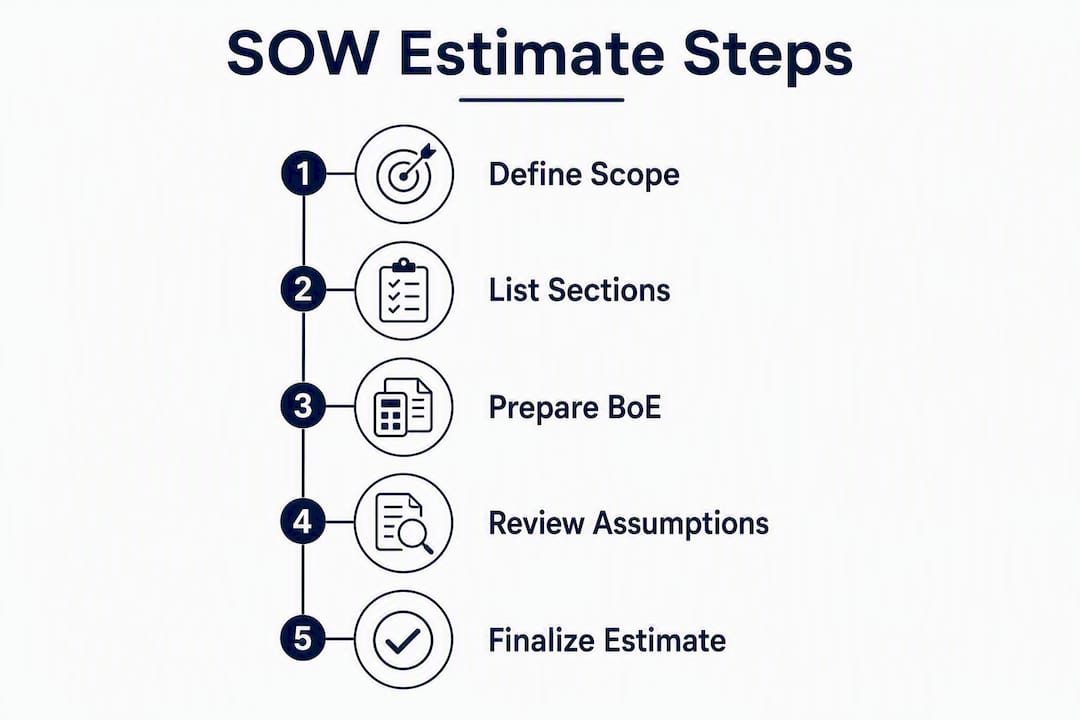
- A Basis of Estimate (BoE) translates every SOW line item into a priced entry with assumptions, unit costs, and contingency logic documented so a second estimator can verify or reproduce the number independently.
- Omitting exclusions is the most frequent cause of payment disputes; absent a written exclusion, owners and subcontractors routinely interpret silence as inclusion.
Start with these documents before you price anything:
- SOW checklist (sections, line items, acceptance criteria, exclusions)
- Basis of Estimate template (line item, quantity, unit, unit cost, assumptions, contingency)
- Change-order form (written request, priced quote, written approval, version log)
- Milestone payment schedule (tied to deliverable acceptance, not calendar dates)
- Exclusions register (explicit list of what is not in scope)
Table of Contents
- What is a scope of work, and how does it differ from a contract or WBS?
- Why you need a SOW and when skipping one creates real risk
- What sections does every estimator expect in a SOW?
- How does a SOW become an estimate? Writing a usable Basis of Estimate
- Which estimate type is right for your project stage?
- Practical SOW templates and sample clauses you can use today
- Common SOW mistakes that inflate costs and cause disputes
- How to manage change orders and stop scope creep from wrecking your estimate
- Research-backed evidence on why precise SOWs cut cost overruns
- A 6-step process to build an estimator-ready SOW fast
- Key Takeaways
- The part of SOW writing most guides skip entirely
- Real Estate Investor Toolkit puts your SOW math to work instantly
- Sources and further reading
What is a scope of work, and how does it differ from a contract or WBS?
A scope of work (SOW) is the execution-level document that describes exactly what work will be performed, the boundaries of that work, the materials and methods to be used, and the measurable conditions that define completion. It is not a legal agreement, a marketing proposal, or a planning hierarchy. It is the technical description that sits between the client’s intent and the estimator’s spreadsheet.
Confusing these documents costs money. Here is how they differ:
| Document | Primary user | Primary purpose | When created |
|---|---|---|---|
| Proposal | Contractor / vendor | Communicate approach and price to win work | Pre-award |
| SOW | Estimator, PM, subcontractor | Define what work is included and how it will be accepted | Pre-award, updated at award |
| Contract | Legal / owner / GC | Bind parties to obligations, payment, and remedies | At award |
| WBS | Project manager | Decompose deliverables into manageable work packages | Planning phase |
| BoE | Estimator | Document cost assumptions, sources, and contingency | Estimating phase |
The relationship flows in one direction: the WBS breaks the project into packages, the SOW describes what each package requires, the BoE prices each SOW line item, and the contract incorporates the SOW as an exhibit. Keeping the SOW as a separate exhibit inside the contract means change orders can amend the SOW without renegotiating the entire agreement — a practice that reduces legal friction and preserves original contract terms.
A WBS without a corresponding SOW is a planning document with no enforcement. A SOW without a WBS is often too vague for accurate estimating. Use both together, and attach the SOW to the contract by reference so its version number is legally binding.
Why you need a SOW and when skipping one creates real risk
A formal SOW is non-negotiable in four situations: competitive bidding on lump-sum contracts, subcontract scope definition, investor rehab underwriting, and insurance repair claims. In each case, the SOW is the document that converts a client’s intent into a priceable, auditable set of instructions.
When a SOW is required:
- Competitive bids: Without a shared SOW, each bidder prices a different project. Apples-to-apples comparison is impossible, and the low bidder often wins by omitting scope the owner assumed was included.
- Lump-sum subcontracts: A subcontractor pricing without a written SOW has no documented basis for what is in or out of their number. Any verbal understanding becomes a dispute the moment conditions change.
- Investor rehab deals: Fix-and-flip and BRRRR investors need a line-item SOW to validate rehab cost estimates against ARV and Maximum Allowable Offer (MAO) math. A vague scope produces a vague number, and a vague number destroys deal analysis.
- Insurance repair claims: Adjusters and contractors must agree on scope before pricing. An undocumented scope leads to supplement battles and delayed payments.
The cost of skipping a formal SOW is not hypothetical. Poorly defined scope is a primary driver of construction cost overruns, with approximately 50% of overruns attributed to scope gaps. Schedule delays follow the same pattern: when the team discovers undefined work mid-project, the schedule absorbs the impact while the budget absorbs the cost.
Pro Tip: Before issuing a SOW for bidding, run it past the lead estimator and one subcontractor in the dominant trade. If either one asks “does this include X?” more than twice, your exclusions section needs work.
What sections does every estimator expect in a SOW?
A complete SOW gives an estimator everything needed to price without a phone call. That means 14 sections, each with a specific job. Here is the checklist, organized to mirror CSI MasterFormat groupings for construction projects:

1. Project overview Name, address, owner, GC, project type, contract delivery method (lump-sum, GMP, unit-rate), and a two-sentence description of the project’s purpose.
2. Objectives and purpose statement What the completed project must achieve — not what work will be done, but what outcome the owner requires. Example: “Restore the second-floor apartment to rentable condition meeting local housing code within 45 days.”
3. Deliverables list Discrete, numbered outputs the contractor must produce. Each deliverable should be a noun phrase, not a verb phrase. “Installed and inspected HVAC system” rather than “install HVAC.”
4. Detailed work description / WBS line items This is the core of the SOW. Organize by CSI division for construction (Division 03 Concrete, Division 06 Wood Framing, Division 09 Finishes, etc.). For each trade package, list:
- Work tasks in sequence
- Materials with brand, model, or SKU where specified
- Installation method or applicable standard (ASTM, NFPA, local code)
- Quantities and units of measure
5. Materials and specifications Call out approved products by manufacturer and model number. Detailing materials to SKU or brand is one of the most effective defenses against change orders and pricing disputes — vague specs invite substitutions that shift cost and quality.
6. Roles and responsibilities Who supplies materials, who provides site access, who is responsible for permits, inspections, and temporary utilities. Ambiguity here produces unauthorized work orders.
7. Resource requirements Equipment, scaffolding, dumpsters, temporary power, and any owner-furnished materials (OFM). List OFM separately with delivery dates.
8. Schedule and milestones Start date, substantial completion date, and 3–5 intermediate milestones tied to payment triggers. Milestones should be deliverable-based, not calendar-based.
9. Assumptions and constraints Document what the estimator assumed to be true (existing conditions, site access hours, soil bearing capacity, lead times). Assumptions that prove false become the basis for change orders.
10. Exclusions Explicit exclusions are the most critical single section for preventing disputes. List every item a reader might reasonably expect to be included but is not. “Painting of exterior trim is excluded” beats discovering the disagreement at final inspection.
11. Acceptance criteria Measurable conditions that define “complete” for each deliverable. Effective SOWs must explicitly define acceptance criteria to prevent payment disputes. Example: “Hardwood flooring installation is accepted when surface is level within 3/16 inch over 10 feet, all transitions are installed, and no visible gaps exceed 1/16 inch.”
12. Payment terms Tie payment to milestone acceptance, not to calendar dates. Linking payments to milestones improves cash flow and reduces disputes by making the payment trigger objective and verifiable.
13. Change-order process A one-paragraph summary of the change-order workflow: written request required, priced quote within X business days, written approval before work begins. Full workflow detail belongs in a separate change-order exhibit.
14. Sign-off and version control Signature blocks for owner, GC, and relevant subcontractors. Version number, date, and revision history at the top of the document.
WBS-to-SOW conversion example:
WBS Work Package: 09 21 16 — Gypsum Board Assemblies SOW Line Item: Furnish and install 5/8-inch Type X gypsum board on all interior walls and ceilings in Units 201–205, taped, floated, and sanded to Level 4 finish per GA-214. Approximately 4,200 SF. Excludes priming and painting.
Pro Tip: Version your SOW with a date stamp and revision number in the header (e.g., “SOW Rev 3 — March 14, 2026”). When a change order is approved, issue a new SOW revision so the contract exhibit always reflects current scope.
How does a SOW become an estimate? Writing a usable Basis of Estimate
A BoE translates SOW line items into priced entries with assumptions and allowances clearly stated, so any experienced professional can assess the estimate independently. That is the standard AACE International recommends in its 34R-05 guidance on Basis of Estimate documentation.

The BoE is not a bid form. It is the internal document that explains how you got to the number on the bid form. It protects you in disputes, supports cost trending across the project lifecycle, and makes it possible for a different estimator to step in and reproduce your figures.
Standard BoE table columns:
| Line item | Quantity | Unit | Unit cost | Extended cost | Assumptions / allowances | Contingency |
|---|---|---|---|---|---|---|
| Install engineered hardwood, 12mm | — | SF | $6.85 | — | Shaw Floorté Pro; includes adhesive, transitions; excludes subfloor prep | 10% |
| Demo existing vinyl tile | — | SF | — | — | Assumes single layer; double-layer adds $0.65/SF | 5% |
| Subfloor leveling allowance | 1 | LS | — | — | Allowance for minor low spots; major structural issues excluded | 0% |
Notice that the assumptions column does the heavy lifting. It tells the next estimator exactly what was included in the unit cost and what was not, so they do not have to reverse-engineer your thinking.
Pro Tip: Never bury an allowance inside a unit cost without disclosing it. If your $6.85/SF hardwood number includes a $0.40/SF adhesive allowance, say so. Hidden allowances are the source of most “how did we get here?” conversations at project close-out.
A clear SOW combined with a BoE forms the baseline for cost trending and dispute resolution across the entire project lifecycle. When a change order arrives, you compare the new scope against the BoE baseline — not against memory.
Which estimate type is right for your project stage?
The right level of estimating detail depends on where you are in the project and what decision the estimate needs to support. Using a conceptual estimate to price a lump-sum contract, or demanding a definitive estimate before design is complete, both produce bad outcomes.
| Estimate type | Typical purpose | Accuracy range | Required SOW detail |
|---|---|---|---|
| Conceptual / order-of-magnitude | Feasibility, investor go/no-go, budget setting | approximately ±50% | Project type, size, location, major systems |
| Preliminary / schematic | Design validation, owner budget approval | approximately ±30% | Major scope areas, key materials, rough quantities |
| Budget / design development | GC budget, value engineering | +20% / -10% | Complete design intent, specified systems, preliminary quantities |
| Definitive / detailed | Lump-sum bid, subcontract pricing, change-order pricing | +10% / -5% | Full SOW with quantities, specs, brands, acceptance criteria |
For fix-and-flip and BRRRR investors, the conceptual estimate answers the go/no-go question at acquisition. The definitive estimate comes after a walkthrough and a line-item SOW, and it is the number that feeds your rehab cost analysis and ARV/MAO math.
Decision guidance:
- Lump-sum contracts require a definitive estimate. Pricing a lump-sum on a preliminary estimate transfers scope risk to the contractor without adequate information to price it.
- Unit-rate contracts can tolerate a budget estimate if quantities are uncertain, because the contract adjusts as actual quantities are measured.
- Early-stage investor underwriting works with a conceptual estimate, but you must widen your contingency and your MAO buffer to match the accuracy range.
- Insurance repair claims need a definitive estimate tied to a line-item SOW; adjusters will not approve a lump-sum without scope backup.
Practical SOW templates and sample clauses you can use today
Four template types cover the most common situations. Each one has a different level of detail and a different primary user.
Templates included:
- Residential remodel SOW — for GCs and contractors pricing kitchen, bath, or whole-home renovations; organized by CSI division with trade-by-trade line items
- New construction SOW — for developers and PMs managing ground-up builds; includes site work, foundation, framing, MEP, and finishes sections
- Subcontractor exhibit SOW — a one-trade document (e.g., electrical, plumbing, HVAC) that attaches to a subcontract agreement as Exhibit A
- Small job one-pager — for jobs under $10,000; a single-page format with scope, exclusions, acceptance criteria, and payment terms
Estimate templates and calculators help translate SOW line items into priced entries and are widely recommended for independent contractors and small businesses managing multiple bids simultaneously.
Adaptation checklist for each template:
- Replace placeholder quantities with field-measured or plan-takeoff quantities.
- Specify materials by brand, model, or SKU — remove any “or equal” language unless you intend to allow substitutions.
- Write acceptance criteria for every deliverable that triggers a payment.
- List all exclusions specific to this project — do not rely on the template’s generic exclusion list.
- Confirm the change-order process matches your contract terms.
- Add version number, date, and signature blocks before issuing.
Sample clauses for common trouble spots:
Exclusions clause: Allowance language: Client-supplied materials: Latent conditions: On version control and signatures: Embedding the SOW as a contract exhibit and version-controlling approvals prevents informal scope changes from becoming unauthorized work. Every revision needs a new version number, a date, and initials from both parties. A verbal “go ahead” is not a signed change order.
Common SOW mistakes that inflate costs and cause disputes
The five most damaging SOW mistakes are: vague material specifications, missing exclusions, absent acceptance criteria, undefined quantities, and no change-order process. Each one creates a gap that gets filled by the most expensive interpretation at the worst possible moment.
Before/after phrasing examples:
| Vague (avoid) | Specific (use instead) |
|---|---|
| “Install new flooring throughout” | “Install — SF of Shaw Floorté Pro 12mm engineered hardwood in Rooms 101–105; excludes bathrooms and closets” |
| “Paint walls” | “Apply two coats of Sherwin-Williams Emerald Interior Latex, eggshell finish, to all walls in Units 201–205; excludes ceilings and trim” |
| “Replace windows as needed” | “Replace 6 double-hung windows (sizes per window schedule Rev 2); excludes interior trim repair and exterior caulking” |
| “Electrical work per code” | “Install dedicated circuit for kitchen appliances; excludes panel upgrade” |
Pro tips for drafting:
- Use CSI divisions to organize construction SOWs. Division 09 Finishes should not contain plumbing work. Organized SOWs produce organized bids.
- Quantify every deliverable. “Install baseboards” is not a scope item. “Install 340 LF of 3.5-inch colonial base, primed and painted” is.
- Tie every payment to a milestone. “50% at start” funds the contractor before any value is delivered. “50% upon substantial completion of rough-in, verified by inspection” funds them when you can verify progress.
- Define “complete” before work starts. If your acceptance criteria say “to owner’s satisfaction,” you have no enforceable standard. Write a measurable condition instead.
Clauses to avoid or reword:
- “Work to be performed in a workmanlike manner” — unenforceable without a defined standard. Reference a specific code, standard, or specification instead.
- “All work included” — this is a scope landmine. List what is included; list what is excluded.
- “Or approved equal” — use only when you genuinely intend to allow substitutions, and define the approval process.
- “Time and materials as needed” — for any undefined scope item, set a not-to-exceed cap and require written approval before work begins.
How to manage change orders and stop scope creep from wrecking your estimate
A pre-defined change-order process is the only reliable defense against scope creep. A professional-grade SOW requires a change-order process that specifies identification, pricing, written approval, and incorporation steps — in that order, every time.
Step-by-step change-order workflow:
- Identify the change. Any party (owner, GC, sub, PM) submits a written Change Order Request (COR) describing the proposed addition, deletion, or substitution. No verbal requests are processed.
- Price the change. The contractor prepares a Change Order Proposal (COP) within the timeframe specified in the contract (typically 5–10 business days). The COP includes scope description, quantity, unit cost, labor hours, material receipts or quotes, and impact on schedule.
- Review and negotiate. The owner or PM reviews the COP against the BoE baseline and the original SOW. Disputed items are resolved in writing before approval.
- Approve in writing. Both parties sign the Change Order document before any changed work begins. Work performed without a signed change order is at the contractor’s risk.
- Incorporate into the SOW. Issue a revised SOW with a new version number reflecting the approved change. Update the BoE baseline and the project schedule.
Pricing methods for change orders:
- Unit-rate: Best when the change involves a quantity of work already priced in the BoE. Apply the established unit cost to the new quantity.
- Time and material (T&M): Use for undefined or emergency work where scope cannot be determined in advance. Require daily T&M tickets signed by the owner’s representative.
- Lump-sum addition: Use when the change is fully defined and both parties agree on a fixed price before work starts. Preferred for cost certainty.
Documentary controls to keep audits clean:
- Maintain a change-order log with COR number, date submitted, date approved, dollar value, and schedule impact.
- Attach all supporting cost documentation (supplier quotes, labor tickets) to the signed change order.
- Never issue a revised SOW without incrementing the version number and dating the revision.
- Require initials on every page of a revised SOW, not just the signature page.
- Store signed change orders with the contract file, not in a separate folder that gets lost at project close-out.
Research-backed evidence on why precise SOWs cut cost overruns
The evidence is direct: approximately 50% of construction project cost overruns are attributed to poorly defined scope. That figure makes scope definition the highest-return investment in your pre-construction process, ahead of value engineering, schedule compression, or procurement strategy.
AACE International’s 34R-05 standard establishes that a BoE allows any experienced professional to assess an estimate independently by documenting assumptions, methods, and sources. The implication is practical: if your BoE cannot be handed to a second estimator who then arrives at the same number, your assumptions are not documented well enough.
Implementation checklist mapped to research findings:
- Document every assumption in the BoE (AACE 34R-05): site conditions, lead times, labor productivity rates, material pricing sources, and contingency logic.
- Write explicit exclusions (Tasktag / Provision): list every item a reader might assume is included. Silence is interpreted as inclusion.
- Define acceptance criteria for every payment milestone (Aviy): measurable, objective conditions only — no “owner’s satisfaction” language.
- Attach the SOW as a contract exhibit (Provision): version-controlled, signed, and referenced by exhibit letter in the contract body.
- Maintain a BoE baseline (AACE 34R-05): when changes occur, compare the new scope against the baseline rather than against memory or verbal agreements.
- Use CSI MasterFormat groupings for construction SOWs: organized scopes produce organized bids and make scope gap analysis faster.
The BoE and SOW together form the baseline for cost trending and dispute resolution across the project lifecycle. Projects that maintain this baseline from bid through close-out have a documented audit trail that resolves most disputes before they reach litigation.
A 6-step process to build an estimator-ready SOW fast
Define the objective, build the WBS, quantify deliverables, specify materials, write acceptance criteria, and define the change process — in that order. This sequence works for both a $4,000 bathroom flip and a $400,000 gut rehab.
6-step SOW development process:
-
Define the objective (Owner / PM owns this step) Write one sentence describing what the completed project must achieve. Tie it to a measurable outcome: rentable condition, code compliance, ARV target, or certificate of occupancy. This sentence becomes the SOW’s purpose statement and prevents scope drift from the first meeting.
-
Build the WBS (PM / estimator owns this step) Decompose the project into work packages by trade or CSI division. Each work package becomes a SOW section. A residential rehab typically produces 8–12 work packages (demo, framing, electrical, plumbing, HVAC, insulation, drywall, finishes, fixtures, site cleanup).
-
Quantify deliverables (Estimator / takeoff specialist owns this step) Measure or count every item in each work package. Use field measurements, architectural drawings, or satellite data. Quantities drive unit-cost pricing; a 20% quantity error produces a 20% cost error on that line item.
-
Specify materials and methods (PM / architect / owner owns this step) Assign brand, model, SKU, grade, and installation standard to every specified material. For investor rehabs, use your standard finish schedule (e.g., LVP flooring, builder-grade cabinets, mid-range fixtures) so your cost database stays consistent across deals.
-
Write acceptance criteria (PM / owner owns this step) For each deliverable that triggers a payment, write one measurable condition that defines completion. Reference applicable codes or standards (IRC, NEC, NFPA) where relevant.
-
Define the change-order process (PM / legal / GC owns this step) Specify the COR form, the pricing timeline, the approval authority, and the incorporation procedure. Attach the change-order form as an exhibit alongside the SOW.
Pre-issue checklist before sending the SOW to estimators:
- All quantities verified against field measurements or drawings
- Materials specified by brand/SKU or approved substitution process defined
- Exclusions list reviewed by PM and owner
- Acceptance criteria written for every payment milestone
- Site access hours, parking, and staging area confirmed
- Permit responsibility assigned
- Attachments included: drawings, specifications, photos, geotechnical report if applicable
- Version number, date, and signature blocks in place
For project planning tips that extend this workflow into full investor project management, the pre-issue checklist above maps directly to the handoff sequence between acquisition, design, and construction phases.
Key Takeaways
A precise scope of work estimate, backed by a documented Basis of Estimate, is the single most effective control against cost overruns, payment disputes, and scope creep on any project.
| Point | Details |
|---|---|
| Exclusions prevent disputes | List every item a reader might assume is included; silence is interpreted as inclusion. |
| BoE enables reproducibility | Document assumptions, unit costs, and contingency so a second estimator can verify your number independently. |
| Many overruns trace to scope gaps | Approximately 50% of construction project cost overruns are attributed to poorly defined scope — making the SOW your highest-return pre-construction investment. |
| Tie payments to milestones | Link every payment trigger to a measurable acceptance criterion, not a calendar date. |
| Real Estate Investor Toolkit | Use the Rehab Cost Calculator to convert SOW line items into investor-ready cost estimates and ARV/MAO inputs. |
The part of SOW writing most guides skip entirely
Most SOW guides spend their energy on format and forget about the reader. The estimator is the real audience of a scope of work, not the owner, not the lawyer, and not the project manager. When you write a SOW that an estimator can price without a single clarifying phone call, you have written a good SOW. When they need three calls to understand what “finishes” means, you have written a liability.
The insight that changed how I think about scope documents is this: the exclusions section is not a legal formality. It is the most honest communication in the entire document. It says, plainly, “here is what I thought about and decided not to include.” That act of deliberate omission is what separates a professional scope from a template someone filled in quickly. Owners who read a thorough exclusions list trust the contractor more, not less, because it signals that the contractor actually thought through the job.
The same logic applies to acceptance criteria. Contractors avoid writing them because they feel like setting a trap for themselves. The opposite is true. A measurable acceptance criterion protects the contractor as much as the owner. “Level within 3/16 inch over 10 feet” means the contractor knows exactly when they are done. “To owner’s satisfaction” means they are never done until the owner decides they are.
The BoE discipline is where most investor rehab projects fall apart. Investors are comfortable with ARV math and MAO formulas, but they treat the rehab cost number as a single figure rather than a documented set of assumptions. When the number is wrong — and it will be wrong sometimes — there is no BoE to explain why, no baseline to measure the variance against, and no audit trail to support a change order. The fix is not a better spreadsheet. It is the habit of writing down what you assumed before you priced it.
Real Estate Investor Toolkit puts your SOW math to work instantly
Translating a line-item SOW into investor decision math is where most rehab projects lose time. You have the scope, you have the quantities, and then you spend hours building a spreadsheet from scratch to figure out whether the deal works. Real Estate Investor Toolkit eliminates that step.
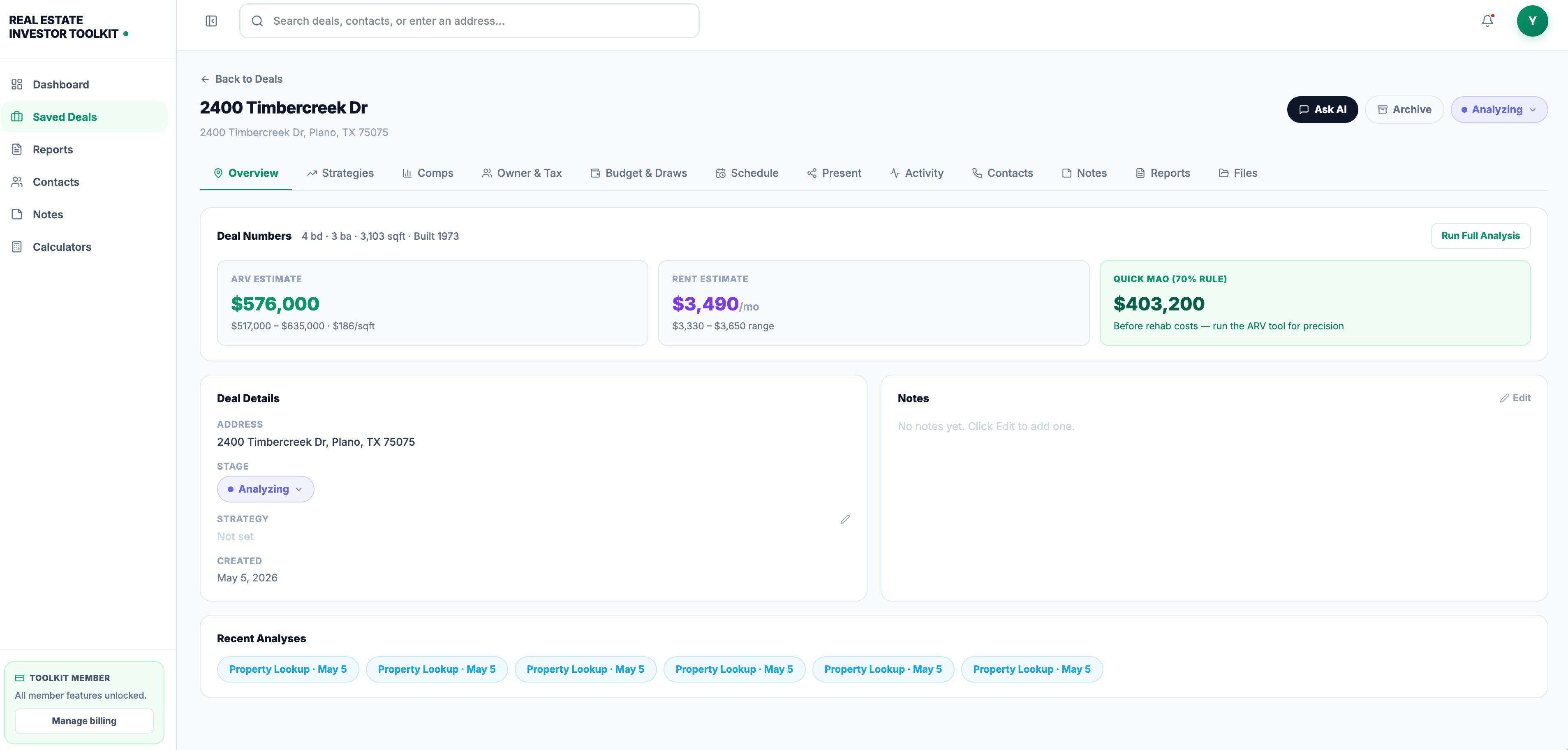
The Rehab Cost Calculator takes your SOW line items directly into a structured cost estimate, producing the rehab total that feeds your ARV and MAO calculations without manual re-entry. Pair it with the BRRRR Calculator if you are modeling a buy-rehab-rent-refinance-repeat deal, and your SOW-driven cost estimate flows straight into refinance and cash-flow projections. For investors who want the full picture, the investing guides and frameworks on the platform cover BoE methodology, rehab cost benchmarks, and deal analysis workflows in depth.
No sign-up is required to run the free calculators. Start with your SOW quantities, enter them into the Rehab Cost Calculator, and have an investor-ready cost estimate in minutes.
Sources and further reading
- 34R-05: Basis of Estimate (AACE International) — The authoritative standard for documenting cost assumptions, methods, and sources in a reproducible Basis of Estimate.
- How to write a construction scope of work (Provision) — Step-by-step guidance on SOW structure, change-order workflow, and contract exhibit placement.
- Rehab Cost Calculator — Real Estate Investor Toolkit — Free calculator for converting SOW line items into investor-ready rehab cost estimates.
- How to Estimate Rehab Costs on Investment Properties — Real Estate Investor Toolkit — Practical guide to rehab cost estimation that pairs directly with SOW line items and BoE inputs.
This article provides general educational information about scope of work and cost estimation practices. It is not legal or financial advice. Confirm current code requirements, contract terms, and regulatory rules with a qualified professional before executing any project agreement.
Recommended
- How to Calculate a Wholesale Offer (Assignment Fee + MAO) — Real Estate Investing Guide | Real Estate Investor Toolkit
- Real Estate Investing Guides, Frameworks, and Strategies | Real Estate Investor Toolkit
- How to Estimate Holding Costs Before They Kill the Flip Spread — Real Estate Investing Guide | Real Estate Investor Toolkit
- How to Pull Comps in Non-Disclosure States Without Fooling Yourself — Real Estate Investing Guide | Real Estate Investor Toolkit