Scope Creep Control: How to Keep a Rehab on Budget

Scope creep control means one thing on a rehab: no work gets built until it has been written down, priced and approved. Do that, and a change becomes a managed scope change instead of a surprise bill. This guide shows you how to set that system up, what uncontrolled changes can cost your deal, and how much contingency to carry.
TL;DR
- Scope creep is work added without a documented price, schedule impact and approval. The same change, approved in writing first, is a change order.
- Rehabs can run 20–40% over budget when creep combines with extra holding costs.
- Control it with a written, itemized scope, change orders before work starts, milestone payments and a contingency line.
- Underwrite the deal with the full cost, not just the first rehab number, so a surprise does not erase your spread.
Table of Contents
- What scope creep is, and what it is not
- Where scope creep comes from on a property rehab
- What scope creep costs your deal
- A seven-step system for scope creep control
- How much contingency to carry
- What to do when creep has already started
- Perspective: why we build the numbers first
- Run the numbers before the work starts
- FAQ
- Sources
What scope creep is, and what it is not
Scope creep is the gradual growth of a project beyond its original deliverables without matching changes to budget, schedule or resources. Accelo’s glossary describes it in those terms. On a rehab, it sounds like: “While you’re in there, can you also…”
The key distinction is process, not size. According to the Association of the Wall and Ceiling Industry, when budget, resources and schedule grow along with the scope, the result is an acceptable addition or change order, not scope creep. A Houzz Pro guide frames it the same way: creep happens when terms expand beyond the proposal without explicit written consent and compensation.
Think of it as the order of events:
| Step | Controlled change | Scope creep |
|---|---|---|
| 1 | Request is raised | Request is raised |
| 2 | Cost and schedule impact are written down | Agreed in a phone call or text |
| 3 | You approve the revised terms | Work starts |
| 4 | Work is built | Price is set after the work exists |
A construction knowledge article from VIABUILD makes the leverage point well: when the price is set after the work is built, you pay whatever number arrives, because you have already lost your negotiating position. That article is about Australian projects, but the logic holds on any job site.
Note that a good idea can still hurt you. Accelo points out that even valuable additions damage performance when they are not integrated into the plan, because they still consume time, skills and capacity.
Where scope creep comes from on a property rehab
Most creep is predictable. Knowing the source tells you which control to use.
Vague scope before the purchase
Pine Financial Group’s guidance for real estate investors lists the usual causes: an unclear original scope, professionals left out of planning, underestimated permits and holding time, omitted cosmetic details and labor, and no contingency. Many of these start during rushed acquisition underwriting, before a single wall is opened.
“While we’re at it” upgrades
The most common version is cosmetic. Quartz countertops or premium tile feel justified in the moment, yet may not raise ARV enough to cover their cost. ARV, or After Repair Value, is what the finished property should sell for. Think of it like buying ingredients and selling a meal: a pricier ingredient only makes sense if the diner will pay more for the plate. Before approving any upgrade, check it against what comparable sold homes in the neighborhood actually have. If you want a quick comp-based number, our ARV calculator does that.
If you are flipping in a market where buyers care about specific finishes, read local seller advice on what not to fix before selling. It is written about Austin, and it shows how to separate fixes buyers expect from upgrades they will not pay for.
Owner indecision and late selections
Houzz Pro notes that visualizing a finished space, picking materials late and communicating incompletely all create predictable expansion. Choose finishes before demolition, not during it.
Hidden conditions
Some growth is not your fault. Opening walls can reveal structural, electrical or plumbing problems. That is not creep when you handle it correctly: document it, price it and approve it before the contractor proceeds. It becomes creep when it is absorbed into the job informally.
Small favors
The AWCI article warns that even an insignificant favor can be the first sign of creep. One extra outlet is cheap. Ten undocumented extras are a draw problem.
What scope creep costs your deal

A budget overrun is only part of the damage. Axiant Partners reports that creep can push rehab costs 20–40% over budget, and added holding costs such as interest, utilities, insurance and taxes can shrink or eliminate profit.
Here is a hypothetical example, using round numbers of our own to show the mechanics:
| Item | Planned | With 20% creep | With 40% creep |
|---|---|---|---|
| ARV | $250,000 | $250,000 | $250,000 |
| Purchase price | $150,000 | $150,000 | $150,000 |
| Rehab budget | $40,000 | $48,000 | $56,000 |
| Two extra months of holding at $1,800 per month | $0 | $3,600 | $3,600 |
| Spread before selling costs | $60,000 | $48,400 | $40,400 |
The spread drops by about a third at the high end, and that is before agent fees, closing costs or financing charges. Our guide on estimating holding costs walks through each carrying cost so you can fill in your own numbers.
The cash-flow problem
Creep also hits your funding. Kiavi’s rehab-budget guidance says work outside the original plan may not be covered by a renovation draw without an approved change order. Undocumented extras can therefore leave you paying out of pocket while the lender waits for paperwork.
The time problem
Delays compound across deals. A two-month overrun repeated across five deals means ten months of capital not working. That is capital you cannot put into the next purchase.
Profit is made at purchase
Axiant’s view is that profit is made at the purchase stage, with margins that account for full pro forma costs and are stress-tested against longer holds. In practice, your maximum offer should already assume some growth. Our guide to MAO, the maximum allowable offer explains how to back into a price that leaves room.
A seven-step system for scope creep control
- Inspect and plan before you close. Bring in the people who will do the work, including your contractor, and account for permits, finish items and labor. Pine Financial Group recommends involving a network of qualified professionals and allowing more time for permitting and work.
- Write an itemized scope. LendingOne’s contractor guidance recommends a detailed written scope with itemized tasks, materials and timelines. Define spaces, materials, schedule, subcontractors and exclusions. A line that says “kitchen remodel” is an invitation to argue.
- Use a checklist. Scope samples or checklists help you avoid omitted line items, which Pine Financial Group flags as a cause of creep. Our rehab cost guide and Rehab Cost Calculator give you a category-by-category structure.
- Lock selections early. Pick tile, fixtures, flooring and paint before demolition. Late choices are the easiest source of owner-driven creep.
- Require a change order for everything. The AWCI process: at the first sign of a change, tell the project manager, decide whether it is official or unofficial, discuss the financial impact and request a change order before work begins. No signature, no work.
- Pay by milestone. LendingOne also recommends weekly communication with progress evidence and milestone-based payments or draws. You pay for verified progress, and unapproved extras have no place in the draw schedule.
- Say no to marginal changes. The Hard Money Co. describes scope discipline as rejecting changes that are not absolutely necessary or that do not add value beyond their total impact. Run each request through that filter.
A simple change-order test
Before signing any change order, ask four questions:
- Does it fix a code, safety or structural issue? If so, it is not optional.
- Will it raise ARV or rent by more than it costs? Check comps or your rental projections.
- How many days does it add, and what do those days cost in holding expenses?
- Is the price in writing, with materials and labor separated?
If an upgrade fails the second and third questions, skip it or defer it to the next deal.
How much contingency to carry
Contingency is a budget line for the things you cannot see yet. It is different from a change order: contingency covers unknowns, and change orders cover decisions.
- LendingOne recommends a 10–15% contingency for unexpected renovation costs.
- A construction-cost professional at CSI says estimates should include appropriate contingencies, overhead and anticipated change orders, and many teams include 5% for construction-phase changes.
- Larger institutional investors often use a layered 5–15% of hard costs, with governance that tightens as design and execution progress.
A practical reading for a small investor: carry a higher percentage on older houses or unseen conditions, and a lower one on a light cosmetic job you have fully inspected. On a $40,000 budget, 10% is $4,000 and 15% is $6,000. Treat that money as spoken for, and release it only against a documented need.
The CSI author also warns that budget-stage quotes often leave out non-material costs, so ask every bidder what is excluded. Funding choice affects how you handle overruns too, and a comparison of fix-and-flip versus construction loans is useful when planning your rehab budget and contingency allowance. Our own guide to financing a flip with hard money or conventional loans covers draw schedules and costs in more detail.

What to do when creep has already started
Stop and sort. List every change requested since the original scope, and mark each as approved in writing, verbal only or not yet started.
- Verbal and not started: price it, then approve or cancel it.
- Verbal and in progress: get a written price now, and note the date work began.
- Required for safety or code: approve it, record it and move the money from contingency.
Then recalculate. Re-run your numbers with the new rehab total, the new timeline and the added holding costs, so you know whether the deal still works. If it does not, you can decide to cut features, extend your hold or change your exit, for example from a flip to a rental. Our rental property calculator and BRRRR calculator help you compare those exits with real numbers.
Perspective: why we build the numbers first
We built Real Estate Investor Toolkit around a simple belief: most scope creep is a math problem that shows up late. Investors rarely set out to overspend. They underwrite with a rehab number that was a guess, then spend months reacting.
That is why our tools start before the offer. We designed the rehab and ARV calculators so you can test a deal with verified comps and market data in minutes, with no sign-up required. When your maximum allowable offer already includes a realistic rehab figure, a contingency line and holding costs, a surprise has less room to hurt you.
Our approach is to keep everything in one place. You can run the ARV, check the rehab estimate, model the BRRRR or rental exit and compare financing scenarios without juggling separate subscriptions. When a change request comes in, you can re-run the same deal and see the effect on your spread immediately. That turns a heated conversation on a job site into a number you can decide on.
Control is not about saying no to every change. It is about making sure every yes has a price attached before the work begins.
Michael
Run the numbers before the work starts
You can try our calculators for free: no sign-up and a $0 cost to run an ARV, rehab or rental analysis. Start with the free tools and test your next deal with a contingency line in place.
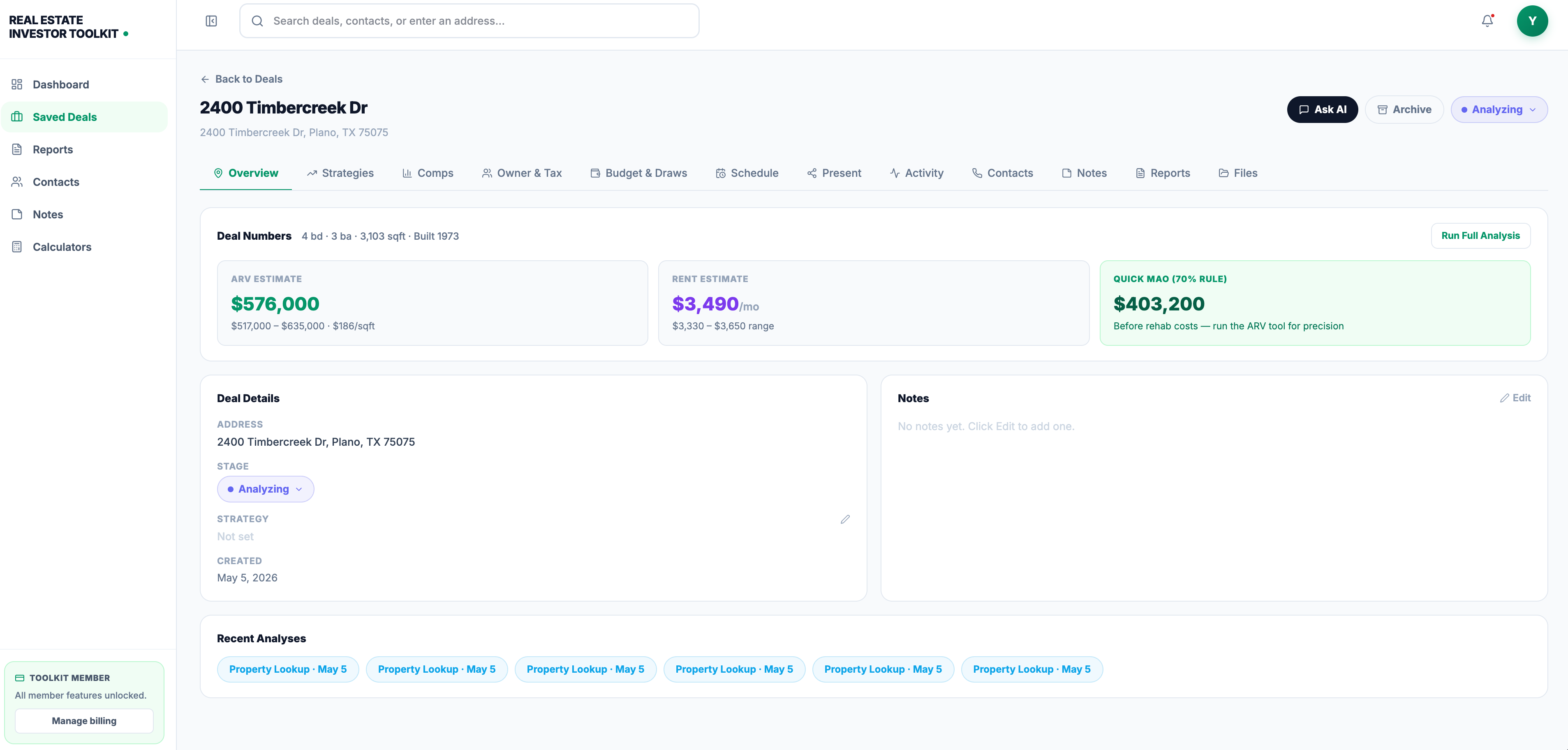
When you are managing several rehabs at once, the Real Estate Investor Toolkit plan is $39.99 per month. It adds unlimited reports, saved deal pipelines, advanced property data, owner-occupancy details and AI chat insights, so you can re-check a deal each time a change order lands. See the details on the pricing page.
FAQ
How do you stop scope creep on a rehab?
Write an itemized scope before work starts, lock your material selections and require a signed change order for every addition. Pay by milestone so unapproved extras never enter the draw schedule. Add a contingency line so true surprises have a funding source.
What is an example of scope creep in a flip?
You approve a basic kitchen, then upgrade to quartz countertops and premium tile after seeing the space. The cost climbs, but the upgrade may not raise ARV enough to pay for itself. Another example is a contractor opening a wall and finding a structural issue that gets fixed without a written price.
How much does scope creep cost?
One investor-lender source reports overruns of 20–40% of the rehab budget, with holding costs reducing profit further. Your own number depends on the house, the contractor and how tightly you control changes. A contingency of 10–15% is a common planning range.
Is a change order the same as scope creep?
No. A change order is a documented, priced and approved change, so budget and schedule move with the scope. Scope creep is the same change escaping that process, built without agreed terms.
Sources
- Fighting Scope Creep (AWCI)
- Managing Scope Creep in Project Management (Accelo)
- How to Manage Scope Creep (Houzz Pro)
- Scope creep and variation control (VIABUILD)
- Scope Creep (REI Prime)
- Scope Creep’s Impact on Your Next Real Estate Investment (Pine Financial Group)
- Fix-and-Flip Mistakes to Avoid (Axiant Partners)
- Rehab Over Budget? Draw, Reserve, and Contingency Options (Kiavi)
- The Sunk Cost Renovation (Pomegra)
- Contractor Management Best Practices (LendingOne)
- Real Estate Project Management: Complete Guide 2026 (The Hard Money Co.)
- Construction Cost Estimates: Advice for Accuracy (CSI)
- Construction contingency planning (Conseco Group)
- Fix and Flip vs. Construction Loans (Sizzle Capital Group)
- What Not to Fix Before Selling Your Austin Home in 2026