3–5 Comps to Value a House: Appraisal Standard Process for Investors

To value a house correctly, pull several recent, similar closed sales, verify their data, and make market-supported adjustments before reconciling them into one indicated value. Favor sales from recent months, generally within about a year, and use time adjustments when an older sale is still your best match. Skipping verification is the fastest way to misprice a deal.
TL;DR:
- Using recent closed sales within a year or applying time adjustments to older sales ensures more accurate property valuations.
- Verified sale data from MLS, county records, or public sources outweigh asking prices and reduce the risk of mispricing.
- Adjustments should be market-supported and based on local trends, not flat rules, especially for condition changes in rehab projects.
- Weight comps closest physically and with the fewest adjustments when reconciling into a final value for a more defensible estimate.
- Running consistent, source-verified comps and documenting your process accelerates and strengthens your property valuation efforts.
Table of Contents
- What comparable sales are and why closed data beats asking prices
- How far back to look and how many comps you need
- Step-by-step methods to find comps
- Selecting comps and making adjustments the market actually supports
- Reconciling comps into one defensible number
- A repeatable checklist to run comps and feed your calculators
- How the Real Estate Investor Toolkit speeds up documented comp analysis
- Why judgment still beats automation on comps
- Try the comps analyzer before your next offer
- Where these standards come from
- Sources
- FAQ
What comparable sales are and why closed data beats asking prices
A comparable sale, or comp, is a recently closed property similar enough to the subject property in location, size, and condition to indicate what it’s worth. Comps are the backbone of a comparative market analysis and of the sales comparison approach appraisers use to reach an opinion of value.
Asking prices tell you what a seller hopes to get. Sold prices tell you what a buyer actually agreed to pay, which is why NAR guidance stresses focusing client conversations on sold inventory rather than active listings. Appraisers and experienced agents weigh several characteristics when judging comparability:
- Site and lot size relative to the subject property
- Room count and finished square footage
- Overall condition and age of major systems
- Financing terms and any seller concessions baked into the price
How far back to look and how many comps you need
Most comps come from closed sales in the last three to twelve months, since Fannie Mae’s reporting standards call for twelve months of comparable sales history on appraisal forms. Older sales can still work if you apply a time adjustment for market movement.
- Use at least three closed comparables, per Fannie Mae guidance, and pull extra sales when the market is thin.
- Expand your search area only after exhausting the immediate neighborhood, and note why you did it.
Step-by-step methods to find comps
Start with the source that gives you verified, closed data, then cross-check it. Here’s the order that works best for most investors and agents:
- MLS, if you or a partner agent has access, since it carries the richest detail on condition, concessions, and days on market.
- County deed and tax records, which confirm actual sale prices and dates even when MLS access is limited. Our guide to pulling comps without MLS walks through this path in detail.
- Recorder’s office filings, useful for verifying transfer amounts and catching non-arms-length sales like family transfers.
- Sold-listing feeds on public real estate sites, which are convenient but often lag or omit concessions.
- Paid investor data platforms, which aggregate public records and MLS feeds into faster, filtered searches.
Once you’ve picked a source, apply real filters instead of eyeballing a list: beds, baths, finished square footage, lot size, architectural style, year built, condition, sale date, financing type, and concessions. For each comp you keep, record the sale date, sale price, data source, any concessions, and unusual conditions such as a distressed sale or a relative-to-relative transfer.
Pro Tip: Screenshot or save the original listing and public record for every comp you use. If a buyer, lender, or appraiser questions your number later, you want the receipts, not your memory.
Our comps guide for investors covers how to weigh these sources when they disagree.
Selecting comps and making adjustments the market actually supports
Match on market area first. A comp two miles away in a different school zone or buyer pool is weaker than one three streets over, even if the square footage lines up better. Once you’ve narrowed to the same market, refine by physical and legal characteristics: lot size, room count, finished area, and condition.
- Pull adjustment amounts from paired sales analysis, local price-per-square-foot trends, or a reliable local index, not a flat rule like “$20 per square foot” applied everywhere.
- Treat the comp needing no adjustment as your strongest evidence, and treat large adjustments as a signal to explain your reasoning in writing.
- Follow Fannie Mae’s standard that every adjustment must be market-supported, never arbitrary.
Condition adjustments deserve special care on fix-and-flip deals, since a rehabbed comp and an as-is comp can differ by tens of thousands of dollars. Our repair adjustment workflow breaks down how to quantify that gap using actual rehab scope rather than guesswork.
Reconciling comps into one defensible number
Reconciliation is where most DIY comps analyses fall apart. The goal isn’t to average your three to five sales. It’s to weight the ones that need the fewest and smallest adjustments and come from verified, arms-length transactions.
- Give more weight to comps that are physically closest to the subject and required minimal adjustment.
- Document why you excluded any sale, whether it was a distressed transfer, a family sale, or simply too far outside the market area.
- Explain, in writing, why an expanded-market comp made the cut if you had to reach beyond the immediate neighborhood.
Fannie Mae’s reconciliation guidance treats this step as qualitative judgment layered on top of the math, not a spreadsheet average.
A repeatable checklist to run comps and feed your calculators
Run the same sequence every time so your numbers hold up under scrutiny:
- Collect subject property facts and define the market area boundaries.
- Pull three to five closed comps using the filters above.
- Verify each sale’s details, note concessions, and record the data source.
- Apply market-supported adjustments and reconcile them into a final value.
- Enter the results into your ARV or valuation calculator and save your source documentation.
How the Real Estate Investor Toolkit speeds up documented comp analysis
The Real Estate Investor Toolkit pulls comp data into its comps analyzer, then feeds the reconciled numbers straight into ARV and MAO calculators, cutting the manual re-entry that causes transcription errors.
- Verified market data speeds up the source-checking step instead of replacing it.
- No-sign-up access lets you test a deal’s numbers before committing to a subscription.
- Adjustment templates keep your condition and concession notes attached to each comp for later reference.
Why judgment still beats automation on comps
Software can surface sales fast, but it can’t smell a distressed sale, a relative transfer, or a neighborhood quirk. The most common mistakes I see are trusting list prices, applying flat per-square-foot rules, and ignoring concessions buried in the closing statement.
— Michael
Try the comps analyzer before your next offer
Running comps by hand takes an afternoon; the Real Estate Investor Toolkit’s comps analyzer turns verified market data into ARV and MAO numbers in a fraction of that time, with no sign-up required to start.
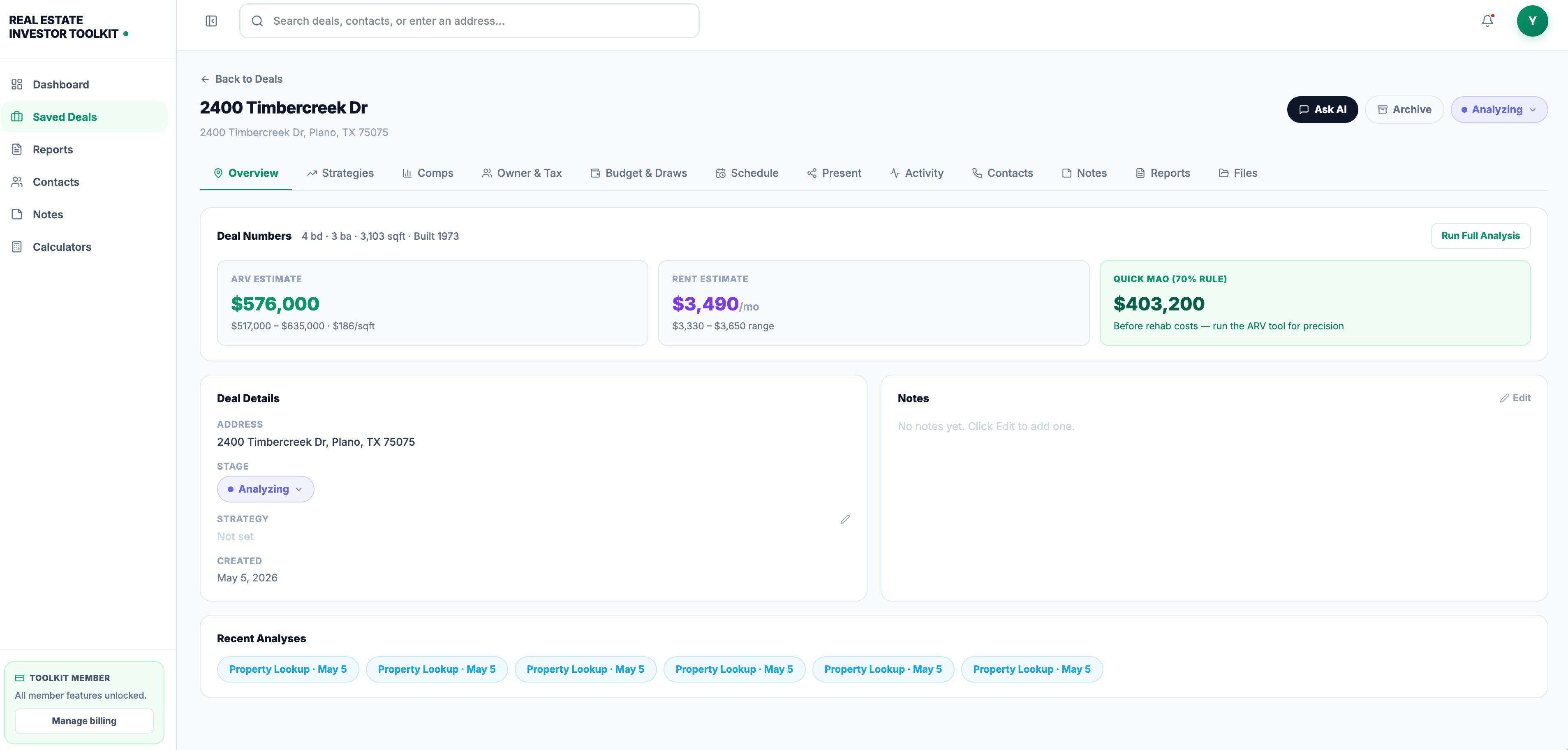
The free calculators cover comps, ARV, and rehab costs, while the Real Estate Investor Toolkit plan at $39.99 per month adds unlimited reports, owner data, and saved deal pipelines for investors running multiple properties at once. Even with verified data feeding the tool, double-check local nuances like school zone lines or HOA rules before you submit an offer. Start with the comps tool and see how your next deal pencils out.
Where these standards come from

This approach follows Fannie Mae’s comparable sales guidance, the Appraisal Foundation’s data verification advisory, and NAR’s guidance on explaining sold versus asking prices to clients.
Sources
- Valuation Advisory #8: Collection and Verification of Residential Data
- What sellers need to know about comps | NAR
FAQ
Can I run comps myself without a real estate license?
Yes, comps rely on public sales data and sold-listing information that anyone can access through county records or public real estate sites. You won’t get MLS-level detail without a licensed partner, but our guide to pulling comps without MLS access shows a workable path.
How do I look up comps in my area?
Start with county deed and tax records for confirmed sale prices, then cross-reference sold listings on public real estate sites for property details and photos. Services like Recent Sold Properties also show how to track down closed sales in a specific market.
How far back do agents and appraisers look for comps?
Most professionals prefer closed sales from the last three to twelve months, which lines up with Fannie Mae’s requirement to report twelve months of comparable sales history on appraisal forms. Older sales can still work if you apply a documented time adjustment.
How much does a realtor make off of a house sale?
Realtor commissions vary by market, brokerage, and the terms negotiated in the listing agreement, so there’s no fixed percentage that applies everywhere. Ask any agent you’re considering to disclose their commission structure before you sign a listing agreement.
What’s the minimum number of comps I should use?
Use at least three closed comparable sales, which matches the standard Fannie Mae requires in the sales comparison approach. Pull additional sales when the market is thin or when your first three require large adjustments.
Recommended
- Appraisal Grade Workflow to Adjust Comps for Repairs for Investors
- How to Pull Real Estate Comps for Investment Properties — Real Estate Investing Guide
- How to Analyze Your First Real Estate Deal, Step by Step — Real Estate Investing Guide
- 5-Minute Investor Workflow: Turn Off-Market Comps Into a Defensible MAO