Rental Property Depreciation for Landlords: How to Calculate It

Rental property depreciation is a non-cash deduction that lets U.S. landlords recover the cost of a residential building using the Modified Accelerated Cost Recovery System (MACRS) straight-line method over a specified recovery period. You do not pay cash to claim it — the IRS simply lets you write off a portion of the building’s value each year, reducing your taxable rental income. The three references you will use most are IRS Publication 527 (the authoritative rulebook for residential rental property), Form 4562 (filed in the year you place property in service), and Schedule E (where annual depreciation flows every year after that). The Rental Property Calculator, available at Real Estate Investor Toolkit, can automate the schedule so you are not doing this by hand.
Three things to do this tax year:
- Confirm your depreciable basis: purchase price plus qualifying closing costs plus capital improvements, minus land value.
- Set your placed-in-service date and apply the mid-month convention to prorate your first-year deduction correctly.
- Record depreciation on Schedule E line 18, and attach Form 4562 in the year you first place each asset in service.
Table of Contents
- What you can and cannot depreciate on a rental property
- How to calculate rental property depreciation step by step
- Which depreciation method and convention apply to your property
- How to decide whether a cost is a repair or an improvement
- When depreciation starts and when it stops
- How to report depreciation on your federal tax return
- What depreciation recapture means when you sell
- Worked example: calculating your first-year depreciation
- How a rental calculator automates your depreciation schedule
- Key Takeaways
- The depreciation mistakes that cost landlords the most
- Build your depreciation schedule with Real Estate Investor Toolkit
What you can and cannot depreciate on a rental property
The building structure itself is the primary depreciable asset, but it is not the only one. IRS Publication 527 defines depreciable property as anything with a determinable useful life that wears out, decays, or becomes obsolete over time. For rental owners, that covers different categories with varying recovery periods depending on the asset class.
Not depreciable:
- Land — always. The ground beneath the building never wears out, so the IRS never allows a deduction for it.
For mixed-use or partially personal-use properties, you allocate depreciation based on the rental-use percentage. If you rent out 60% of a duplex and occupy the rest, only 60% of the building’s basis is depreciable. Keep the allocation documented; the IRS expects it to be consistent year over year.
Pro Tip: Property must be “placed in service” — meaning ready and available for rent — before depreciation begins. A vacant unit you are actively marketing still qualifies. A unit you are renovating before its first tenant does not.
How to calculate rental property depreciation step by step
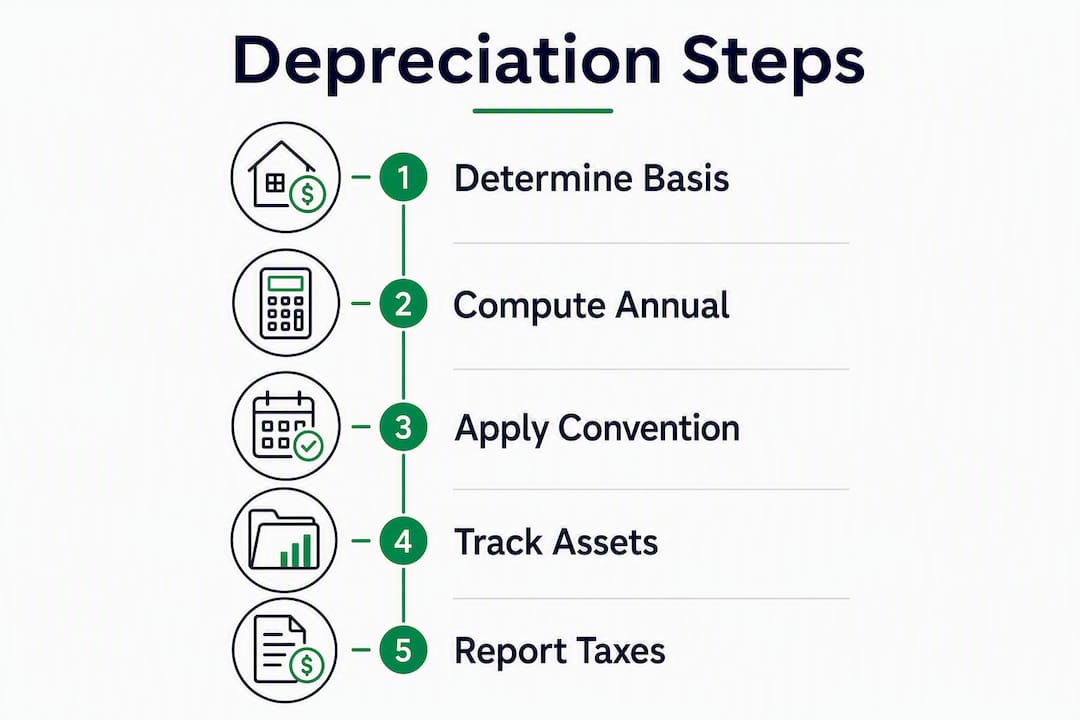
The math is straightforward once you have the right inputs. Work through these five steps in order.
-
Compute your acquisition cost basis. Start with the purchase price. Add qualifying closing costs: title insurance, recording fees, legal fees, and transfer taxes paid by the buyer. Do not include prepaid insurance, prorated rent credits, or loan origination fees — those are not basis items.
-
Remove the land value. Land is never depreciable, so you must separate it from the building. The most common method is to apply the county assessor’s land-to-improvement ratio to your total purchase price. If the assessor values the parcel at 20% land and 80% improvements, and you paid $300,000, your depreciable building basis starts at $240,000. A professional appraisal or the allocation on your settlement statement can also support this split. Many investors use the county assessor’s ratio when a formal appraisal is not available, though assessor breakdowns vary widely by market.
-
Split costs across asset classes. The building goes into the 27.5-year class. Appliances and carpeting go into 5-year or 7-year classes. Land improvements go into the 15-year class. Each class has its own recovery period and convention.
-
Apply the recovery period and method. For the residential building, use straight-line MACRS over 27.5 years. The formula is simple:
Annual depreciation = Depreciable basis ÷ Recovery period
Example: $240,000 ÷ 27.5 = $8,727 per year
-
Prorate the first and last years. Buildings use the mid-month convention (explained in the next section). Short-lived personal property typically uses the half-year convention. Your first-year deduction will be less than a full year’s amount.
Pro Tip: Track each asset on its own row in a spreadsheet or calculator from day one. Lumping the building, appliances, and improvements into a single line makes recapture calculations at sale nearly impossible to reconstruct accurately.

Which depreciation method and convention apply to your property

MACRS is required for virtually all rental property placed in service after 1986. Within MACRS, you choose between two systems: the General Depreciation System (GDS) and the Alternative Depreciation System (ADS).
GDS vs. ADS at a glance:
- GDS is the default. Residential rental buildings use GDS straight-line over 27.5 years with the mid-month convention. This is what most landlords use.
- ADS uses longer recovery periods (40 years for residential rental under ADS) and is required in specific situations: property used predominantly outside the U.S., property used for tax-exempt purposes, property financed with tax-exempt bonds, or when you elect it for a qualified business. Some investors elect ADS voluntarily for state tax reasons, but it produces smaller annual deductions.
The three conventions:
- Mid-month convention: applies to residential and commercial real property. The building is treated as placed in service at the midpoint of the month it actually enters service, regardless of the exact date. This is the convention you will use for the 27.5-year building.
- Half-year convention: applies to most personal property (appliances, carpeting). The asset is treated as placed in service at the midpoint of the tax year, giving you a half-year of depreciation in year one regardless of when you actually bought it.
- Mid-quarter convention: triggered when more than 40% of all personal property placed in service during the year is placed in service in the fourth quarter. It changes first-year deductions for all personal property placed in service that year, not just the fourth-quarter purchases.
First-year mid-month proration example: A residential building placed in service in March earns 9.5 months of depreciation in year one (March counts as half a month, so: 0.5 + 9 full months = 9.5). On an $8,727 full-year deduction, the first-year amount is $8,727 × (9.5 ÷ 12) = $6,909.
Pro Tip: Watch the mid-quarter trap. If you buy several appliances or other short-lived assets in October, November, or December and they exceed 40% of all personal property placed in service that year, every personal property asset placed in service that year shifts to the mid-quarter convention — reducing first-year deductions across the board.
How to decide whether a cost is a repair or an improvement
This distinction has real money attached to it. A repair is deductible in full the year you pay it. An improvement must be capitalized and depreciated over its recovery period, which could be 5, 15, or 27.5 years depending on what it is.
The IRS draws the line using a practical test: a repair keeps the property in its ordinary operating condition, while an improvement adds value, prolongs useful life, or adapts the property to a new or different use.
Quick classification checklist:
- Repairs (deduct now): Patching a leaky pipe, repainting walls between tenants, replacing a broken window pane, fixing a broken door lock, unclogging drains.
- Improvements (capitalize and depreciate): Installing a new roof, replacing the entire HVAC system, adding a deck or garage, converting a garage into a rentable room, replacing all flooring with hardwood.
- Gray-area items: Replacing a single appliance is usually a repair if the appliance is not part of a larger project. Replacing all appliances as part of a full kitchen renovation is likely an improvement to the building or a separately tracked personal property addition.
When you capitalize an improvement, it increases your depreciable basis. A $15,000 roof replacement added to a building with a $240,000 basis raises the depreciable basis to $255,000 and starts its own 27.5-year depreciation clock from the date it is placed in service. That is a separate row on your depreciation schedule, not a revision to the original building entry.
For guidance on estimating and categorizing rehab costs before you buy, the rehab cost estimator at Real Estate Investor Toolkit helps you allocate project costs by component, which feeds directly into your depreciation schedule.
Pro Tip: When the classification is genuinely unclear, capitalize and depreciate. The downside of capitalizing a repair is a slower deduction. The downside of expensing an improvement is an audit adjustment that adds back the deduction, plus interest and potential penalties. Document your reasoning either way.
When depreciation starts and when it stops
Placed in service is the trigger. A property is placed in service when it is ready and available for rent, not when a tenant actually moves in. If you close on a property in June, finish minor cleaning, and list it for rent in July, depreciation begins in July — even if the first tenant does not sign a lease until September.
When depreciation ends:
- Destruction or casualty loss — a fire, flood, or other casualty that removes the property from service ends depreciation. A casualty loss deduction may apply for the unrecovered basis, subject to insurance proceeds and IRS rules.
Timeline note on conversion: If you convert a rental to personal use mid-year, you claim depreciation only through the month before conversion. The accumulated depreciation up to that point still reduces your adjusted basis and will factor into gain calculations if you later sell.
How to report depreciation on your federal tax return
Depreciation flows to your federal return through two forms: Form 4562 and Schedule E.
Form 4562 is required in the year you first place a property or asset in service. It captures the asset description, placed-in-service date, cost basis, recovery period, convention, and method. In subsequent years, if you have no new assets to place in service and no Section 179 or bonus depreciation elections, you do not need to re-file Form 4562 — the annual depreciation amount simply carries to Schedule E directly.
Schedule E is where rental income and expenses live. Depreciation appears on line 18. If you own multiple properties, each gets its own Schedule E column (up to three per page), and you attach additional pages as needed. The totals from all Schedule E pages flow to the main Schedule E summary.
Records you must keep:
- Settlement statement (HUD-1 or Closing Disclosure) showing purchase price and closing costs.
- Documentation of any closing costs added to basis.
- Invoices and receipts for capital improvements, with dates.
- Placed-in-service dates for each asset.
- Your depreciation schedule showing annual and accumulated depreciation per asset.
- Prior-year tax returns showing depreciation claimed.
A depreciation schedule that maps totals directly to Schedule E line 18 reduces return-prep errors and makes CPA handoffs cleaner. One row per asset, with columns for placed-in-service date, cost basis, recovery period, annual depreciation, and accumulated depreciation to date.
When Schedule C applies: If you provide substantial services to tenants — daily maid service, meals, or hotel-style amenities — the IRS may treat your rental as a business subject to Schedule C and self-employment tax rather than Schedule E. Most residential landlords do not cross this threshold.
Pro Tip: Maintain your depreciation schedule as a living document. Update it every time you place a new improvement in service, and reconcile it to your tax return annually. Discrepancies compound over time and become painful to unwind when you sell.
What depreciation recapture means when you sell
Every dollar of depreciation you claim reduces your adjusted basis in the property. When you sell, the IRS compares your sale price to that reduced basis to determine your gain. The portion of the gain attributable to depreciation previously taken is taxed as unrecaptured Section 1250 gain at a federal rate of up to 25%, rather than at the lower long-term capital gains rates that apply to the rest of the gain.
Here is the practical sequence:
- You buy a property with a $240,000 depreciable basis.
- Over 10 years, you claim $87,270 in depreciation ($8,727 × 10).
- Your adjusted basis drops to $152,730.
- You sell for $350,000. Your total gain is $197,270.
- Up to $87,270 of that gain (the depreciation portion) is taxed at up to 25% federal. The remaining gain may qualify for lower long-term capital gains rates.
Planning options:
- 1031 exchange: defer both the capital gain and the recapture by rolling proceeds into a like-kind replacement property. The deferred recapture carries into the new property’s basis.
- Model recapture at acquisition: when you buy a property, estimate the recapture pool you will accumulate over your expected hold period. This belongs in your after-tax return projections, not as an afterthought at sale.
- Do not skip depreciation to avoid recapture: the IRS taxes the depreciation that was allowable, whether or not you actually claimed it. Skipping deductions does not reduce your recapture exposure — it just means you paid more tax during the hold period for no benefit.
For a broader view of how strategic tax planning integrates depreciation, recapture, and long-term wealth building, the Tax Refinery’s framework is worth reviewing alongside your CPA’s guidance.
Pro Tip: When you buy a property, run a quick recapture estimate: multiply the expected annual depreciation by your planned hold period, then apply 25% to that number. That figure is the approximate federal tax liability sitting in your depreciation schedule. Factor it into your exit-price targets.
Worked example: calculating your first-year depreciation
Here is a realistic scenario you can follow step by step.
Purchase details:
- Purchase price: $325,000
- Qualifying closing costs (title, recording fees, legal): $4,500
- Total acquisition cost: $329,500
- County assessor land/improvement split: 18% land, 82% improvements
Step 1: Determine depreciable basis
| Item | Amount |
|---|---|
| Purchase price | $325,000 |
| Qualifying closing costs | $4,500 |
| Total acquisition cost | $329,500 |
| Depreciable building basis | $270,190 |
Step 2: Compute annual depreciation
Divide the depreciable basis by the recovery period to calculate the annual depreciation amount.
Step 3: Apply mid-month convention for first year
Property placed in service in March uses the mid-month convention counting March as a half-month.
The months in service are prorated accordingly to calculate the first-year depreciation deduction.
Step 4: Map to tax forms
- Form 4562: enter the building description, March placed-in-service date, $270,190 basis, 27.5-year GDS straight-line, mid-month convention, and the $9,825 annual deduction (prorated to $7,778 for year one).
- Schedule E line 18: enter $7,778 for this property in year one.
- From year two onward: $9,825 flows to Schedule E line 18 each year without re-filing Form 4562 (assuming no new assets).
This example maps directly to the formula from Investopedia’s depreciation walkthrough and the calculation method described in IRS Publication 527.
How a rental calculator automates your depreciation schedule
Manual spreadsheets work, but they introduce risk — especially for the mid-month and mid-quarter convention calculations that trip up even experienced investors. Purpose-built calculators reduce those mistakes by automating the proration logic and generating asset-level schedules you can hand directly to your CPA.
How to use the Real Estate Investor Toolkit’s Rental Property Calculator for depreciation:
- Enter your purchase price and closing costs to establish the acquisition cost basis.
- Input your land allocation (either the assessor percentage or a dollar amount from an appraisal).
- Add capital improvements as separate line items with their own placed-in-service dates and costs — the rehab cost tool helps you itemize these before they go into the depreciation schedule.
- Set the placed-in-service date for the building and for each personal property asset.
- Review the output: annual depreciation per asset, accumulated depreciation to date, and the Schedule E line 18 total for the current year.
The calculator handles mid-month convention for the building and half-year convention for personal property automatically. For portfolios with multiple properties, tracking each asset with its own placed-in-service date and accumulated total prevents the audit issues that arise when assets are lumped together.
A note on short-lived components: if you have done a cost segregation study, some building components may qualify for 5-year, 7-year, or 15-year recovery periods, and bonus depreciation may apply to those components depending on the year placed in service and state conformity rules. The calculator handles standard MACRS classes; for cost segregation results, work with your CPA to enter each component separately.
Pro Tip: Export the calculator’s depreciation schedule to a PDF or spreadsheet and store it with your closing documents and tax returns. When you sell, your CPA will need the full accumulated depreciation history to compute recapture correctly. This is educational guidance, not tax advice — confirm your specific situation with a qualified tax professional.
Key Takeaways
Residential rental property depreciation follows a 27.5-year MACRS straight-line schedule, and every landlord should build an asset-level depreciation record from the day they close on a property.
| Point | Details |
|---|---|
| 27.5-year MACRS for residential | Residential rental buildings depreciate straight-line over 27.5 years under MACRS GDS with the mid-month convention. |
| Land is never depreciable | Separate land value from building value at acquisition; use the county assessor’s ratio or a formal appraisal. |
| Asset-level records prevent problems | Track each asset (building, improvements, appliances) on its own row with its placed-in-service date and accumulated depreciation. |
| Form 4562 in the placed-in-service year | File Form 4562 the year you first place each asset in service; annual depreciation flows to Schedule E line 18 thereafter. |
| Plan for recapture before you sell | Accumulated depreciation is taxed at up to 25% federal on sale; model this at acquisition, not at closing. |
| Real Estate Investor Toolkit | The free Rental Property Calculator automates mid-month proration and generates an asset-level schedule mapped to Schedule E. |
The depreciation mistakes that cost landlords the most
Most landlords understand that depreciation reduces taxable income. Fewer understand the three places where the math quietly goes wrong.
The first is conflating mortgage principal with a deductible expense. Principal payments reduce your loan balance — they do not reduce your tax bill. Only mortgage interest is deductible, and it goes on Schedule E separately from depreciation. Mixing the two inflates your expected deductions and creates a gap when you file.
The second mistake is lumping all assets into a single depreciation line. A building, a new HVAC unit, and a set of kitchen appliances all have different recovery periods. Treating them as one asset means you are either under-depreciating the short-lived items (losing deductions you are entitled to now) or over-depreciating the building (creating recapture exposure you did not account for). Build the schedule asset by asset from the start.
The third is forgetting placed-in-service dates for improvements. A $20,000 roof replacement added to the building’s original entry instead of tracked as a separate asset with its own date will produce incorrect accumulated depreciation totals. When you sell, that error flows directly into a miscalculated recapture figure.
My practical suggestion: build the depreciation schedule at acquisition, not at tax time. Add each improvement to the schedule the month it is completed. Reconcile the schedule to your prior-year return every January. If you own more than two properties, centralize all schedules in one document so you can see the total recapture exposure across your portfolio at a glance. And ask your CPA specifically about bonus depreciation eligibility for short-lived components and whether your state conforms to federal bonus depreciation rules — the answer varies by state and by the year assets are placed in service.
Build your depreciation schedule with Real Estate Investor Toolkit
Calculating depreciation correctly from day one protects your deductions, keeps your basis accurate, and makes sale-time recapture calculations straightforward. Real Estate Investor Toolkit’s Rental Property Calculator gives you a fast, structured way to enter your purchase price, land allocation, closing costs, and improvements, then generates an asset-level depreciation schedule mapped to Schedule E line 18.
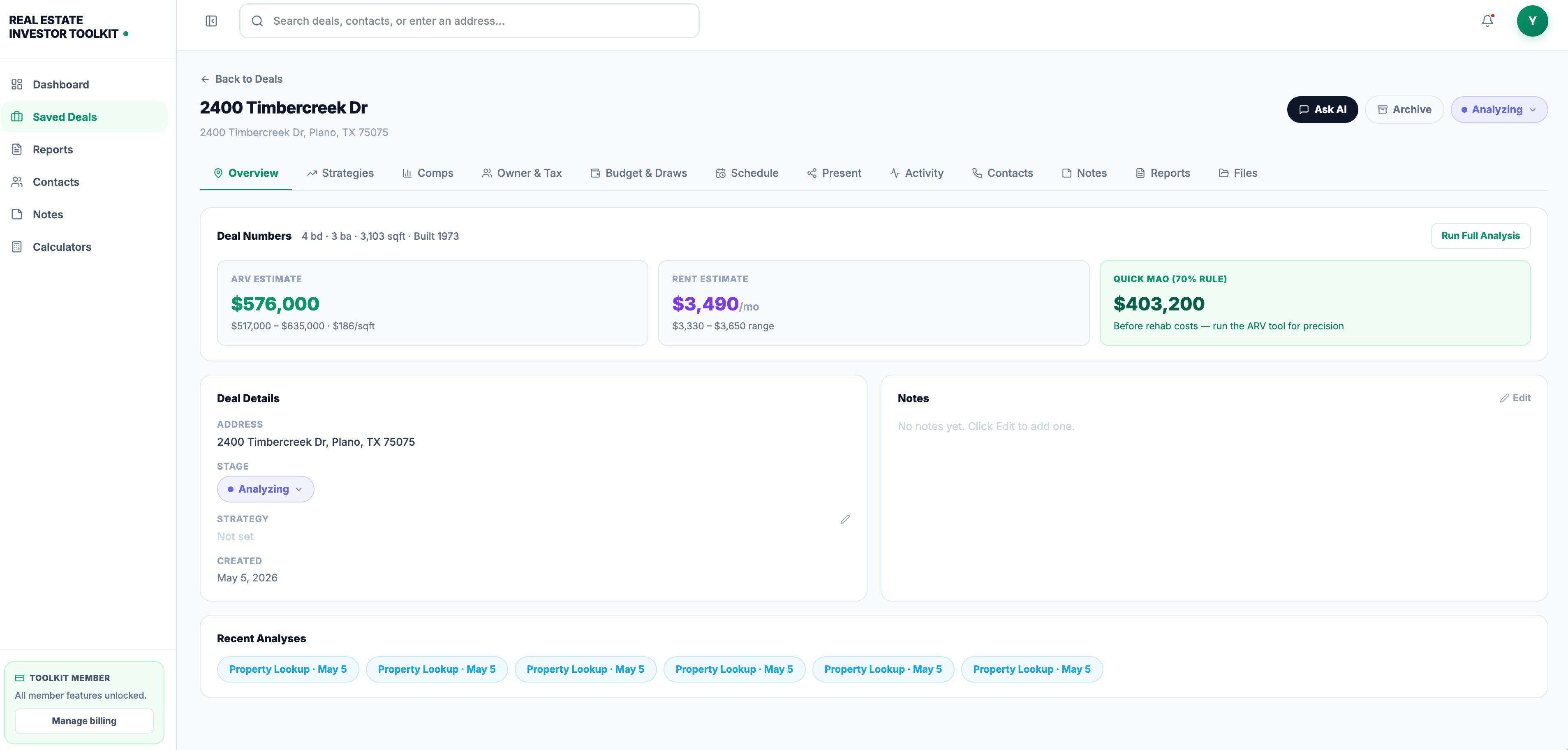
No signup is required to run the numbers. The calculator handles mid-month convention for residential buildings and half-year convention for personal property automatically, so you are not manually prorating first-year deductions or tracking conventions across multiple asset classes. For investors managing several properties, the paid subscription unlocks saved deal pipelines and portfolio-level reporting, giving you a single view of accumulated depreciation across every asset you own.
The tool is designed for analysis and education, not as a substitute for professional tax advice. Use the output as the foundation for your depreciation schedule, then confirm your specific situation with a CPA before filing. Start with the free rental property analysis today.
This article is general educational information, not tax or legal advice. Consult a qualified tax professional and verify current IRS rules before filing.
Recommended
- Rental Property Calculator — Cash Flow, Cap Rate & ROI | Real Estate Investor Toolkit
- Investment Property Financing Calculator | Real Estate Investor Toolkit
- How to Estimate Rehab Costs on Investment Properties — Real Estate Investing Guide | Real Estate Investor Toolkit
- Rehab Cost Calculator — Fix & Flip Deal Analyzer