How to Build a Rental Pro Forma That Actually Predicts Returns

A rental pro forma is a forward-looking projection of a property’s income, expenses, and cash flow over a set holding period, built to show you what a deal could return before you sign anything. If you’re evaluating a deal right now, your next move is simple: run the numbers through our rental property calculator or drop them into a spreadsheet template, then check four numbers before you go any further. Look at net operating income (NOI), pre-tax cash flow, the cap rate, and either the debt service coverage ratio (DSCR) or cash-on-cash return. If any of those key metrics looks weak against your investment goals, stop and reconsider before proceeding. Most investors run this over a typical multi-year hold period, since that’s the window where rent growth, loan amortization, and an eventual sale all show up in the math.
Key Takeaways
A rental pro forma is only as reliable as its inputs, and the deal that survives a worst-case rent and vacancy scenario is the one worth pursuing.
| Point | Details |
|---|---|
| Check four metrics first | Verify NOI, cash flow, cap rate, and DSCR or cash-on-cash before deeper analysis. |
| Follow the standard order | Revenue minus vacancy and expenses equals NOI, minus debt service equals cash flow to equity. |
| Keep reserves below NOI | Model replacement reserves and CapEx separately from operating expenses, per institutional convention. |
| Stress test every deal | Run best, base, and worst-case scenarios on rent, vacancy, and rehab costs before committing. |
| Use the free calculator | Real Estate Investor Toolkit’s rental calculator automates NOI, cash flow, DSCR, and reversion math with no sign-up required. |
Table of Contents
- What Goes Into A Rental Pro Forma?
- How Do You Build A Pro Forma Step By Step?
- Which Investment Metrics Matter Most?
- Spreadsheet Or Calculator: Which Tool Fits Your Deal?
- How Sensitive Is Your Deal To Rent And Vacancy Swings?
- What Mistakes Sink Otherwise Good Pro Formas?
- What Do Pro Formas Leave Out?
- How Do Our Calculators Source Their Numbers?
- When Does A Pro Forma Actually Change Your Decision?
- Try Our Free Pro Forma Calculators And Templates
- Sources
What Goes Into A Rental Pro Forma?
A rental pro forma is really a simplified income statement for a property, stretched across multiple years instead of one. Every legitimate version flows through the same sequence: gross revenue, minus vacancy and expenses, equals NOI, minus debt service, equals cash flow to you as the equity holder. Get the order wrong and every downstream number breaks.
Revenue. Start with potential rent at full occupancy, sometimes called gross potential rent. Add other income streams like laundry, parking, storage, or pet fees. Then subtract a vacancy and credit-loss allowance to arrive at effective gross income (EGI). The formula is straightforward: EGI = Potential Rent + Other Income − Vacancy Loss.
Operating expenses. These are the recurring costs of running the property: property taxes, insurance, utilities not billed to tenants, repairs and maintenance, property management fees (commonly a percentage of collected rent), and a reserve for turnover and capital items. Subtracting these from EGI gets you NOI: NOI = EGI − Operating Expenses.
Reserves and CapEx. Replacement reserves for roofs, HVAC systems, and major systems usually sit below the NOI line in institutional-style pro formas rather than folded into operating expenses, since they’re irregular and capital in nature rather than routine, according to guidance on multifamily pro forma structure. Keeping them separate also makes your NOI comparable to how appraisers and lenders calculate it.
Debt service and cash flow. Subtract your loan’s principal and interest payments from NOI to get pre-tax cash flow to equity: Cash Flow = NOI − Debt Service. This is the number that actually lands in your pocket each year, before taxes.
Reversion proceeds. At the end of your hold, model a sale. The standard approach divides your projected exit-year NOI by an assumed exit cap rate to estimate sale value, then subtracts loan payoff and selling costs to get net proceeds.
Here’s how the core line items typically stack, top to bottom:
- Potential rent (gross scheduled income)
- Plus other income (fees, parking, laundry)
- Minus vacancy and credit loss
- Equals effective gross income (EGI)
- Minus operating expenses (taxes, insurance, utilities, repairs, management)
- Equals net operating income (NOI)
- Minus replacement reserves/CapEx
- Minus debt service (principal and interest)
- Equals pre-tax cash flow to equity
Sourcing these numbers correctly matters more than the spreadsheet math. Rent estimates should come from actual comparable listings in the submarket, not the seller’s rent roll wishlist. Property taxes come straight from the county assessor. Insurance needs a real quote, not a percentage guess. And expense ratios benchmarked against multifamily operating data will catch a pro forma that’s been dressed up to look better than the property performs in reality.
For CapEx reserves, budget $250 to $400 per unit annually for older properties, and use actual bids from a licensed contractor whenever you can get one, instead of a flat percentage.*

How Do You Build A Pro Forma Step By Step?
Building a rental pro forma follows a repeatable sequence whether you’re working in Excel or plugging numbers into a calculator.
- Gather your inputs. Purchase price, current rent roll, comparable market rents, tax bill, insurance quote, utility costs, and loan terms (rate, amortization, loan-to-value).
- Build the income statement. Project EGI, subtract expenses, and calculate NOI for each year of your hold period, applying a rent growth rate (often 2% to 3% annually) and an expense growth rate.
- Layer in the debt schedule. Calculate the monthly principal and interest payment based on your loan amount, rate, and amortization term, then sum to an annual figure.
- Build the cash flow grid. Subtract annual debt service from NOI for each year to get pre-tax cash flow to equity.
- Model the exit. Apply an exit cap rate to your final year’s NOI to estimate sale price, subtract loan payoff and closing costs, and add that to your final year’s cash flow.
- Summarize returns. Calculate cap rate, cash-on-cash, and IRR across the full holding period.
From here, the return metrics fall out directly. IRR requires a full cash flow timeline including the exit proceeds, so it’s best left to a spreadsheet’s IRR function or a financing calculator that automates the amortization schedule for you. Whatever tool you use, feed it the exact same inputs listed above, in the same order, so the outputs are directly comparable across deals.
Which Investment Metrics Matter Most?
Not every metric answers the same question, and leaning on the wrong one is how mediocre deals get bought.
- NOI is the property’s income independent of financing, calculated as EGI minus operating expenses. Lenders and appraisers use it to value the asset itself.
- Cap rate (NOI ÷ purchase price for going-in, or NOI ÷ sale price for exit) tells you how the market is pricing the asset relative to its income. Use going-in cap rate to compare a listing against similar properties in the same submarket.
- Cash-on-cash return (annual pre-tax cash flow ÷ total cash invested) measures near-term yield on the money you actually put down. This is the number that matters most if you need income now rather than appreciation later.
- DSCR (NOI ÷ annual debt service) determines whether a lender will size your loan the way you want. Most agency small-balance loan products require a DSCR floor between 1.20x and 1.25x, and dropping below that threshold usually caps your loan amount, per multifamily lending conventions.
- IRR and MOIC (multiple on invested capital) capture total return across the entire hold, including the exit sale. Use these when comparing deals with different hold periods or exit strategies.
- Breakeven occupancy shows what percentage of units need to stay rented to cover expenses and debt service. It’s a fast stress test for how much cushion a deal actually has.
Expense ratios also deserve a benchmark. Multifamily properties typically run 35% to 45% of EGI in operating expenses, and a pro forma showing 25% almost always signals someone forgot a line item, a pattern worth checking against operating benchmarks before you trust the number. If your metrics of choice depend on your strategy, our breakdown of cap rate versus cash-on-cash walks through which one to weight for different investor goals.
Spreadsheet Or Calculator: Which Tool Fits Your Deal?
A spreadsheet template earns its place when you need custom scenarios, full auditability, or you’re modeling something unusual, like a value-add repositioning with a multi-phase rehab budget. A dedicated calculator wins on speed: it builds the amortization schedule and calculates IRR automatically, which matters when you’re screening a dozen listings in an afternoon and don’t want to rebuild formulas each time.
Either way, the inputs you need are identical:
- Purchase price and closing costs
- Current and market-rate rents, plus lease-up timing for any vacant units
- Vacancy assumption and other income
- Expense categories: taxes, insurance, utilities, repairs, management, reserves
- CapEx schedule and rehab budget, if applicable
- Loan amount, rate, term, and amortization schedule
- Exit cap rate and assumed hold period
A good calculator should return NOI, cap rate, cash-on-cash, IRR, MOIC, DSCR, and reversion proceeds without you touching a single formula. Our rental property calculator handles the core metrics, and pairing it with our investment property financing calculator fills in the amortization side automatically.
Pro Tip: Build one source-of-truth input sheet with every assumption listed once, then paste those same numbers into whatever calculator or template you’re comparing. Re-typing inputs into three different tools is where most underwriting errors creep in.
How Sensitive Is Your Deal To Rent And Vacancy Swings?
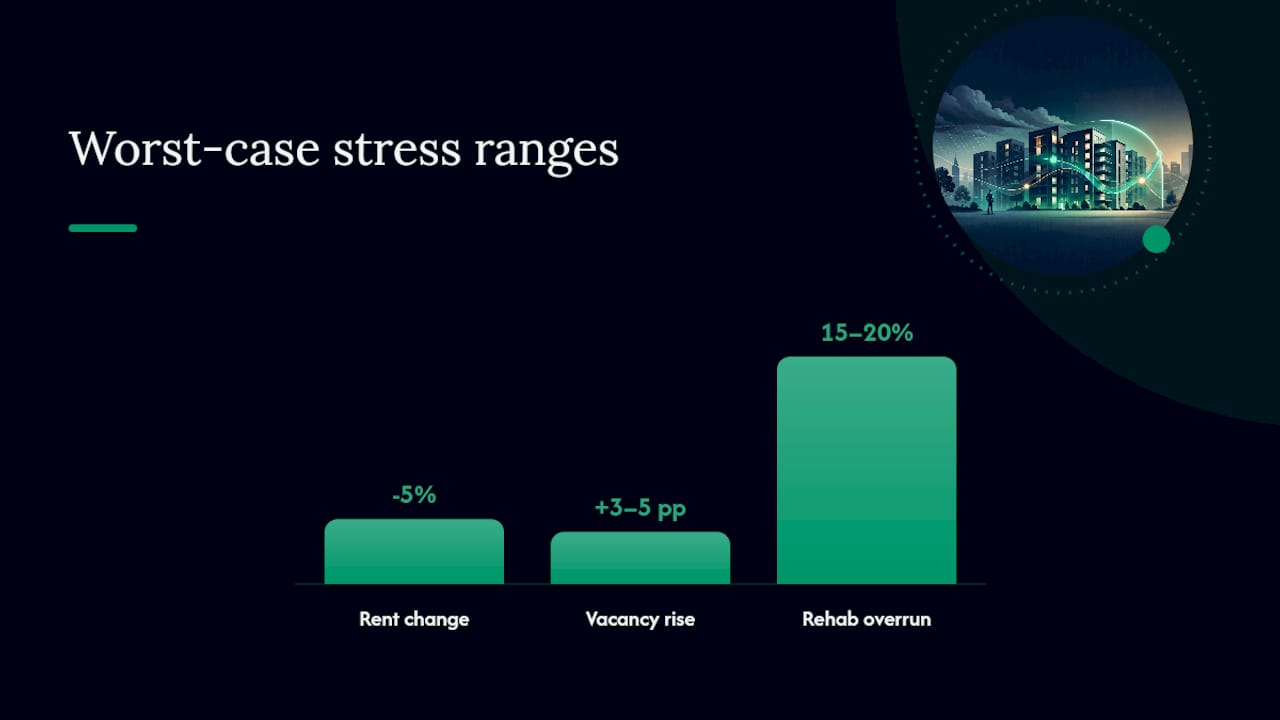
Run a quick one-variable test before you trust any single pro forma output.
Run three scenarios on every deal before you commit:
- Best case. Rents grow on schedule, vacancy stays low, no CapEx surprises. Confirms your upside.
- Base case. Your actual pro forma assumptions. This is the number you underwrite to.
- Worst case. Rent flat or down 5%, vacancy up 3 to 5 points, and rehab costs 15% to 20% over budget. Watch what happens to DSCR and cash flow.
Exit cap rate assumptions move total returns more than almost any other single variable, followed by rent growth and rehab overruns. A deal that only works in the best case isn’t a deal. It’s a bet.
What Mistakes Sink Otherwise Good Pro Formas?
The same handful of errors show up across bad deals over and over:
- Projecting rent growth above the local market average without comp data to back it
- Underbudgeting CapEx reserves, especially on properties over 20 years old
- Ignoring vacancy entirely, or using an unrealistically low rate like 2%
- Skipping property management fees because you plan to self-manage, then burning out in year two
- Never stress-testing what happens if your interest rate resets or refinances higher
Did the rehab budget skip a contractor quote? Any yes answer means re-underwrite before you sign. Fixing each one takes minutes: pull real comps, get a contractor bid, and use your submarket’s actual vacancy history instead of the seller’s optimistic number.
What Do Pro Formas Leave Out?
Operating pro formas almost always exclude non-cash accounting items:
- Income taxes on your personal or entity-level return
- Depreciation and amortization, which reduce taxable income but never touch your bank account
- Recognition of debt principal paydown as a return, separate from cash flow
Pro forma statements are explicitly a planning tool built to project or restate figures outside standard accounting rules, not a substitute for GAAP-compliant reporting, which matters if a lender or partner ever asks for audited financials instead.
Pro Tip: Keep a separate after-tax worksheet that layers depreciation, recapture on sale, and capital gains treatment onto your pre-tax cash flow. That’s the only place taxes belong in this process.
How Do Our Calculators Source Their Numbers?
Our tools follow the same order of operations used in institutional underwriting: revenue down to EGI, expenses down to NOI, reserves and debt service down to cash flow, and reversion calculated as exit-year NOI divided by your assumed exit cap rate.
Rate and benchmark data draws from public references like the SOFR series for floating-rate debt, Mortgage Bankers Association research for financing trends, and NAHB housing economics for rent growth and construction cost context. Every formula is visible in the tool, and the core calculators require no sign-up to use.
When Does A Pro Forma Actually Change Your Decision?
A pro forma is a decision tool, not a guarantee. It’s decisive when your rent comps are tight, your expense data is real, and the numbers clear your thresholds with room to spare. It’s not enough on its own when you still need title work, lease audits, or a physical inspection. Walk away when the seller can’t produce real leases, when rent comps are thin, or when the deal only clears your bar under best-case assumptions. A clean spreadsheet never fixes a shaky input.
Try Our Free Pro Forma Calculators And Templates
Skip the manual spreadsheet building and run your numbers through tools that calculate NOI, cash flow, cap rate, cash-on-cash, DSCR, and reversion proceeds automatically, with the full amortization schedule built in. Real Estate Investor Toolkit’s rental property calculator gets you from raw rent and expense numbers to a full return summary in minutes, no spreadsheet formulas required.
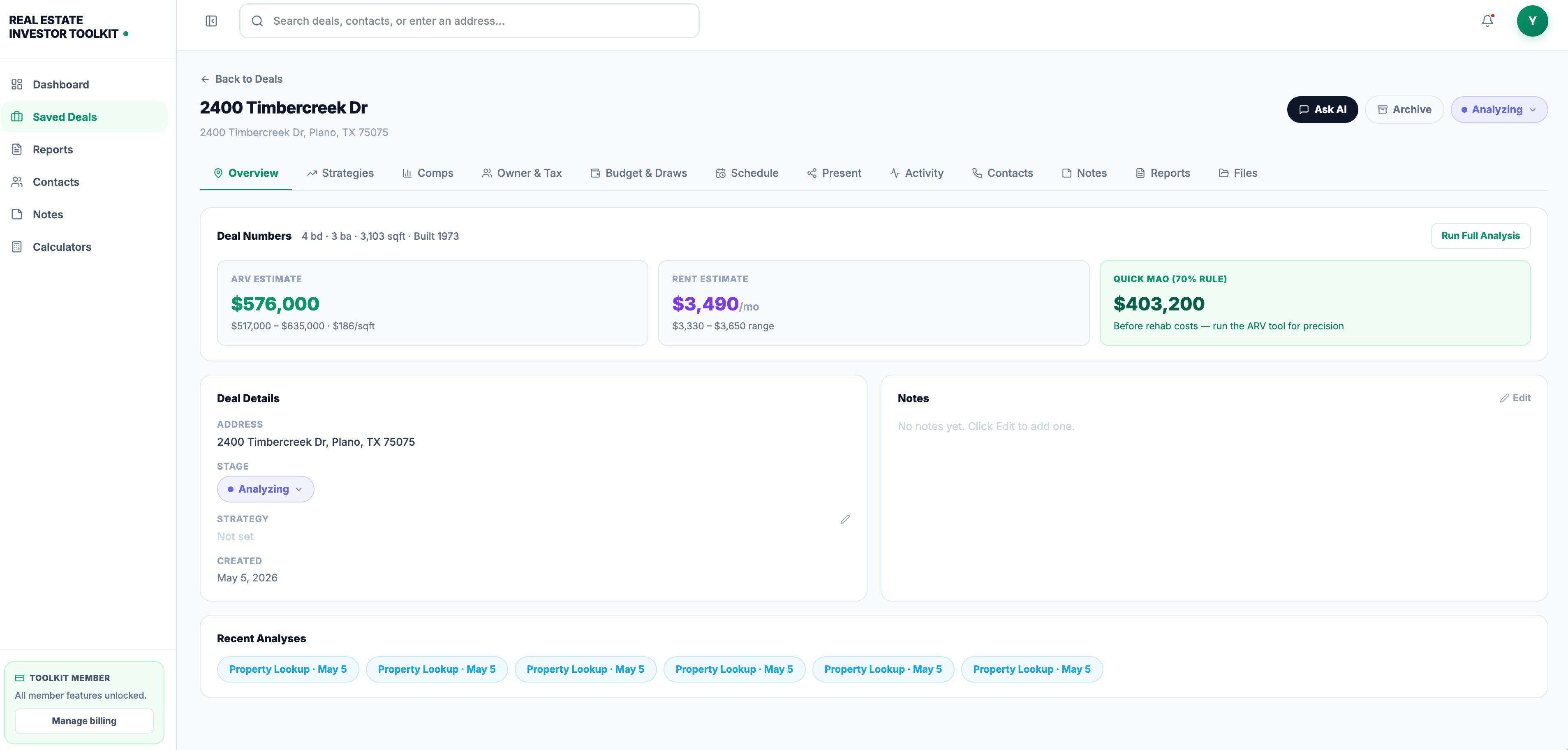
Pair it with the investment property financing calculator to model your exact loan terms, or start with our learning hub if you want a deeper walkthrough before you run your first deal. Core calculators require no sign-up, and every output is exportable if you want to keep a spreadsheet copy for your files. Run your next deal through the calculator before you make an offer.
Sources
Ground your rent, expense, and financing assumptions in real market data instead of guesswork:
If you’re weighing operating expense assumptions for a managed rental, a licensed rental property management service can also give you a realistic read on local management fees and turnover costs before you finalize your pro forma.