20 Minute Remote ARV for Investors With UAD 3.6 Ready Documentation

Remote ARV analysis is the process of estimating a property’s after-repair value using comparable sales, market and time adjustments, and rehab cost inputs, all without setting foot on the property. Done properly, it hands you three deliverable numbers: an ARV figure, a maximum allowable offer range, a rehab budget, and a short evidence list worth saving. Remote data is usually enough to decide whether a lead is worth pursuing; a full inspection or appraisal still matters before you close.
TL;DR:
- Remote ARV analysis works best for quick screening and initial offer ranges but cannot detect hidden structural issues or concealed damage.
- Adjustments should be made using median prices and documented market or time changes to maintain defensibility in fluctuating markets.
- Using three to five comps within the last six months, with detailed notes and screenshots, ensures a solid and reviewable basis for your estimates.
- In rising markets, include a conservative buffer in your ARV and lean on recent sales data to avoid overestimating property value.
- The upcoming UAD 3.6 standards will require more detailed property condition data, making good documentation during remote work increasingly valuable.
Table of Contents
- When remote ARV works and what it can’t replace
- Step-by-step: calculating ARV, adjustments, rehab, and MAO
- Common mistakes, verification checks, and the UAD 3.6 shift
- A 20-minute remote ARV workflow you can run on every lead
- Reading remote ARV against local market conditions
- Validating your ARV without setting foot on the property
- Bringing digital tools into your remote ARV process
- Case examples across property types and conditions
- Balancing speed and defensibility in remote underwriting
- Run your ARV, rehab, and MAO numbers with the Real Estate Investor Toolkit
- Sources
- FAQ
When remote ARV works and what it can’t replace
Remote ARV analysis earns its place at the top of your funnel. It’s built for speed, not certainty, and knowing that difference keeps you from underwriting a bad deal with false confidence.
Use it when the job is triage, not verification:
- Screening inbound leads to decide which properties deserve a phone call or a drive-by
- Building a fast, defensible offer range before a seller call
- Running early BRRRR math to see if a property clears your rent-to-value threshold
What it can’t tell you is what’s behind the walls. Structural issues, unpermitted additions, foundation cracks, and concealed water damage rarely show up in photos or public records. A comp-based ARV also assumes the subject property will match the comps’ finish level once repaired, an assumption that only holds if your rehab scope is realistic.
Market direction changes how much slack you should build in. When mortgage rates climb and buyer demand softens, flipped homes sold at a median discount from peak list price in 2025 that was notably larger than the discount seen for older, non-renovated homes. That gap tells you renovation alone doesn’t guarantee pricing power in a cooling market, so a remote ARV run during a softening period should lean conservative. In a rising market, you still want a buffer, but the risk sits more in overpaying for time than in overestimating your exit price.
Step-by-step: calculating ARV, adjustments, rehab, and MAO
This sequence turns raw comps into a number you can act on.
Step 1: Gather subject facts and pull three to five comps. Confirm square footage, bed and bath count, lot size, and year built for your subject, then pull comps that match those same fundamentals in their post-rehab condition.

Step 2: Adjust each comp line by line. Add or subtract value for differences in square footage, bedroom and bathroom count, garage space, and finish quality, then take the median of your adjusted comps rather than the mean. Median adjusted price reduces the pull of an outlier sale and tends to produce a more defensible ARV in markets with thin comp data.
Step 3: Apply a market or time adjustment. Fannie Mae expects market condition adjustments to be backed by a documented method, whether paired sales, grouped sales, a home price index, or regression analysis, and you should note which method you used and why.
From there, run your MAO formula:
- Wholesalers commonly use a 70% rule: MAO equals 70% of ARV minus rehab costs.
- Flippers with tighter margins or lower-risk markets sometimes use 75%, trading a slimmer buffer for a more competitive offer.
- Freddie Mac’s own guidance on renovation appraisals notes that an as-if-renovated value should reflect how specific renovations affect market demand, not simply the as-is value plus a renovation budget, which is worth remembering when your rehab scope goes beyond cosmetic work.
MAO example: if your ARV comes out to $300,000 and your rehab estimate is $40,000, a 70% rule puts your maximum offer at $170,000 ($300,000 x 0.70, minus $40,000).
Step 5: Run a sanity check. If your ARV feels high relative to comparable days-on-market data or if the rehab scope touches structural systems, get a contractor’s quick quote or order a full appraisal before you commit.
Our rehab cost calculator converts scope notes into budget ranges automatically, which makes this step faster to run consistently across leads.
Common mistakes, verification checks, and the UAD 3.6 shift
Most remote ARV errors trace back to optimism, not bad data. Three mistakes show up again and again: picking comps that flatter the deal instead of matching it, skipping the market-trend adjustment entirely, and underestimating contingency on rehab scope that turns out to be bigger once work starts.
Run these checks before you trust your number:
- Compare median versus mean adjusted comp price and flag a large gap.
- Check days-on-market trends for your comp set against the broader area.
- Cross-reference flip performance signals, since flipped homes get more views and sell faster but at a wider discount to peak list price when rates rise, a useful cross-check against your own ARV assumptions.
- Get a rough contractor quote on any rehab item you’re unsure about before finalizing your offer.
UAD 3.6 will require more discrete property and condition datapoints in appraisal reports, with lenders expected to require the new format for Fannie Mae and Freddie Mac loans by late 2026.
This shift toward appraisals with expanded condition datapoints means the labeled photos and transaction notes you collect during remote ARV work now double as material an appraiser could use later. Better documentation habits today pay off when a deal eventually needs a formal valuation.
A 20-minute remote ARV workflow you can run on every lead
A tight time box keeps your team consistent and stops analysis paralysis on marginal leads.
- Minutes 0 to 5: Collect the address, listing and sale history, current photos, and any obvious rehab flags.
- Minutes 5 to 12: Pull three to five comps and make your line-item adjustments.
- Minutes 12 to 18: Run a quick rehab estimate and calculate your MAO.
- Minutes 18 to 20: Sanity-check the number against days-on-market and market-trend data, then decide: make an offer, request an inspection, or pass.
Save every screenshot and note from this run. It becomes your appraisal packet if the deal moves forward.
Reading remote ARV against local market conditions
A comp-based ARV is only as good as the market context around it. Two properties with identical comps can carry very different risk depending on what’s happening locally: inventory levels, days-on-market trends, and whether buyers in that specific submarket are stretching for renovated homes or pulling back.
Watch a few signals alongside your comp math. Rising days-on-market figures across your comp set suggest the market is cooling faster than your comps reflect, which argues for trimming your ARV rather than trusting the raw median. A shrinking gap between list price and sale price points the other way, toward a market with room to hold your number steady.
Interest rate movement matters more than most remote analysts give it credit for. When rates rise, buyer purchasing power shrinks, and renovated homes that once commanded a premium start losing some of that pricing power, a pattern borne out in broader flip market data through late 2025. Treat your ARV as a range tied to current conditions, not a fixed number good for the next six months. If your market has shifted meaningfully since your comps closed, widen your contingency and lean toward the more conservative end of your adjusted range rather than the optimistic one.
Local nuance also shows up in school zone boundaries, HOA restrictions, and flood zone designations, all of which can separate two otherwise similar comps by tens of thousands of dollars. None of that shows up in a simple square-footage adjustment, so treat any comp with a materially different location factor as a weaker data point.

Validating your ARV without setting foot on the property
You can’t inspect every lead, but you can stress-test your number from a distance in a few reliable ways.
Cross-reference your comp-based ARV against a second, independent signal. If your platform or MLS access includes an automated valuation estimate, compare it against your manual comp median. A wide gap is a signal to slow down and dig into why the two disagree rather than average them together.
Lean on transaction detail, not just price. Concessions, contract dates, and other transaction specifics materially affect how comparable a sale really is, so a comp that closed with a large seller concession or a rushed contract timeline deserves a discount in how heavily you weight it.
Get a second opinion from someone local when the deal is close to your threshold. A real estate agent who knows the specific block, or a contractor who can eyeball exterior photos and street view for obvious red flags, can catch something your comp spreadsheet won’t. Reviewing property due diligence approaches from other valuation practitioners, including the methodological notes on quantitative valuation techniques from OptiWealth Insights, can also sharpen how you weigh conflicting signals before committing capital.
Finally, treat your rehab estimate as a second point of validation, not just a cost line. If the rehab scope needed to hit your comps’ finish level seems unrealistic for the budget you’ve allotted, that mismatch is often the first sign your ARV assumption is too optimistic.
Bringing digital tools into your remote ARV process
Specialized calculators remove most of the manual grind from remote ARV work, but they work best when you understand what they’re doing under the hood rather than trusting the output blindly.
A dedicated ARV calculator pulls comparable sales and displays an adjusted value automatically, which saves the time you’d otherwise spend cross-referencing MLS records by hand. Pair that with a rehab cost calculator to turn your scope notes into a realistic budget range, and you’ve covered the two inputs that drive your MAO.
For strategies with more moving parts, purpose-built tools matter even more. A BRRRR calculator folds refinance assumptions into your ARV-based math, and a rental property calculator checks whether the cash flow still works once you’ve settled on a purchase price. Running these together, rather than eyeballing each one separately, catches conflicts between your flip math and your hold math before you make an offer.
The tradeoff worth naming: automated comp pulls speed up data gathering, but they don’t replace the judgment call on which comps actually match your subject’s post-rehab condition. Treat any platform’s output as a strong starting point that still needs your line-item review, not a finished number you can hand straight to a seller.
Case examples across property types and conditions
The same remote workflow bends differently depending on what you’re underwriting.
A dated three-bedroom ranch in a stable, older suburb is the easiest case. Comps are plentiful, condition differences are mostly cosmetic, and a straightforward median-adjusted comp price plus a cosmetic rehab budget get you close to a defensible ARV within minutes.
A distressed multifamily property is harder. Comps are thinner, unit mix varies more, and rehab scope often includes systems work that’s difficult to price from photos alone. Here, the remote number is really a screening range, and any offer close to your ceiling should trigger a contractor walkthrough before you commit.
A property in a fast-changing submarket, where new construction or a wave of recent renovations is shifting buyer expectations, calls for extra weight on your market-trend adjustment. Comps from even four or five months ago may already understate what a fully renovated property commands, or overstate it if the market has cooled since they closed.
Across all three, the core discipline stays the same: match comps to post-rehab condition, document your adjustment method, and treat any scope you can’t verify from photos as a reason to slow down rather than a detail to skip.
Balancing speed and defensibility in remote underwriting
Remote ARV work is a filter, not a verdict. I use it to sort leads fast: any deal that doesn’t clear a conservative MAO on paper doesn’t get a phone call, and any deal that does gets escalated to a contractor bid or a walkthrough before an offer goes out. The rule I keep coming back to is simple: when a comp set feels thin or the market’s shifting, trim the ARV before you trim the contingency.
— Michael
Run your ARV, rehab, and MAO numbers with the Real Estate Investor Toolkit
The workflow in this article gets faster once you’re not rebuilding comp spreadsheets by hand for every lead. The Real Estate Investor Toolkit offers calculators built specifically for this job, pulling verified market data so your ARV, rehab, and offer numbers hold up when you need to defend them.
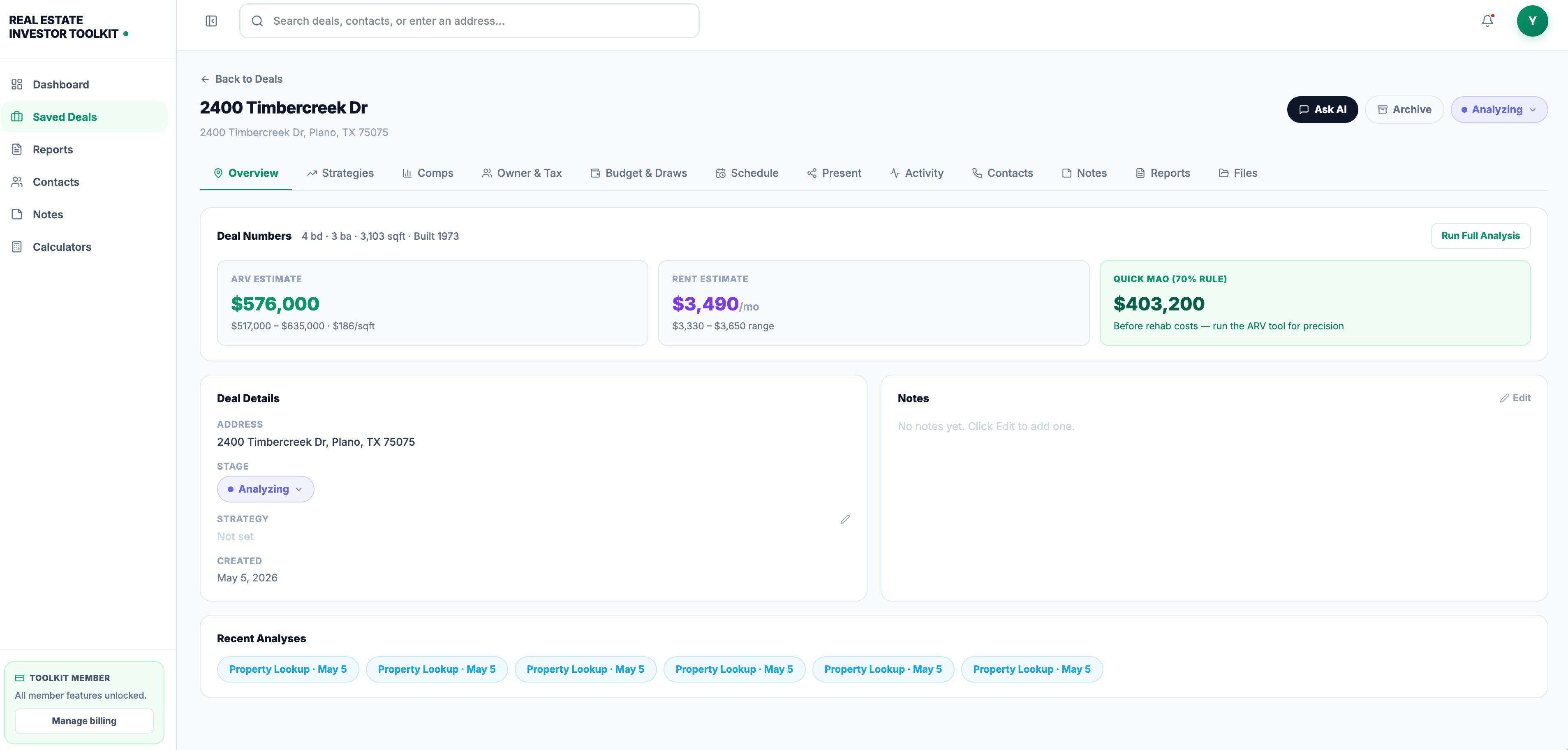
A few things make it a practical fit for the workflow above:
- The ARV calculator and rehab cost calculator generate the two core inputs behind your MAO, using verified market data rather than manual comp pulls.
- The platform helps you avoid the two most common underwriting errors: overestimating purchase price and underestimating rehab costs.
- No sign-up is required to start, so you can run a lead through the numbers the moment it lands in your inbox.
When a deal moves past the screening stage, the pricing plans unlock saved reports and more advanced property data for readers managing multiple deals at once. Start with the free ARV calculator on your next lead and see where the number lands.
Sources
Good remote ARV starts with good raw material. You’re not just estimating a number, you’re building a record that would hold up if a lender or appraiser reviewed it later.
Pull your data from a consistent set of sources every time:
- When Mortgage Rates Rise Flipped Homes Fall Flat - Dec 18, 2025
- Appraisals Will Look Very Different in the Near Future—Are You Ready?
- Best practice: moderate rehab appraisals (Freddie Mac)
- Adjustments to Comparable Sales (Fannie Mae guidance)
Comp selection has rules, not guesses. Pick three to five comps that closed within the last six months when possible, match the subject’s post-rehab condition rather than its current condition, and adjust line by line for square footage, bedroom and bathroom count, and finish quality. MLS records, public records, listing photos, and transaction details including concessions and contract dates are what give appraisers the facts they need to judge comparability, and the same standard applies to your own remote workup.
Documentation is what separates a guess from an underwriting file. Screenshot each comp listing, note the sale date and any concessions, label your photos by room, and keep a running file you could hand to an appraiser later.
Pro Tip: Save your comp screenshots and adjustment notes in the same folder as your offer calculation, so you can defend your number the moment a seller or partner asks how you got there.
Our ARV calculator pulls comps automatically and shows the adjusted output, which speeds up this step considerably. For a deeper primer on the underlying concept, see what ARV actually measures.
FAQ
What outputs should I expect from a remote ARV analysis?
A remote ARV analysis should give you an ARV figure based on adjusted comps, a maximum allowable offer range, and a rehab cost estimate with contingency built in. It should also leave you with a saved set of comp screenshots and notes you can reference later.
How many comps do I need for a defensible remote ARV?
Three to five recent comps, ideally closed within the last six months, is the standard range used in remote underwriting. Fewer than three makes your median unreliable, and more than five rarely adds precision once you’ve matched for post-rehab condition.
Should I use the median or the average of my comps?
Use the median of your adjusted comps rather than the average, since a single outlier sale can skew a mean price significantly. Median pricing tends to hold up better in markets with limited recent sales data.
How does UAD 3.6 affect how I should document my remote ARV work?
UAD 3.6 will require appraisals to include more discrete property and condition datapoints, with lenders expected to require the new format for Fannie Mae and Freddie Mac loans by November 2026. Collecting labeled photos and detailed transaction notes now makes your remote ARV work more useful if the property later needs a formal appraisal.
Can I run a remote ARV analysis without paying for a subscription?
Yes, tools like the Real Estate Investor Toolkit’s free ARV calculator let you pull comps and calculate an adjusted ARV without creating an account. Paid plans add saved reports and more advanced property data for investors managing several deals at once.