Refinance Cash-Out Analysis: The Math Investors Should Run

A cash-out refinance analysis comes down to four numbers: the most the lender will loan on the appraised value, the payoff of your current loan, the costs of closing, and what the new payment does to your cash flow. Subtract the middle two from the first and you have your cash. Then check whether the property still pays for itself. This guide shows each step with worked numbers, including the BRRRR version where the goal is to get your money back out.
TL;DR
- Cash out = (appraised value × max LTV) − current payoff − closing costs. Investment-property limits are commonly 75% LTV for one unit and 70% for two to four units.
- Closing costs typically run 2% to 6% of the loan. Financing them still shrinks your cash.
- A bigger loan means a bigger payment. Always re-run cash flow and debt service coverage on the new loan, not the old one.
- For BRRRR, the appraisal is the whole deal. A small miss on value can leave tens of thousands of dollars stuck in the property.
Table of Contents
- How a cash-out refinance works on a rental
- The cash-out formula, step by step
- Worked example: a rental you want to refinance
- Compare the new payment with the old one
- Seasoning rules that can delay your refinance
- Cash-out math for a BRRRR deal
- Prepayment penalties and other costs of getting out
- Mistakes that make the analysis misleading
- Our perspective
- Run your own numbers
- FAQ
- Sources
How a cash-out refinance works on a rental
A cash-out refinance replaces your current mortgage with a new, larger one. The lender pays off the old balance at closing and the surplus goes to you. Investors use that cash for renovations, a down payment on the next property or other business needs.
Two details matter for investment property. First, FHA, VA and USDA loans can’t be used for this purpose, so you are looking at conventional or investor-focused products. Second, the leverage limits are tighter than on a primary home, which is why the math below starts with LTV.
The cash-out formula, step by step
The order of operations is the same whichever lender you use:
- Find the maximum loan. Appraised value × the program’s maximum LTV.
- Subtract your payoff. That means the existing first mortgage plus any other liens or hard-money loans being paid off.
- Subtract costs paid from the loan. Lender fees, title, appraisal, points, prepaids and escrow deposits. What remains is your net cash.
The same logic appears in calculator form as max cash = value × max LTV − balance − financed costs. Costs you pay out of pocket reduce the net cash you actually keep.
Step 1: Loan-to-value limits
LTV is the new loan divided by the appraised value. For investment property cash-out refinances, the common maximums are 75% for a one-unit property and 70% for two to four units. Put another way, a single-unit owner must keep 25% equity and a two- to four-unit owner must keep 30%.
The value in the formula is the appraiser’s number, not your purchase price and not your rehab estimate. If you are projecting a value before you buy, build it from sold comparables with our ARV calculator and then haircut it, because the lender’s appraiser may land lower.
Step 2: The payoff
Use the payoff figure from your lender, not the balance on your last statement. Accrued interest and fees change the number. On a BRRRR, the payoff is usually a hard-money or bridge loan, and you should include points, extension fees and any prepayment charge.
Step 3: Closing costs
Refinance closing costs typically range from 2% to 6% of the loan principal. Other lenders put conventional cash-out costs at 2% to 4% of the balance. For planning, pick a number inside that range, then replace it with the figure on your Loan Estimate and Closing Disclosure.
Two traps are worth knowing:
- “No-closing-cost” offers. The costs are usually still there, built into a higher rate or added to the balance.
- Financed costs. They can be rolled into the loan, but each dollar financed uses up room under the maximum loan, so your net cash falls either way.
Worked example: a rental you want to refinance
These numbers are illustrative, not a quote.
| Line | Amount |
|---|---|
| Appraised value | $300,000 |
| Max LTV (one unit) | 75% |
| Maximum new loan | $225,000 |
| Current mortgage payoff | −$180,000 |
| Closing costs at 3% of the loan | −$6,750 |
| Net cash to you | $38,250 |
That is the easy half. The harder half is whether the property survives a $225,000 loan in place of a $180,000 one.
Compare the new payment with the old one
Cash-out loans often price 0.25 to 0.75 percentage points higher than rate-and-term refinances, because lenders see more risk. A larger balance at a higher rate almost always means a higher payment.
To measure the change:
- Calculate the new principal-and-interest payment, plus taxes and insurance.
- Subtract the old payment. A negative result means your monthly cost went up.
- Subtract the new payment from your rent after vacancy and maintenance reserves.
In the example above, assume a 7% rate on a 30-year loan. Principal and interest on $225,000 is about $1,497 a month. Add $400 for taxes and insurance and the payment is $1,897.
If rent is $2,200, you have about $303 a month before reserves. Set aside 15% of rent for vacancy and repairs ($330) and the property is at about −$27 a month. The deal still works if the cash you pulled out is earning more elsewhere, but you should know that going in. Our rental property calculator runs this cash flow, cap rate and ROI in one pass.
Break-even on the costs
If you refinance partly to lower your payment, the standard test is: total loan costs ÷ monthly savings = months to break even. For example, $5,000 in fees with $200 a month in savings takes 25 months to recoup.
With cash-out, the extra loan balance can shrink or even reverse the monthly savings. In that case break-even does not apply, and the better question is what the cash earns. If you want a second look at recovering refinance costs through savings, run the break-even months against how long you realistically expect to hold the loan.
Check DSCR and qualification
Lenders qualify rentals in two main ways. Conventional underwriting counts only part of your rent: Fannie Mae’s guidelines multiply gross monthly rent by 75% before the debt-to-income calculation, with the remaining 25% standing in for vacancy and maintenance.
DSCR (debt service coverage ratio) loans look at the property alone. A DSCR of 1.0 means rent covers the payment exactly. Above 1.25 generally unlocks the best pricing and highest leverage, and many standard programs set 1.0 as the minimum. In our example, $2,200 ÷ $1,897 is a DSCR of about 1.16, which clears 1.0 but leaves little cushion for better pricing.

Seasoning rules that can delay your refinance
Seasoning is how long you must hold the property or the loan before a lender will cash you out. For conventional investment-property cash-out refinances, Freddie Mac’s product snapshot says the borrower must have held the property at least six months and the first lien being refinanced must be seasoned for at least 12 months. Fannie Mae uses a similar pair of conditions.
BRRRR investors often work around this with DSCR products built for bridge-to-rental refinances, which have their own terms. Ask each lender for its written seasoning rule before you set your timeline, and build the holding costs of waiting into your analysis.
Cash-out math for a BRRRR deal
BRRRR (buy, rehab, rent, refinance, repeat) is the strategy where cash-out math matters most, because the goal is to recover your capital and keep the property. The formula is the same one above, with the hard-money payoff in step 2: 75% × appraised value − bridge payoff − closing costs, with closing costs typically 2% to 4% of the new loan in that playbook.
A published example shows how the pieces fit. A property appraised at $260,000 at 75% LTV gives a $195,000 loan. After a $163,250 hard-money payoff and $6,500 in costs, the investor recovers $25,250 of $29,750 invested, leaving $4,500 in the deal.

Capital left in the deal
Track this one number on every BRRRR:
Money left in = total cash invested − net refinance cash
Total cash invested includes your down payment, rehab, closing costs on the purchase, and holding costs such as interest, taxes and insurance during the rehab. Investors often forget the holding costs, which makes the plan look better than it is.
What a lower appraisal does
Using the earlier example, suppose you invested $40,000 and the property was expected to appraise at $300,000. Here is how the same deal changes if the appraisal comes in lower.
| Scenario | Appraisal | Max loan (75%) | Payoff | Costs (3%) | Net cash | Left in deal |
|---|---|---|---|---|---|---|
| Plan | $300,000 | $225,000 | $180,000 | $6,750 | $38,250 | $1,750 |
| Appraisal 7% lower | $279,000 | $209,250 | $180,000 | $6,278 | $22,972 | $17,028 |
A 7% miss on value cost about $15,000 of recovered cash, because LTV applies to the whole number. This is why our BRRRR calculator lets you test the appraisal, the LTV and the rate together. For the full strategy, see our BRRRR method guide, and for what can go wrong at the refinance step, read our guide to underwriting BRRRR refinance risk.
Prepayment penalties and other costs of getting out
Many DSCR loans carry a prepayment penalty. A 3-2-1 step-down structure over the first three years is common: the penalty shrinks each year, then disappears. If you might sell or refinance again soon, add the penalty to your cost line for that exit.
Mistakes that make the analysis misleading
- Using the purchase price plus rehab as the value. Lenders use the appraisal, which rests on comparable sales. Build your number from comps and stress-test it.
- Ignoring financed costs. Closing costs and points rolled into the loan reduce your borrowing room.
- Skipping holding costs. Interest, insurance and taxes during the rehab count as cash invested.
- Measuring cash flow on the old loan. The new payment is what you will live with. Rerun it every time.
- Assuming full rent. Conventional underwriting counts 75% of rent, and your own budget should reserve for vacancy and repairs too.
- Treating the cash as free money. Cash pulled out is debt. It should buy something with a return above the added cost of the loan.
- Using a quoted rate for the whole analysis. Rates move. Run your numbers at the quoted rate and at one point higher.
Our perspective
Most bad refinance decisions start with a spreadsheet that has one scenario in it. The investor plugs in the hoped-for value, the hoped-for rate and a rough cost, sees cash coming out, and moves forward.
We built the Real Estate Investor Toolkit around the opposite habit: change one input at a time and watch what moves. Value, LTV, rate, costs and rent each have their own effect on cash out and on cash flow. Seeing them side by side is what keeps you from finding out at the closing table.
The free calculators need no sign-up, so you can check a deal in a couple of minutes before you spend money on an appraisal or an application. When you are working a pipeline of deals, saved analyses and property data in one place save you the work of rebuilding the same numbers.
Michael
Run your own numbers
Start with the free investor calculators. Our free tools need no sign-up: use the investment property financing calculator to test loan amounts and payments, then the BRRRR calculator for cash left in the deal.
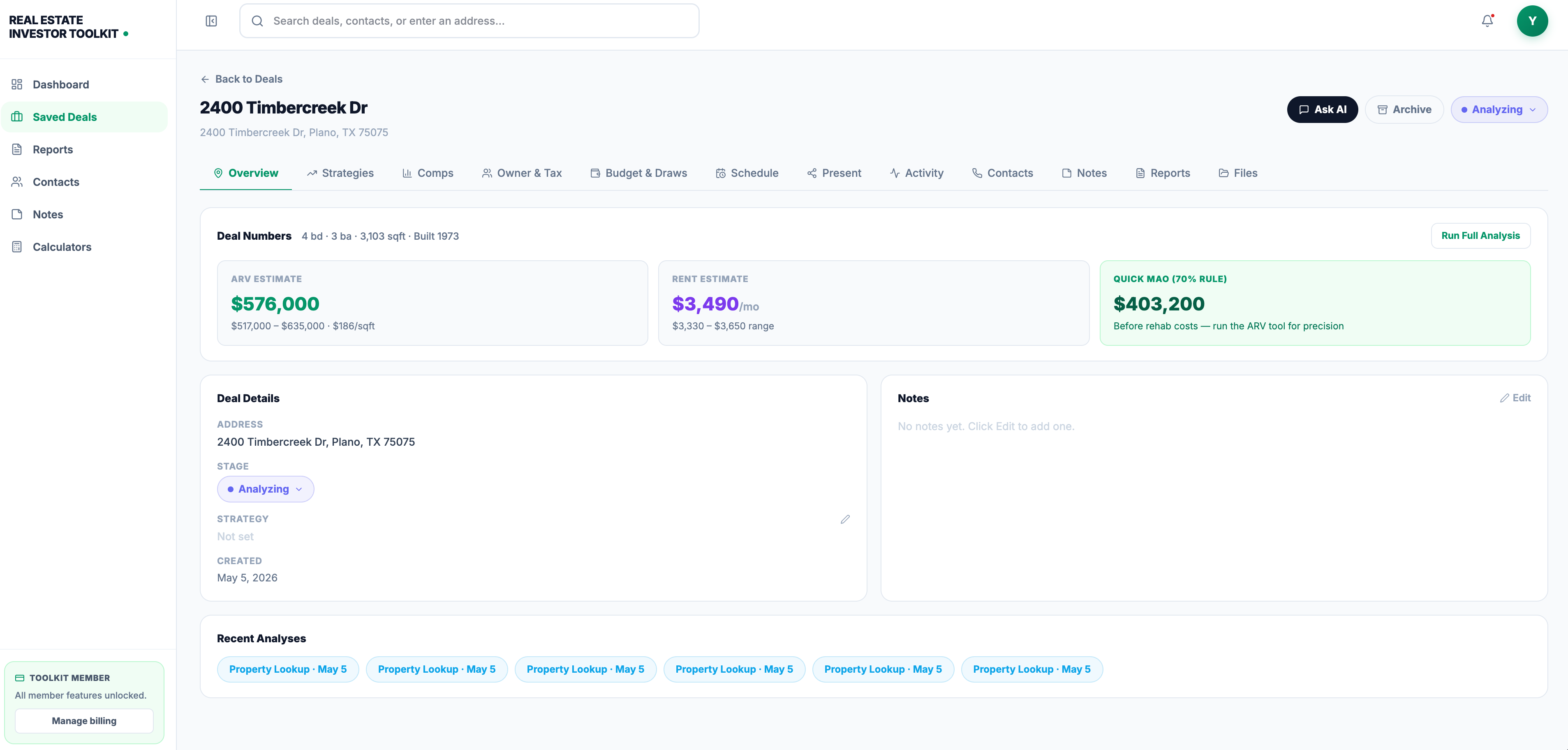
If you analyze deals regularly, the paid plan is $39.99 per month. It adds unlimited reports, saved deal pipelines, advanced property data, owner details and an AI assistant for deal insights, all in a single plan.
FAQ
How much cash can I take out of a rental property?
Multiply the appraised value by the maximum LTV, then subtract your payoff and closing costs. With common limits of 75% for one unit and 70% for two to four units, a $300,000 single-unit property supports a loan up to $225,000. Your lender’s own program and your credit profile set the final figure.
How long must I own a property before a cash-out refinance?
For conventional loans, Freddie Mac’s snapshot calls for six months of ownership and a first lien seasoned at least 12 months. Other loan types set their own rules, so get the seasoning requirement in writing before you plan your timeline.
What are typical closing costs on a cash-out refinance?
Plan on 2% to 6% of the loan amount, covering lender, title, appraisal and credit-report fees. Your Closing Disclosure shows the real net cash and cost breakdown.
Does cash-out math work the same for BRRRR?
Yes, with one change: the payoff is usually a hard-money or bridge loan. The formula is 75% of appraised value minus bridge payoff minus closing costs for a DSCR refinance. Then compare the result to total cash invested to see what is left in the deal.
Sources
- Conventional Refinance Rates and Guidelines (The Mortgage Reports)
- Cash-Out Refinance: How It Works (NerdWallet)
- How to Calculate the Break-Even Point on a Mortgage (NerdWallet)
- Freddie Mac conforming product snapshot
- Cash-Out Refinance on an Investment Property (Amerisave)
- Cash-Out Refinance on Investment Property (Zillow)
- Getting a Cash-Out Refinance on an Investment Property (Refi.com)
- How Closing Costs Reduce Cash Out (Lendmire)
- Cash-Out Refinance Calculator (MoneyDeck)
- Cash Out Refinance on Investment Property (Loankea)
- Mortgage Refinance Calculator (FiscalGrove)
- Bridge to DSCR Refinance Playbook (PeerSense)
- How DSCR Loan Qualification Works for BRRRR Beginners (Pinnacle Funding Network)
- Math First Refinance (Fordham Capital)