How to Calculate Your Refinance Break-Even Point

Your refinance break-even point is the number of months it takes for your monthly mortgage savings to fully recover what you paid in closing costs. The formula is straightforward: break-even months = total refinance costs ÷ monthly payment savings. When you expect to stay in the home longer than that number of months, refinancing is likely worth it. If you plan to move sooner, you’ll exit before recovering the upfront cost.
Bankrate guidance notes that borrowers who locked rates above 7% between 2022 and 2025 may be losing $200–$400 per month, and that breaking even within a couple of years often makes refinancing worthwhile. Use after-tax monthly savings in the formula when you itemize deductions and claim the mortgage interest deduction, since your real net savings will be slightly lower than the gross payment difference.
- Total refinance costs: closing costs, lender fees, prepayment penalties, and any other upfront charges
- Monthly savings: current principal and interest (P&I) payment minus new P&I payment
- After-tax savings: monthly savings × (1 − your marginal tax rate), used when interest is deductible
- Decision rule: if your planned time in the home exceeds break-even months, refinancing is likely beneficial
Key Takeaways
The refinance break-even point is total closing costs divided by monthly payment savings, and staying in the home longer than that number of months is what makes refinancing financially worthwhile.
| Point | Details |
|---|---|
| Core formula | Break-even months = total refinance costs ÷ after-tax monthly savings. |
| Closing cost range | Refinancing costs typically fall in a moderate percentage range of the loan amount, so model the full dollar figure before deciding. |
| Term reset risk | Resetting to a longer term lowers monthly payments but can increase lifetime interest; always compare both figures. |
| Prepayment and seasoning | Ask your lender about prepayment penalties and seasoning requirements before calculating, since both add to your cost basis. |
| Real Estate Investor Toolkit | The Investment Property Financing Calculator models multiple refinance scenarios, financed fees, and lifetime interest comparisons in one place. |
Table of Contents
- What is the refinance break-even point and why does it matter?
- How do you calculate the refinance break-even step by step?
- Worked example and a worksheet you can copy
- What factors lengthen or shorten your break-even?
- How do you use online refinance calculators effectively?
- When does refinancing make sense even with a long break-even?
- Your refinance checklist: documents, questions, and next steps
- Run your refinance scenarios with Real Estate Investor Toolkit
- Sources
What is the refinance break-even point and why does it matter?
The break-even point answers one practical question: how long before you actually come out ahead? Measured in months, it tells you whether the upfront cost of refinancing pays off before you sell, move, or pay off the loan.
The metric applies across several common refinance scenarios. Lowering your rate to cut monthly payments is the most familiar use case, but the same math governs a term shortening (say, from 30 years to 15), switching from an adjustable-rate mortgage (ARM) to a fixed rate, a cash-out refinance, or removing private mortgage insurance (PMI). Each scenario changes the monthly savings figure, which directly shifts the break-even timeline.
Not every reason to refinance is purely financial. Converting an ARM to a fixed rate locks in payment certainty even if the break-even is 36 months away. Consolidating a second mortgage into a single payment simplifies your finances. These non-financial benefits are real, but they should complement the numbers, not replace them.
Pro Tip: If you’re refinancing a rental property, factor in how the new payment affects cash flow and cap rate, not just break-even months. The rental property cash flow calculator at Real Estate Investor Toolkit can model that shift quickly.
How do you calculate the refinance break-even step by step?
Gather your inputs first
Before running any math, collect these six numbers from your current mortgage statement and any Loan Estimate you’ve received from a lender:
- Current monthly P&I payment (principal and interest only, not escrow)
- New monthly P&I payment (from the lender’s quote at the new rate and term)
- Total refinance closing costs (origination fee, appraisal, title insurance, recording fees, prepaid interest, and any other lender charges)
- Prepayment penalty on your current loan, if any
- Remaining years on your current loan
- Your marginal federal income tax rate, if you itemize deductions
The four-step calculation
Chase’s break-even method uses total refinance costs divided by monthly savings as the baseline formula. Here’s how to work through it:
- Add all upfront costs. Sum closing costs plus any prepayment penalty. This is your total refinance cost.
- Calculate gross monthly savings. Subtract the new P&I from the current P&I.
- Adjust for taxes (if applicable). Multiply gross monthly savings by (1 − your marginal tax rate). If you don’t itemize, skip this step and use gross savings.
- Divide total costs by after-tax monthly savings. The result is your break-even in months.
How no-closing-cost refinances change the math
A “no-closing-cost” refinance doesn’t eliminate fees. As NerdWallet explains, lenders typically roll those fees into a higher interest rate or add them to your loan balance. Either way, you pay them over time through interest. When fees are financed into the balance, treat the added principal as part of your cost basis and recalculate the new monthly payment accordingly. The break-even period often lengthens because your monthly savings shrink when the rate is bumped up.
Pro Tip: When comparing a no-closing-cost offer against a standard refinance, run both scenarios through a lifetime interest comparison. The no-cost option frequently costs more over a full loan term even when it looks attractive upfront.
Worked example and a worksheet you can copy
Numeric example
Total closing costs are $7,000.
If you plan to stay in the home for five or more years, 38 months is well inside your window and refinancing makes financial sense. If you expect to sell in two years, you’d exit before recovering the cost.
Note that this example resets the term from 27 remaining years to a new 30-year loan. That three-year extension lowers the monthly payment but adds interest over the life of the loan. Always run a lifetime interest comparison alongside the break-even calculation, as the Lower refinance calculator does, to see the full picture.
Copyable worksheet
Use these labeled rows in a spreadsheet or any online calculator:
- A: Current P&I — from your mortgage statement (exclude escrow)
- B: New P&I — from lender’s Loan Estimate, line 1a
- C: Gross monthly savings — A minus B
- D: Tax factor — enter (1 − marginal rate), or 1.0 if you don’t itemize
- E: After-tax monthly savings — C × D
- F: Total closing costs — sum all fees from Loan Estimate, Section A and B
- G: Prepayment penalty — check your current note or call your servicer
- H: Total cost basis — F plus G
- I: Break-even months — H ÷ E
What factors lengthen or shorten your break-even?
Several variables pull the break-even in opposite directions. Understanding each one helps you spot where to negotiate and where to be cautious.
- Closing cost size. Refinancing costs typically fall in a moderate percentage range of the loan amount, which on a $300,000 loan means $9,000–$18,000 in upfront costs. Higher costs push break-even further out.
- Interest rate difference. A 1.5-percentage-point drop produces far more monthly savings than a 0.25-point drop. Smaller rate gaps require longer break-even periods to justify the same closing costs.
- Term reset. Resetting from 23 remaining years to a new 30-year loan lowers your payment but extends your payoff date and adds interest. Bankrate cautions that this can increase total lifetime interest even when the monthly payment falls.
- Prepayment penalties. Some loans charge a fee, often a percentage of the remaining balance, for paying off early. The Federal Reserve notes these penalties can materially extend break-even; ask your current lender whether they’ll waive it if you refinance with them.
- Seasoning requirements. For cash-out refinances, Fannie Mae’s selling guide sets minimum seasoning periods before you can access equity. This affects timing, not the monthly math, but it can delay when you start the break-even clock.
- PMI removal. If your current loan carries PMI and the new loan does not (because your equity now exceeds 20%), add the monthly PMI amount to your savings figure. This shortens break-even significantly.
- Escrow changes. A new loan may reset your escrow account, requiring an upfront deposit. That’s an additional out-of-pocket cost that belongs in your total cost basis.
- Credit score impact. A lower credit score at application time can push your rate up, shrinking monthly savings and extending break-even. Pull your credit report before applying.
- Appraisal results. If the home appraises lower than expected, your loan-to-value ratio rises, which can trigger a higher rate or PMI on the new loan.
Pro Tip: When a term reset is unavoidable, compare total interest paid on both loans side by side. Multiply the new monthly P&I by the new term in months, then subtract the remaining balance on the current loan multiplied by its remaining months. The difference tells you the real lifetime cost of extending the term.
A closing cost range of 3%–6% of the loan amount means a $400,000 refinance could cost $12,000–$24,000 upfront before you save a single dollar.
How do you use online refinance calculators effectively?
A good refinance calculator does more than divide costs by savings. The best ones compare lifetime interest on both loans, model financed fees, and let you toggle the new term independently.
Inputs that matter most
- Current loan balance — not the original amount, the payoff balance today
- Remaining term — years left on your current loan, not the original term
- Current interest rate — your actual note rate, not the APR
- New interest rate and term — from a real lender quote, not a guess
- Total closing costs — itemized from a Loan Estimate, not a rounded estimate
- Marginal tax rate — only if you itemize; enter 0% if you take the standard deduction
- PMI change — current monthly PMI if it will be eliminated
- Prepayment penalty — dollar amount if applicable
How to validate a calculator’s assumptions
Before trusting any result, check whether the tool:
- Compares lifetime interest on both the old and new loan (not just monthly savings)
- Allows you to enter financed fees separately from the rate
- Accounts for prepayment penalties as a one-time cost
- Lets you change the new term independently of the current remaining term
Bankrate and Rocket Mortgage both offer mainstream refinance calculators that cover the basic break-even formula and are widely used as reference points. For investor-oriented scenarios, including modeling financed fees, term changes, and cash-out effects, the Investment Property Financing Calculator at Real Estate Investor Toolkit handles those variables in one place. Running the same scenario on two or three tools is good practice because different calculators make different assumptions about compounding and tax treatment.
When does refinancing make sense even with a long break-even?
A break-even of 48 months isn’t automatically a reason to walk away. Several situations justify refinancing even when the payback period stretches past three or four years.
- Converting an ARM to a fixed rate. If your adjustable rate is set to reset upward, locking a fixed rate protects you from payment shock regardless of break-even math. The certainty has real financial value.
- Long-term stay with lifetime interest savings. If you plan to stay 10 or more years and a shorter term (15 years vs. 30) cuts total interest by tens of thousands of dollars, the break-even on closing costs is almost irrelevant compared to the lifetime gain.
- Removing expensive PMI. Monthly PMI on a $350,000 loan can run $150–$200 per month. Adding that to your monthly savings figure can cut break-even from 40 months to under 24.
- Cash-out for high-return use. Pulling equity to fund a rental property acquisition or a high-return renovation can produce returns that exceed the cost of the refinance. Model this with a cash-out refinance analysis before committing.
- Debt consolidation. Rolling high-interest debt into a mortgage at a lower rate can produce net monthly savings that shorten break-even even when the mortgage rate itself doesn’t drop much.
The term-reset tradeoff deserves a direct note: extending from 20 remaining years to a new 30-year loan gives you immediate monthly relief but adds a decade of interest payments. That trade is sometimes worth it for cash-flow reasons, but you should enter it with eyes open on the lifetime cost.
Your refinance checklist: documents, questions, and next steps
Documents to collect before you apply
- Current mortgage statement — shows your balance, rate, remaining term, and monthly P&I
- Loan Estimate from at least three lenders — required by law within three business days of application
- Payoff balance — call your servicer for the exact figure, which differs from the statement balance
- Credit report snapshot — pull from AnnualCreditReport.com before lenders do a hard inquiry
- Current escrow breakdown — taxes, insurance, and PMI amounts affect your total monthly payment comparison
Questions to ask every lender
- What fees are included in the quoted closing costs, and are any negotiable?
- Does my current loan carry a prepayment penalty, and will you waive it if I refinance with you?
- If this is a no-closing-cost offer, are fees rolled into the rate or added to the balance?
- What is the exact APR (not just the interest rate), and how does it compare across your loan options?
- Are there seasoning requirements that affect my eligibility, particularly for a cash-out refinance?
Concrete next steps
- Pull your credit report and note your score range before applying anywhere.
- Collect Loan Estimates from at least three lenders on the same day so rates are comparable.
- Run the break-even calculation using after-tax savings for a conservative estimate.
- Compare break-even months to your realistic planned time in the home.
- If the numbers are close, consult a HUD-approved housing counselor or mortgage advisor before locking.
For a deeper look at whether refinancing fits your situation, the Should I Refinance? guide at Real Estate Investor Toolkit walks through the decision framework in detail.
What the break-even formula actually tells you (and what it misses)
The break-even formula is the right starting point, but treating it as the final word is where most homeowners go wrong. A 30-month break-even on a rate-and-term refinance looks clean on paper. What it doesn’t show is whether you’re resetting a 22-year remaining term to 30 years, which can cost more in lifetime interest than you save in monthly payments, even after you’ve passed the break-even date.
The smarter move is to run two numbers side by side: break-even months and total lifetime interest on both loans. When both figures favor the refinance, the decision is straightforward. When break-even is short but lifetime interest rises, you’re trading long-term wealth for short-term cash flow relief. That trade can be worth it, particularly for investors managing multiple properties where monthly cash flow is the constraint, but it should be a deliberate choice, not an oversight.
One more thing most articles skip: your credit score at application time is a variable, not a fixed input. A score that dropped 40 points since you bought the home can push your rate up enough to eliminate the savings entirely. Check your score before you request quotes, and if it’s lower than expected, spend 60–90 days improving it before applying. The difference between a 680 and a 740 score can be 0.5 percentage points on the rate, which on a $350,000 loan is roughly $100 per month in savings you’re leaving on the table.

Run your refinance scenarios with Real Estate Investor Toolkit
Calculating break-even by hand works, but it gets tedious when you’re comparing three lender quotes, two term options, and a no-closing-cost variant all at once.
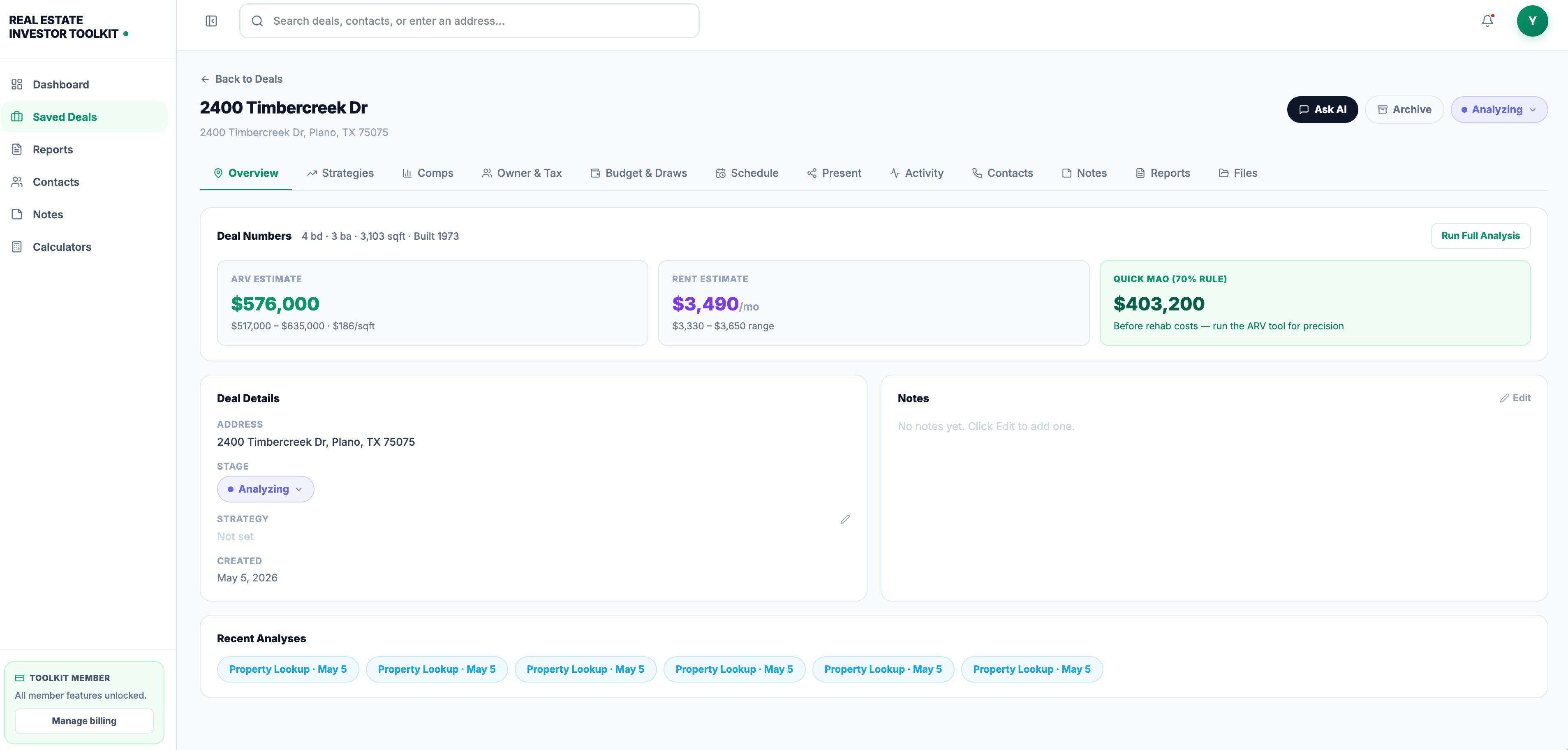
The Investment Property Financing Calculator at Real Estate Investor Toolkit lets you model all of those scenarios in one place, no spreadsheet required. Enter your current balance, remaining term, new rate, closing costs, and financed fees, and the tool computes monthly savings, after-tax savings, and lifetime interest for each scenario side by side. Investors refinancing rental properties can pair it with the rental cash flow calculator to see how the new payment affects cap rate and ROI. Free calculators require no sign-up. Paid subscribers can save scenarios, compare multiple deals, and access advanced property data for deeper analysis. Start with the mortgage calculator and plug in the worked example from this article to see your own numbers immediately.

Sources
These authoritative sources provide rate context, calculator tools, and methodology guidance for validating your break-even numbers:
- How Much Does It Cost To Refinance a Mortgage? | Bankrate
- Calculating the Break-Even Point When Refinancing | Chase
- What Does It Really Cost to Refinance Your Mortgage? | Investopedia
- Refinance Break Even Calculator | Lower
- How Much Does It Cost To Refinance a Mortgage? | NerdWallet
This article is general information, not a substitute for advice from a qualified financial advisor. Consult a qualified financial professional about your own circumstances before acting on anything here.
Recommended
- Should I Refinance? How to Know When a Lower Rate Actually Helps | Mortgage Guides | Real Estate Investor Toolkit
- Cash-Out Refinance Math: When Pulling Equity Helps and When It Backfires | Mortgage Guides | Real Estate Investor Toolkit
- How to Underwrite BRRRR Refinance Risk Before It Wrecks the Deal — Real Estate Investing Guide | Real Estate Investor Toolkit