Real Estate Underwriting for Investors: A Practical Guide

Real estate underwriting is the financial analysis that decides whether a property and borrower justify a loan or an acquisition. The result is always one of four outcomes: approval, conditional approval with required changes, repriced terms, or denial. Underwriting combines borrower credit evaluation with property valuation and other factors to determine loan eligibility and pricing. For investors, it also answers a more direct question: does this deal produce enough cash flow to carry the debt and still return a profit?
The principal inputs underwriters examine are:
- Borrower credit: FICO score, debt-to-income ratio (DTI), payment history
- Property appraisal: market value relative to the purchase price and loan amount
- Net operating income (NOI): gross rents minus operating expenses, before debt service
- Rent roll and lease abstracts: actual tenants, lease terms, and current rents
This guide covers the four types of underwriting, the step-by-step mortgage process, key metrics with formulas, investor-specific checks, red flags, timelines, a worked example, and career paths.
Table of Contents
- What are the main types of real estate underwriting?
- How does the mortgage underwriting process work, step by step?
- What metrics do underwriters actually use to evaluate a deal?
- What red flags do underwriters flag, and how can you fix them?
- How long does underwriting take, and what documents do you need?
- Worked example: underwriting a 6-unit rental from scratch
- How do you become a real estate underwriter or appraiser?
- Key Takeaways
- What most investors get wrong about underwriting
- Run your underwriting numbers before you submit
- Useful sources and further reading
What are the main types of real estate underwriting?
Not every underwriting review looks the same. The focus shifts depending on who is doing the analysis and what decision they need to make.
-
Mortgage underwriting is performed by retail lenders and, increasingly, by automated systems like Fannie Mae’s Desktop Underwriter (DU) or Freddie Mac’s Loan Product Advisor (LPA). The primary focus is borrower creditworthiness: income verification, DTI, credit score, and whether the appraised value supports the loan amount.
-
Investor or sponsor underwriting is done by acquirers, private equity funds, and individual investors evaluating whether to buy a property. The focus shifts from the borrower’s salary to the property’s cash flow, exit assumptions, and return metrics. CRE underwriting combines property-level operating analysis, sponsor credit evaluation, and market context, with modern workflows adding AI for document extraction while retaining human credit judgment.
-
Insurance underwriting is performed by property and casualty insurers. They assess hazard exposure, flood zone classification, roof age, and construction type to price the policy and set coverage limits. This matters to investors because insurance cost directly affects NOI.
-
Securities underwriting applies when mortgage loans are pooled into mortgage-backed securities (MBS). Investment banks and government-sponsored enterprises (GSEs) like Fannie Mae and Freddie Mac evaluate the pool’s credit quality before issuance.
Each type uses overlapping data but weights it differently. An insurance underwriter cares about wind exposure; a mortgage underwriter cares about your W-2. An investor underwriting a 12-unit building cares about both, plus the trailing-12 (T12) income statement.
How does the mortgage underwriting process work, step by step?
A typical mortgage underwriting decision takes 30–60 days for a residential loan and 45–90 days for a commercial deal, though bridge lenders can move faster. Here is what happens between application and closing.
1. Intake and initial screen The lender collects the loan application, pulls a tri-merge credit report, and runs the file through an automated underwriting system. Files that pass the automated screen move to processing; those that fail go to a manual underwriter or are declined.
2. Documentation collection The processor assembles the full package with guidance from IDX Property Services, ensuring smooth mortgage documentation and IDX workflows. Document verification and third-party appraisal are core to mortgage underwriting; inconsistent documentation or a low appraisal can lead to denial. Standard documents include:
- Paystubs (30 days), W-2s, and two years of federal tax returns
- Bank statements (2–3 months)
- Rent roll, T12 income statement, and lease abstracts for investment properties
- Signed purchase agreement
- Homeowners insurance declaration page
3. Property appraisal and title An independent, licensed appraiser inspects the property and produces a report comparing it to recent sales. The lender orders a title search to confirm ownership and identify any liens or encumbrances. For commercial deals, a Phase I environmental assessment and property condition assessment (PCA) are often required.
4. Underwriting analysis The underwriter reviews the complete file: credit history, income verification, DTI calculation, loan-to-value (LTV) ratio, appraisal reconciliation, and reserve requirements. For investment properties, they also verify the rent roll against bank deposits and check that the NOI supports the debt service coverage ratio (DSCR).
5. Decision and conditions The underwriter issues one of three decisions: approved, approved with conditions (e.g., proof of repairs, additional documentation, or a larger down payment), or denied. Conditional approvals are common. Lenders can mitigate identified risks via increased rates, reduced loan amounts, co-signers, or required repairs and insurance.
What metrics do underwriters actually use to evaluate a deal?
These seven metrics drive nearly every underwriting decision. Learn the formula, know the threshold, and you can anticipate a lender’s answer before you submit.
| Metric | Formula | Typical Threshold |
|---|---|---|
| LTV | Loan Amount ÷ Appraised Value | 75% max (investment); 95% (owner-occupied) |
| DTI | Total Monthly Debt ÷ Gross Monthly Income | 43–45% max (conventional) |
| NOI | Gross Rents − Operating Expenses | Property-specific; must exceed debt service |
| Cap Rate | NOI ÷ Purchase Price | Varies by market; used to value the asset |
| DSCR | NOI ÷ Annual Debt Service | 1.20x minimum (most CRE lenders) |
| Cash-on-Cash | Annual Pre-Tax Cash Flow ÷ Total Cash Invested | Investor target: 8–12%+ |
| IRR | Discount rate where NPV = 0 | Investor target: 12%+ depending on risk |
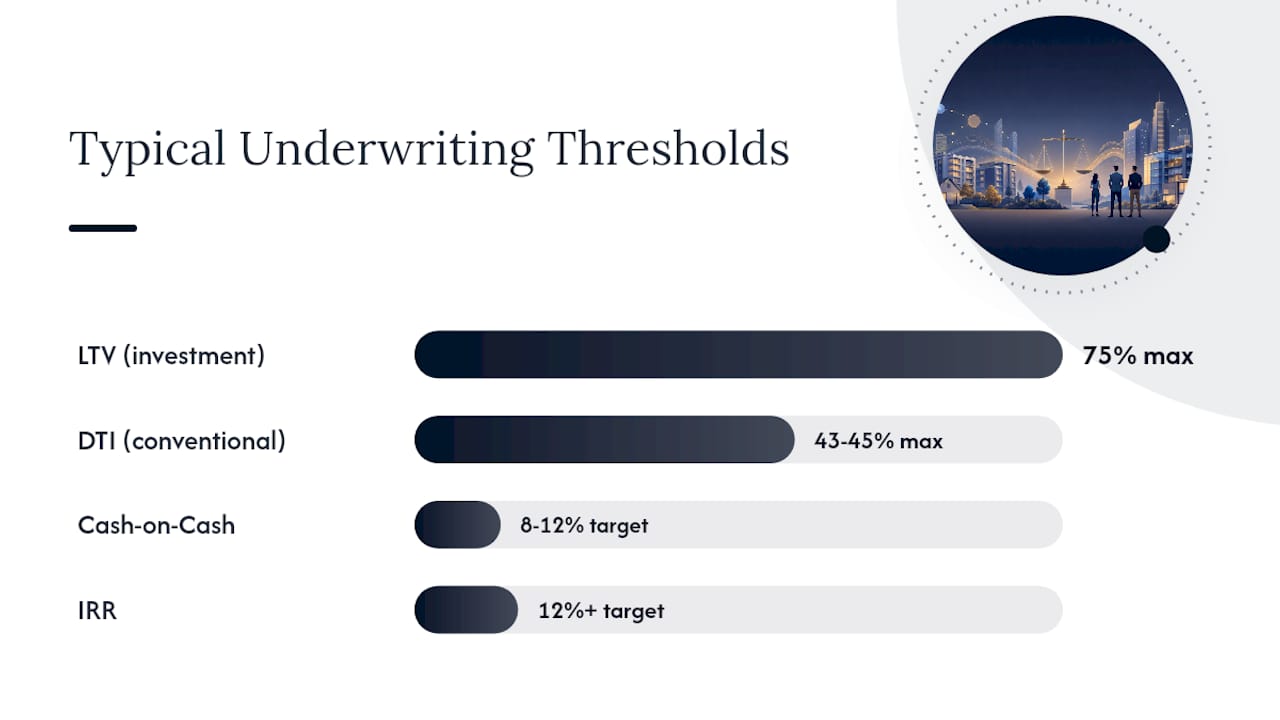
How these metrics connect matters as much as the formulas themselves. NOI feeds directly into cap rate, which drives the property’s income-based valuation. That valuation sets the maximum loan amount, which determines debt service. Debt service then feeds DSCR. A deal that looks fine on the purchase price can fail underwriting entirely if the NOI is overstated.

DSCR below 1.0 means the property does not generate enough income to cover its loan payments. Most commercial lenders require at least 1.20x to build in a cushion for vacancies or unexpected expenses. For rental cash flow analysis, the DSCR and cash-on-cash return together tell you whether a deal works at the proposed financing terms.
Pro Tip: Price your debt at the rate you will actually carry, not the teaser rate. A deal that pencils at 5% but breaks at 7% is not a deal.
What red flags do underwriters flag, and how can you fix them?
Underwriting identifies risks and lists mitigation options lenders commonly use. Knowing the flags in advance lets you address them before submission.
Common red flags:
- Low appraisal relative to purchase price
- Inconsistent or undocumented income (especially self-employed borrowers)
- Title clouds: liens, easements, or ownership disputes
- High vacancy or below-market rents on the rent roll
- Environmental issues flagged in a Phase I report
- Deferred maintenance or structural deficiencies noted by the appraiser
- DSCR below 1.20x at proposed loan terms
Lender mitigation responses:
- Higher rate or points: compensates for elevated risk without changing the loan structure
- Reduced loan amount (lower LTV): requires the borrower to bring more equity
- Repair escrow: lender holds funds at closing until required repairs are completed
- Additional insurance: flood, earthquake, or umbrella coverage required as a condition
- Co-signer or guarantor: adds a creditworthy party to the loan obligation
- Denial: when the risk exceeds the lender’s appetite or guidelines
The decision flow generally works like this: a single fixable issue (one deferred-maintenance item, a minor title cloud) usually leads to a conditional approval. Multiple overlapping issues, or one severe one like a Phase II environmental finding, typically result in denial or a significant repricing. As an investor, you can reduce friction by ordering your own preliminary title search, getting an insurance quote before submission, and presenting a verified rent roll with supporting bank statements rather than waiting for the lender to ask.
How long does underwriting take, and what documents do you need?
Expected timelines:
- Residential mortgage (owner-occupied): 30–45 days from application to closing
- Residential investment property (1–4 units): 30–60 days
- Small commercial or multifamily (5+ units): 45–90 days
- Bridge or hard-money loan: 7–21 days (less documentation, higher rate)
The timeline follows a predictable sequence:
- Preliminary screen (Days 1–3): automated underwriting, initial credit pull, prequalification
- Appraisal and title order (Days 3–10): third-party appraisal scheduled; title search initiated
- Full underwriting review (Days 10–30): income verification, DTI, LTV, NOI, DSCR analysis
- Credit committee or final approval (Days 30–45): senior sign-off, conditions issued
- Closing (Days 45–90 for CRE): conditions cleared, loan documents signed, funds disbursed
Document checklist for a lender-ready package:
- Paystubs (most recent 30 days) and W-2s (2 years)
- Federal tax returns, personal and business (2 years)
- Bank statements (2–3 months, all accounts)
- Rent roll (current, signed by property manager or owner)
- T12 income and expense statement
- Lease abstracts for each unit or tenant
- Signed purchase agreement
- Homeowners or landlord insurance declaration page
- Appraisal (ordered by lender, but you can provide a pre-appraisal for reference)
- Title commitment or preliminary title report
- Phase I environmental report and PCA (commercial deals)
For how lenders evaluate your mortgage in detail, including income, debt, credit, and reserve requirements, that guide walks through each criterion lenders apply. Automated underwriting (DU or LPA) can compress the timeline for clean, conforming files. Manual underwriting, required for non-QM loans or complex investment structures, adds time but allows more flexibility on documentation.
Worked example: underwriting a 6-unit rental from scratch
Small changes to rent, vacancy, or insurance can flip a deal from approval to denial. This example shows exactly how.
Inputs:
- Purchase price: $600,000
- Gross rents: $7,200/month ($1,200 per unit × 6)
- Vacancy and credit loss: 8%
- Operating expenses: $2,400/month (taxes, insurance, maintenance, management)
- CapEx reserve: $600/month ($100/unit)
- Loan terms: 75% LTV, 7.0% rate, 30-year amortization
- Down payment: $150,000 (25%)
Step-by-step calculation:
- Effective gross income (EGI): $7,200 × (1 − 0.08) = $6,624/month = $79,488/year
- Total operating expenses: ($2,400 + $600) × 12 = $36,000/year
- NOI: $79,488 − $36,000 = $43,488/year
- Cap rate is net operating income divided by the purchase price, reflecting the unleveraged yield
- Loan amount typically represents a percentage of the purchase price, such as seventy-five percent
- Annual debt service is the approximate yearly mortgage payment based on the loan amount and interest rate
- DSCR is net operating income divided by the annual debt service; lenders seek a minimum above one to ensure coverage
- Annual cash flow is net operating income minus the debt service
- Cash-on-cash return is annual cash flow divided by the initial equity investment, representing leveraged return
Result: Conditional approval. The DSCR clears the 1.20x threshold by a thin margin. A lender will likely approve this deal but may require 3–6 months of reserves and verify the rent roll against bank deposits.
What flips the decision: raise vacancy to 12% and the NOI drops to $41,904, pushing DSCR to 1.17x. That triggers a denial or a required rate buydown. Alternatively, if insurance comes in $200/month higher than budgeted, the same math applies.
Inputs to enter in Real Estate Investor Toolkit:
- Purchase price, down payment percentage, and loan rate
- Gross monthly rents per unit
- Vacancy rate assumption
- Monthly operating expenses (taxes, insurance, management)
- CapEx reserve per unit
- Loan term and amortization period
The rental property calculator runs this spread automatically, and the investment property financing calculator models the debt service and DSCR side by side. For a step-by-step deal analysis walkthrough, that guide covers the full investor process from comps to offer.
How do you become a real estate underwriter or appraiser?
The two career paths diverge early. Underwriters typically enter through banking or mortgage lending, learning on the job within a lender’s credit department. Appraisers follow a state-regulated credentialing path governed by the Appraisal Qualifications Board (AQB) and administered through the Appraisal Foundation.
Appraiser credential levels (AQB framework):
- Trainee Appraiser: no minimum education required; must work under a certified supervisor; completes 75 hours of qualifying education
- Licensed Residential Appraiser: 150 hours of education, 1,000 hours of experience over at least 6 months; can appraise non-complex 1–4 unit residential properties
- Certified Residential Appraiser: 200 hours of education, 1,500 hours of experience over at least 12 months; can appraise all residential properties regardless of complexity
- Certified General Appraiser: 300 hours of education, 3,000 hours of experience (at least 1,500 in non-residential); required for commercial property appraisals
The AQB also offers PAREA (Practical Applications of Real Estate Appraisal), a simulation-based pathway that allows candidates to complete some experience requirements without a traditional supervisor. This matters because finding a supervising appraiser has historically been one of the biggest barriers to entry.
Practical steps for aspiring underwriters:
- Start in loan processing or mortgage operations to learn document review and lender guidelines
- Pursue a finance, real estate, or economics degree; lenders often prefer candidates with analytical coursework
- Obtain a mortgage underwriter certification through the Mortgage Bankers Association (MBA) or similar industry body
- Build experience with automated underwriting systems (DU, LPA) and commercial credit analysis tools
For appraisers, check your state’s specific education and experience requirements through the Appraisal Foundation’s state licensing directory, as hours and course requirements vary by state.
Key Takeaways
Real estate underwriting determines whether a property and borrower justify a loan or acquisition by analyzing credit, cash flow, collateral, and market conditions together.
| Point | Details |
|---|---|
| DSCR is the gating metric | Most CRE lenders require a minimum 1.20x DSCR; below that, expect denial or repricing. |
| Verify the rent roll yourself | Cross-check rent roll figures against bank deposits before submitting to any lender. |
| Documents drive the timeline | A complete package at submission cuts underwriting time; missing items cause the most delays. |
| Small assumption changes matter | An 8% vs. 12% vacancy rate or a $200/month insurance error can flip a deal from approval to denial. |
| Real Estate Investor Toolkit | The rental, mortgage, ARV, and BRRRR calculators map directly to each underwriting step. |
What most investors get wrong about underwriting
The conventional wisdom treats underwriting as something that happens to you, a lender’s process you wait on. That framing is wrong, and it costs investors money.
The investors who move fastest and close most reliably are the ones who underwrite every deal themselves before a lender ever sees it. They know their DSCR before they submit. They have a verified rent roll, an actual insurance quote, and a conservative vacancy assumption. When the lender’s underwriter asks a question, the answer is already in the package.
The deeper mistake is optimism in the inputs. A conservative five-step underwriting checklist that includes real rents, full NOI with actual insurance and reserves, and debt priced at the rate you will carry prevents the most common and expensive underwriting failures. Sellers present best-case numbers. Your underwriting model should present worst-case ones, and the deal should still work.
Two things to stop doing: using the seller’s expense figures without verification, and underwriting at a rate lower than what you will actually pay. Both produce a model that approves a deal a lender will deny or that loses money in year two.
Two things to start doing: run a sensitivity analysis on every deal (e.g., test how higher vacancy or lower rents affect returns), and obtain an actual insurance quote before making an offer. Insurance costs on multifamily properties can vary significantly across markets, making generic estimates unreliable.
Underwriting is not a formality. It is the only honest answer to whether a deal works.
Run your underwriting numbers before you submit
Spending hours assembling a lender package only to discover the DSCR doesn’t clear 1.20x is a fixable problem, but only if you catch it first. Real Estate Investor Toolkit gives you the calculators to run every underwriting step before a lender sees the deal.
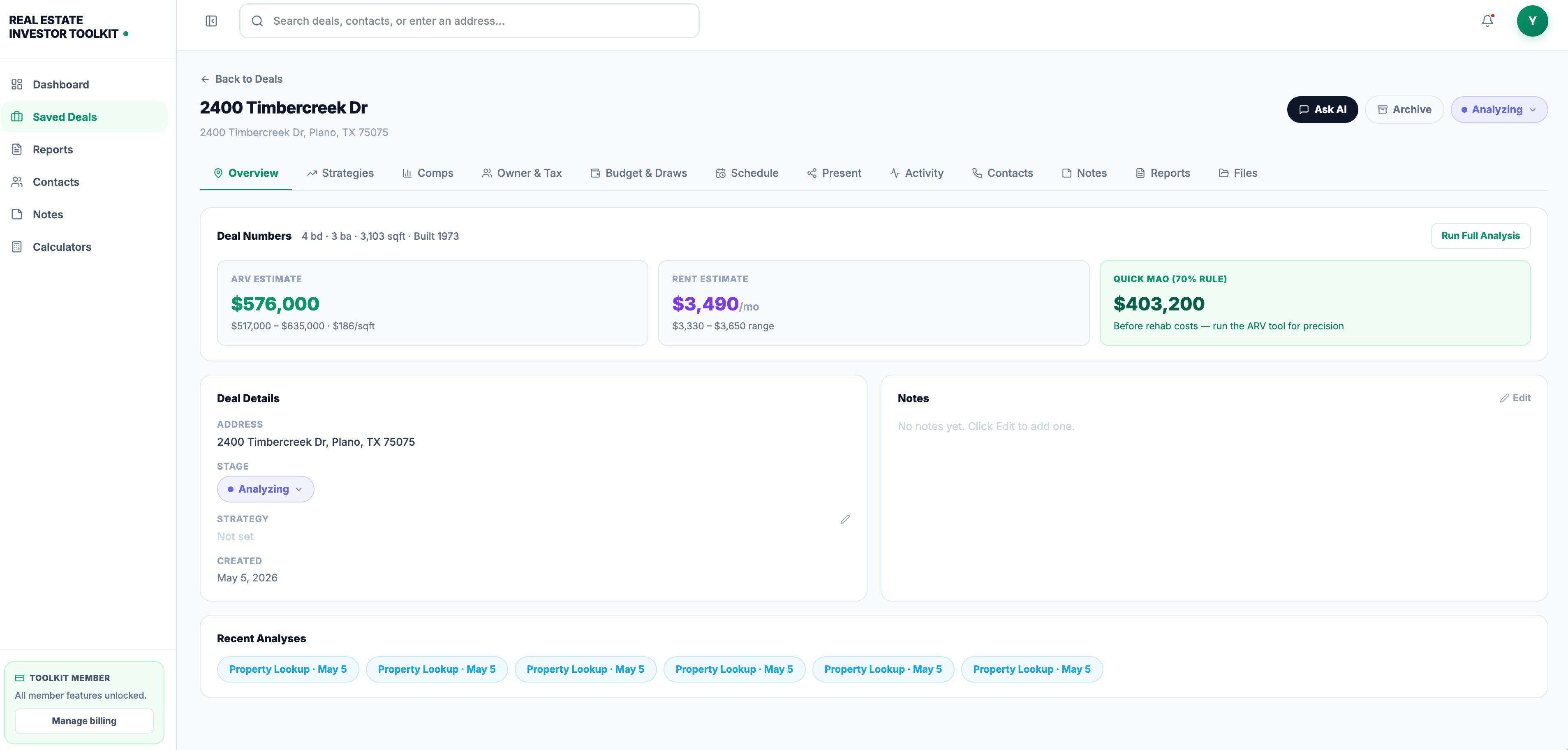
The rental property calculator builds your NOI and cash-on-cash return from actual inputs. The investment property financing calculator models debt service and DSCR at any rate and term. The ARV calculator and rehab cost estimator handle value-add and fix-and-flip deals. For BRRRR investors, the BRRRR calculator models the full cycle from acquisition through refinance. Basic calculators require no signup. Run your next deal’s numbers at Real Estate Investor Toolkit before you make an offer.
Useful sources and further reading
These primary authorities and guides were used to build this article. Each covers a specific piece of the underwriting process.
- What is real estate underwriting? — Investopedia
- What Is Underwriting? | PNC Insights
- Real property appraisal — The Appraisal Foundation
- Appraisal Institute
- How to Analyze a Real Estate Deal in 2026: The 5-Step Checklist That Kills Bad Deals Before You Sign | REI Prime
- What Is Commercial Real Estate Underwriting? The Definitive 2026 Guide | LenderBox
- How to Underwrite a Property: Step-by-Step Process — LegalClarity
State-level variation applies to appraiser licensing hours, lender regulations, and environmental disclosure requirements. Verify your state’s specific rules through the Appraisal Foundation’s state licensing directory or your state’s department of financial institutions. This article provides general information, not legal or financial advice. Confirm current guidelines with a licensed professional or the relevant regulatory body before making investment or lending decisions.
Recommended
- How to Pull Comps in Non-Disclosure States Without Fooling Yourself — Real Estate Investing Guide | Real Estate Investor Toolkit
- Blog | Real Estate Investor Toolkit | Real Estate Investor Toolkit
- When the 70% Rule Works, When It Breaks, and What to Use Instead — Real Estate Investing Guide | Real Estate Investor Toolkit
- How to Underwrite BRRRR Refinance Risk Before It Wrecks the Deal — Real Estate Investing Guide | Real Estate Investor Toolkit