3 State Examples: Estimate U.S. Property Tax From County Mill Rates

Enter your property’s location and purchase price into a county assessor tool or a location-aware calculator, then subtract any exemptions to get taxable value and multiply by the local mill rate. That’s your estimate. County assessor sites and state comptroller pages give you the most accurate inputs, and a tool like Real Estate Investor Toolkit can help you plug the result straight into rental or purchase underwriting. Just know that a sale often triggers reassessment, so the number you land on today can shift once the county recalculates.
TL;DR:
- Real estate investors should prioritize county assessor estimators and local millage tables over generic online tools for more accurate property tax calculations.
- Properties sold or transferred often trigger reassessments, causing the tax bill to increase significantly in the year after purchase, which can impact mortgage escrow amounts.
- Property tax estimates should incorporate assessment ratios, exemptions, and non-ad valorem assessments for a precise calculation tailored to the specific parcel.
- Reliable tools use official millage data, allow detailed input of assessment and exemption details, and provide current rate information directly from local authorities.
- The annual property tax estimate must be integrated into overall financial modeling and cash-flow analysis to avoid overestimating rentability or underestimating costs.
Table of Contents
- What Determines Your Property Taxes Estimate
- How Property Tax Calculators Actually Run the Numbers
- Where to Find Real Millage Rates and Assessor Data
- Three Worked Examples: California, Florida, and Texas
- Why Your Tax Bill Can Change Right After Closing
- What Makes a Property Tax Estimator Trustworthy
- How to Estimate Property Tax With a Calculator, Step by Step
- What Most Buyers Get Wrong About Tax Estimates
- Get Your Property Tax Number Into a Real Underwriting Model
- Where to Verify Your Numbers
- Sources
What Determines Your Property Taxes Estimate
Your property tax bill comes down to three numbers: assessed value, assessment ratio, and mill rate. Assessed value is what the county says your property is worth for tax purposes, which is often different from market value. Some states assess at 100% of market value; others use a fraction. The assessment ratio converts market value into taxable value, and the mill rate (tax per $1,000 of taxable value) is set by every taxing body that touches your parcel.
A basic formula looks like this: taxable value = (market value × assessment ratio) minus exemptions, then tax owed = taxable value × mill rate.
Multiple authorities usually stack onto one bill:
- County government
- City or municipal government
- School district
- Special districts (fire, water, drainage, or utility)
Common exemptions reduce taxable value before that math happens, including homestead exemptions for primary residences, senior citizen reductions, and veteran exemptions. Each one changes your final number meaningfully, so any credible property tax calculator needs a field for them.
How Property Tax Calculators Actually Run the Numbers
A calculator worth trusting needs specific inputs, not just a ZIP code and a guess. Here’s what to plug in and why each field matters:
- Purchase price or current market value — the starting point for taxable value.
- Current assessed value, if you know it — useful when a property hasn’t sold recently.
- Assessment ratio for your state or county — some places tax full market value, others tax a percentage.
- Local millage rate — the combined rate from every taxing authority on the parcel.
- Homestead or exemption status — knocks dollars off taxable value before the rate applies.
- Non-ad valorem assessments — flat fees for things like fire service or drainage that aren’t based on value at all.
The math runs two equivalent ways. Using mills: tax = (taxable value ÷ 1,000) × mill rate. Using an effective rate: tax = taxable value × effective tax rate (a decimal, like 1.1%). Both get you to the same number if your inputs match.
Statistic Callout: Pinellas County’s estimator assumes just/market value equal to 89% of your purchase price and applies the most recently certified millage rate, not a projected future one. That’s a real-world example of the kind of assumption baked into most public tools, and it’s exactly why generic statewide-average calculators fall short for a specific parcel.
Where to Find Real Millage Rates and Assessor Data
Skip generic web estimates and go straight to the source. County assessor offices and state revenue departments publish the actual millage rates and assessment rules that apply to your specific parcel, not a statewide blend.
To pull accurate numbers, search your county assessor’s site using your property’s APN (assessor’s parcel number) or street address. That lookup usually surfaces the current assessed value, homestead status, and the certified millage table for the tax year in question.
A few starting points worth bookmarking:
- Texas Comptroller of Public Accounts links out to every local appraisal district in the state.
- Michigan’s Property Tax Estimator lets you compare millage across local units using assessed value.
- Pinellas County’s tax estimator shows how a Florida county builds its estimate from purchase price assumptions.
- Nevada’s Department of Taxation aggregates county-level resources for assessment and appeals.
Every state runs this differently, so treat your own county assessor as the final word over any third-party tool.
Three Worked Examples: California, Florida, and Texas
Property tax rules vary enough state to state that the same $400,000 home can generate wildly different bills. Here’s how the math plays out in three of the largest markets for real estate investors.
California taxes under Proposition 13, which caps assessed value growth at 2% annually regardless of market appreciation, but a sale resets that assessment to the new purchase price. Buy a home for $500,000 and the county reassesses at roughly that number, with a base rate near 1% plus local voter-approved add-ons.
Florida uses a homestead exemption up to $50,000 off assessed value for primary residences, plus a portability provision letting owners carry accumulated tax savings to a new home. A non-homesteaded Florida property gets no such cushion.
Texas has no state income tax, so property taxes run higher, but large school-district homestead exemptions (commonly $100,000 off school-tax value) soften the blow significantly for owner-occupants.
Divide any of those annual figures by 12 and you’ve got the property tax portion of a monthly escrow payment, before insurance and principal.
Why Your Tax Bill Can Change Right After Closing
The tax bill you saw during your home search often reflects the seller’s assessed value, not yours. Most states reassess a property when it changes hands, typically effective the following January 1, which means your first full year of ownership can carry a materially higher bill than what the listing showed.
That gap is exactly how escrow shortages happen. Lenders frequently set your initial escrow based on the seller’s prior tax bill, and when the county resets the assessment to your purchase price, the resulting shortfall shows up as a jump in your monthly mortgage payment the following year.
Before closing, run through this checklist:
- Check your county assessor’s reassessment timing and rules.
- Ask the seller or title company for the property’s current assessor record, not just the tax bill.
- Recalculate the estimate yourself using your purchase price, not the seller’s assessed value.
- Search the parcel for pending special assessments (new sewer lines, road improvements, or bond levies) that haven’t hit the tax roll yet.
Pro Tip: Save a screenshot of every input you used in a county estimator, including the millage year and exemption assumptions. If your first bill comes in higher than expected, that snapshot is your evidence for an appeal or an escrow dispute.
What Makes a Property Tax Estimator Trustworthy
Not every online calculator deserves your trust. Before you rely on a number for budgeting or underwriting, check it against this list:
- Uses officially certified millage data, not a rounded statewide average.
- Lets you input assessment ratio and exemption status separately.
- Discloses which millage year the rate comes from.
- Accepts parcel number, ZIP code, or full address, not just a city name.
- Shows the downstream escrow or monthly payment impact, not just an annual figure.
Statistic Callout: Effective-rate calculators built from statewide median tax divided by median home value work fine for comparing states, but they’re the wrong tool for budgeting a specific purchase. A parcel-level estimator that uses your actual purchase price and local millage gets you much closer to the real number.
Real Estate Investor Toolkit’s calculators are built around that same discipline. Every input, purchase price, location, and exemption status, feeds into estimates that mirror how county assessors actually calculate a bill, and the outputs connect directly into rental cash-flow and mortgage payment tools so you’re not estimating tax in isolation from the rest of the deal.
How to Estimate Property Tax With a Calculator, Step by Step
Running a real estimate takes about two minutes once you know the sequence. Start with your property’s address or parcel number, since that’s what lets a calculator pull the correct taxing jurisdiction instead of guessing from a ZIP code that might span multiple districts.
Next, enter the purchase price or current market value. If you already know the county’s assessed value from a prior tax bill, add that too. It gives the calculator something to cross-check against.
Then select your exemption status. Are you buying this as a primary residence eligible for a homestead exemption, or is this a rental or investment purchase with no owner-occupant discount? This single choice can swing your estimate by hundreds or thousands of dollars a year, so don’t skip it.
Finally, confirm the millage year the tool is using. Rates change annually as school districts, cities, and counties adjust budgets, so a calculator using a rate from two years ago will understate what you’ll actually owe.
Once you have the annual number, divide by 12 to see the monthly impact, then add it to your other holding costs, insurance, principal, and interest, to get a full picture of what the property will actually cost you each month. Investors running rental numbers should feed that tax line directly into a rental cash-flow calculator rather than eyeballing it, since even a small miss on annual tax can flip a deal’s cap rate.

What Most Buyers Get Wrong About Tax Estimates
Most advice on this topic treats property tax estimation as a one-time task you finish before closing. That’s backwards. The estimate you calculate before you buy is really just a starting point for how you underwrite the property over the next several years, especially if you’re holding it as a rental.
The conventional wisdom leans too hard on generic online calculators that use statewide averages. Those tools are fine for a rough gut check, but they routinely get the specifics wrong for exactly the properties investors care about most: recently sold parcels headed for reassessment. If you’re underwriting a deal based on the seller’s old tax bill instead of a post-sale reassessment, you’re underwriting a fantasy number, not a real one.
What should you prioritize first? Go straight to the county assessor’s own estimator or millage table before trusting any third-party number. Then run that figure through your actual holding-cost math, not a mental estimate. A tax line that’s off by $150 a month is the difference between a rental that cash flows and one that quietly bleeds you for years.
— Michael
Get Your Property Tax Number Into a Real Underwriting Model
A one-off tax estimate is only useful if it feeds into the rest of your numbers with expert guidance from San Diego Cash For Houses. Real Estate Investor Toolkit lets you enter a property’s location, purchase price, and exemption status, then carries that estimate straight into your holding-cost math instead of leaving it stranded in a separate spreadsheet.
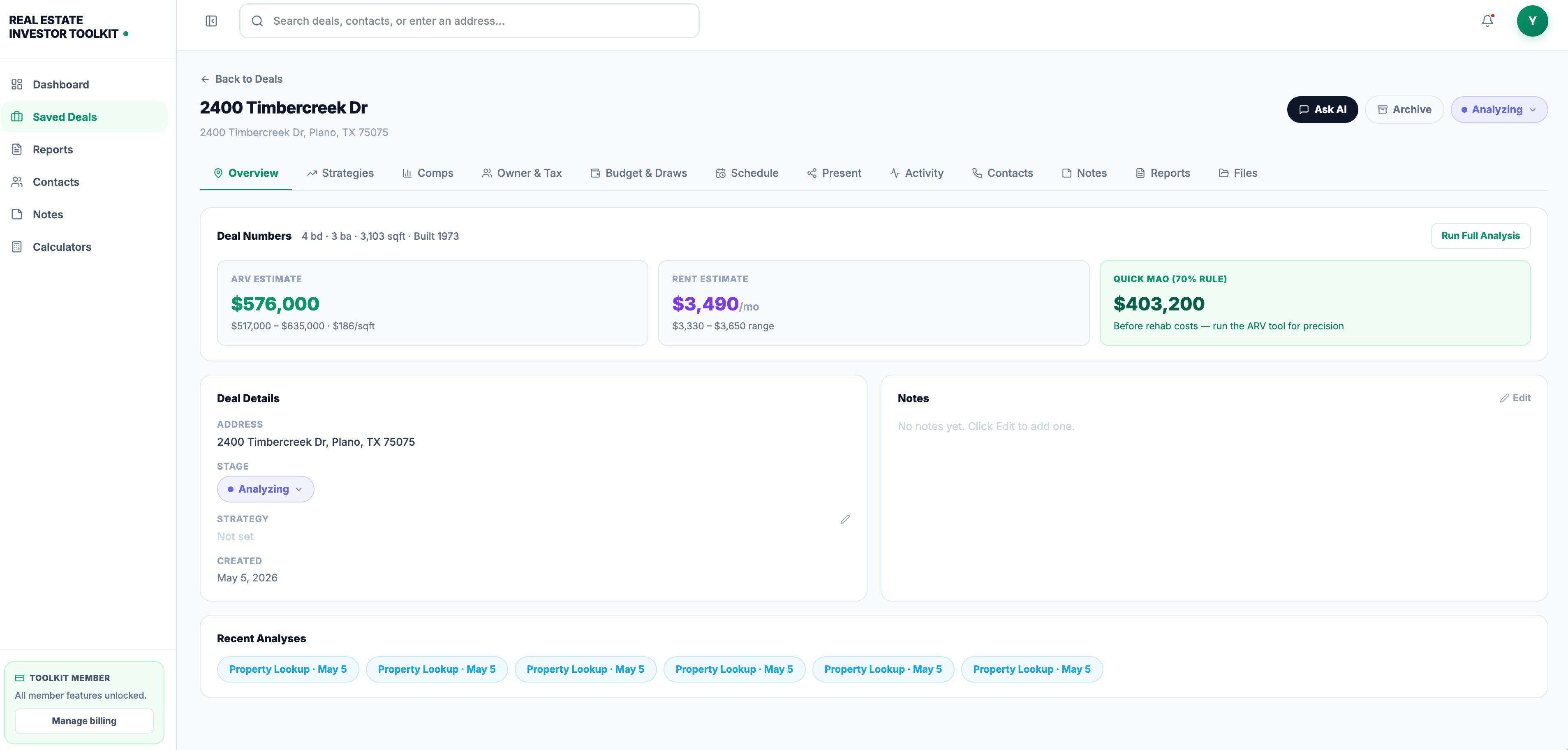
Once you’ve got your estimate, you can save it, export it, or run it directly through the rental cash-flow calculator to see how property tax affects your cap rate and monthly return. If you’re financing the purchase, the investment property financing calculator shows exactly how that tax line changes your monthly payment once escrow is factored in. No sign-up required to run either one. Just enter your numbers and see the deal as it actually pencils out, before you’re locked into a purchase price that doesn’t work.
Where to Verify Your Numbers
For parcel-level accuracy, check your state’s official resources directly: the Texas Comptroller’s property tax hub, Michigan’s Property Tax Estimator, and county tools like Pinellas County’s estimator. For broader housing-value context, the Census ACS housing tables show value distributions by area, and the IRS’s homeowner tax topic explains how property taxes interact with itemized deductions.
This article is general information, not a substitute for advice from a qualified financial advisor. Consult a qualified financial professional about your own circumstances before acting on anything here.
Sources
- Tax Estimator | Pinellas County Property Appraiser
- Property Tax Estimator | Michigan Department of Treasury
- Property tax | Texas Comptroller of Public Accounts
- ACS table: Value of owner-occupied housing units