Property Owner Lookup: Find Who Owns Any U.S. Property

The fastest path to a property owner lookup in the United States runs through three free official sources: the county assessor (current tax owner, parcel number, and mailing address), the county recorder or register of deeds (the legal deed and chain of title), and the county GIS parcel viewer (visual boundary confirmation). For multi-property or batch searches, Real Estate Investor Toolkit consolidates owner reports, absentee-owner flags, and APN mapping in one place. Start with the assessor, verify with the recorder, and confirm the parcel on the GIS map.
Key Takeaways
The fastest, most reliable property ownership search in the U.S. starts at the county assessor, verifies through the county recorder’s deed index, and confirms parcel identity on the GIS viewer.
| Point | Details |
|---|---|
| Start at the county assessor | The assessor portal returns the current tax owner, APN, and mailing address for free at most counties. |
| Verify with the recorded deed | The county recorder’s grantor/grantee index is the authoritative legal record; always confirm the assessor name matches the most recent deed. |
| Use the APN as your pivot | Once you have the parcel number, every subsequent search across recorder, GIS, and data platforms becomes faster and more reliable. |
| Escalate for LLCs and trusts | Trace the deed chain, check mortgage signatories, and run a Secretary of State entity search to find the individual behind an entity owner. |
| Real Estate Investor Toolkit for batch work | The platform consolidates owner reports, absentee-owner flags, and county source links for multi-property lookups without manual portal switching. |
Table of Contents
- How do you check who owns a property? Step-by-step
- Why county portals are the right starting point for any ownership search
- What each public record type shows and which fields return owner data
- When an online search fails: how to escalate and request records officially
- Common complications: LLCs, trusts, and absentee owners
- Typical fees, turnaround times, and privacy limits
- How Real Estate Investor Toolkit speeds up owner lookups
- An investor’s quick workflow for a property ownership check
- Real Estate Investor Toolkit gives you owner reports without the county-by-county grind
- Sources
How do you check who owns a property? Step-by-step
Follow these steps in order. Each one builds on the last.
-
Identify the correct county. Every U.S. property record lives at the county level. If you’re not sure which county the address falls in, type the full street address into Google Maps and check the county label, or use the USPS ZIP code lookup to confirm the city/county pairing.
-
Search the county assessor portal. Go to the county assessor (sometimes called the property appraiser or tax collector, depending on the state). Enter the full street address, owner name, or parcel/APN number. The county assessor portal typically returns the current tax owner, APN, assessed value, and mailing address for free.
-
Record the APN. The parcel number (also called APN, PIN, folio, or parcel ID depending on the state) is your pivot point for every subsequent search. Write it down.
-
Open the county recorder or register of deeds. Search by APN or owner name to pull the recorded deed. The recorder holds the authoritative legal record of ownership transfers, including deeds, mortgages, and liens. Some offices offer free online access; others charge a nominal per-page fee.
-
Confirm on the GIS parcel viewer. County GIS portals layer property boundaries on an interactive map. Click the parcel to verify the APN, lot boundaries, and any linked assessor data. NETR Online maintains a directory of county assessor, recorder, and GIS portals when you need to locate the right county site quickly.
-
Cross-check a free national aggregator. Tools like AssessorSearch can match an address or APN to assessor and recorder sources, but owner-field availability varies by county. Always verify against the county original.
Quick troubleshooting:
- No results returned: Confirm the county, try abbreviating the street name (St vs. Street), and omit unit numbers for multi-unit buildings.
- Result shows an LLC or trust: The entity is the legal owner of record. See the complications section below for next steps.
- Searching at scale: When you need owner data on dozens of properties, a paid data platform saves hours. BatchData and similar services aggregate county records and add skip-trace contact enrichment for a fee.
Why county portals are the right starting point for any ownership search
Property records in the United States are not centralized at the federal or state level. They live at the county, and sometimes the municipal, level. Understanding this split saves you from chasing the wrong portal.
Each county typically maintains three separate offices that hold different pieces of the ownership picture: the assessor (tax roll and valuation), the recorder or register of deeds (legal instruments), and the GIS department (parcel maps). A state-level directory may link to all three, but the records themselves sit at the county.

To find the right county portal, start with a Google search for “[county name] assessor” or “[county name] recorder.” If the county name is unclear, state guidance pages can help. Massachusetts, for example, publishes a property records guide that directs users to municipal assessors and explains local naming conventions. Many states have similar help pages.
Naming conventions vary widely. In Florida, the assessor function is called the property appraiser. In some Louisiana parishes, the equivalent office is the tax assessor. In New York, records are split between county and town levels. When a county page is hard to find, NETR Online’s public records directory collects links to assessor, recorder, and GIS portals organized by state and county.
Pro Tip: Some county assessor portals, such as Clark County, Nevada’s real property search, include direct links to parcel maps and recorder images right from the assessor result page, cutting out a separate recorder search entirely.
What each public record type shows and which fields return owner data
Different record types answer different questions. Knowing which document to open saves time.
| Record Type | Typical Fields | Best Used When |
|---|---|---|
| Assessor file | Owner name, mailing address, APN, assessed value, tax status | Starting a lookup; confirming current tax owner |
| Recorded deed | Grantor, grantee, legal description, book & page, sale date | Verifying legal ownership; tracing chain of title |
| Mortgage / lien | Borrower name, lender, loan amount, recording date | Identifying individuals behind LLCs; checking encumbrances |
| Tax bill | Owner name, mailing address, tax year, payment status | Finding absentee-owner mailing addresses |
| Parcel / GIS map | APN, lot boundaries, acreage, zoning | Confirming parcel identity visually |
Key abbreviations to know:
- APN (Assessor’s Parcel Number): the universal parcel identifier used by most western states
- PIN (Parcel Identification Number): common in Illinois and the Midwest
- Folio: Florida’s equivalent of the APN
- Book & page: the recorder’s filing reference for a specific deed image
- Grantor/grantee index: the recorder’s searchable index of sellers (grantors) and buyers (grantees) by name
The recorder’s grantor/grantee index is the authoritative legal record for ownership transfers, and it is the right tool when the assessor’s tax roll shows an outdated owner or an entity name. A deed is the legal instrument that transfers title; the recorder maintains the index and images that prove chain of title.
Sample search logic: enter “123 Main St, Anytown, CA” into the assessor portal to get the APN and owner name. Then take that APN into the recorder’s search to pull the most recent deed image and confirm the grantee matches the assessor’s listed owner.
When an online search fails: how to escalate and request records officially
Not every county has fully digitized records. When the online portal returns nothing useful, work through this escalation path.
- Re-check the county boundary. Properties near county lines are sometimes indexed under the adjacent county. Confirm the correct jurisdiction before escalating.
- Search the recorder’s grantor/grantee index by name or APN. Even when deed images aren’t online, the index itself is often searchable and will confirm whether a deed was recorded.
- File a public records request. Email or call the recorder’s or assessor’s office directly. Include: the full property address, the APN if known, the record type you need (deed, tax record, lien), and your preferred delivery method. Most offices respond within a few business days for straightforward requests, though mailed certified copies can take one to three weeks depending on the county’s digitization level.
- Visit in person. County clerk and recorder offices are open to the public. Bring the address and APN. Staff can pull physical deed books for older records that were never digitized.
When the owner of record is an LLC, run a Secretary of State business entity search in the state where the LLC was formed. This returns the registered agent and sometimes the managing member, though it rarely names the beneficial owner directly. For trusts, the deed itself names the trustee, which is the starting point for further research.
Fees for public records access vary by county and are typically nominal when required. Certified copies of deeds generally run a few dollars per page. A full title report from a title company costs more but provides a complete, insured chain of title, which is worth the expense when a transaction or dispute is involved.
Contact template for a recorder or assessor inquiry:
Common complications: LLCs, trusts, and absentee owners
An LLC or trust as the owner of record is not a dead end. It just requires a few extra steps.
- Trace the deed chain. Open the full deed history in the recorder’s grantor/grantee index. Prior grantees are often individuals, and earlier deeds may name the person who transferred the property into the entity.
- Check mortgage documents. When an LLC took out a loan to buy the property, the mortgage signatory is often an individual. LLC filings, registered agent details, and deed signatories provide investigative leads; trusts generally do not file beneficiary details publicly.
- Run a Secretary of State entity search. Search the state where the LLC was formed. You’ll get the registered agent’s name and address, the formation date, and sometimes the organizer’s name.
- Check UCC filings. If the property owner filed a UCC financing statement, the debtor name may be an individual even when the deed is in an entity name.
- Review probate and court records. For inherited properties or disputed ownership, county probate filings and PACER (federal court records) can name individuals connected to the property.
- Look at deed-in-lieu and foreclosure records. Documents like deeds in lieu of foreclosure sometimes appear in recorder indexes and can reveal prior individual owners or lenders connected to a property.
Pro Tip: Search the tax mailing address across multiple parcels. When the same mailing address appears on several properties owned by different LLCs, it often points to a single controlling person or management company. Repeated signatures on deed documents across a portfolio are another reliable tell.
Typical fees, turnaround times, and privacy limits
Free vs. paid lookups:
- Assessor basic owner and APN lookup: free at most county portals
- Recorder index search: free at most counties; document images sometimes carry a nominal per-page fee
- Certified deed copies: typically a few dollars per page, paid to the county
- Full title report: priced by the title company, usually in the range of a few hundred dollars for a residential property
- Commercial data platforms: subscription or per-search pricing, with added skip-trace contact data
Turnaround times:
- Online assessor or recorder search: immediate
- Emailed records request: a few business days for most counties
- Mailed certified copies: one to three weeks, depending on county staffing and digitization level
- In-person visit: same day in most cases
What is never public: Social Security numbers, bank account details, and personal financial records are not part of any public property record. Owners who use a trust or a registered agent service can legally obscure their personal mailing address from the tax roll.
Verifying accuracy: Always compare the assessor’s listed owner name against the most recent recorded deed. A mismatch often means the property transferred recently and the assessor’s roll hasn’t updated yet. The recorder’s deed is the controlling legal document in that case.
How Real Estate Investor Toolkit speeds up owner lookups
For a single property, the free county path described above works well. For investors running due diligence on multiple properties at once, the manual county-by-county process adds up fast.
Real Estate Investor Toolkit is the publisher of this article and the consolidated owner-report option recommended here. The platform pulls owner data, absentee-owner indicators, APN mapping, and links to underlying county assessor and recorder documents into a single report. For batch workflows, the DealFlow platform lets you upload a list of addresses and pull owner reports across multiple counties without switching between portals.
When to use the Toolkit vs. free county searches:
- Single property, no time pressure: the free county path is sufficient
- Multiple properties or batch outreach lists: the Toolkit saves significant time
- Absentee-owner targeting: the absentee-owner flag surfaces properties where the tax mailing address differs from the property address, a key signal for investor outreach
- Verification step: always follow county links in the report back to the original assessor or recorder page to confirm the data is current
After confirming ownership, you can move directly into deal analysis using the Toolkit’s ARV calculator, rehab cost estimator, or rental property calculator without leaving the platform.
An investor’s quick workflow for a property ownership check
When I approach a new address, the sequence is consistent: confirm the county first, then pull the APN from the assessor, then open the recorder to verify the deed matches.
- Confirm county → pull APN → open deed: I type the address into the county assessor portal, record the APN immediately, then open the recorder’s grantor/grantee index with that APN to pull the most recent deed image. I screenshot the deed and log the recorder’s URL and the book & page reference for later verification.
- Save the parcel number and source URL: The APN is the key that unlocks every subsequent search across the recorder, GIS, and any data platform. Saving it at step one prevents redundant work later.
When a title dispute or complex lien situation surfaces, that’s the moment to hand off to a title company or real estate attorney. Public records research gets you to the owner; a title professional gets you to a clean, insured answer.
Real Estate Investor Toolkit gives you owner reports without the county-by-county grind
Pulling owner data manually across multiple counties works, but it takes time you could spend analyzing deals.
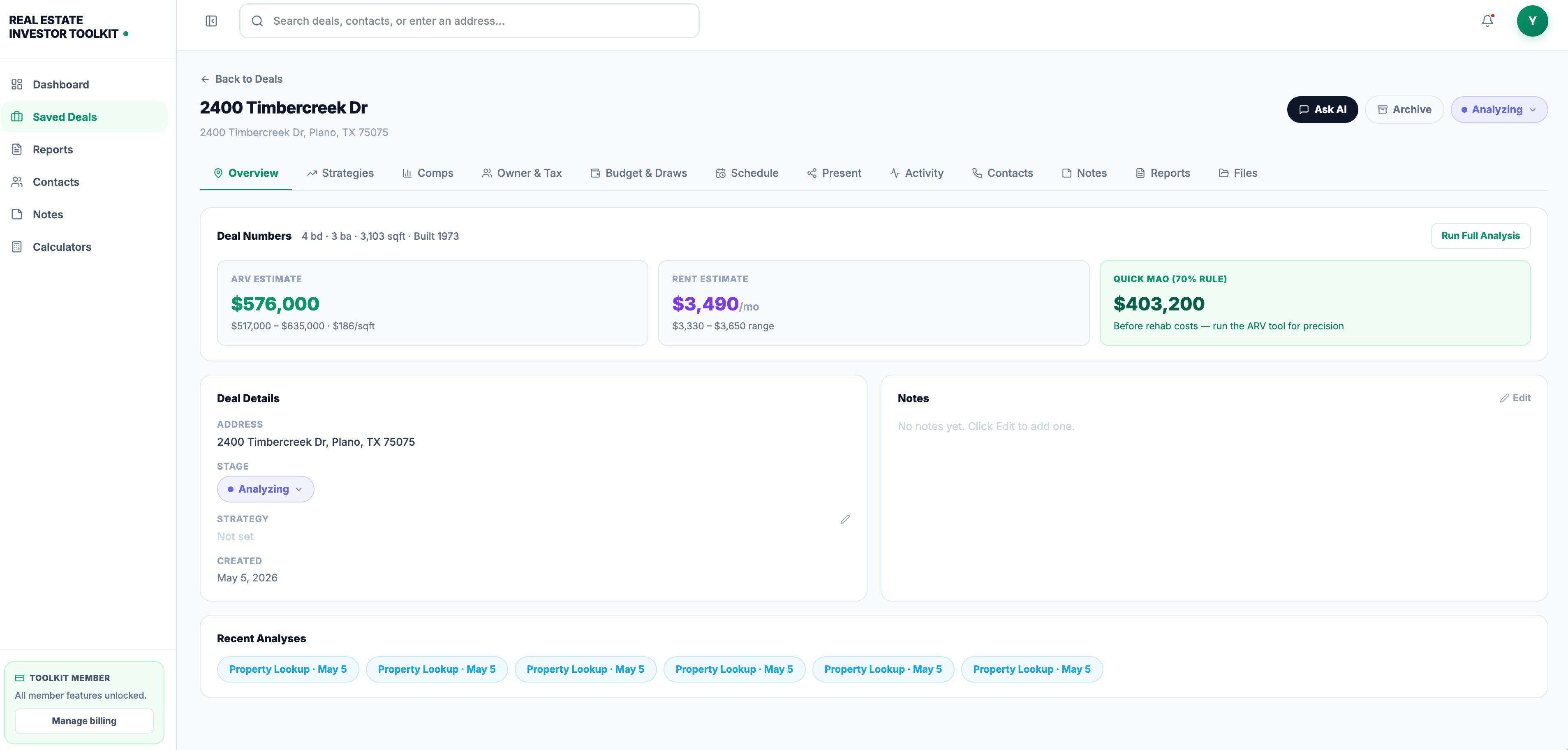
Real Estate Investor Toolkit gives investors a faster path: enter an address or upload a batch list, and the platform returns owner name, absentee-owner status, APN, and direct links to the underlying county assessor and recorder records for verification. No switching between a dozen county portals. No reformatting spreadsheets. The DealFlow platform handles batch owner lookups and keeps your pipeline organized in one place.
Free calculators are available without signing up. Paid subscriptions unlock unlimited owner reports, batch exports, and the full suite of deal-analysis tools. Check the pricing page to see which tier fits your volume. Start with a free single lookup at Realestateinvestortoolkit and run your first owner report today.
Sources
Use these as your primary starting points. Prefer original county links for final verification.
- How To Find Out Who Owns A Property You Want
- NETR Online • Public Records, Search Records, Property Tax …
- Real Property Records Search - Assessor
- Finding Your Property Records
- Free Property Owner Search by Address - Find the Owner’s Name | AssessorSearch
Recommended
- How to Find Off-Market Investment Properties — Real Estate Investing Guide | Real Estate Investor Toolkit
- Rental Property Calculator — Cash Flow, Cap Rate & ROI | Real Estate Investor Toolkit
- Investment Property Financing Calculator | Real Estate Investor Toolkit
- Blog | Real Estate Investor Toolkit | Real Estate Investor Toolkit