Property Data APN Lookup: A Fast Workflow for Investors

Use the county assessor or recorder portal first. For scale, use a property-data API with the APN and county FIPS code to return owner, tax, deed, permits, and comps in one pull. An APN, short for assessor’s parcel number, is the identifier your county uses to track a specific piece of land, its improvements, its tax status, and its assessment history.
To resolve one right now, you need just two things: the APN itself (or a street address plus county) and access to that county’s assessor site. In return, a clean lookup gives you the current owner of record, assessed value, tax status, deed reference, open permits, and a starting point for comps.
- Grab the APN or address, plus county name
- Search the county assessor or recorder portal directly
- For bulk or repeated pulls, query a property-data API like AssessorSearch
- Note the “last updated” or effective date on every record you pull
Key Takeaways
Resolving a property’s APN through a county assessor portal, then routing the resulting fields into an ARV and rehab calculator, is the fastest reliable path from raw lead to underwriting decision.
| Point | Details |
|---|---|
| Start with the assessor portal | County assessment rolls are the authoritative source for legal description, assessed value, and tax status. |
| Normalize your APN input | Try with and without dashes, and check for county-specific prefixes before assuming the record doesn’t exist. |
| Cross-check recorder and permits | Verify ownership through recorded deeds and confirm permit history before finalizing any rehab scope. |
| Always log the update date | Assessment rolls update on a cycle, so a “current” record can still be months behind a recent sale. |
| Automate at scale, verify at the deal | Use a property-data API for bulk pulls, but confirm high-potential leads with certified county documents; feed the resulting fields into Real Estate Investor Toolkit’s ARV and rehab calculators to move straight into underwriting. |
Table of Contents
- How Do You Look Up Property Data by APN?
- Which Public Records Give You the Most Reliable Data?
- What APN Formatting Tricks Improve Your Search Results?
- How Do You Verify an APN Record Is Accurate?
- From APN to Underwriting: What Comes Next?
- Run Your APN-Derived Numbers Through Real Estate Investor Toolkit
- Sources
How Do You Look Up Property Data by APN?
Every county formats its parcel data a little differently, but the underlying workflow doesn’t change much once you’ve done it a few times. Treat it as a five-step sequence, and you’ll rarely get stuck.

1. Normalize the input. APNs show up with dashes, without dashes, and sometimes with alphabetical prefixes tied to a map book or subdivision. If a search returns nothing, strip the dashes and try again, or add them back in the county’s documented format. When you only have a street address, that works too. Most assessor portals index both APN and address fields.
2. Query the assessor’s site first. This is your primary source for parcel number, site address, assessed value, land use code, and property type. Copy these fields into your notes exactly as shown, including any legal description language, since that’s what ties the record to the actual land.
3. Expand to the recorder for deed history. The recorder’s office holds the actual conveyance documents: grantor, grantee, deed book/page or document number. This is where you confirm who legally holds title, not just who the assessor’s database currently lists.
4. Check the tax collector and permit readiness before your Miami-Dade property sale. The treasurer’s office shows current tax amounts and whether the property is delinquent. A separate municipal permit system (often not linked to the assessor at all) shows open permits, which tells you what work has and hasn’t been legally completed.
5. Automate when you’re working a list, not a single address. A property-data API that accepts an APN plus county FIPS code returns a structured JSON record with owner, assessed value, last sale, and tax data in one call, which beats opening a dozen browser tabs when you’re screening 50 addresses.
Pro Tip: Save the assessor’s PDF parcel report or appraisal card if the county offers one. It’s a dated snapshot you can drop straight into your deal file, which matters if a record changes before you close.
Which Public Records Give You the Most Reliable Data?
Each source in the public-records ecosystem answers a different question, and treating them as interchangeable is where a lot of lookup mistakes start.
The assessor’s office is your first stop and your most authoritative one for tax-related facts. County assessment rolls are the authoritative public record for legal descriptions, assessed values, and parcel maps, and many offices, including Ada County, Idaho, offer downloadable property records with search help built into the portal itself. When precision matters for a legal or financial decision, this is the record you cite, not a summarized version from somewhere else.
The recorder holds deeds and other recorded conveyances, which is where you verify the actual chain of title rather than a snapshot of “current owner” shown elsewhere.
The tax collector or treasurer shows current tax amounts, payment status, and delinquencies, separate from the assessed value itself.
Permit portals and municipal GIS systems show building permits and interactive parcel boundary maps, often hosted by the city or county planning department rather than the assessor.
Third-party APIs like AssessorSearch add convenience on top of all of this: bulk lookups, normalized APN formats across counties, and JSON responses built for automation rather than manual browsing. County portal behavior itself varies widely. Some, like Sonoma County’s assessor search, allow search by owner name, address, or parcel number with an interactive GIS map layered on top, while others restrict certain fields entirely.

What APN Formatting Tricks Improve Your Search Results?
A surprising number of “failed” lookups aren’t data problems. They’re formatting mismatches between what you typed and what the portal expects.
- Try the APN both with and without dashes. Some counties store it one way in the database but display it another way on tax bills.
- Watch for alphabetical prefixes (M, O, R, S, and similar county-specific codes) that indicate map book type or parcel subtype; dropping them can break the search.
- If an address search returns nothing, try a partial address or just the street name. Many assessor portals, including Travis Central Appraisal District’s search tool, accept partial matches and list their accepted input formats directly on the search page.
- Some counties skip newly recorded sales until the next assessment cycle, a quirk Riverside County’s portal documents in its own search guidance.
- Check for label differences: PIN, folio number, and SBL (section/block/lot) all refer to the same concept as APN in different states. Keep a running alias note for every county you work in so you’re not relearning this each time.
How Do You Verify an APN Record Is Accurate?
Speed is only useful if the data underneath it is trustworthy. Before you act on any pulled record, confirm the source date, and never assume a portal’s “current” tab reflects this week’s reality.
- Capture the source’s last-updated or effective date every time. Assessor rolls are updated on a cycle, not continuously, so a record can be technically current and still be months old.
- If owner name searches return nothing, that’s often a privacy restriction rather than missing data. Pull the recorded deed instead, or use a paid ownership report if the deed search doesn’t resolve it.
- Watch for adjacent counties using entirely different numbering systems for what looks like a similar parcel format. That mismatch causes real errors when you’re working a multi-county lead list.
- Third-party data providers can lag the county’s own update cycle by weeks, so a normalization error at the API level can propagate into your notes unnoticed.
Pro Tip: When a deal is close to an offer, skip the summarized version entirely and request a certified copy of the deed directly from the county recorder. It costs a small fee and settles any ambiguity for good.
From APN to Underwriting: What Comes Next?
The point of resolving an APN isn’t the lookup itself. It’s what you do with the fields once you have them.
- Pull the core facts: lot size, building square footage, last sale date and price, current assessed value, tax amount, and any open permit history.
- Layer in recent comps from the assessor’s parcel map or a comps tool, focused on similar square footage and lot size nearby.
- Feed those numbers into an ARV calculator to model post-rehab value, then into a rehab estimator using the permit history as a scope check.
- Use the resulting ARV and rehab estimate to calculate your maximum allowable offer.
Say you resolve an APN and find a house of typical size that last sold several years ago, sitting on a modest lot with no open permits. That’s enough to run a real ARV and rehab pass before you ever call the owner.
Real Estate Investor Toolkit’s ARV calculator and rehab estimator are built for exactly this handoff, taking the raw fields from an APN pull straight into a post-repair value and cost estimate, with several tools open to use without creating an account.
A practitioner’s note on speed versus verification
Most pros triage lead lists fast: resolve the APN, run a quick underwriting pass, then slow down hard for anything promising. Pause for certified deed copies or title work before any offer, and always respect state rules on owner contact.
— Michael
Run Your APN-Derived Numbers Through Real Estate Investor Toolkit
Once you’ve pulled lot size, last sale price, and comps for a property, the slow part of a deal isn’t finding the data anymore. It’s turning that data into a number you can act on. Real Estate Investor Toolkit is built for exactly that gap: paste your APN-derived fields straight into a calculator and get an after-repair value or rehab estimate back in seconds, no account required for a quick check.
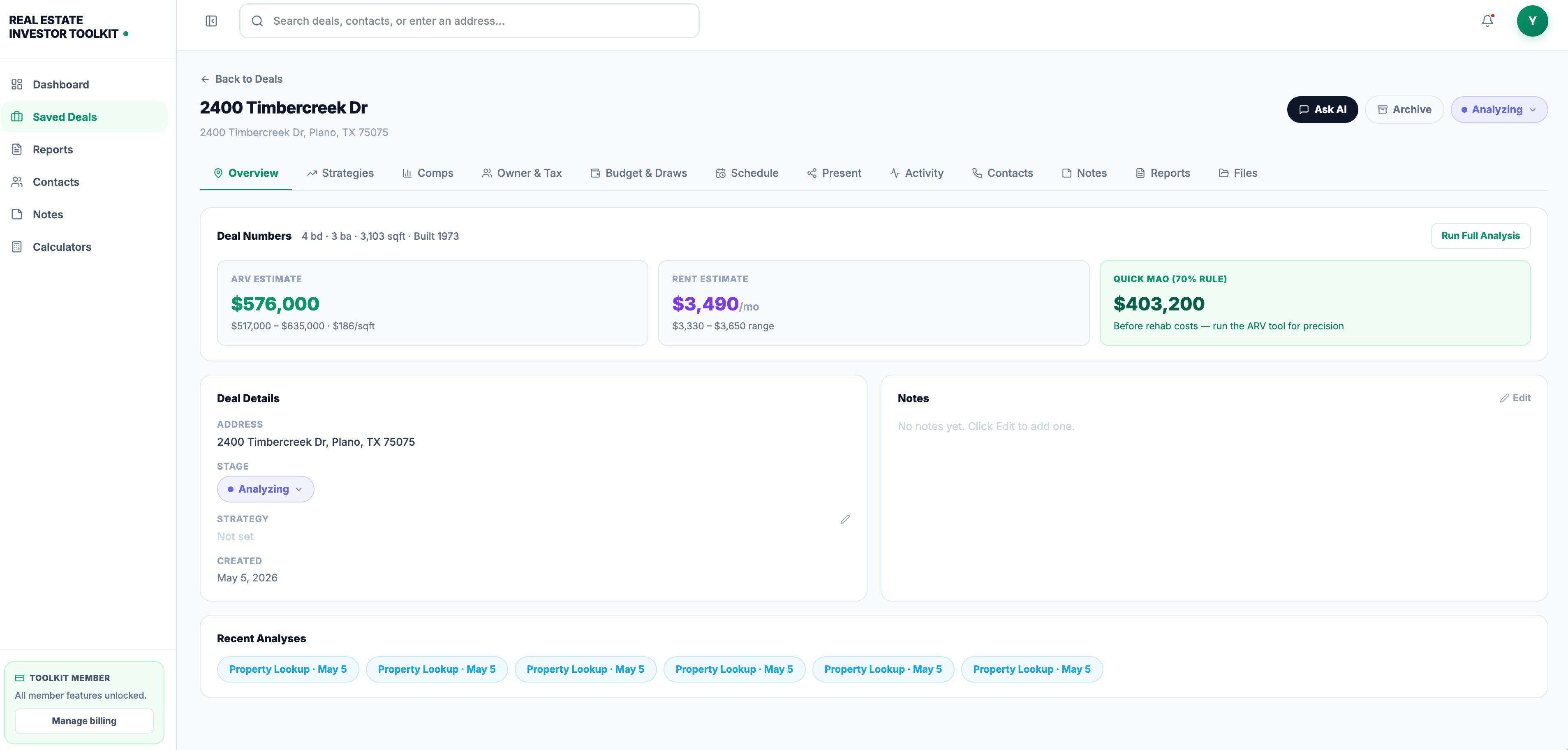
Start with the ARV calculator to turn your comps into a post-repair value, then run the same address through the rehab cost calculator using whatever permit history you pulled from the county portal. If you’re screening leads regularly across multiple counties, the pricing page covers what unlocks with a subscription, including saved deal pipelines and deeper property reports. For a first walkthrough of the full process, the step-by-step deal analysis guide is a solid place to start.
Sources
- Assessor’s parcel number — Wikipedia
- Assessor’s Property Records - Ada County Assessor
- Property Data API for U.S. Property Records | AssessorSearch