Equity First County Verification for U.S. Preforeclosure Lead Analysis

If a pre-foreclosure record shows meaningful equity, your first move is not outreach. It’s verification: confirm the filing type and sale date at the county level, then run ARV and MAO math before you dial a single number. Skip that order and you’ll waste hours chasing leads that are already dismissed, underwater, or in bankruptcy.
TL;DR:
- Confirm the filing type and sale date at the county level before pursuing a preforeclosure lead to avoid wasting effort on dismissed or underwater properties.
- Use county recorder offices for non-judicial states and court dockets for judicial states to accurately source active filings, adjusting your approach based on the state’s foreclosure process timeline.
- Filter leads by equity, owner motivation, filing recency, and lien status, with a maximum age of 90 days for filings to improve conversion rates and prioritize fresh, motivated cases.
- Calculate the maximum allowable offer based on ARV, rehab costs, and liens, ensuring the deal has at least a small profit margin before contact or making an offer.
- Always verify that a foreclosure filing is still active immediately before outreach or closing, especially if the case has indications of being dismissed, postponed, or resolved through bankruptcy.
Table of Contents
- What Is Preforeclosure Lead Analysis?
- Where to Source Preforeclosure Leads
- How to Filter and Score Preforeclosure Leads
- How to Run the Financial Analysis on a Preforeclosure Deal
- How Do You Verify a Filing Is Still Active?
- Outreach and Legal Considerations When Contacting Homeowners
- Tools That Speed Up Preforeclosure Lead Analysis
- Step-by-Step: Analyzing One Preforeclosure Lead in a Single Session
- Why Discipline Beats Speed in Preforeclosure Analysis
- Run Your Numbers Before You Make the Call
- Sources
- FAQ
What Is Preforeclosure Lead Analysis?
Preforeclosure lead analysis is the process of confirming a distressed property’s legal status and financial upside before you spend time or money pursuing it. It combines public-record verification with deal math, and the two halves cannot be separated. A property with equity but a case that’s already been dismissed is worthless to you. A property with an active filing but negative equity is a short-sale problem, not a wholesale opportunity.
Pre-foreclosure begins when a lender files a legal notice against a homeowner who has missed payments, typically after 90 to 120 days of delinquency. That notice takes one of two forms depending on the state, and the difference changes everything about how you source and time your outreach.
- Notice of Default (NOD): used in non-judicial states, where the lender forecloses through a trustee process without going to court. NODs are recorded with the county recorder’s office.
- Lis pendens: used in judicial states, where foreclosure runs through the court system. This filing shows up in court dockets, not recorder databases.
Timelines diverge sharply between the two. Non-judicial states typically move from filing to auction in roughly 90 to 120 days, while judicial states often stretch the same process to 6 to 18 months. That gap dictates your urgency: a lead in a non-judicial state needs same-week action, while a judicial-state lead might sit in a workable window for months.
Finding the right portal matters as much as knowing the timeline. Non-judicial states route you to the county recorder’s public filing search. Judicial states route you to the county court’s civil case docket, sometimes gated behind an e-filing system like Odyssey or a state-specific portal. Confirm which system your target county uses before you build any sourcing workflow around it.
Where to Source Preforeclosure Leads
Public pre-foreclosure filings are free to access but scattered across thousands of county systems with no shared format. Your sourcing strategy needs to combine primary filings with secondary confirmation signals, whether you pull records by hand or pay a vendor to do it.
Primary sources are the filings themselves:
- County recorder offices, for Notice of Default filings in non-judicial states
- County court civil dockets, for lis pendens filings in judicial states
Secondary signals confirm and enrich what the primary filing tells you:
- Tax assessor and treasurer records, which reveal unpaid property tax balances that eat into your offer math
- Trustee or sheriff sale lists, which show scheduled auction dates once a case has progressed past the notice stage
- Municipal lien registries, which surface code violations or utility liens that don’t show up in the mortgage filing
Manual sourcing costs nothing but your time, and it works well if you’re mastering one or two counties. Vendor data feeds cost money but solve a real problem: county formats vary so much that normalizing fields like owner name, filing date, and loan amount across jurisdictions is its own project. Cotality’s pre-foreclosure dataset documents millions of these filings pulled from county recorder and court records, illustrating both the scale of available data and how much normalization work sits behind a clean feed. The tradeoff with any vendor is freshness versus lock-in. A feed that updates weekly instead of daily will hand you stale leads that competitors already called.
How to Filter and Score Preforeclosure Leads
Not every filing deserves your attention. A scoring model turns a raw list of names and addresses into a ranked queue you can actually work through in order.

Start with equity. If the recorded mortgage balance plus any liens exceeds a rough ARV estimate, walk away unless you’re specifically structured for short-sale negotiations with the lender. Equity-first screening eliminates the leads that will cost you weeks of negotiation for no payoff.
From there, layer in secondary flags:
- Owner status — absentee owners, probate estates, and portfolio landlords tend to be more motivated and easier to negotiate with than an owner-occupant fighting to keep their home.
- Filing recency — a notice recorded three days ago is worth more than one recorded three months ago, because the homeowner hasn’t yet been buried in offers.
- Sale date proximity — a scheduled auction 30 days out demands same-week contact; one 150 days out can wait for your normal cadence.
- Tax and lien status — multiple unpaid tax cycles or a pile of municipal liens usually signals a seller under more financial strain, but it also raises your total payoff cost.
Practitioner experience across the industry suggests that leads lose conversion value fast once they sit unworked, and lists older than roughly 90 days convert far worse than fresh filings. Set a freshness cutoff for your own pipeline and refresh scores weekly at minimum, daily if you’re working non-judicial counties where timelines compress.
Pro Tip: Build your scoring spreadsheet with four columns only: equity estimate, owner flag, days since filing, and days to sale. Anything else is noise until the deal survives that first cut.
How to Run the Financial Analysis on a Preforeclosure Deal
Once a lead clears your equity and urgency filters, the math determines whether you actually make an offer. Three numbers drive the decision: After Repair Value, rehab cost, and Maximum Allowable Offer.
ARV is what the home will sell for once fully renovated. Pull three to five recent comps within a half mile and 90 days, adjusted for square footage and condition. If comps are thin or conflicting, get a local agent’s opinion before you commit to a number, since a bad ARV estimate poisons every calculation downstream.
Rehab cost should include a contingency buffer of 10% to 20% on top of your line-item estimate. Foreclosure properties often hide deferred maintenance behind a fresh coat of paint, and an underwriting checklist built specifically to catch overrun risk will save you from the single most common flip mistake: underestimating repairs.
MAO comes from the 70% rule: ARV × 0.70, minus estimated repair costs. This isn’t a rigid law, and you’ll adjust it up in hot markets with thin inventory or down in slower markets with carrying-cost risk. A deeper look at when the 70% rule breaks explains those adjustments in more detail.
Before you finalize any number, subtract every lien, unpaid tax balance, HOA arrearage, and the actual lender payoff (not just the original loan amount, which almost always understates what’s owed after fees and accrued interest).
Two quick examples show the range you’ll encounter:
- Equity-rich deal: ARV $280,000, rehab $35,000, MAO comes to $161,000. Recorded debt and liens total $140,000. That $21,000 spread is workable.
- Marginal deal: ARV $210,000, rehab $40,000, MAO comes to $107,000. Debt and liens total $118,000. This one is underwater at the MAO price and needs a short sale conversation with the lender or a pass.
How Do You Verify a Filing Is Still Active?
A pre-foreclosure record you pulled last week might already be dead. Homeowners cure defaults, file bankruptcy, or negotiate a deed in lieu constantly, and none of that always updates in a vendor feed the same day it happens at the courthouse.
Run these checks before any outreach or offer:
- Pull the current docket or recorder entry directly to confirm the sale date hasn’t been postponed, canceled, or already passed.
- Search PACER for an active bankruptcy filing tied to the owner’s name. An automatic stay halts foreclosure proceedings immediately and makes outreach premature at best.
- Check the county trustee or sheriff’s sale calendar directly rather than trusting a third-party summary, then call the trustee’s office if the entry looks stale or contradictory.
- Watch for red flags that mark a lead dead: recently filed bankruptcy, a deed-in-lieu recording, or a sale that already closed. Any of these means stop working the file.
Case status changes fast enough that re-verifying the day before you make an offer, or close, isn’t optional caution. It’s routine.
Outreach and Legal Considerations When Contacting Homeowners
A homeowner in pre-foreclosure is dealing with one of the more stressful financial events of their life. Outreach that leads with a purchase pitch reads as predatory. Outreach that leads with options, sale, refinance, loan modification, deed in lieu, tends to get a callback.
A workable sequence looks like this:
- Day 1: A short, empathetic letter naming the specific filing and offering a conversation, not a number.
- Day 4 to 6: A follow-up call or text referencing the letter, asking what the homeowner has already looked into.
- Day 10 to 14: A final touch, by mail or phone, restating your willingness to help even if that means pointing them elsewhere.
Legal guardrails matter here. Respect Do Not Call registrations, and know that many states regulate anyone contacting homeowners in default as a “foreclosure consultant,” with specific disclosure and contract requirements attached to that label. Rules differ by state, and HUD’s foreclosure process overview is a useful starting point, but confirm your state’s specific consultant statute before your first cold call.
Pro Tip: Keep a simple log of every contact attempt, date, method, and response. If a seller asks you to stop, or a case shows a bankruptcy stay, document it and refer them to a HUD-approved housing counselor instead of pushing further.
Tools That Speed Up Preforeclosure Lead Analysis
Manual analysis works, but it doesn’t scale, and every extra hour spent on comps or rehab math is an hour a competitor spends closing. A workable pipeline looks like this: monitor county sources, normalize the formats, dedupe overlapping records, enrich with owner and tax data, then score against your equity and urgency rubric.
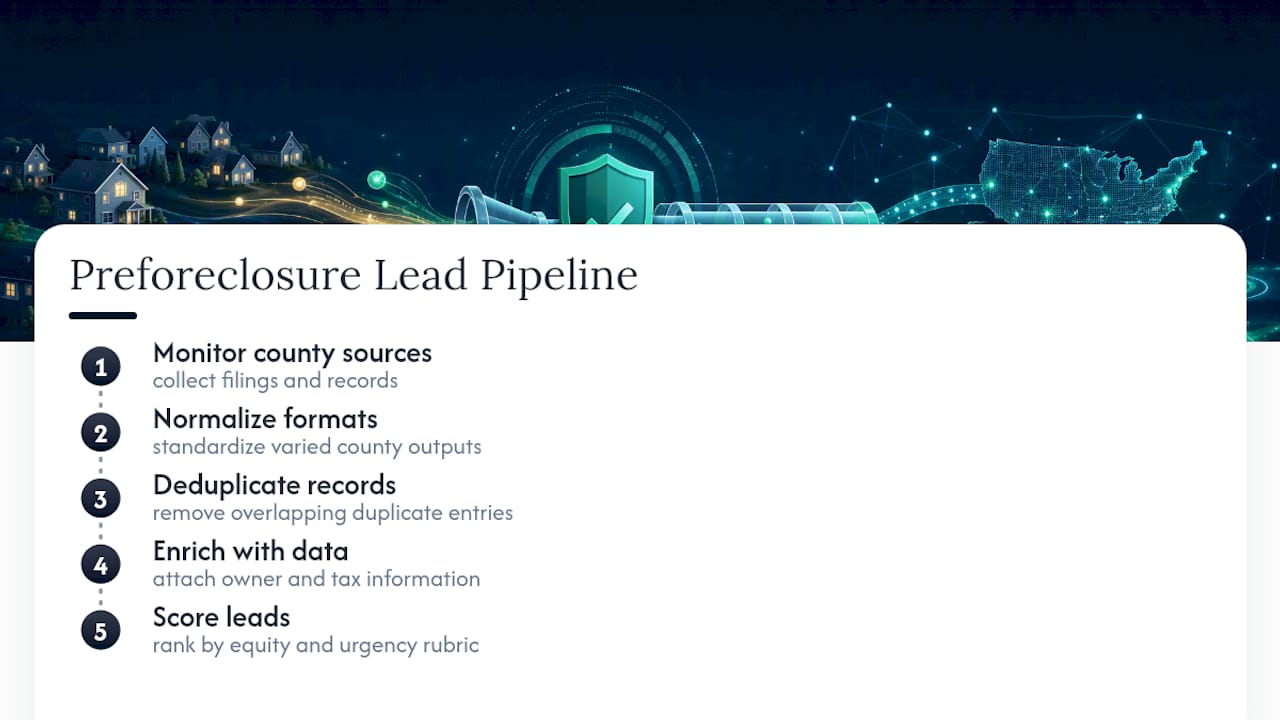
Calculators map directly onto that pipeline’s final steps. An ARV calculator replaces manual comp pulling with verified market data. A rehab estimator turns a walkthrough into a defensible number instead of a guess. An MAO calculator applies the 70% rule instantly once ARV and rehab are locked in, and a BRRRR calculator handles the math differently for investors planning to hold and refinance rather than flip.
The practical gain isn’t glamorous: fewer title surprises because liens get checked before an offer goes out, faster MAO turnaround because the math is instant instead of a spreadsheet you rebuild every time, and fewer wasted offers on leads that never had workable equity to begin with. Real Estate Investor Toolkit’s free calculators are built around exactly these steps, so the tooling matches the checklist instead of sitting apart from it.
Step-by-Step: Analyzing One Preforeclosure Lead in a Single Session
Run this checklist top to bottom on every new lead before you spend outreach time on it.
- Verify the filing. Confirm the county classification (recorder or court), the filing date, and whether a sale date has been set.
- Check for kill signals. Search for bankruptcy, dismissal, or deed-in-lieu entries that make the lead non-actionable.
- Run the equity screen. Add up recorded debt, liens, and unpaid taxes. Compare against a rough ARV estimate.
- Calculate ARV. Pull comps or use a verified ARV tool to lock in the number.
- Estimate rehab cost. Build a line-item estimate with a contingency buffer, then compute MAO using the 70% rule.
- Confirm the payoff. Call the lender or check the recorder for the actual payoff amount, not just the original loan balance.
- Prioritize outreach. Rank the lead against your freshness and urgency flags, and prepare a simple offer packet if the math clears.
A lead that survives every gate above is one worth calling today, not next week.
Why Discipline Beats Speed in Preforeclosure Analysis
The instinct in this business is to move fast, because someone else might call first. That instinct is right about urgency and wrong about process. Spray-and-pray outreach to unverified leads burns your reputation with homeowners who are already stressed, and it burns your time on deals that were dead the moment the bankruptcy stay hit.
The rookie mistake isn’t slowness. It’s skipping verification because a filing looks fresh in a feed. A record can be three days old in your data and already dismissed at the courthouse. Investors who build the habit of checking the docket before every call close more deals with less wasted effort, not because they’re faster, but because they’re not chasing ghosts. Pair that discipline with the deal frameworks and calculators that turn verification into a five-minute step instead of a research project, and the entire pipeline moves faster anyway.
— Michael
Run Your Numbers Before You Make the Call
Some online investment platforms provide verified ARV, rehab, and MAO math tools with no sign-up required, allowing you to clear a lead’s financials in the same session you verify the filing. Every calculator in this article, ARV, rehab estimator, 70% rule MAO, and BRRRR modeling, runs free at Real Estate Investor Toolkit, pulling real market comps instead of a manual guess.
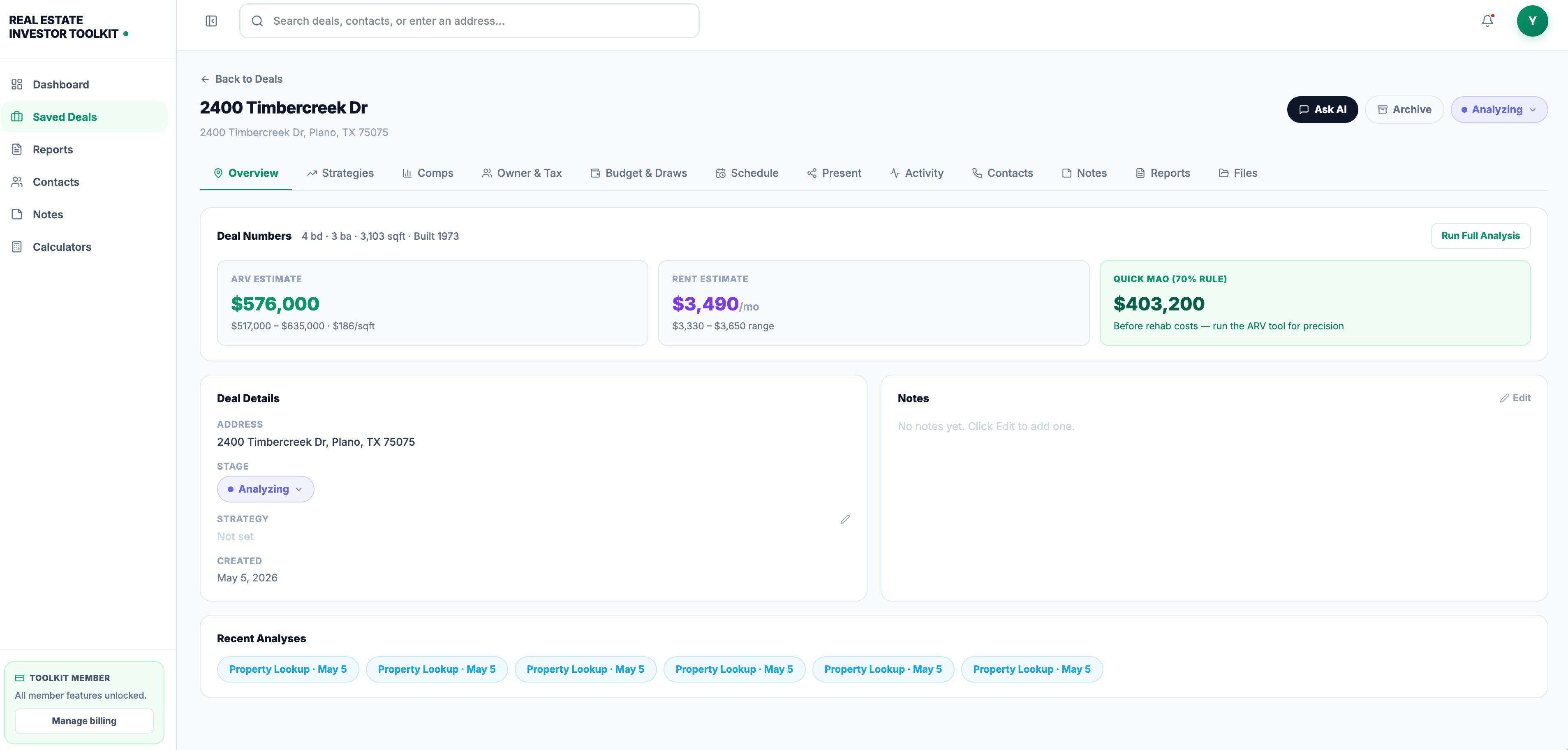
That matters most on the leads with thin margins, where a rounding error in your rehab estimate turns a workable deal into a loss. Once you’re running enough leads to need saved pipelines, batch property reports, or owner and absentee-owner data, the paid plan on the Real Estate Investor Toolkit pricing page at $39.99 per month unlocks unlimited reports and the AI deal advisor on top of the free calculators. Start with the free ARV and MAO tools on your next lead, right after you confirm the county filing, and see whether the math actually clears before you pick up the phone.
Sources
FAQ
What Is the Difference Between a Notice of Default and Lis Pendens?
A Notice of Default is filed with the county recorder in non-judicial states and starts a trustee-led foreclosure without court involvement. A lis pendens is filed with the court in judicial states and signals an active foreclosure lawsuit, which typically moves slower, 6 to 18 months versus 90 to 120 days.
How Do I Calculate MAO on a Preforeclosure Property?
Multiply your ARV estimate by 0.70, then subtract your estimated rehab cost, following the standard 70% rule. Subtract recorded liens, unpaid taxes, and the actual lender payoff before you finalize any offer number.
Where Can I Find Reliable Preforeclosure Data?
County recorder offices and court dockets are the primary free sources, though formats vary widely between jurisdictions. Aggregated datasets like Cotality’s pre-foreclosure records normalize some of that variation if you’re working multiple counties at once.
How Do I Know if a Lead Is Still Active?
Check the current county docket or recorder entry for dismissal, cure, or sale postponement notices, and search PACER for a bankruptcy filing tied to the owner’s name. A bankruptcy filing triggers an automatic stay that halts the foreclosure process until it’s resolved.
Does Real Estate Investor Toolkit Cost Anything to Use?
The core calculators, including ARV, rehab, and MAO tools, are free with no sign-up required. The paid plan, listed at $39.99 per month on the pricing page, adds unlimited reports, saved pipelines, and owner data for investors working leads at volume.