Move in 60 Days or Scale: Owner Occupied vs Absentee for Investors

Owner-occupied means you live in the property as your primary residence; absentee ownership means you hold title but don’t live there day-to-day, usually leasing it out and hiring help to run it. The practical split is financing versus scale: owner-occupied buyers unlock cheaper loans and lower down payments, while absentee owners trade that discount for the ability to build a portfolio. The sections ahead break down lender rules, taxes, insurance, and a decision checklist so you can pick the right lane.
TL;DR:
- Owner-occupied financing offers lower down payments and interest rates but requires moving in within 60 days and staying for at least a year.
- Absentee owners face higher costs for loans, insurance, and management, along with more complex tax reporting and maintenance oversight.
- Rental properties managed by absentee owners need structured systems, including property managers, regular inspections, and proper insurance to avoid costly issues.
- Zoning laws and HOA rules increasingly restrict absentee leasing, requiring registration, licensing, and approval processes that owners must verify before purchasing.
- Effective screening, maintenance, and financing modeling are essential for both ownership types to maximize returns and minimize legal or financial risks.
Table of Contents
- Owner Occupied vs Absentee: Key Differences at a Glance
- Financing and Occupancy Rules: What Lenders Actually Require
- Tax and Insurance Traps That Catch Absentee Owners
- Building the Management System Absentee Ownership Requires
- Pros and Cons: Weighing the Two Models
- A Decision Checklist for Choosing Your Path
- How to Model Both Scenarios Before You Commit
- Implications on Property Resale Value and Market Perception
- Impact on Local Zoning Laws and HOA Regulations
- Effect on Tenant Selection and Screening Processes
- Differences in Maintenance Responsibilities and Cost Implications
- Long-Term Wealth-Building Strategies for Each Ownership Type
- Publisher Perspective: When Investors Actually Shift to Absentee Ownership
- Test Your Numbers Before You Commit to Either Path
- Sources
Owner Occupied vs Absentee: Key Differences at a Glance
Owner occupancy status determines which loan programs you qualify for, how your insurer prices risk, and who handles the 2 AM maintenance call. A primary residence is where you live most of the year; a second home is a part-time retreat that still doesn’t count as owner-occupied for lending purposes; an investment property held by an absentee owner is title held by someone who doesn’t live there and typically delegates operations to a property manager.
The practical differences stack up fast:
- Financing: Owner-occupants access FHA, VA, and USDA loans with lower down payments; absentee buyers face conventional or portfolio loans with stricter terms.
- Taxes: Primary residences get capital gains exclusions on sale; rentals get depreciation and expense deductions but generate taxable rental income.
- Insurance: Homeowners policies cover owner-occupied homes; absentee owners generally need landlord or dwelling policies with vacancy provisions.
- Management: Owner-occupants handle their own maintenance; absentee owners typically hire a property manager or build a vendor network.
Each of these differences compounds over time, which is why the choice matters more than it looks at first glance.
Financing and Occupancy Rules: What Lenders Actually Require
Lenders don’t just ask if you’ll live in the home. They verify it, and the rules have teeth. Most owner-occupant loan programs require you to move in within 60 days of closing and stay for at least one year before you can legally convert the property to a rental or sell it as an investment.
That single rule explains why FHA, VA, and USDA loans exist as owner-occupant-only products: the government subsidizes the risk because you’re supposed to be living there, not renting it out from day one. Absentee buyers don’t get that subsidy.
Statistic Callout: A 12-month residency requirement plus a 60-day move-in window means owner-occupant financing carries a real time commitment, not just a lower rate. Plan around it before you close.
Investment loan terms look different across the board:
- Down payments for investment loans typically are significantly higher than for owner-occupied loans, especially for multi-unit properties.
- Interest rates for investment property loans are usually higher than those for owner-occupied properties.
- Portfolio loans for investors who already hold several mortgaged properties and exceed conventional limits.
- Occupancy affidavits signed at closing, with real legal and financial exposure if you misrepresent your intent.
Lying on an occupancy affidavit isn’t a paperwork technicality. Lenders can call the loan due in full or refer the file for fraud review if they discover a supposed primary residence sitting on a rental listing three months after closing.
Tax and Insurance Traps That Catch Absentee Owners
The tax code treats these two ownership types like different animals entirely. A primary residence gets you a capital gains exclusion when you sell, but no depreciation deduction while you own it. A rental property flips that: you can deduct mortgage interest, repairs, property management fees, and claim depreciation under IRS rental property rules, but every dollar of rent collected is taxable income you have to report.
Insurance is where absentee owners get burned most often. Standard homeowners policies typically exclude coverage once a property sits vacant beyond 30 to 60 days, which matters enormously during tenant turnover or a slow renovation stretch. Absentee owners need a landlord or dwelling policy, and if the unit will sit empty for a while between tenants, a vacancy endorsement added ahead of time, not after a pipe bursts.
Recordkeeping matters too. Rental income, repair receipts, and mileage for property visits are common audit triggers when documentation is thin. Keep a dedicated file per property from day one.
Building the Management System Absentee Ownership Requires
Absentee ownership is not “buy it and forget it.” It’s a systems problem. The moment you stop living in the property, you shift from hands-on manager to someone who has to build infrastructure. Skipping that step is the single most common reason absentee investments underperform.
A property manager typically handles:
- Marketing the unit and screening applicants
- Collecting rent and enforcing lease terms
- Coordinating maintenance and emergency repairs
- Managing evictions when necessary
- Delivering monthly financial reports
Property management fees commonly represent a percentage of rent collected, with possible additional fees for services such as leasing or evictions. Compare that against the practical trade-offs of hiring management before assuming self-management from a distance is cheaper. It rarely is once you count your own time.
Pro Tip: Set a recurring quarterly inspection, not just an annual one. Small maintenance issues caught early cost a fraction of what they cost after two seasons of neglect.
Track net operating income, average vacancy days, and manager response time on a simple dashboard so problems surface before they become expensive.
Pros and Cons: Weighing the Two Models
Neither model wins outright. The right choice depends on your capital, your timeline, and your appetite for delegation.
- Owner-occupied pros: Cheaper financing, direct control over the property, no management fees eating into cash flow.
- Owner-occupied cons: Limits your ability to scale, ties your living situation to your investment strategy.
- Absentee pros: Enables portfolio growth, geographic diversification, and full access to rental tax deductions.
- Absentee cons: Higher financing costs, real management risk if oversight is weak, and vacancy exposure if insurance isn’t structured correctly.
If you’re optimizing for the lowest possible cost of capital on one property, owner-occupied wins. If you’re optimizing for scale across multiple properties, absentee ownership is the only path that gets you there.
A Decision Checklist for Choosing Your Path
Run through this before you make an offer:
- Confirm your financing capacity. Can you qualify for owner-occupant terms, or does your situation point to an investment loan regardless?
- Decide your timeline. Are you ready to move in within 60 days, or does the property need to cash flow from a tenant immediately?
- Assess your appetite for scale. One property you live in caps your growth; several absentee units compound it.
- Rate your tolerance for delegation. Are you comfortable managing vendors and reports remotely, or do you want hands-on control?
- Clarify your tax objectives. Are you chasing a future capital gains exclusion, or maximizing depreciation and expense deductions now?
If owner-occupied wins, confirm lender requirements early, document your move-in date, and plan explicitly for eventual tenant use if your goals shift later. If absentee wins, line up a property manager before closing, confirm your vacancy endorsement is active, and set a reporting cadence you’ll actually stick to.
How to Model Both Scenarios Before You Commit
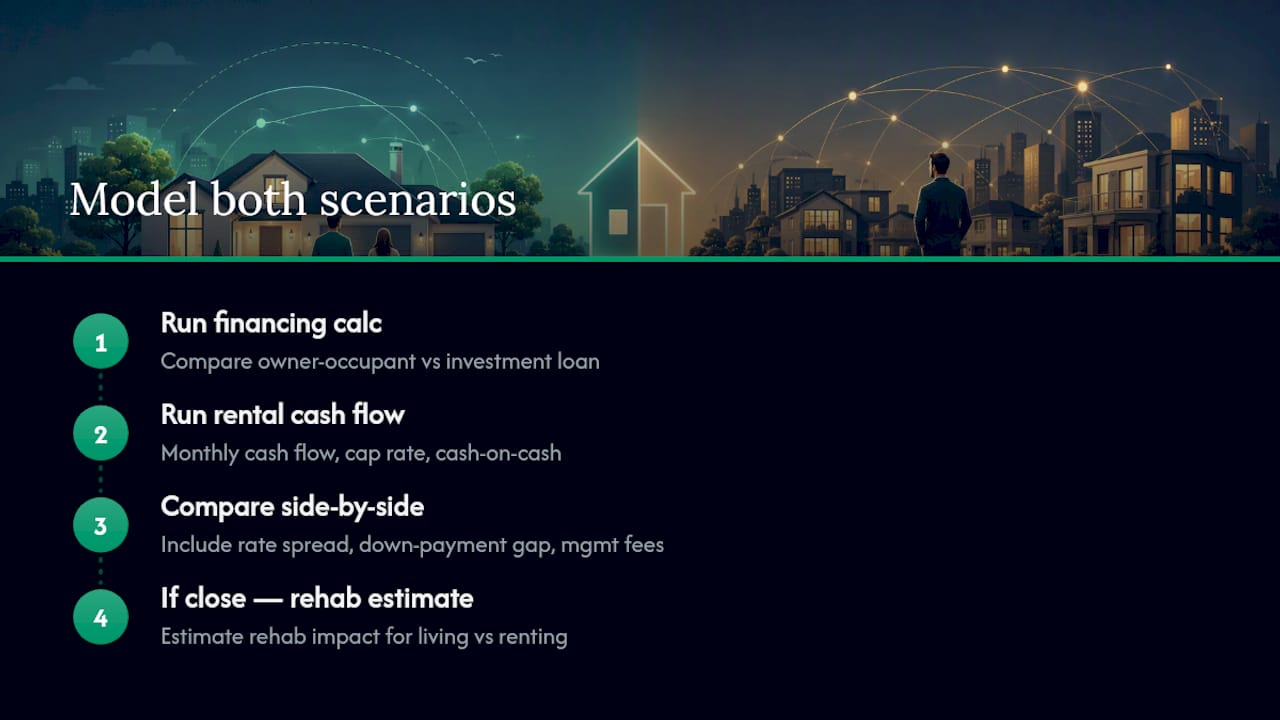
Run the numbers before you run your gut instinct. Start with the Investment Property Financing Calculator to compare an owner-occupant loan against an investment loan side-by-side, factoring in the rate spread and down payment gap. Then plug the same property into the rental cash flow calculator to see monthly cash flow, cap rate, and cash-on-cash return under absentee management fees.
Comparing both scenarios side-by-side is the fastest way to see your real break-even timeline, factoring in the rate spread against ongoing management costs. If the numbers are close, run the rehab cost estimator too, since a property needing work changes the math differently depending on whether you’re rehabbing to live in it or rehabbing to rent it out immediately.
Implications on Property Resale Value and Market Perception
Buyers and appraisers read occupancy history, whether they say so or not. A property that’s been owner-occupied for years often shows better cosmetic upkeep, since the person living there has a daily incentive to fix small problems before they become big ones. That translates into a smoother inspection and, occasionally, a slightly stronger offer.
Absentee-owned rentals aren’t automatically worse off, but the resale story shifts. A tenant-occupied property complicates the sale timeline because most buyers, especially owner-occupants, want vacant possession at closing. That can mean structuring the sale around lease expiration or offering a discount to attract an investor buyer who doesn’t mind inheriting the existing tenant.
Market perception also depends on neighborhood composition. In areas with a high concentration of absentee-owned rentals, some buyers perceive lower long-term appreciation potential, rightly or wrongly, tying it to slower maintenance response and less community investment. That perception can affect days on market even when the physical property is in fine condition.
The fix on the seller side is straightforward: keep the property well maintained regardless of who lives there, and if you’re selling an absentee-owned unit, time the listing around lease turnover so you can offer vacant possession. That single move often widens your buyer pool from investors-only to the full market.
Impact on Local Zoning Laws and HOA Regulations
Zoning and HOA rules increasingly draw a hard line between how they treat owner-occupants and absentee landlords, and that gap is widening in many markets. Some municipalities have adopted short-term rental restrictions that exempt owner-occupied properties but heavily regulate or cap absentee-owned units, often requiring a rental license, an inspection, or a registration fee.
Local ordinances and registration requirements aimed at absentee owners have become more common as cities respond to concerns about neglected rental properties and neighborhood stability. Before buying with an absentee strategy in mind, check whether the jurisdiction requires a rental registration, caps the number of non-owner-occupied units on a block, or charges an annual absentee-owner fee.
HOAs add another layer entirely. Many HOA governing documents cap the percentage of units that can be leased at any given time, sometimes at 20% to 30% of the total community, and some require board approval before you rent a unit at all. If you’re buying into an HOA with plans to lease it out later, get the rental cap and approval process in writing before closing, not after you’ve already signed a lease with a tenant.
Owner-occupants rarely bump into these restrictions since they’re living there, not renting. Absentee buyers should treat zoning and HOA rental caps as a due diligence item as serious as the home inspection itself.
Effect on Tenant Selection and Screening Processes
Screening looks different depending on who’s doing it and why. Owner-occupants who rent out a room or an accessory unit tend to screen informally, prioritizing personal compatibility since they’ll be sharing walls or a yard with whoever moves in. That’s not necessarily worse, but it does carry more legal risk if screening decisions aren’t documented consistently across applicants.
Absentee owners working through a property manager typically get a more standardized process: credit checks, income verification against a 3x rent threshold, rental history checks, and background screening run the same way for every applicant. That consistency matters for fair housing compliance, since a documented, repeatable process protects you if a rejected applicant ever challenges the decision.
The trade-off is speed and personal judgment. A hands-on owner-occupant landlord might waive a rent-to-income ratio for an applicant with a strong personal reference or a longer work history in a way a property manager processing dozens of applications typically won’t. Absentee owners lose that flexibility but gain a defensible, uniform paper trail.
Whichever model you run, put your screening criteria in writing before you list the unit. That single step prevents the kind of inconsistent, memory-based decisions that create legal exposure and, frankly, worse tenants.
Differences in Maintenance Responsibilities and Cost Implications
Maintenance is where the day-to-day reality of these two models diverges the most. Owner-occupants notice the small stuff: a slow drain, a flickering light, a loose railing, and usually fix it themselves or call a handyman before it escalates. That immediacy keeps repair costs lower over time, since small issues rarely turn into big ones.
Absentee owners depend entirely on someone else noticing. A tenant might not report a minor leak for weeks, either because they don’t recognize it as urgent or because they’re hesitant to bother the landlord. By the time it surfaces, you’re looking at water damage instead of a $150 plumber visit. That gap is exactly why quarterly inspections, not just annual ones, matter so much for remote owners.

Cost implications extend to vendor relationships too. Owner-occupants often build a personal relationship with a trusted contractor over years. Absentee owners, especially those managing from a distance, need a pre-vetted emergency vendor roster covering plumbing, HVAC, and electrical before a crisis hits, not during one. Scrambling for a same-day plumber in an unfamiliar market almost always costs more than having someone on call.
Budget for maintenance differently depending on your model. Owner-occupants can often absorb minor repairs into monthly cash flow without much planning.
Long-Term Wealth-Building Strategies for Each Ownership Type
Owner-occupied wealth building tends to move on a slower, steadier track. You benefit from forced appreciation through your own improvements, mortgage paydown funded partly by the tax savings of homeownership, and eventually a tax-advantaged sale. The classic path is living in a property for a few years, building equity, then rolling that equity into a down payment on the next home or your first rental.
Absentee ownership compounds differently: through portfolio expansion. Each property adds rental income, depreciation deductions, and its own appreciation curve, and the BRRRR method lets you recycle capital from one deal into the next rather than saving from scratch for every purchase. That’s the mechanism that turns one rental into five over a decade, something owner-occupied strategies structurally can’t replicate since you can only occupy one primary residence at a time.
Many investors don’t pick one model permanently. A common trajectory: buy owner-occupied to get the cheap financing, live there for the required year, then convert to a rental and repeat the process with a new primary residence. That “house hack and repeat” approach stacks the financing advantage of owner-occupancy with the scaling advantage of absentee ownership, just sequenced rather than simultaneous.
Whichever path you’re on, the tax treatment compounds too. Depreciation on rentals lowers your taxable income year over year, while a primary residence sale exclusion can shelter a substantial gain when you eventually sell. Neither strategy is inherently better for building wealth. They’re built for different timelines and different levels of hands-on involvement.
Publisher Perspective: When Investors Actually Shift to Absentee Ownership
Investors typically go absentee once they’ve built real equity in one property and want to scale faster than one primary residence allows. The recurring mistake: underestimating management costs and skipping the vacancy endorsement until a claim gets denied. Before you convert, line up your property manager and insurance first, not last.
— Michael
Test Your Numbers Before You Commit to Either Path
Real Estate Investor Toolkit gives you a faster way to stress-test both paths than guessing off a spreadsheet: run the exact loan terms, rental income, and management fees for your specific property and see the break-even point in minutes, not hours.
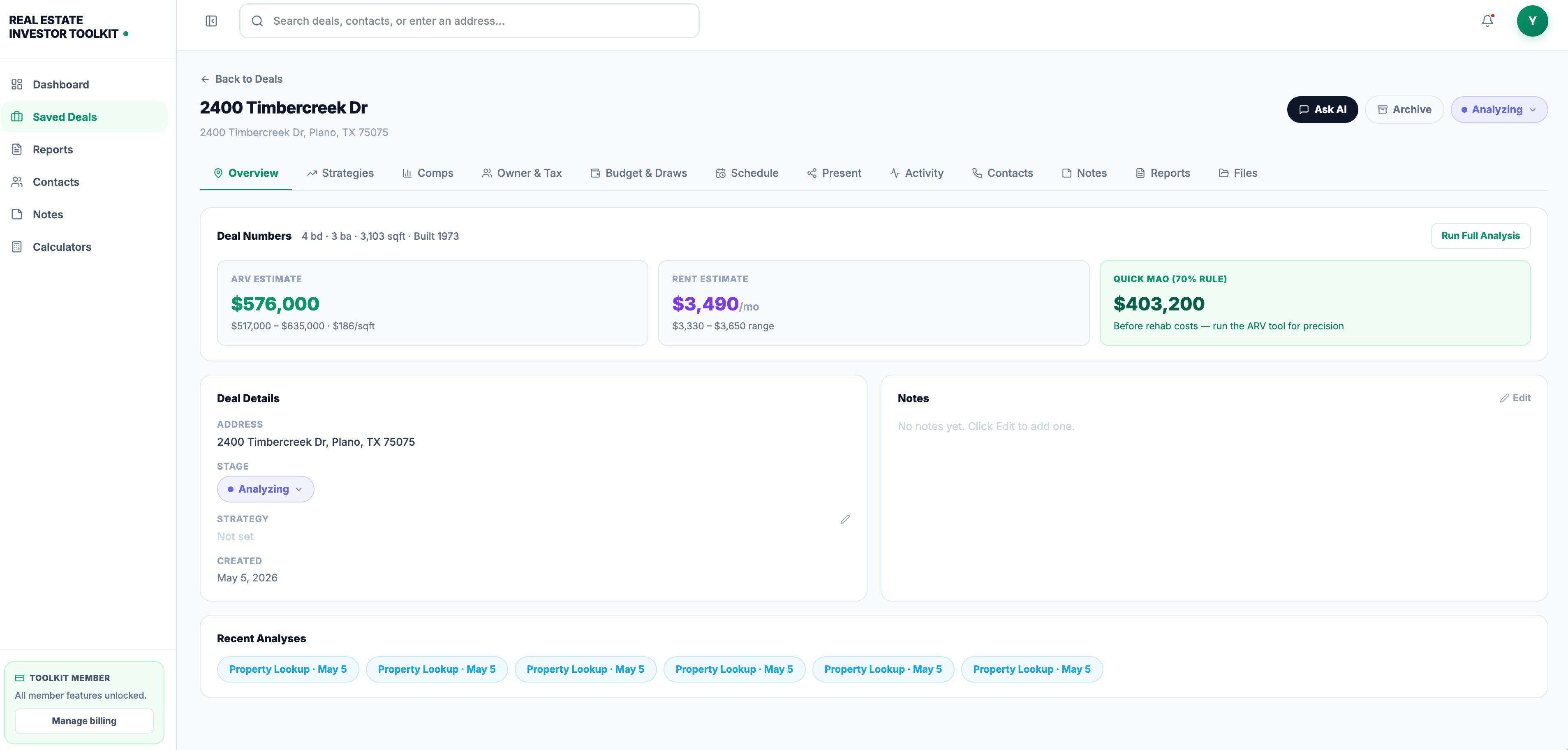
Start with the rental cash-flow calculator to see what an absentee scenario actually nets you after management fees, then compare it against owner-occupant terms in the financing calculator. Every calculator is free to use with no sign-up required, and if you want saved deal pipelines or advanced property data down the line, the paid subscription unlocks that without changing how the free tools work today. Run your next property through the rental calculator before you make an offer.
Sources
- Occupancy requirements by loan type — Lower
- Absentee owner — Investopedia
- What does absentee owner mean legally? — LegalClarity
Recommended
- How to Analyze a Rental Property: Cash Flow, Cap Rate, and the 1% Rule — Real Estate Investing Guide
- Breakeven Occupancy: The Formula That Tells You When You’re Safe
- How to Build a Rental Pro Forma That Actually Predicts Returns
- When the 70% Rule Works, When It Breaks, and What to Use Instead — Real Estate Investing Guide