Orlando Wholesale Comps: How to Pull and Adjust Them

Good Orlando wholesale comps are closed sales of similar, renovated homes, close to your subject property and recent enough to reflect today’s market. Pull three to six of them, adjust each one for size, bedrooms, baths, features and condition, then take a conservative weighted figure as your After Repair Value (ARV). Your maximum allowable offer (MAO) is built on that number, so a weak comp becomes a bad offer. Our Orlando comps guide and free calculators are built for exactly this workflow, and none of them requires a sign-up.
TL;DR
- A reliable comp is a closed sale (not an active listing), recent, nearby, and similar in size, type and condition.
- In Orlando, stay tight: roughly half a mile or less, sold within the last 3 to 6 months, and square footage within about 15 to 20% of the subject.
- Pull sale records from the Orange County Property Appraiser, then adjust each comp and apply a conservative buffer to the final ARV.
- Feed the ARV and your rehab estimate into MAO. If your adjustments on one comp get very large, replace the comp.
- Free calculators on our site handle the math, and the paid plan adds unlimited reports and saved deals.
Table of Contents
- What makes a comp usable for a wholesale deal
- Radius and neighborhood: Orlando is not one market
- Where to find Orlando sold data and verify it
- How to adjust Orlando comps step by step
- From comps to ARV to your MAO
- Common comp mistakes that inflate offers
- Florida wholesaling rules that touch your comps and marketing
- Run your Orlando comps in minutes
- FAQ
- Sources
What makes a comp usable for a wholesale deal
A comp (short for comparable sale) is a recently sold property that looks like the one you are pricing. As a wholesaler you are not guessing what the house is worth today. You are estimating what a renovated version will sell for, because your cash buyer’s offer, and your fee, depend on that number.
The ARV works like a restaurant menu price. You price the finished plate, then work backward through ingredients (purchase and repairs) to see what you can pay.
The lending industry already has a clear standard. Fannie Mae’s appraisal rules call for at least three closed comparable sales, with sales from the last 12 months used, and for comps from the same market area as the subject when possible, because neighborhood sales best reflect the same location strengths and weaknesses. Appraisers work to that rule, and your cash buyer’s lender or partner will often test your numbers against it. Wholesaling in a hot, fast-moving market justifies a tighter window than 12 months.
Use this checklist for every comp:
- Closed, not listed. Asking prices are wishes. Only a recorded sale counts.
- Same property type. Single-family against single-family, not a condo or townhome.
- Similar size. Keep square footage within about 15 to 20% of your finished product, a range that an Orlando lender’s ARV guide recommends along with 3 to 6 sales within 0.5 miles sold in the last 3 to 6 months.
- Similar layout. Same bedroom and bath count, or a clear adjustment for the difference.
- Renovated condition. Your ARV comps should reflect the finished product, not other distressed sales.
Radius and neighborhood: Orlando is not one market
Orlando’s neighborhoods change block by block, and a radius drawn on a map can cross a very different area. The same Orlando guide notes that a College Park home in 32804 will not comp well against one in Azalea Park in 32807, even at similar square footage. School zones, flood exposure, age of housing and proximity to major roads all shift value.
A practical way to set the radius:
- Dense urban neighborhoods near downtown: start at a quarter mile.
- Typical suburban streets: start at half a mile.
- Low-density or newer outlying subdivisions: expand toward a mile only if you cannot find three good sales closer in, and note why.
Whenever you reach beyond the subject’s own subdivision, you owe an explanation and a location adjustment, which is the same principle Fannie Mae applies. Where possible, keep comps inside the same subdivision or on the same side of a major road.
Where to find Orlando sold data and verify it
You do not need to start with a paid data subscription. The public record is the verification layer for everything else.
Orange County Property Appraiser. The county’s public sales search covers all of Orange County, including Orlando, and lets you filter by city, zip code, radius, property type, sale date, price, beds, baths and square footage. That is nearly every filter a comp search needs. The county’s underlying sales data also carries fields such as the sale date, living area, bedrooms, baths and whether the property has a pool.
Two cautions apply. The webmap states that its data is produced for property appraisal purposes with no warranties and is not a legal survey, so treat it as a starting point for deal analysis rather than for title or boundary questions. And a recorded price tells you nothing about condition. You still need photos, listing history or a drive-by to know whether a sale was a gut renovation or a tear-down.
City records. The City of Orlando’s property information page points to the Orange County Comptroller for official records such as deeds, and offers a project lookup for permit status by address or parcel ID. Permit history is one of the best ways to confirm that a comp was actually renovated.
Your own tools. Our free ARV calculator and the Orlando ARV calculator bring verified comps and market data into one place, so you spend less time cross-referencing records by hand.

How to adjust Orlando comps step by step
No two homes are identical. Adjustments make each comp behave as if it were your subject. The rule is simple: if the comp is better than your subject in some way, subtract value from its sale price. If the comp is worse, add value.
Step 1: Line up the comps in a table
List sale price, sale date, distance, square footage, beds, baths, garage, pool, lot and condition for each. Seeing them side by side shows quickly which comp is the odd one out.
Step 2: Adjust for size, rooms and features
There is no official Orlando adjustment schedule, so use a range you can defend and apply it consistently. One Orlando lender’s guide offers examples: an extra full bathroom can be worth $20,000 to $30,000, a larger lot may justify a 2 to 5% premium in areas like Winter Garden, and growth areas such as Lake Nona (32832) may justify upward adjustments of 3 to 5%. Treat such figures as guides, and check them against paired sales in your own target neighborhood.

A paired sale is the strongest evidence you can find. If two near-identical homes sold within weeks of each other and only one had a pool, the price gap is your pool adjustment for that street.
Step 3: Adjust for condition
This is where most wholesalers lose money. The same lender’s example is a comp moving from good to excellent condition, which warrants roughly 5%, for instance $15,000 on a $300,000 sale. A renovated comp that sold at a premium is only a fair comp if your finished product will match its finish level. Pair it with a realistic scope using the Orlando rehab estimator or our guide to estimating rehab costs.
Step 4: Adjust for time
A sale from five months ago in a rising or falling market needs a time adjustment. Better still, prefer newer sales so you need little or none.
Step 5: Weight the comps and set the ARV
Give the most weight to the comp that is closest, most recent and most similar. Then discard any comp that needed enormous adjustments. A common discipline is to replace any comp whose total adjustments pile up past roughly 15% of its sale price, because at that point you are pricing the adjustments, not the comp.
Step 6: Add a cushion
The lender guide recommends a 5% conservative buffer on the adjusted ARV to absorb appraisal variation and market shifts: adjusted comps averaging $290,000 become a $275,500 working ARV.
From comps to ARV to your MAO
Your comps give you the ARV. Your rehab estimate and your fee come next. A widely used shortcut multiplies the ARV by 70% and subtracts repairs. Our guide on what MAO is explains the formula, and the wholesale offer formula shows where your assignment fee fits.
Worked example using the working ARV above:
| Step | Amount |
|---|---|
| Working ARV after 5% buffer | $275,500 |
| ARV x 70% | $192,850 |
| Estimated repairs | $40,000 |
| MAO before your fee | $152,850 |
| Assignment fee you want | $10,000 |
| Contract price to offer the seller | $142,850 |
The repair figure and fee are illustrative, not Orlando averages. What matters is the sensitivity: if the ARV had been $290,000, the same math would produce a MAO about $10,000 higher. A 5% comp mistake can erase your entire fee, which is why the comp work comes first. For the difference between value and offer, see ARV vs MAO.
Common comp mistakes that inflate offers
- Using active listings. They show what sellers hope for, not what buyers paid.
- Cherry-picking the high sale. If one comp is $30,000 above the rest, it is the exception, not the market.
- Ignoring condition. A flipped, fully renovated sale next to a dated one is not the same product.
- Stretching the radius. One of Orlando’s busy roads or a school boundary can separate two very different prices.
- Using stale sales. The older the sale, the more the market may have moved.
- Skipping the buffer. An ARV with no cushion leaves your buyer no margin, and your deal falls apart at the walkthrough.
Florida wholesaling rules that touch your comps and marketing
Comps decide your price. Florida law decides how you may market the deal. In Florida, wholesalers generally assign their own purchase contract rather than sell the property, and one education guide explains that this works under the principal-buyer exemption in §475.011, with advertising limited to your contract interest and unlicensed brokerage carrying felony exposure under §475.42. Read our Florida wholesaling laws overview, and talk to a Florida real estate attorney and your title company before you market a contract, since some title companies handle assignments differently. This is general information, not legal advice.
Our perspective on Orlando comps
Most bad wholesale deals do not fail on negotiation. They fail on the comp set. A wholesaler grabs three nice sales, skips the condition check, and quotes an ARV the buyer’s own numbers will not support.
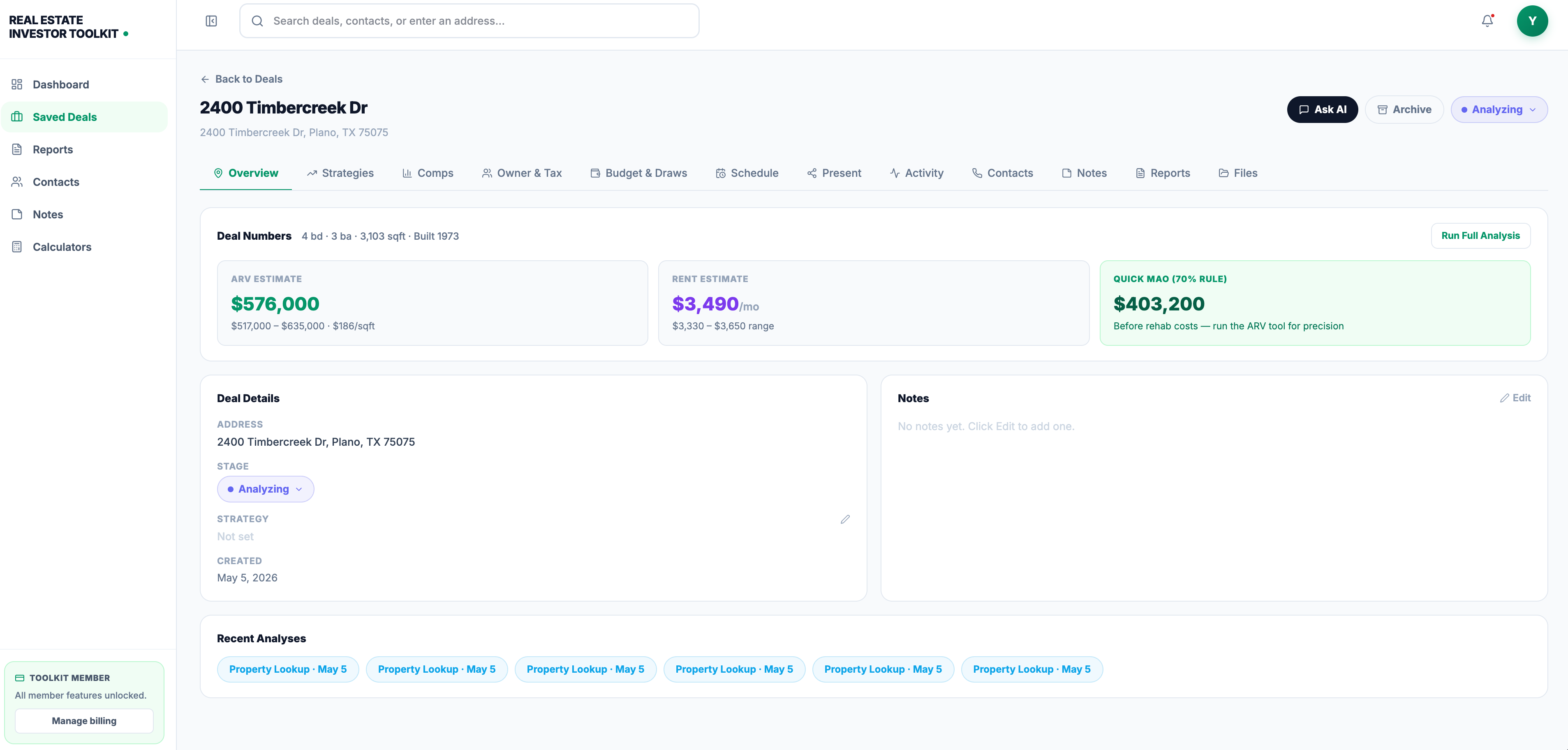
We built Real Estate Investor Toolkit so the first pass is fast and the numbers are verified. You can run free calculators with no sign-up, use verified comps and market data for ARV and rehab estimates, and move to one plan when you need unlimited reports and saved deals instead of juggling multiple subscriptions.
Our advice: run every Orlando deal through the same routine. Tight radius, recent closed sales, honest condition adjustments, a cushion, then MAO. Consistency is what keeps your buyers coming back.
Michael
Run your Orlando comps in minutes
Start with the free tools, which need no sign-up, to check an ARV, estimate rehab and test an offer. When you are analyzing several deals a week, the Real Estate Investor Toolkit plan at $39.99 per month adds unlimited reports, saved deal pipelines, advanced property data, owner-occupancy details and AI chat insights. You can see everything on the pricing page.
If you plan to keep a flip as a rental, run the same property through the Orlando rental analysis or the Orlando BRRRR calculator before you commit.
FAQ
How far back should Orlando wholesale comps go?
Prefer sales from the last 3 to 6 months, and the fresher the better. Fannie Mae’s appraisal standard uses sales within 12 months, but wholesale pricing needs a tighter window. If you must go older, explain why and adjust for time.
How many comps do I need?
Use at least three, since three closed comps is the appraisal minimum. Three to six well-matched sales is a practical range for a wholesale ARV. More comps are not better if they are far away or different in condition.
Where can I find free sold data for Orlando?
The Orange County Property Appraiser’s sales search lets you filter by radius, sale date, price, beds, baths and square footage. Confirm condition separately through listing photos and permit records. Our free calculators also pull verified comps into an ARV estimate.
Can you wholesale real estate in Florida?
Yes, by assigning your own purchase contract rather than acting as an unlicensed broker. Read our Florida wholesaling laws guide and confirm your approach with a Florida real estate attorney and your title company before you market any deal.
Sources
- Comparable Sales, Fannie Mae Selling Guide
- OCPA Webmap sales search
- Orange County Property Appraiser sales layer
- Property Information, City of Orlando
- How to Accurately Calculate ARV in Orlando Real Estate
- Is Wholesaling Real Estate Legal In Florida? (2026)