Off-Market Valuation Methods: How to Price a Deal No One Has Bid On

The safest way to value an off-market property is to use three methods and compare them: as-is comparable sales, after-repair value (ARV) minus rehab and profit, and, for rentals, income. Nobody else has bid on the property, so no competing buyer has tested the seller’s number for you. You have to build the evidence yourself, and you should only make an offer when the methods land in the same range.
This guide shows each method, the inputs it needs, where each one commonly goes wrong, and a worked example. It is written for first-time investors, wholesalers, flippers and landlords, including those buying in Florida and Dallas-Fort Worth (DFW). Our free calculators run the arithmetic, so you can spend your time checking the inputs.
TL;DR
- Off-market means no competitive process has set the price, so the buyer carries the valuation work.
- Use three lenses: as-is comps, ARV minus repairs and margin, and income for rentals. Appraisers use the same three families: cost, sales comparison and income.
- ARV comps must be renovated sales, roughly within a half-mile and the last 90 to 180 days. As-is comps value the house you are buying today.
- The 70% rule is a screening formula, not a verdict. Florida insurance costs and code-compliant comps can push your number lower.
- Make an offer only when the methods overlap, and keep the math on a saved sheet so you can defend it.
Table of Contents
- Why off-market deals need a different valuation approach
- Method 1: As-is value from comparable sales
- Method 2: ARV minus repairs and margin
- Method 3: Income value for rentals
- Method 4: The cost check
- Putting the methods side by side
- A worked off-market example
- Florida and DFW adjustments
- Mistakes that cost investors money
- Run these methods in one place
- Our perspective
- FAQ
- Sources
Why off-market deals need a different valuation approach
On the open market, listing exposure produces information: how many buyers show up, how aggressively they bid and where the price settles. A private negotiation produces none of that. One investment firm puts it this way: the buyer must assemble verified comparable transactions and a buyer-instructed valuation rather than inheriting the seller’s number.
In practice, the seller’s asking price is a starting point and nothing more. It may come from a Zestimate, a neighbor’s sale, a tax bill or a hope. Your job is to replace it with a number you can explain line by line.
Before you run any method, gather a basic property profile. A pricing guide for off-market sellers lists the facts that drive value: address and neighborhood, property type, living area, lot size, beds and baths, year built, parking, recent upgrades, roof and system ages, occupancy, rent if any, tax and HOA information, known defects, and easements or title concerns. Write these down first. Every comp you pull will be judged against this list.
Method 1: As-is value from comparable sales
Comparable sales, or comps, are recently closed sales of similar nearby properties. The as-is method asks one question: what would this house sell for today, in its current condition?
- Pick 3 to 5 closed sales in the same neighborhood. The same guide recommends starting with recent closed sales, not active listings, because asking prices are wishes and closed prices are facts.
- Match condition. If the subject has a failing roof and dated kitchen, use comps with similar problems. Pairing it with a fully renovated sale overstates value.
- Adjust for differences. Add or subtract for size, layout, lot, garage, pool and features. Keep each adjustment small and explainable.
- Reconcile into a range, not a single figure. A range of $175,000 to $190,000 is more honest than $182,350.
Where it goes wrong: investors grab the highest comp because it supports the deal they want. Choose comps first, before you look at the asking price, and let the numbers fall where they fall.
The as-is value tells you what a retail buyer or a lender’s appraiser would likely say about the house today. It is also the number you compare against the seller’s ask to see how much room exists for negotiation.
Method 2: ARV minus repairs and margin
If you plan to renovate and resell, you care less about today’s value and more about the finished value. After-repair value is the expected sale price of the property once the work is done.
Pulling a clean ARV
Flowstate’s ARV guide describes a screen many investors use: 3 to 5 comps within roughly a half-mile, sold in the last 90 to 180 days, within about 20% of the subject’s square footage, with similar bed and bath counts and construction era, and renovated to the condition you plan to reach. Then adjust each sale price for differences in square footage, garage, pool, lot and finish level.

The same source flags the most common mistake: comping against as-is or distressed sales. That produces an as-is value, not an ARV. If your ARV comps include foreclosures and fixer-uppers, your finished value is too low, and if your as-is comps include renovated homes, your starting value is too high. Keep the two sets separate.
Our ARV calculator is built around verified comps and market data, so you can pull and compare sales without creating an account.
From ARV to maximum allowable offer
The maximum allowable offer (MAO) is the most you can pay and still hit your profit. The standard screen, as Flowstate lays it out, is:
MAO = ARV × 0.70 − repair costs
With a $300,000 ARV and $45,000 in repairs, that gives a maximum offer of $165,000. The 70% figure builds in room for purchase costs, holding costs, selling costs and profit, which is why it works as a quick filter and not a full pro forma.
Repairs are the weak link. A guess of “around $40,000” can be off by tens of thousands once you count the roof, electrical, permits and a contingency. Use our rehab cost calculator to price the scope by category, and read our guide on how to estimate rehab costs before you walk the property.
Method 3: Income value for rentals
If you will hold the property as a rental, or it is already tenant-occupied, price it by what it earns. The same off-market pricing guide says to review current rent, market rent, vacancy, property taxes, insurance, maintenance, management, utilities, HOA dues and expected capital expenditures.
The core steps:
- Estimate market rent, not the rent the current tenant happens to pay. Our guide to market rent estimate methods covers five ways to do it.
- Subtract a vacancy and collection allowance from gross rent.
- Subtract operating expenses: taxes, insurance, maintenance, management, utilities and HOA.
- The result is net operating income (NOI).
- Divide NOI by a market capitalization rate (cap rate, the annual return a buyer in that area expects) to get value.
Here is an illustration with made-up numbers. Rent of $2,000 a month is $24,000 a year. Take out 5% for vacancy ($1,200) and $7,800 in expenses, and NOI is $15,000. At a 7.5% cap rate, the income value is $200,000. If the as-is comps say $185,000 and the seller wants $230,000, the income method has just told you the ask is rich for a rental.
The Florida Department of Revenue’s Real Property Appraisal Guidelines name the same three valuation approaches (cost less depreciation, sales comparison and income capitalization) and list rent income, vacancy and collection loss, operating expenses, cap rates and income multipliers as the income inputs. Run the numbers in our rental property calculator to see cash flow, cap rate and return together.
If you plan to refinance after renovating, model the whole cycle in the BRRRR calculator, because the refinance value depends on the ARV you just built.
Method 4: The cost check
The third family of valuation is the cost approach: land value plus the cost to rebuild, less depreciation. The Florida guidelines list it alongside sales comparison and income. Investors rarely use it as the main method on a single-family house, but it works as a ceiling. If you are about to pay a price that, with your rehab budget, exceeds what the same home could be built for in that area, stop and re-check your assumptions.
Putting the methods side by side
No single source is perfect, which is why the pricing guide recommends comparing several valuation sources and reconciling them. Use this table as a worksheet.
| Method | Question it answers | Best for | Main input risk |
|---|---|---|---|
| As-is comps | What is it worth today? | Every deal, and negotiating against the ask | Comps in better condition than the subject |
| ARV minus repairs and margin | What can I pay and still profit? | Flips and wholesale deals | Distressed comps in the ARV set, low repair budgets |
| Income (NOI and cap rate) | What is it worth as a rental? | Landlords, BRRRR, occupied properties | Using the tenant’s rent instead of market rent |
| Cost check | Does the price plus rehab beat rebuilding? | Sanity check on high asks | Outdated construction costs |
How to read the result:
- Methods agree within about 5% to 10%: you have a number you can defend.
- One method is far off: find out why. Usually an input is wrong, such as a bad comp, a rent guess or a missing repair.
- The ask is above every method: the seller needs a reason, such as a motivated timeline or a feature your comps miss, before you move.
A worked off-market example
Suppose you are offered a three-bedroom house at $210,000 off-market.
- As-is comps: four closed sales of similarly dated houses average $195,000 after adjustments. The ask is already about 8% above as-is value.
- ARV: four renovated sales within a half-mile in the last 120 days adjust to $300,000.
- Repairs: your scope comes to $45,000 with the roof and HVAC included.
- MAO: $300,000 × 0.70 = $210,000, minus $45,000 = $165,000.
- Income check: if you would hold it instead, market rent supports about $200,000 as a finished rental, before repair costs.
The seller wants $210,000, and your numbers say $165,000. That is a $45,000 gap, and you now know exactly what to say: the as-is comps put it near $195,000, the repairs are real, and your offer reflects both. If the seller will not move, you walk away having lost nothing. Save the analysis so you can compare it with the next lead.
A variation on the same math, from a Florida cash-offer guide, uses a 75% base on the same $300,000 ARV, which is $225,000, then subtracts $45,000 in repairs and $15,000 in holding and selling costs to reach the same $165,000 offer. The point is not which percentage is right. It is that every cost should be on the page.

Florida and DFW adjustments
The same methods apply everywhere, but local conditions change the inputs.
Florida. One Florida cash-offer guide says the 70% rule is often too aggressive in 2026 Florida markets because insurance premiums now account for nearly 9% of a monthly mortgage payment, and it uses a flexible 70% to 80% band instead. It also notes that homes meeting the newer Florida building safety codes set the price ceiling in an area, so screen your ARV comps for code compliance. Get an insurance quote early, because it affects both your holding costs and the buyer’s affordability when you resell.
DFW. For wholesalers in Dallas-Fort Worth, the discipline is the same: tight geography, recent renovated sales for the ARV, and a repair budget you can back up. Neighborhoods can differ sharply from one block to the next, so keep the comp radius small and note any comps that sit across a major road or school boundary.
If you also want an independent opinion of value, remember that lenders sometimes skip the appraisal through an appraisal waiver. In an off-market deal that means no third party may ever look at the number, so your own comp work carries the weight.
Mistakes that cost investors money
- Mixing as-is and renovated comps. Keep two separate sets.
- Using stale sales. Comps older than about six months can miss a moving market.
- Trusting the seller’s repair list. Inspect and price the scope yourself.
- Forgetting holding and selling costs. Insurance, taxes, utilities, interest and agent fees all reduce your margin.
- Using the tenant’s rent. Value the unit at market rent.
- Anchoring on the ask. Run your comps before you see the seller’s number.
- Not saving the work. A deal you cannot reconstruct is a deal you cannot learn from.
If this is your first analysis, our step-by-step guide to analyzing your first deal walks through the full sequence.
Run these methods in one place
Our free tools cover the first pass: ARV, rehab costs, rental cash flow and financing scenarios, with no sign-up required. When you are working several leads at once, the Real Estate Investor Toolkit plan is $39.99 per month and adds unlimited reports, saved deal pipelines, advanced property data, owner-occupancy details and an AI chat assistant for deal insights, so every valuation lives in one place.
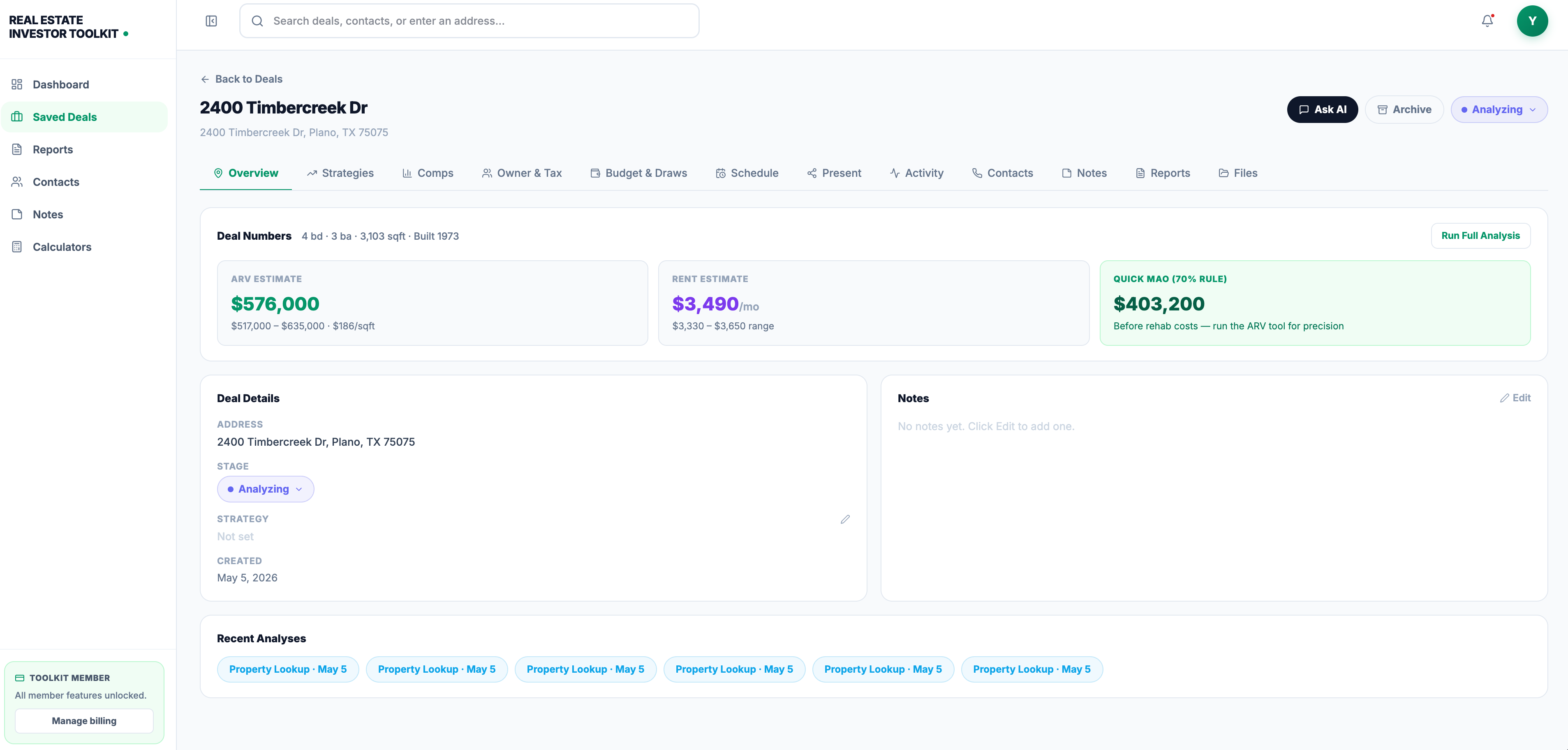
Start with the free tools, or see the plan details.
Our perspective
Most valuation mistakes we hear about are not math mistakes. The formula is simple. The trouble comes from the inputs: a comp that is better than the house, a repair budget built from a guess, a rent number copied from a listing.
That is why we built our calculators around verified comps and market data, and why the free tools need no sign-up. You should be able to test a lead in minutes, before you spend a weekend on it.
We also think one number is rarely enough. Run the as-is value, the ARV and the rental view, then compare. When they agree, you have a deal. When they do not, you have found the question worth asking the seller.
The unified platform exists for the moment you have ten leads and not one. Saved pipelines, owner data and unlimited reports keep every analysis in one place, so you compare deals on the same footing.
Michael
FAQ
What is the most reliable way to value an off-market property?
Use more than one method. Start with as-is comps, add an ARV-based maximum offer if you will renovate, and an income value if you will rent it out. When the results fall in the same range, you can trust the number.
How many comps do I need?
Three to five recent closed sales is the usual standard. For ARV, they should be renovated to your target condition, close by, and sold within the last 90 to 180 days. More comps help only if they are genuinely similar.
Is the 70% rule always right?
It is a quick screen: ARV times 0.70 minus repairs. It works as a first filter, but costs vary by market. In Florida, for example, higher insurance costs have led some investors to use a 70% to 80% band, so build your own holding and selling costs into the final offer.
Should I order an appraisal on an off-market deal?
An independent, buyer-instructed valuation is the strongest check when the purchase is large or the comps are thin. It gives you evidence the seller did not write. Many investors pair it with their own comp analysis before closing.
Sources
- Evaluating Off-Market Real Estate Opportunities
- How to Price an Off-Market Property Right
- How to Estimate ARV: The Investor’s Formula Explained
- How Are Cash Home Offers Calculated? The 2026 Math
- Florida Real Property Appraisal Guidelines
- What Is an Appraisal Waiver and How Do You Get One?