5-Minute Investor Workflow: Turn Off-Market Comps Into a Defensible MAO

Yes, you can produce defensible comps for a property that never touched the MLS. It takes a mixed-data approach: recent solds, public records, and an AVM check, triangulated instead of trusted individually. Your first move is simple. Pick the subject property, set a tight radius and a recent sale window, pull three to six of the closest solds, and run a conservative ARV before you calculate your maximum allowable offer.
TL;DR:
- Off-market comps have wider error margins due to data sparsity, non-disclosure laws, and AVM inaccuracies on unique or heavily renovated homes.
- Using MLS, public records, and agent CMAs together improves the accuracy of comparable sale estimates, especially when MLS access is limited.
- The step-by-step process for off-market comps involves detailed attribute recording, filtered gathering, adjustments, and stress-testing the ARV and MAO calculations.
- Relying solely on one comp or AVM can lead to costly errors; triangulating multiple sources and setting clear kill criteria safeguards your investment.
- Employing automated calculators and tools accelerates the comp analysis process, making it more consistent and reducing manual errors.
Table of Contents
- Why Off Market Comps Behave Differently Than MLS Comps
- Where to Find Off Market Sales Data When MLS Access Is Limited
- How Do You Build a Comp Set and Calculate MAO Step by Step?
- Adjusting Comps for Size, Condition, and Date
- Verification Steps That Protect Your Off Market Offer
- Using Calculators to Move From Comps to MAO Faster
- How Do You Estimate Time-on-Market for an Off Market Deal?
- Should You Use Expired, Withdrawn, or Pending Listings as Comps?
- Common Mistakes That Wreck Off Market Comp Analysis
- Three Mistakes That Sink Off Market Underwriting
- Run Your Off Market Comps Through a Faster Workflow
- Sources
- FAQ
Why Off Market Comps Behave Differently Than MLS Comps
Off market comps carry wider error bands than a standard MLS-derived comparable set, and pretending otherwise is how investors overpay. Non-disclosure states hide actual sale prices from public deed records, and unique or heavily renovated properties confuse automated valuation models that lean on pattern matching rather than judgment.
Several forces widen your margin of error on an off-market subject:
- Data sparsity means fewer true solds inside your radius and date window, forcing you to widen filters and accept weaker matches.
- Non-disclosure states strip sale prices from deed records, so you’re often estimating from indirect signals instead of hard numbers.
- AVMs like Zestimate, Redfin’s estimate, or Opendoor’s valuation model degrade the fastest on unique layouts, oversized lots, or heavily customized homes.
- Selection bias creeps in when the only comps you can find are distressed sales, which drag your ARV band lower than the true market supports.
A successful off-market comp analysis doesn’t produce one perfect number. It produces a defensible ARV range and a MAO that survives stress testing. Document every assumption in writing, then stress-test your numbers by adding 15 to 25 percent to repair estimates and 30 to 60 days to your hold timeline, a buffer. OffMarket Deck recommends this specifically because off-market narratives tend to understate both cost and time.
Where to Find Off Market Sales Data When MLS Access Is Limited
MLS-derived solds remain the gold standard for comparable sales off market because they carry verified sale prices, accurate closing dates, and clean property details. If you don’t have direct MLS access, an agent’s CMA or a paid data platform that licenses MLS feeds gets you most of the way there, and PropStream recommends combining MLS and public record data with filters for sale date, beds and baths, square footage, and distance to build a workable comp set.
When MLS coverage runs out, layer in these sources:
- Public-record deeds and county tax assessor files give you official sale dates and buyer names, though they often lag actual closings by weeks.
- AVMs work as a cross-check, not a primary source. Median errors run notably higher on off-market homes than on-market ones, sometimes by several percentage points, so treat any single AVM number with suspicion.
- Agent CMAs tend to be more accurate than raw AVM output because an agent factors in condition and hyperlocal demand an algorithm can’t see.
- Auctions, probate filings, driving-for-dollars leads, and agent pocket listings fill remaining gaps but need extra verification before you rely on them.
Off market comps at a glance MLS solds carry the tightest error bands. AVMs run the widest on unique or off-market properties. Public records lag but confirm the sale actually happened. Agent CMAs split the difference, usually landing closer to MLS accuracy than to AVM accuracy.
Networking with agents who handle pocket listings still opens doors that a database search never will, and sellers often consider selling your house to an investor as an off-market option to avoid the traditional MLS process.
How Do You Build a Comp Set and Calculate MAO Step by Step?
Running off market comps well is a sequence, not a guess. Follow these six steps in order and you’ll land on a number you can defend to a lender, a partner, or yourself six months later.
- Record subject attributes. Log beds, baths, square footage, lot size, year built, and condition flags (roof age, kitchen finish, foundation issues) before you touch a single comp.
- Set your filters. Start with a tight radius, usually a quarter mile to half mile in dense areas, and a 6 to 12 month sale date window. Widen only if you can’t find enough matches.
- Gather candidate solds. Pull from MLS data, public records, or an agent CMA, then prune anything that isn’t a true property-type match, like a condo comped against a single-family subject.
- Apply adjustments. Adjust for size, condition, and sale date, then compute a weighted average or median across your surviving comps to form your ARV band.
- Calculate MAO. Take your ARV, subtract rehab costs, holding costs, and your desired profit margin, and you have your ceiling offer.
- Sanity-check against an AVM range and local market signals, then write down every assumption you made along the way.
Pro Tip: Run your comps analysis twice, once with a tight radius and once with the radius doubled. If the two ARV bands don’t overlap, you don’t have enough real data yet, and you need more solds before you trust either number.
The MAO formula in practice: ARV minus rehab costs minus holding costs minus desired profit equals your maximum offer. A Real Estate Investor Toolkit ARV calculator handles the ARV side of that math once your comps are in, and a rehab cost estimator fills in the second variable so you’re not guessing on repair scope.
Adjusting Comps for Size, Condition, and Date
Raw comps rarely match your subject property exactly, so adjustments are what turn a rough list of sales into an actual ARV. Use a dollar-per-square-foot or percentage adjustment for size differences, fixed-dollar adjustments for major features like a garage or an extra bathroom, and time-based adjustments when the local market has moved noticeably since a comp closed.
Here’s a compact three-comp example for a 1,500 square foot subject:
- Comp A sold for $210,000 at 1,450 square feet, 3 months ago, in similar condition. Adjustment: plus $3,500 for size difference.
- Comp B sold for $225,000 at 1,600 square feet, 5 months ago, updated kitchen the subject lacks. Adjustment: minus $8,000 for size, minus $6,000 for the kitchen gap.
- Comp C sold for $198,000 at 1,480 square feet, 8 months ago, in a softening submarket. Adjustment: plus $3,000 for size, plus $4,000 for market appreciation since the sale.
Adjusted, those three comps land between $211,000 and $213,500, giving you an ARV band centered around $212,000. On a subject you’d buy at $130,000 with a $35,000 rehab and $8,000 in holding costs, a 15 percent profit target of roughly $32,000 puts your MAO near $137,000, well above what you’d pay, which tells you the deal has margin.
When comps are thin, a flat conservative haircut, knocking 5 to 8 percent off your raw ARV, is faster and safer than forcing granular adjustments onto sales that aren’t truly comparable.
Verification Steps That Protect Your Off Market Offer
Comps get you to a number. Verification tells you whether you can actually collect on it. Run a title and lien search before you commit to anything, since outstanding taxes or unrecorded encumbrances can quietly kill your margin, and escalate anything unusual to title counsel rather than guessing.
- Confirm occupancy status. A tenant with unclear lease terms can add weeks and legal costs to your timeline through eviction or estoppel disputes.
- Check for unpermitted work and deferred maintenance, roof age, foundation cracks, and sewer line condition are the big three you can often spot from photos or a drive-by.
- Verify seller authority, especially in probate sales or deals involving a power of attorney, where timing and negotiation leverage shift significantly.
OffMarket Deck’s core rule applies here: kill fast, verify slow. Pro Tip: Set your kill criteria before you ever make an offer, title clouds, repair estimates that blow past your margin, or undocumented tenancy should end the deal automatically, no debate required.
Using Calculators to Move From Comps to MAO Faster
Manually running the size, condition, and date adjustments described above in a spreadsheet works, but it’s slow and error-prone when you’re evaluating several off-market leads a week. A comps analyzer that ingests your subject’s attributes alongside candidate solds, combined with an ARV tool that turns adjusted comps into a defensible range, cuts that process down substantially.
The workflow maps cleanly onto three tool categories:
- A comps analyzer replaces the manual spreadsheet step from your comp set, applying size and date adjustments automatically.
- An ARV calculator takes your adjusted comps straight into an ARV band without re-entering data.
- A rehab cost estimator and a MAO formula tool stack rehab and holding costs onto that ARV to produce your ceiling offer in one pass.
For an off-market subject with six candidate comps, pairing a comps analyzer with an ARV calculator turns what used to be a 45-minute spreadsheet exercise into a five-minute check, freeing you to spend the saved time on verification instead of math.
How Do You Estimate Time-on-Market for an Off Market Deal?
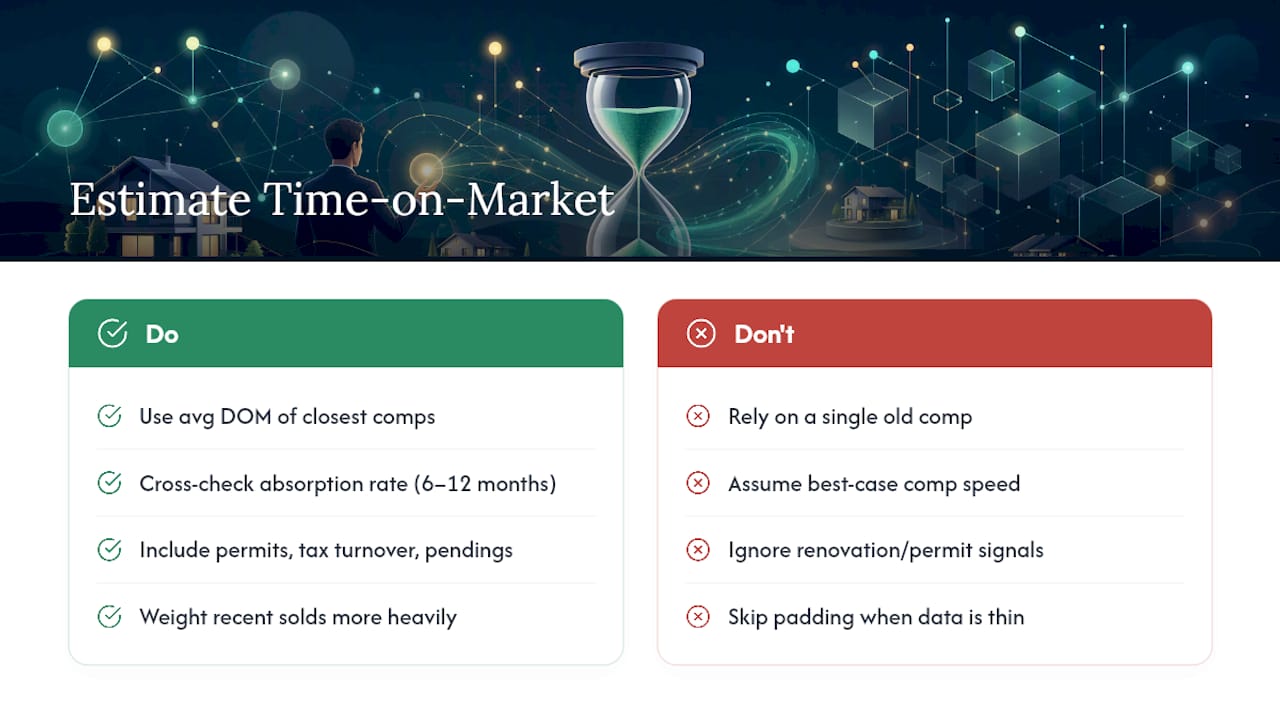
Off-market properties don’t come with a days-on-market counter the way an MLS listing does, but you can still estimate deal velocity if you know where to look. Start with the average days-on-market for your closest comps, pulled from whatever MLS or agent data you can access, since that number reflects genuine buyer demand in your subject’s price band and location.
Cross-reference that baseline against absorption rate, meaning how many comparable homes sold in your radius over the last 6 to 12 months. A tight radius with five solds in six months tells you a different story than a radius with five solds in eighteen months, even if the price points look identical. Faster absorption generally means a faster exit if you’re flipping, and it also means competing off-market buyers are more likely circling the same seller.
Local permit activity and county tax record turnover offer a secondary signal. A neighborhood showing frequent renovation permits and quick resales usually has more retail buyer demand waiting at the end of your rehab than one where properties sit for a year after listing. Pair that with pending sales in your dataset, since a pending sale that hasn’t closed yet still tells you buyer appetite exists at a specific price point right now, not six months ago.
If your comps show wide date spreads, weight the most recent solds more heavily when estimating your own time-on-market, since a market that’s cooling or heating will make an eight-month-old comp less predictive than one from last month. Building this into your MAO math means padding your holding cost line whenever absorption data looks thin, rather than assuming you’ll sell as fast as your best-case comp did.
Should You Use Expired, Withdrawn, or Pending Listings as Comps?
Expired and withdrawn listings aren’t sales, but they’re not worthless either. An expired listing tells you what the market rejected. If a property sat listed at $250,000 for 120 days and expired unsold, that price was too high for current demand, which gives you a soft ceiling for your own ARV estimate on a similar property.
Withdrawn listings carry a similar signal but often mean the seller pulled the property for reasons unrelated to price, financing falling through, a life change, or a decision to rent instead. Treat withdrawn listings as weaker evidence than expired ones, since you don’t know if price was the actual issue.
Pending sales are the most useful non-traditional comp in your toolkit, because they represent a buyer and seller who’ve already agreed on a number, even though the deal hasn’t recorded yet. If you can get the pending price through an agent contact or a data platform, weight it close to a closed sale, just flag it as unconfirmed until the closing records. A cluster of pending sales in your radius, especially several close in price, is often a leading indicator that solds a month or two from now will land in the same range.
The mistake investors make is ignoring these categories entirely because they’re not “real” sales. Used correctly, expired and withdrawn listings mark the outer edges of buyer tolerance, while pending sales preview where the next round of solds will likely land.
Common Mistakes That Wreck Off Market Comp Analysis
The single most common error is anchoring on one comp because it’s the closest geographically, even when its condition, size, or sale date doesn’t actually match the subject. Proximity feels like relevance, but a comp two blocks away that sold 14 months ago in worse condition tells you less than a comp a mile away that closed last month in similar shape.

A second recurring mistake is trusting a single AVM number as if it were a sale price. AVMs run wider on off-market and unique properties, and treating that single figure as gospel instead of a cross-check has sunk more than a few flips before the first shovel hit the ground.
Investors also tend to skip documentation, running the math in their head or on a napkin instead of writing down every filter, adjustment, and assumption. When a deal goes sideways six weeks later, you need to be able to trace back exactly why your ARV landed where it did, and undocumented math makes that impossible.
Finally, many investors underestimate how narrative risk distorts off-market pricing. A motivated seller’s story about the property’s condition or history can bias your comp selection toward whatever confirms the price you already want to pay. The fix is mechanical: set your filters and adjustment rules before you know the seller’s asking price, not after, so the story doesn’t quietly steer your numbers.
Three Mistakes That Sink Off Market Underwriting
The biggest error I see is investors leaning on one source, usually a single AVM pull or a seller’s verbal comp, and calling it done. Real underwriting triangulates. Stress-test your rehab number and your title position before you stress-test your ARV, because those two variables kill more deals than a comp that’s off by a few thousand dollars. Write your assumptions down, and set your kill criteria before you fall in love with the deal.
— Michael
Run Your Off Market Comps Through a Faster Workflow
Online real estate calculators give you a way to turn a raw comp set into a defensible ARV and MAO without building a spreadsheet from scratch every time a new off-market lead lands in your inbox. Some free calculators require no sign-up, so you can test a subject property’s numbers the moment you get an address, without account setup standing between you and a decision.
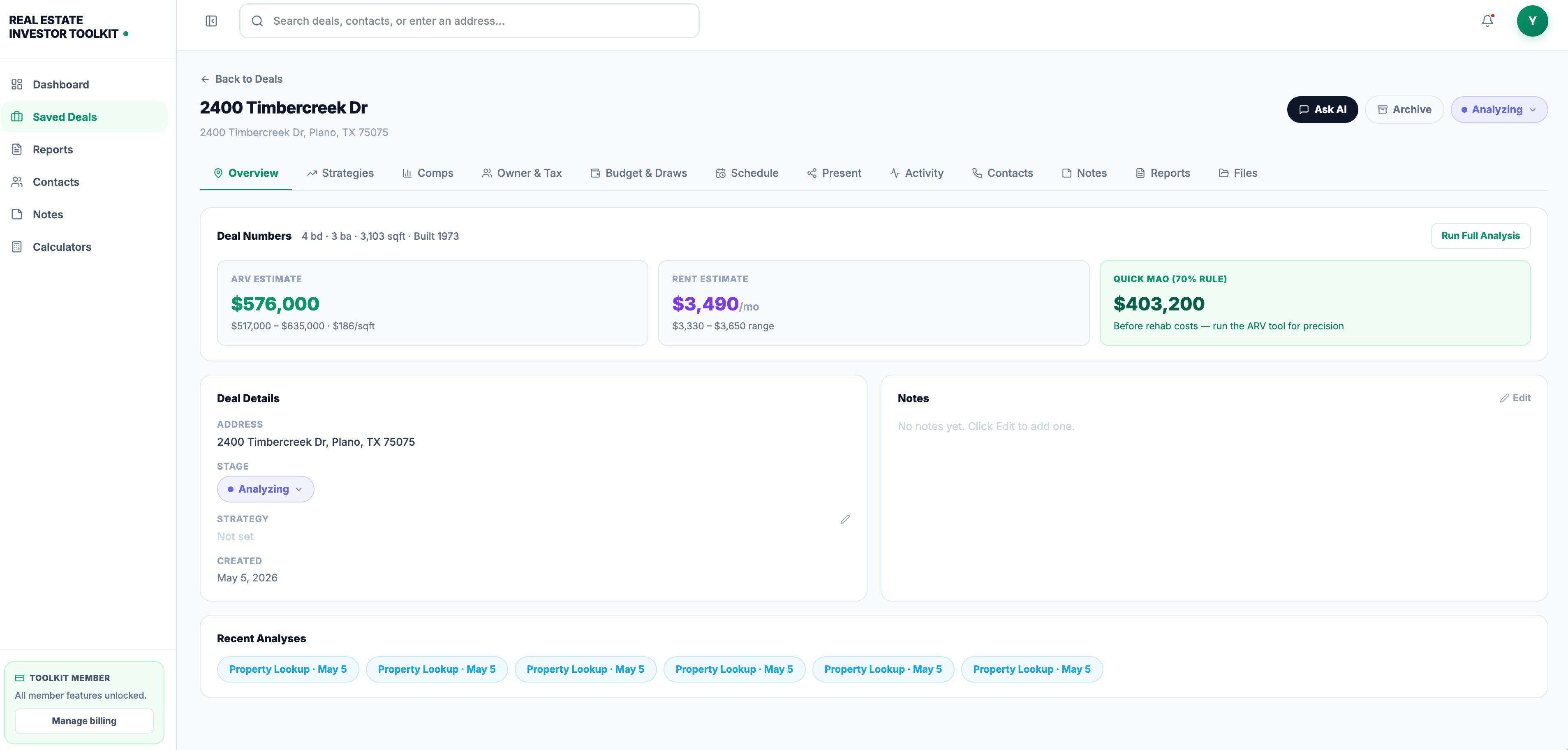
Start with the ARV calculator to turn your adjusted comps into a range, then run the rehab cost estimator to pin down your repair budget before you finalize an offer. If you’re evaluating off-market leads regularly and want saved deal pipelines, unlimited property reports, and owner data alongside your comps work, the paid plan runs $39.99 per month. Either way, pull your comps, run the numbers, and export the results before you sit down to negotiate.
Sources
- How to Find Off-Market Properties: A Buyer and Investor Guide — Redfin
- How property values are estimated — Opendoor
- How to Analyze an Off Market Deal — OffMarket Deck
FAQ
Are Off-Market Deals Legal?
Yes, off-market deals are legal in the United States. Sellers and their agents can market a property privately or through office-exclusive channels under NAR’s Clear Cooperation policy, and Redfin confirms these exceptions still exist even after the rule reduced some off-market listing volume.
What Is the 3-3-3 Rule in Real Estate?
The 3-3-3 rule is a rough guideline some investors use for renovation timing: budget roughly 3 weeks for planning, 3 months for the bulk of construction, and 3 weeks for final touches and listing prep. It’s a loose framework rather than a fixed formula, so treat it as a starting point you adjust against your own contractor bids and comp-based holding cost estimates.
What Is the 70% Rule in Flipping Houses?
The 70% rule says you should pay no more than 70 percent of the ARV minus repair costs for a flip. Your actual MAO should still account for holding costs and profit margin the way the MAO formula in this guide lays out.
What’s the Best Way to Find Off-Market Properties?
Networking with agents who handle pocket listings, direct mail or driving-for-dollars outreach, and public record searches for absentee owners remain the most consistent ways to source off-market deals. A comps analyzer paired with an owner-data tool speeds up the follow-through once you’ve identified a lead worth pursuing.
How Accurate Are Off Market Comps Compared to MLS Comps?
Off market comps carry wider error bands than MLS-derived comps because sale prices are sometimes hidden by non-disclosure laws and AVMs perform worse on unique properties. Building your ARV from multiple sources, including public records and agent CMAs, tightens that error band considerably compared to relying on a single AVM estimate.