3–6 Comps: A Practitioner Workflow for Investors and Appraisers

Use three to six comparable sales for most property valuations. Three is the practical floor since it’s the minimum most appraisal assignments require, while five or six is where accuracy typically peaks without extra noise. Push past six only for unique, high-value, or thin-data markets, and always prioritize recency, proximity, and true similarity over hitting a specific count.
TL;DR:
- Using three comps is only reliable when all are closely clustered in price, recent, and within a quarter mile of the property.
- Most professionals use four to six comps to bracket the subject property and reduce the impact of outliers, especially in stable markets.
- In fast-moving or low-inventory markets, recency often outweighs similarity, with comps up to six months old still providing relevant insights.
- Expanding beyond six comps is justified mainly for unique, high-value, or remote properties where data scarcity makes a wider net necessary.
- A systematic process, including defining the property profile and testing comp sensitivity, ensures a credible valuation without relying solely on quantity.
Table of Contents
- Number of Comps to Use: The Baseline Range Explained
- Why the Right Comp Count Varies by Market
- How to Choose the Right Comps Step by Step
- What Appraisers and Lenders Actually Require
- When You Need More Than the Baseline
- A Practical Workflow for Pulling Comps Yourself
- Why I Trust the Range More Than the Rule
- Try the Comps Analyzer Before You Finalize Your Number
- Sources
Number of Comps to Use: The Baseline Range Explained
Three comps is your floor, not your target. Most lenders and appraisal assignments treat three settled sales as the minimum defensible data set, but three only works when each comp is a near-perfect match on size, condition, and location.
Four to six comps is where most professionals land, and for good reason. Adding a fourth or fifth comp lets you “bracket” the subject property, meaning you pick some comps that sold for more and some that sold for less than your estimated value. That bracket narrows your margin of error and protects you from an outlier throwing off the whole analysis.
Here’s how to decide where in that range to land:
- Use 3 comps when they’re tightly clustered in price per square foot, sold within the last three months, and sit within a quarter mile of the subject.
- Use 4 to 5 comps when the comps show more spread, or you need at least one on each side of your target value.
- Use 6 comps when the market has enough inventory to support it and you want a wider bracket to defend against outlier pricing.
- Go beyond 6 only when uniqueness, thin data, or a high-value property demands it (more on that below).
Industry guidance from McKissock Learning generally recommends three to five recently closed sales as sound practice, ideally sold within the past three to six months and located within a quarter to a half mile of the subject.
Why the Right Comp Count Varies by Market
The honest answer is that no fixed number works everywhere, and the data backs that up. Enterprise-backed mortgage appraisals reviewed by FHFA show a modal comp count of six, with the average and median both landing around five, even though the formal requirement is only three settled comps.
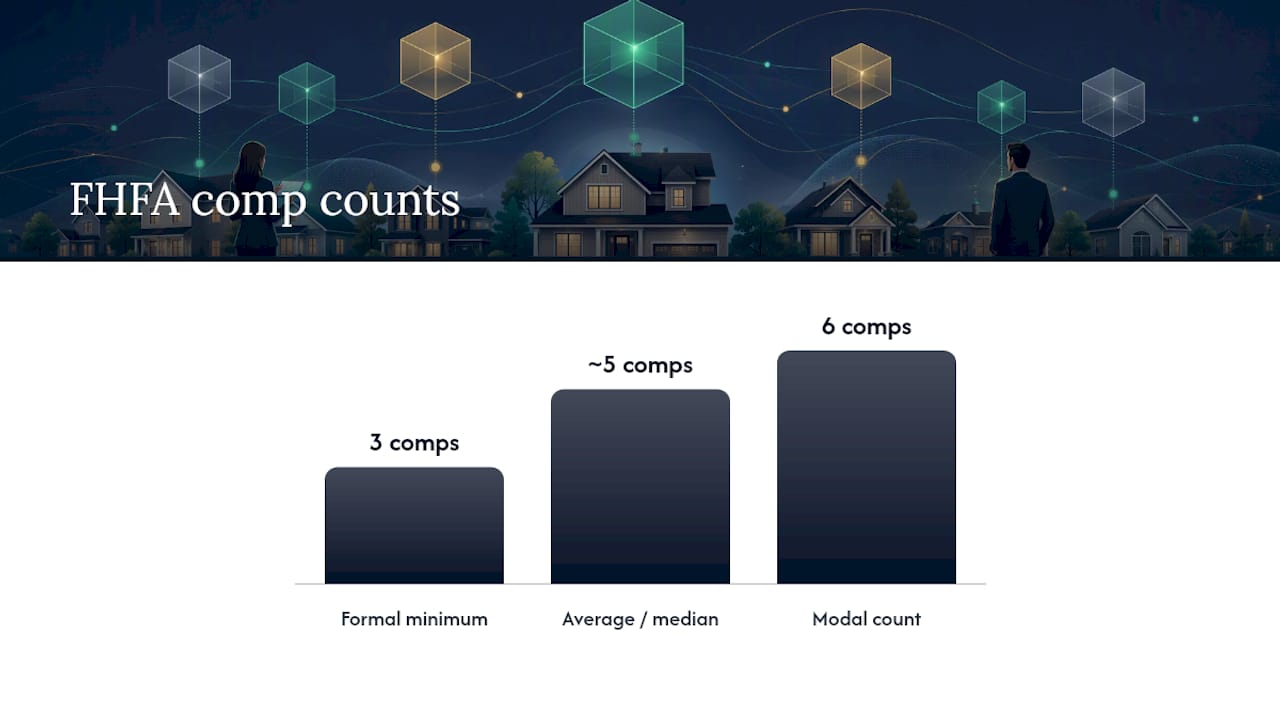
That distribution tells you something important: appraisers routinely exceed the minimum because a bigger candidate pool improves the odds of finding close matches. But more isn’t automatically better. Valuation analyst George Dell argues that the smarter approach is picking the smallest data set that reliably represents the Competitive Market Segment, rather than chasing an arbitrary count. Pile on loosely similar comps just to hit six or seven, and you dilute your analysis with noise instead of sharpening it.
Market speed changes the calculation too. Fast-moving, low-inventory markets often force a trade-off: you either loosen your proximity radius or accept comps that are slightly older than the ideal three-to-six-month window. When that happens, recency usually wins over exact similarity, since a comp from six weeks ago in a shifting market tells you more than a perfectly matched comp from eight months back. Consider these variables together:
- Market density: urban and suburban areas with frequent turnover support tighter comp sets; rural areas often don’t.
- Property uniqueness: custom or heavily renovated homes need a wider net to find anything comparable.
- Price momentum: in a market moving fast in either direction, older comps lose relevance quickly.
How to Choose the Right Comps Step by Step
Building a defensible comp set is a process, not a guess. Follow this sequence and you’ll rarely end up second-guessing your final number.
- Define the subject profile. Nail down gross living area, bed and bath count, lot size, age, and condition before you search for anything. This profile is your filter for every comp you consider.
- Gather candidates within 3 to 6 months and 0.25 to 0.5 miles. Zillow’s guidance points to this same window as the standard starting point. If you have to relax either parameter, write down why.
- Select the three closest matches first. Check whether they bracket your target value and whether their adjusted prices land in a tight range. If they do, you may be done at three or four.
- Expand to five or six if the bracket is missing or the spread is wide. A wide spread between adjusted prices is your signal that you need more data points, not fewer.
- Run the adjustments checklist. Confirm you’ve adjusted for GLA differences, condition, lot size, and any view or amenity premium. If two comps require adjustments larger than 10 to 15% of sale price, that’s a red flag to find a closer match instead of leaning on a big adjustment.
Pro Tip: Never select comps by price alone. A comp that “sold for what I expect” but doesn’t match on size or condition will wreck your credibility with a lender or a buyer’s agent who pulls their own numbers.
What Appraisers and Lenders Actually Require
The formal rule is simpler than the real-world practice. Fannie Mae and Freddie Mac require at least three settled comps for a standard appraisal, full stop. But that FHFA data showing a modal count of six tells you what actually happens in practice once appraisers start working the file.
Statistic callout: The share of appraisals using five or more comps declined over time, reflecting changing inventory and market conditions between 2013 and 2021.
A few things affect what your specific file will need:
- FHA and VA loans sometimes carry stricter proximity or condition documentation than conventional loans.
- Unique assignment conditions (like a desk review or a second appraisal) can push the expected comp count higher.
- Investor or portfolio lenders may set their own internal comp minimums above the standard three.
Best practice, even outside formal appraisal work, is to keep a broader workfile of every comp you seriously considered, not just the three to six that make the final report. If a buyer or underwriter challenges your number, that workfile is your defense.
When You Need More Than the Baseline
Some situations genuinely call for expanding past six comps, and pretending otherwise just produces a weaker valuation.
- High-value or custom homes. Fewer truly comparable sales exist, so casting a wider net (both in distance and time) reduces the risk that one quirky comp skews your number.
- Rural or low-inventory markets. You may need to stretch beyond half a mile or beyond six months just to find enough valid sales, and that’s acceptable as long as you document the trade-off.
- New construction or heavily renovated comps. Active listings and pending sales can add useful context when closed sales are scarce, even though they carry less weight than settled transactions.
Appraiser discussions on forums like Appraisersforum back this up: complex properties routinely draw six or more comps in the final report, with a much larger candidate list reviewed behind the scenes.
A Practical Workflow for Pulling Comps Yourself
You don’t need MLS access to build a solid comp set, but you do need a repeatable process.
- Define your subject property’s profile: square footage, bed/bath count, lot size, age, and condition.
- Search sold listings on public portals and county property records for matches within your target radius and time window.
- Calculate price per square foot for each candidate and check that your subject falls within the bracket.
- Narrow to your three to six best matches, then test sensitivity by adding or removing a comp to see how much your value estimate moves.
If a swing of one comp changes your number by more than a few percent, you haven’t found stable data yet. The Real Estate Investor Toolkit comps analyzer is built for exactly that kind of sensitivity check, letting you swap comps in and out and watch your ARV estimate update instantly instead of rebuilding a spreadsheet each time.
Pro Tip: If you don’t have MLS access, county records, aggregator portals, and agent CMAs can fill the gap. Cross-check at least two sources before you trust any single comp’s sale price.
Why I Trust the Range More Than the Rule
The three-to-six range isn’t a compromise. It’s the point where most appraisers, lenders, and data analysts land once they’ve actually tested the alternatives. I’ve watched plenty of investors chase a bigger comp count thinking it makes their number more defensible, when in reality a sixth or seventh loosely matched comp usually just adds confusion. The workflows built into Real Estate Investor Toolkit reflect that same discipline: pull the tightest set of comps you can defend, then run the sensitivity check before you commit to a number.
— Michael
Try the Comps Analyzer Before You Finalize Your Number
Real Estate Investor Toolkit gives you a faster way to test your comp set than juggling spreadsheets and portal tabs. The comps analyzer lets you swap comps in and out and watch your adjusted value shift in real time, so you can see immediately whether three comps hold up or you need a sixth to tighten your bracket.
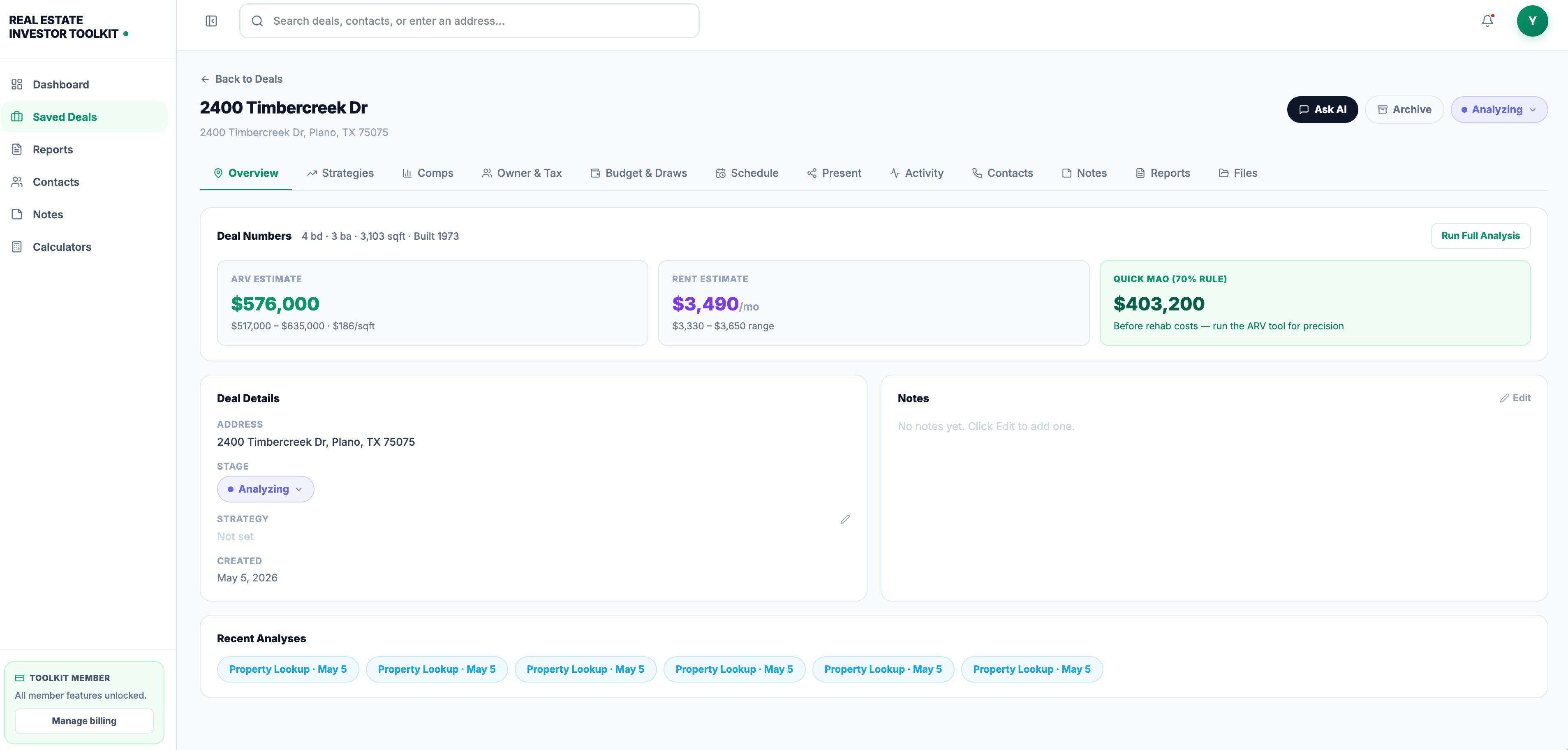
The core calculators, including comps and ARV, are free to use with no sign-up required. A paid subscription unlocks unlimited property reports, saved deal pipelines, and advanced owner-occupancy data if you’re running multiple deals at once. Pull your first comp set on the ARV calculator and see how your estimate holds up once you adjust the count.
Sources
- Counting Comps: Exploring the Number of Comparable Properties in Home Appraisals | FHFA
- Dos and Don’ts of Selecting Appraisal Comps - McKissock Learning
- Real Estate Comps: How to Find Comparables for Real Estate | Zillow
- Enough comps? — George Dell