Investors: When 75% Loan-to-Cost Caps Your Loan, Not 80% LTV

Loan-to-cost (LTC) measures your loan against total project cost, and lenders lean on it for construction and heavy rehab deals. Loan-to-value (LTV) measures your loan against appraised value, and it governs stabilized or refinance deals. When a lender checks both, the more conservative number usually decides how much you can borrow. Below, we walk through the formulas, a worked example, and the underwriting rules lenders apply to each.
TL;DR:
- Developers should carefully model both LTC and LTV ratios because LTC often caps borrowing in ground-up projects, while LTV limits are more relevant for stabilized properties.
- The maximum loan is typically constrained by the more conservative of the two ratios, with LTC usually being the primary limit during construction and LTV during stabilization.
- Including full project costs, such as soft costs, financing fees, and contingency, is essential to accurately determine LTC and avoid mid-project funding gaps.
- Utilizing free calculators can help investors test their deal against lender limits before submitting applications, ensuring they understand the most restrictive borrowing condition.
- Regularly reconciling draw schedules with cost assumptions prevents basis inflation and keeps borrowing limits aligned with actual project expenses.
Table of Contents
- 1. What is loan-to-cost and how do you calculate it?
- 2. What is loan-to-value and which appraisal applies?
- 3. How lenders apply LTC vs LTV and which one wins
- 4. Calculating LTC and LTV on the same deal
- 5. Underwriting rules and supervisory limits lenders reference
- 6. Practical implications, negotiation tips, and lender red flags
- 7. Using Real Estate Investor Toolkit calculators to test your own numbers
- 8. The bottom line on LTC vs LTV
- 9. A pattern worth watching for
- 10. Run your numbers before you talk to a lender
- FAQ
- Sources
1. What is loan-to-cost and how do you calculate it?
Loan-to-cost tells you what portion of your total project budget a lender will finance. The formula is simple: loan amount ÷ total project cost = LTC. If you need a $750,000 loan on a project that costs $1,000,000 to complete, your LTC is 75%.
The “cost” side of that equation is where most new developers underestimate their numbers. Lenders expect a full accounting of everything it takes to get the project to completion, not just the purchase price and construction bids.
A typical LTC denominator includes:
- Acquisition price for the land or existing structure
- Hard costs: labor, materials, site work, and contractor profit
- Soft costs: architectural fees, permits, engineering, and legal work
- Financing costs, including loan fees and interest reserves set aside to cover debt service during construction
- A contingency line, usually a percentage of hard costs, to absorb overruns
The FDIC’s construction and land development lending guidance notes that lenders typically require a documented cost breakdown covering all of these categories before closing. Skip the interest reserve or lowball the contingency, and you are the one who ends up covering the gap with an unplanned equity call mid-project.
2. What is loan-to-value and which appraisal applies?

Loan-to-value compares your loan amount to the property’s appraised value rather than what it cost to build or buy. The formula is loan amount ÷ appraised value = LTV. A $400,000 loan against a property appraised at $500,000 produces an LTV of 80%.
The tricky part is knowing which value the lender is actually using. An appraisal can produce more than one value conclusion, and the one that applies depends on your loan’s purpose.
- As-is value reflects the property’s current condition, often used for acquisition-only loans.
- As-complete value reflects the property once planned renovations or construction are finished, common in rehab and construction underwriting.
- As-stabilized value reflects the property once it reaches normal occupancy and income, typical for permanent or refinance loans on income properties.
Per Federal Reserve SR 23-5, institutions are expected to use the value conclusion that matches the loan’s actual objective rather than whichever figure is most favorable. Lenders also net out senior liens or other encumbrances before applying their LTV limit, so a property with existing debt attached will show a lower effective lending value than the headline appraisal number suggests.
3. How lenders apply LTC vs LTV and which one wins
When a deal involves both construction risk and an eventual stabilized value, lenders typically calculate both ratios and size the loan to whichever one produces the smaller number. That is the conservative underwriting rule in practice: the metric that limits your exposure the most is the one that governs.
Which ratio dominates depends heavily on the loan type:
- Construction, ground-up development, and major value-add rehab loans lean on LTC, since there is no reliable stabilized value yet and the lender’s main exposure is cost overrun.
- Stabilized acquisitions and cash-flowing refinances lean on LTV, since the asset already has an income stream and a defensible market value.
- Transitional loans, such as a bridge loan on a property mid-renovation, often start underwritten to LTC and shift toward LTV once a takeout commitment or permanent financing lines up.
That shift matters because a takeout commitment changes the lender’s risk calculus. The OCC’s Comptroller’s Handbook on commercial real estate lending points out that when a borrower has a credible permanent-financing takeout lined up, lenders will underwrite the construction loan against LTC and the eventual permanent loan against LTV, with the takeout terms directly affecting how the construction loan gets sized and covenanted. In practice, this means your exit strategy is not just a planning detail. It is an input lenders use when deciding how much they will lend today.
4. Calculating LTC and LTV on the same deal
Running both ratios on a single project makes the difference concrete. Here is a step-by-step example using a hypothetical ground-up build.
- Add up total project cost. Say acquisition is $200,000, hard costs are $600,000, soft costs are $100,000, financing costs and interest reserve are $50,000, and contingency is $50,000. Total project cost: $1,000,000.
- Apply the lender’s LTC limit. At a typical LTC cap, the maximum loan is the corresponding percentage of total project cost.
- Estimate the as-complete appraised value. Assume the appraiser values the finished property at $1,100,000.
- Apply the lender’s LTV limit. At a typical LTV cap, the maximum loan is the corresponding percentage of appraised value.
- Compare the two ceilings. The lender sizes the loan to the lower figure, which is $750,000 from the LTC calculation.
- Run a sensitivity check. Raise contingency from $50,000 to $100,000, pushing total project cost to $1,050,000. At 75% LTC, the new ceiling drops to $787,500, still below the LTV-based number.
In this example, LTV would allow a higher loan amount, but LTC caps it at a lower level, making LTC the binding constraint. That gap is common on ground-up projects where the finished value outpaces the build cost, and it is exactly why developers need to model both ratios before assuming the appraisal sets their borrowing limit.
5. Underwriting rules and supervisory limits lenders reference
Lenders do not set LTV and LTC limits in a vacuum. The interagency guidelines on real estate lending policies lay out supervisory LTV benchmarks that institutions commonly reference when building internal policy, including figures like 65% for raw land, 75% for land development, and 80% for nonresidential construction. Individual banks can set tighter internal limits than these benchmarks, and LTV is explicitly treated as one factor among several, not the sole underwriting trigger.
Beyond the headline ratio, lenders layer in additional controls:
- Appraisals performed under Uniform Standards of Professional Appraisal Practice (USPAP)
- Feasibility studies for larger or speculative projects
- Minimum equity contributions from the borrower
- Disbursement controls tied to construction draw schedules
- Lien waivers from contractors and subcontractors at each draw
- Preleasing or presale thresholds before funds release on commercial or condo projects
That guidance matters for loan classification, too. If a lender applies the wrong value conclusion, say, treating an as-stabilized figure as if it were as-is, the resulting LTV understates risk and can misclassify how the loan should be reserved against internally.
6. Practical implications, negotiation tips, and lender red flags
Once you understand which ratio governs your deal, you can structure your numbers to make the most of your allowable leverage without inviting a lender to pull back.
To maximize acceptable LTC, build your cost schedule with:
- A fully funded interest reserve rather than a token placeholder
- Soft costs itemized by category instead of lumped into a single contingency line
- A third-party cost review or feasibility report backing your numbers
- A realistic contingency, typically a meaningful percentage of hard costs rather than a rounding error
On the negotiation side, a few levers tend to move the needle: documenting your basis (purchase price versus appraised value) so the lender uses the more favorable supported figure, lining up pre-sales or pre-leasing commitments to de-risk the project, securing contractor performance bonds, and proposing a phased disbursement schedule tailored to construction lender requirements that matches your actual construction timeline.
Pro Tip: Reconcile your draw schedule against your original LTC assumptions every month, not just at the halfway mark, so a cost overrun shows up while you still have room to adjust.
Watch for red flags that make lenders nervous: inflated historical cost comps, missing permits at submission, unrealistic cost-per-square-foot assumptions, and over-reliance on the interest reserve to paper over a tight operating budget. Any one of these can trigger a lender to shrink your allowable loan or demand more equity up front.
7. Using Real Estate Investor Toolkit calculators to test your own numbers
You do not need a spreadsheet to replicate the calculations above. Our investment property financing calculator models loan sizing the way an LTV-based lender would, while our rehab cost calculator helps you break hard and soft costs apart so you can build an accurate LTC denominator.
A workable sequence looks like this:
- Enter your acquisition price and rehab budget into the rehab calculator to generate a cost breakdown.
- Add financing costs and a contingency line to get total project cost.
- Run your target loan amount through the mortgage calculator against an estimated as-complete or as-stabilized value.
- Compare the LTC and LTV outputs side by side to see which one would constrain your loan.
Try swapping in a higher contingency or a lower appraisal estimate to see how quickly the constraining ratio shifts.
8. The bottom line on LTC vs LTV
LTC governs when your project’s value is not yet realized, LTV governs once it is, and lenders typically size the loan to whichever ratio is more conservative. Before you walk into a lender meeting, run both calculations on your own numbers and build your budget around the tighter of the two constraints.

9. A pattern worth watching for
The pitfall we see most often is basis inflation: developers price acquisition at wishful-thinking levels instead of documented cost, which inflates LTC on paper and invites a correction later. Reconcile your draw schedule to your original cost assumptions every month, not just when something looks off.
— Michael
10. Run your numbers before you talk to a lender
Knowing the formulas is one thing. Seeing where your actual deal lands against a lender’s LTC and LTV limits is another, and that is where a quick pass through our calculators pays off. Our free tools let you plug in acquisition price, rehab budget, and projected value with no sign-up required, so you can check both ratios before you ever submit a loan package.
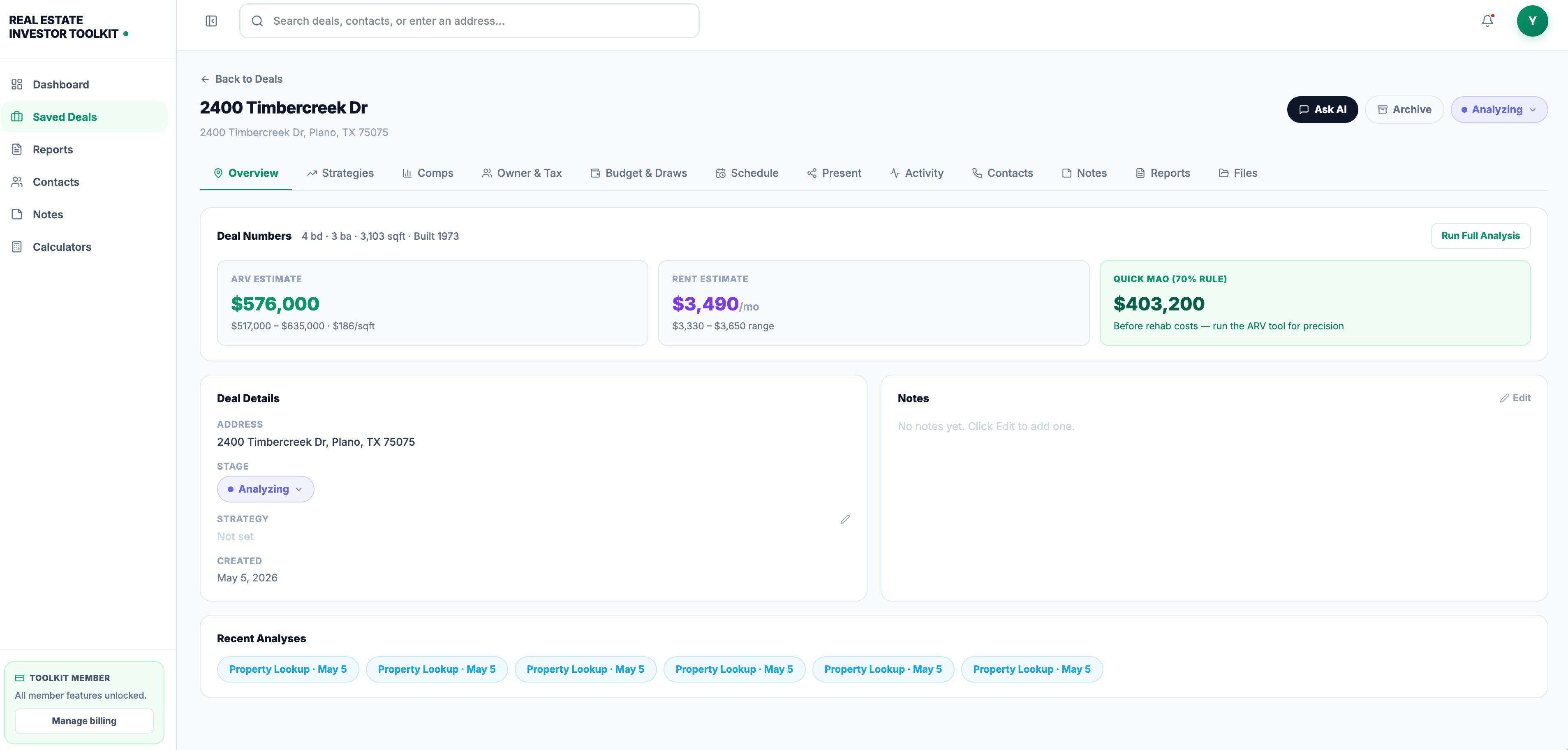
For investors managing multiple deals at once, our Real Estate Investor Toolkit plan at $39.99 per month adds unlimited reports, saved deal pipelines, and an AI assistant that flags cost and value assumptions worth double-checking, all in one place instead of juggling separate spreadsheets and subscriptions. Start with the free calculators, then upgrade when you need to track more than a deal or two at a time.
This article is general information, not a substitute for advice from a qualified financial advisor. Consult a qualified financial professional about your own circumstances before acting on anything here.
FAQ
Is 20% LTV good?
A 20% LTV is unusually low and generally signals a very conservative, low-risk loan, since it means you are financing only a small slice of the property’s value.
Is LTV of 80% good?
An 80% LTV sits at or near the supervisory benchmark many lenders reference for nonresidential construction, according to the interagency guidelines on real estate lending policies. Whether it counts as “good” for your deal depends on the property type and your lender’s internal policy, since some institutions set tighter limits than the supervisory reference points.
What is a good loan-to-cost ratio?
A commonly referenced range for construction and development loans runs up to around 75% to 80% LTC, though your lender’s specific policy and the property type will set the actual ceiling. Projects with thin contingency or an unverified cost schedule often get capped lower regardless of the headline target.
What is a good LTV on a loan?
A “good” LTV depends entirely on the property type and loan purpose, since supervisory benchmarks vary from around 65% for raw land up to roughly 85% for one- to four-family construction, per interagency lending guidelines. Lower LTV generally means less lender risk and easier approval, but it also means you are putting more of your own equity into the deal.
Sources
- Construction and Land Development Lending — FDIC risk management manual
- Policy statement on prudent commercial real estate loan accommodations and workouts (SR 23-5) — Federal Reserve
- Commercial real estate lending — Comptroller’s handbook (OCC)