Calculator Ready Landlord Reserve Funds for Investors: 3–6 Months PITI

Hold 3 to 6 months of PITI (principal, interest, taxes, and insurance) in cash before you close on a rental, then keep contributing 15% and 30% of gross monthly rent afterward, split across vacancy, capital expenditures (CapEx), and repairs. The single rule that matters more than the exact percentage: keep that money liquid, in a separate account, never mixed with your operating cash or your personal checking.
TL;DR:
- Setting aside 3 to 6 months of PITI before closing helps ensure coverage during vacancy and major repairs, especially for older properties.
- Separating reserve buckets for vacancy, CapEx, and repairs prevents raiding capital funds for routine maintenance and clarifies fund usage.
- Running component-based, rent-percentage, and months-of-expenses methods side by side produces a more accurate reserve target, especially when systems near failure.
- Reserve funds should be kept in liquid, interest-bearing accounts with automatic transfers, completely separated from operational and personal accounts.
- Maintaining sufficient reserves signals quality management to lenders and buyers and provides personal confidence to absorb unexpected costs without scrambling for urgent financing.
Table of Contents
- What Landlord Reserve Funds Actually Cover
- Three Ways to Size Your Reserve Fund
- Where to Keep Your Reserve Fund
- How to Build Reserves From Zero
- Lenders and Multi-Property Portfolios
- Tax Considerations for Landlord Reserve Funds
- Professional Landlords vs. Individual Investors: Different Reserve Playbooks
- Common Mistakes Landlords Make With Reserve Funds
- How Reserve Fund Size Affects Property Valuation and Investor Confidence
- An Investor’s Take on Reserve Sizing
- Model Your Reserve Numbers Before You Commit
- Sources
- FAQ
What Landlord Reserve Funds Actually Cover
A landlord reserve fund isn’t one pile of cash. It’s three buckets doing three different jobs, and confusing them is how landlords end up broke the month a tenant moves out and the water heater dies in the same week.
- Vacancy reserve covers the gap between tenants: lost rent, marketing costs, and any concessions you offer to fill the unit fast.
- CapEx reserve covers big-ticket replacements: roofs, HVAC systems, water heaters, and major appliances. A mid-range HVAC replacement runs about $7,500. A standard water heater runs closer to $1,300.
- Repairs and maintenance reserve covers the small stuff: a leaking faucet, a broken garbage disposal, patching drywall after a move-out.
PITI is the survival number underneath all three, because your mortgage, tax, and insurance payment doesn’t pause just because a unit sits empty or a system fails. Lenders think in months of PITI (or PITIA, which adds association dues) for exactly this reason: it’s the one number that tells you how long you can absorb a shock. Landlords who track just one bucket, usually repairs, often get blindsided by a CapEx item because they never separated that money from routine maintenance cash.
Three Ways to Size Your Reserve Fund
You can size reserves three different ways, and the smart move is to run all three and see where they land. If they roughly agree, you’ve got a defensible number. If they don’t, the gap usually tells you something about your property’s actual condition.
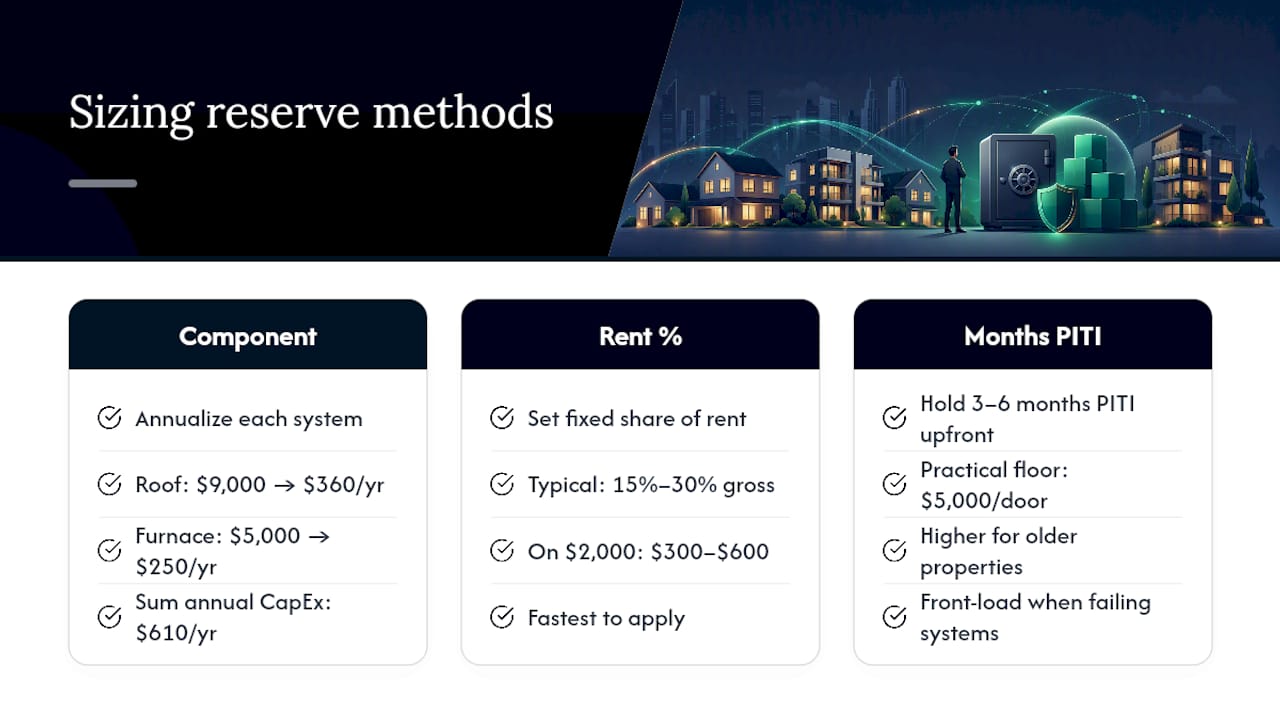
Component-based method. List every major system, its remaining useful life, and its replacement cost, then annualize each one. A roof at $9,000 with 25 years left costs about $360 a year; a furnace at $5,000 with 20 years left adds another $250. Sum the components and you get a defensible annual CapEx target, not a guess.
Rent-percentage method. Set aside a fixed share of gross rent, typically 15% to 30% depending on what the percentage is meant to cover. This is the fastest method to apply but the least sensitive to your specific property’s age and systems.
Months-of-expenses or per-door method. Hold 3 to 6 months of PITI upfront, and treat $5,000 per door as a practical floor for ongoing reserves, higher for older properties or big systems nearing replacement.
Here’s how those methods translate into dollars on a property renting for $2,000 a month:
Say that $2,000-rent property has a 22-year-old HVAC system rated for 25 years. The component math says you need most of that $7,500 replacement cost on hand within three years, not spread evenly over the unit’s remaining life. When a system is that close to failure, slow monthly accrual won’t get you there in time. You should front-load the CapEx bucket now and taper contributions once it’s funded.
Pro Tip: *Run the component-based number and the rent-percentage number side by side.
Where to Keep Your Reserve Fund
Reserve money needs to be boring, liquid, and completely separate from everything else you touch day to day. A dedicated high-yield savings account or money market account, held apart from your operating account, is the standard setup landlords rely on for exactly this reason: funds stay accessible without withdrawal penalties, and they’re never accidentally spent on a grocery run.
For multiple properties, sub-accounts by property or by reserve type (vacancy, CapEx, repairs) keep the bookkeeping honest. You’ll know exactly what’s earmarked for the roof versus what’s sitting there for next month’s vacancy risk.
- Open sub-accounts labeled by property address or by bucket, not by vague “extra cash” names.
- Automate a transfer the same day rent hits your account, so funding isn’t optional or memory-dependent.
- Reconcile monthly: confirm the balance matches what your calculator says it should, given contributions and any withdrawals.
- Avoid CDs, bonds, or anything with a lockup period. Reserves that aren’t accessible during an emergency defeat the purpose.
Pro Tip: Treat your reserve transfer like a bill, not a bonus. Schedule it the same day rent posts, before you touch that money for anything else.
How to Build Reserves From Zero
If you’re starting with nothing, the goal isn’t to hit your full target overnight, it’s to get past the danger zone fast.
- Set an immediate floor. Aim for $1,000 to $1,500 per unit as a bare minimum before you worry about the full 3 to 6 months of PITI.
- Run an aggressive funding window. For 6 to 12 months, push contributions to 20% to 25% of gross rent instead of your steady-state target, then dial back once you hit your number.
- Earmark part of every rent increase. If you raise rent $50, route $15 to $20 of that straight into reserves before it ever counts as spendable income.
- Use refinance proceeds carefully. A cash-out refinance can seed a reserve fund fast, but don’t treat that lump sum as a reason to skip ongoing monthly contributions.
- Replenish on a schedule after withdrawals. Log every draw with its purpose (roof repair, vacancy gap, appliance swap) and set a fixed number of months to rebuild it, treating replenishment like a fixed recurring expense rather than leftover cash.
Lenders and Multi-Property Portfolios
Lenders frequently express reserve requirements in months of PITIA or PITI per financed property, but underwriting standards vary by loan program and lender. Confirm the exact requirement with your loan officer before assuming your reserve fund meets a lender’s test.
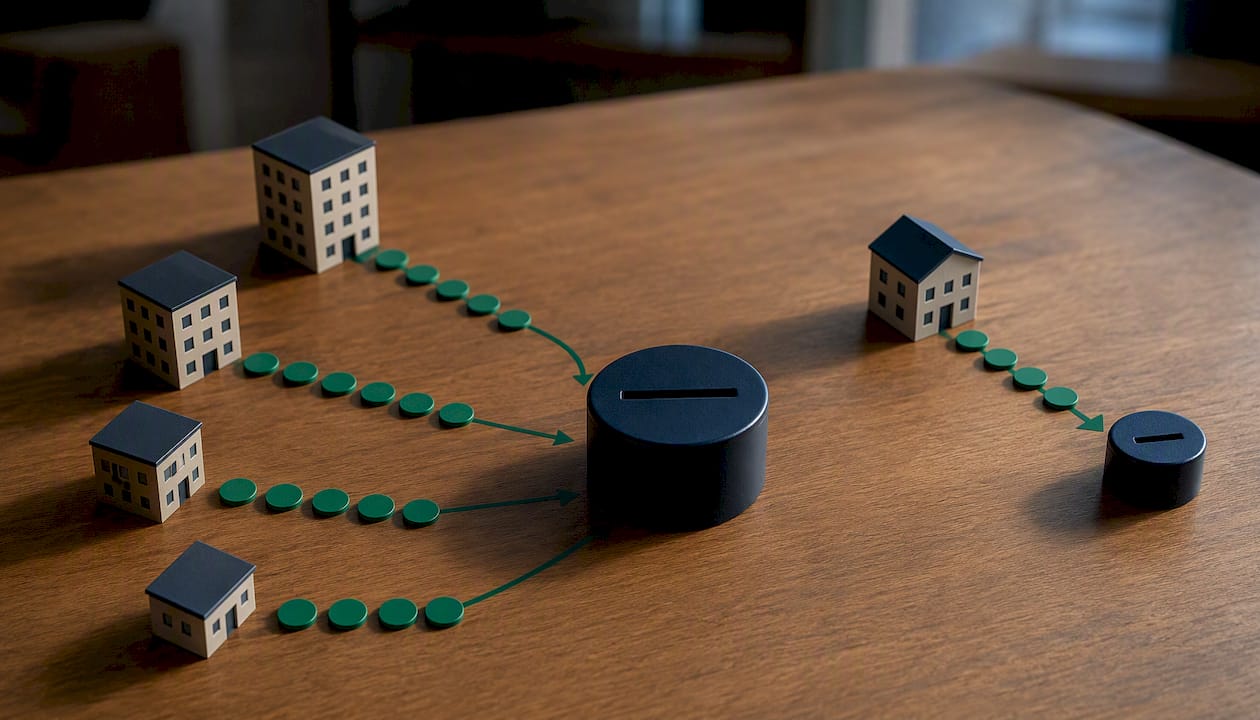
Single-property owners should lean conservative, since there’s no portfolio to spread risk across if one system fails. Investors with several units can consider a shared reserve pool across properties under one LLC, which smooths risk because it’s statistically unlikely every property needs a major repair the same month. The larger the portfolio, the more centralized and percentage-driven your reserve strategy can become.
Tax Considerations for Landlord Reserve Funds
Reserve fund contributions themselves are not tax deductible. Moving cash into a savings account isn’t an expense, it’s just cash changing location, so the IRS doesn’t recognize the transfer as a write-off. What is deductible is the actual repair or maintenance expense once you spend the money: a new furnace filter, a plumbing fix, a repainted unit between tenants.
Capital improvements work differently. A full roof replacement or an HVAC system swap typically gets capitalized and depreciated over its useful life rather than deducted in full the year you pay for it. That distinction matters for how you record withdrawals: pulling $7,500 from your CapEx bucket for a new HVAC unit doesn’t create a $7,500 deduction this year, it creates a depreciation schedule.
Interest earned on a high-yield savings reserve account is taxable income, reported the same way any other bank interest would be. If you’re running reserves through an LLC, keep that interest and any withdrawals documented separately from personal accounts, since commingling reserve funds with personal money is one of the fastest ways to jeopardize liability protection and complicate your books at tax time. None of this replaces guidance from a tax professional who knows your specific structure, but the bookkeeping habit is the same regardless of entity type: track what goes in, what comes out, and what it was for.
Professional Landlords vs. Individual Investors: Different Reserve Playbooks
Professional property managers and larger portfolio owners tend to run reserves as a formal policy: a fixed percentage of rent, automated transfers, and a written schedule for how withdrawals get approved and replenished. They often centralize reserves across dozens of doors, using the law of averages to hold a smaller per-door cushion than a single-property owner would need, because the odds of every property needing a major repair simultaneously are low.
Individual investors with one or two units usually run reserves more reactively, funding them when cash is available rather than on a fixed schedule. That’s the riskier approach. A single-property owner has no portfolio to average against, so a bad year (a lost tenant plus a failed water heater) can wipe out thin reserves fast.
The gap closes when individual investors borrow the professional playbook at a smaller scale: automate contributions instead of funding reserves with whatever’s left over, separate the three buckets instead of lumping everything into one savings account, and calculate CapEx contributions by component age instead of guessing. You don’t need twenty units to run reserves like a professional. You need the same discipline applied to fewer properties, which if anything, makes the margin for error even thinner.
Common Mistakes Landlords Make With Reserve Funds
The most expensive mistake is treating reserves as optional once cash flow feels comfortable. Landlords who skip contributions during a good quarter almost always regret it the quarter a major system fails.
Commingling is the second big one: keeping reserve money in the same account as rent collections and personal spending. It feels convenient until you can’t tell whether that $4,000 balance is earmarked for a roof or just sitting there as slush.
Underestimating CapEx timing causes real damage too. Averaging a roof’s cost evenly over 25 years works fine when the roof is 5 years old, but it fails badly when the roof is 22 years old and you haven’t front-loaded contributions to match. A few other patterns worth watching:
- Using one blended reserve number instead of separate vacancy, CapEx, and repair buckets, which makes it easy to raid capital money for routine fixes.
- Skipping replenishment after a withdrawal, so the fund never returns to target and slowly erodes to zero.
- Assuming a healthy bank balance means reserves are adequate, without checking it against a component-based calculation.
- Ignoring portfolio-level risk management practices that professional investors use to stress-test reserves against multiple bad scenarios at once.
How Reserve Fund Size Affects Property Valuation and Investor Confidence
A well-funded reserve doesn’t show up on a comparable sales report, but it shows up everywhere else that matters. Lenders reviewing a refinance or a new acquisition often look at your reserve position as a proxy for how well the whole portfolio is managed, and thin reserves can raise questions during underwriting even when the property itself performs fine.
Buyers evaluating a portfolio acquisition read reserve history as a signal of deferred maintenance risk. A seller who can show a documented CapEx reserve, funded on schedule and tied to component replacement timelines, is making an implicit claim: nothing on this property has been neglected to protect short-term cash flow. A seller who can’t show that invites a buyer to assume the worst and price it into their offer.
For the individual investor, the confidence effect is more personal than financial. Knowing you can absorb a failed HVAC system or two months of vacancy without scrambling for a credit line changes how you make decisions elsewhere in the portfolio, from screening tenants patiently instead of rushing to fill a unit, to walking away from a marginal deal instead of stretching reserves too thin to make it work.
An Investor’s Take on Reserve Sizing
My default for a first rental is 6 months of PITI upfront and 20% to 25% of rent monthly until the CapEx bucket catches up with the property’s actual age. Older properties and single-property owners should hold more and fund faster. There’s no portfolio to average against, so the margin for error is thinner. Before you lock in a number, run the property’s rent and PITI through a rental property calculator and watch how different reserve percentages change your real monthly cash flow.
— Michael
Model Your Reserve Numbers Before You Commit
Running these three sizing methods by hand works, but it’s slow, and slow math is how landlords quietly skip the exercise altogether. Real Estate Investor Toolkit gives you free calculators that do this math instantly, with no signup required, so you can test a reserve target before you ever touch a spreadsheet.
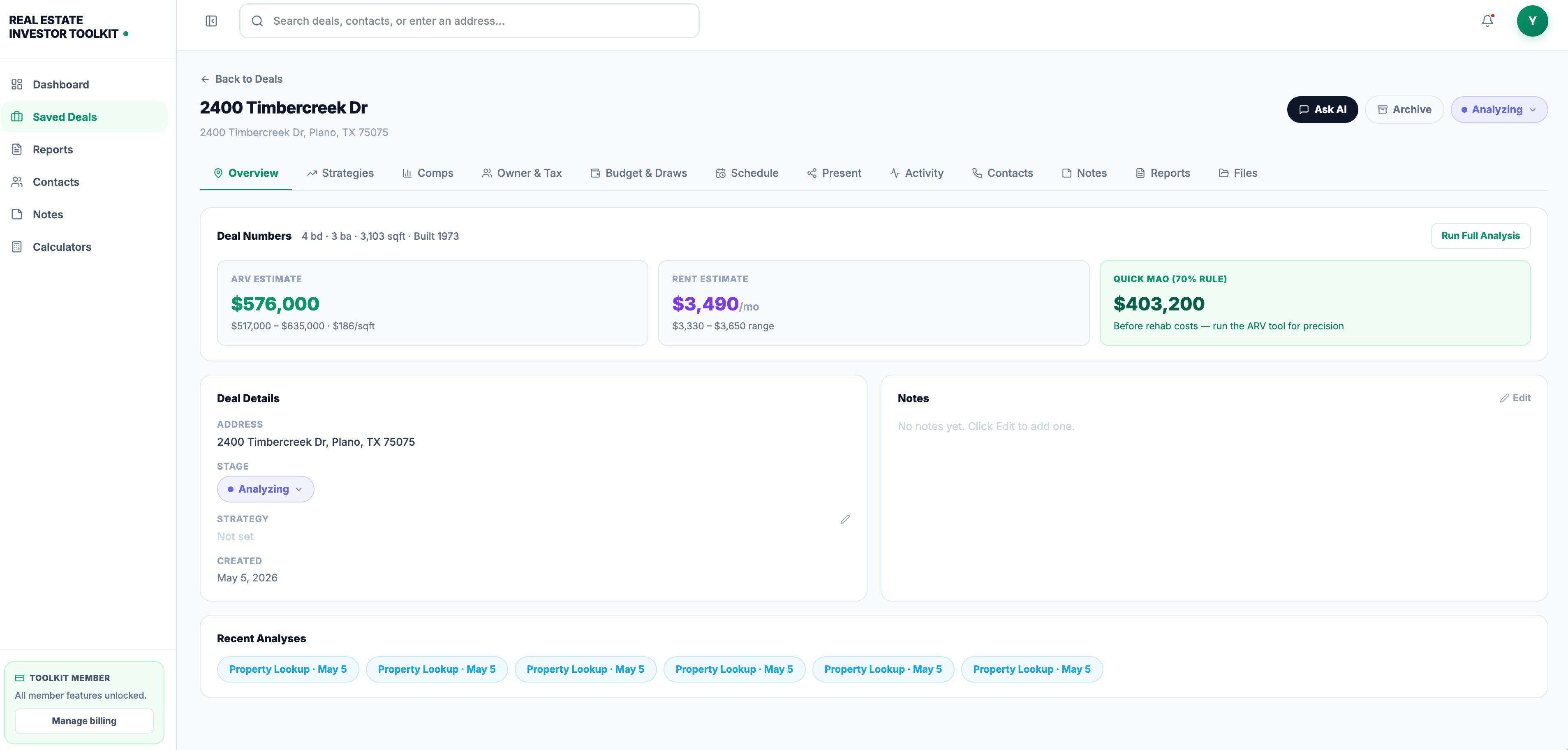
Feed a property’s rent and mortgage terms into the Rental Property Calculator to see your PITI number and convert the 15% to 30% rent rule into an exact monthly dollar figure. For component-based sizing, run replacement costs and remaining useful life through the Rehab Cost Calculator to get an annualized CapEx contribution you can drop straight into your reserve sub-account. Once you’ve got numbers you trust, the Real Estate Investor Toolkit plan at $39.99 a month unlocks saved deal pipelines and unlimited reports, so you’re not rebuilding these calculations from scratch every time you evaluate a new property.
Sources
FAQ
How Much Should a Landlord Keep in Reserve?
Hold 3 to 6 months of PITI before you close on a rental, then set aside 15% to 30% of gross monthly rent afterward, split across vacancy, CapEx, and repairs. Older properties with aging major systems should sit toward the higher end of that range.
What Is the Difference Between a Vacancy Reserve and a CapEx Reserve?
A vacancy reserve covers lost rent and turnover costs between tenants, while a CapEx reserve covers major system replacements like roofs, HVAC units, and water heaters. Keeping them in separate sub-accounts prevents you from raiding capital money for routine turnover expenses.
Are Landlord Reserve Fund Contributions Tax Deductible?
No, moving cash into a reserve account isn’t a deductible expense because it’s just a transfer, not a purchase. The actual repair or capital improvement becomes deductible or depreciable once you spend the money, not when you set it aside.
Can Real Estate Investor Toolkit Help Me Calculate My Reserve Fund?
Yes, the free Rental Property Calculator converts your rent and PITI into concrete monthly reserve targets without requiring a signup. Paid plans starting at $39.99 a month add saved deal pipelines and unlimited reports for tracking reserves across multiple properties.
How Do Lenders Evaluate Reserve Requirements?
Lenders often express reserve requirements in months of PITIA or PITI per financed property, but the exact number of months varies by loan program. Always confirm the specific requirement with your loan officer before assuming your reserve fund satisfies underwriting.