Model the $164 Monthly Gap: Interest Only vs Amortized for Investors

If you need short-term cash flow, interest-only usually fits your goal better. If you want predictable equity growth and lower lifetime interest, an amortized loan is typically the smarter structure. Either way, the real risk sits in what happens after the interest-only period ends, so run the numbers in a calculator before you sign anything.
TL;DR:
- Interest-only loans provide lower payments during the initial period, typically lasting 5 to 10 years, but do not reduce the principal balance during that time.
- Amortized loans gradually build equity through consistent principal payments, with payments that remain fixed over the loan term, making them suitable for long-term investors.
- The main risk for interest-only borrowers is the payment shock at the end of the interest-only period, especially if rates rise or property value declines before refinancing or selling.
- Running detailed calculations for specific loan amounts, rates, and interest-only periods helps prevent overestimating cash flow benefits and ensures preparedness for future payments.
- Borrowers planning to hold property long-term, or those uncomfortable with payment increases, should prioritize amortized loans or carefully mitigate interest-only risks with reserves and exit plans.
Table of Contents
- Interest Only vs Amortized: How Amortization Builds Equity
- Interest Only vs Amortizing: What Happens During the IO Period
- Amortization vs Interest Only: Comparing the Real Numbers
- How to Model IO vs Amortized Scenarios in a Calculator
- Who Should Choose Interest-Only vs Amortized Loans
- Payment Shock, Underwriting Rules, and Refinancing Exposure
- If You Choose Interest-Only: A Risk-Reduction Checklist
- Using Calculators to Avoid Over-Optimistic IO Assumptions
- Try the Investment Property Financing Calculator
- Sources
Interest Only vs Amortized: How Amortization Builds Equity
An amortized loan splits every monthly payment between interest and principal, following a fixed schedule called an amortization schedule. Early in the loan, most of each payment covers interest. As the balance shrinks, a growing share chips away at principal, until the final payment zeroes out the loan.
On a 30-year fixed loan, that shift happens slowly. On a 15-year loan, it happens fast, which is why 15-year payments run higher but build equity much quicker. This structure works well for buy-and-hold investors and landlords who plan to hold a rental for a decade or longer. Every payment reduces the balance and increases what you actually own, and the payment itself never changes, which makes budgeting straightforward. It’s the default structure lenders offer because it’s predictable for both sides.
Interest Only vs Amortizing: What Happens During the IO Period
During an interest-only period, your payment covers only the interest charge. The principal balance stays exactly where it started, month after month, until the IO period ends.
Most interest-only mortgages run for 5, 7, or 10 years before converting to a fully amortizing payment, or in some structures, coming due as a balloon payment. That conversion point matters more than almost anything else in the loan. The immediate upside is real: a lower monthly payment frees up cash for rehab, reserves, or another deal. Interest-only loans are frequently paired with adjustable-rate mortgage (ARM) features, and they also tend to carry a modest rate premium of 10 to 50 basis points compared with a standard amortized loan.
Here’s the part many first-time IO borrowers miss: lenders don’t qualify you based on that low IO payment. Underwriters typically calculate your debt-to-income ratio using the fully amortized payment you’ll eventually owe, not the interest-only figure you’ll pay at closing.
Amortization vs Interest Only: Comparing the Real Numbers
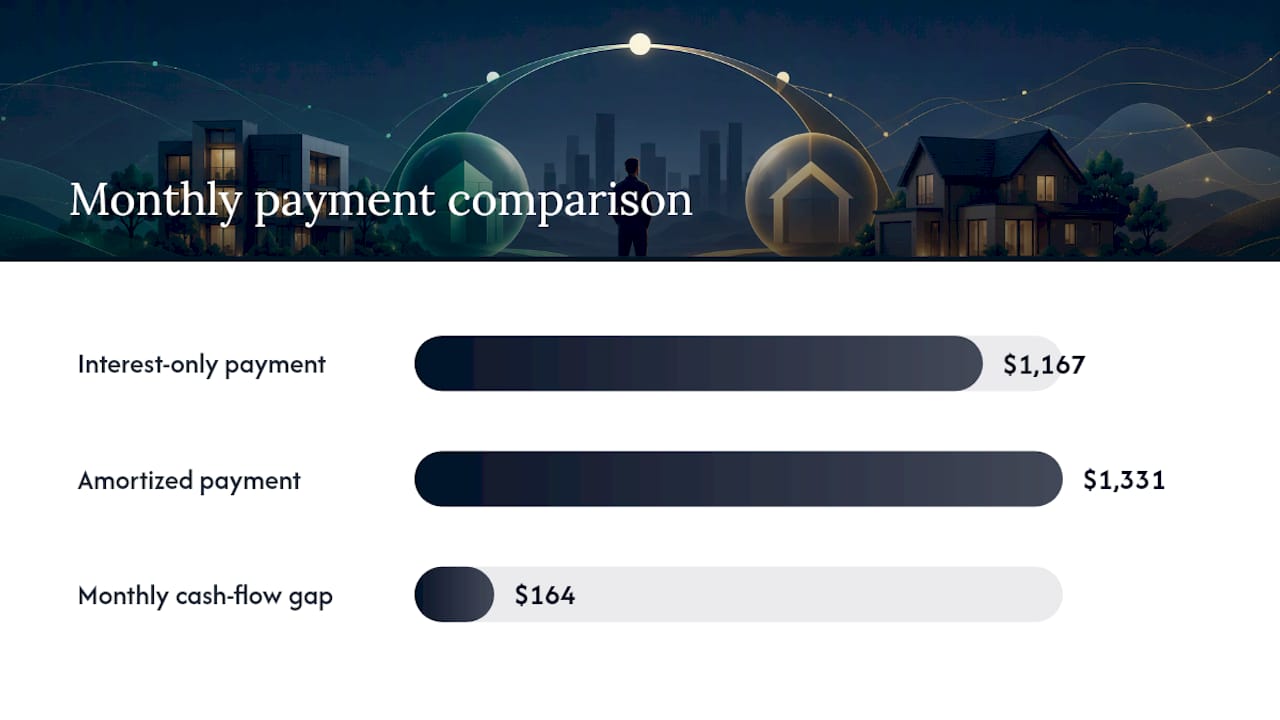
The clearest way to see the trade-off is to run identical loan amounts through both structures. Take a $200,000 loan at 7%. The interest-only payment comes to $1,167 a month, since interest-only math is simply loan balance multiplied by annual rate, divided by 12. An amortized payment on the same loan runs closer to $1,331 a month once you factor in principal, based on CalculatorCafe’s comparison.
That gap adds up to roughly $164 a month in extra cash flow for the interest-only borrower, which is real money for anyone juggling reserves, rehab costs, or a tight rental budget.
But that cash flow comes at a cost. Consider what each structure delivers over time:
- Initial monthly payment: Interest-only wins, often by hundreds of dollars.
- Equity accumulation: Amortized wins outright. IO builds zero equity through principal payments until conversion.
- Total interest paid: Amortized wins over the life of the loan, since IO defers principal and keeps the full balance accruing interest longer.
- Refinancing exposure: Amortized wins here too. IO borrowers face a hard deadline to refinance, sell, or absorb a higher payment.
The core difference between the two structures comes down to timing. Amortization forces steady principal reduction from day one. Interest-only delays that reduction, which means you’re borrowing the cash-flow benefit now against a bigger bill later.
Extra cash flow now, extra interest later: on a $200,000 loan at 7%, that $164 monthly IO advantage stacks up fast, but it never touches the principal balance.
How to Model IO vs Amortized Scenarios in a Calculator
Running your own numbers beats trusting a rule of thumb, because rate, loan amount, and IO length interact in ways that aren’t intuitive. Here’s how to set it up.
- Enter the loan amount and interest rate. Use the actual figures from your deal, not rounded estimates.
- Set the IO period. Test 5, 7, and 10 years separately. Each length changes your post-IO payment dramatically.
- Calculate the IO payment. The formula is loan balance times annual rate, divided by 12. On $300,000 at 7%, that’s $1,750 a month.
- Model the post-IO amortized payment. Once the IO period ends, that same $300,000 balance now amortizes over whatever term remains, which pushes the payment up sharply.
- Run a rate-increase scenario. If your loan has an ARM component, test what happens if rates climb 1 to 2 points before conversion.
- Add voluntary principal payments. Even small extra payments during the IO period soften the post-IO jump.
A rental property calculator that outputs cash flow under both structures side by side saves you from rebuilding this math by hand every time you evaluate a new deal.
A 5-year IO period converting into a 25-year amortization behaves very differently from a 10-year IO period converting into 20 years. Shorter remaining terms force larger payments, because the same principal has to be paid off faster.
Pro Tip: Test your worst-case rate increase and your longest IO period at the same time. If you can stomach that combined scenario, everything better than it is just upside.
Who Should Choose Interest-Only vs Amortized Loans
Your holding period and risk tolerance matter more than your loan officer’s pitch. Interest-only tends to fit:
- Fix-and-flip investors and short-term holders who plan to sell before the IO period ends.
- High-income borrowers who expect rising income and want maximum cash flow now.
- Investors stretching capital across multiple deals who need every available dollar of monthly cash flow.
Amortized loans tend to fit better for:
- Long-term buy-and-hold owners who want equity building on autopilot.
- Risk-averse borrowers who’d rather have a fixed, unchanging payment.
- Anyone who can’t comfortably qualify for the fully amortized payment a lender will eventually require anyway.
Before committing to interest-only, run through this checklist: How long do you actually plan to hold the property? What’s your exit plan if you can’t sell or refinance on schedule? Do you have reserves sized for the post-IO payment? Can you qualify on the amortized number today, not just the IO number?
The biggest red flag is betting on appreciation or a future refinance that isn’t guaranteed. Markets don’t always cooperate on your timeline.
Payment Shock, Underwriting Rules, and Refinancing Exposure
Payment shock is the jump from your interest-only payment to the fully amortized payment once the IO period ends, and it can be brutal on longer IO terms. A 10-year IO loan converting to a 20-year amortization schedule produces a much steeper jump than a 5-year IO loan converting to 25 years, simply because less time remains to pay off the same balance.
Lenders know this, which is why they typically underwrite interest-only loans using the fully amortized payment from the start, along with stronger reserve requirements and lower loan-to-value limits than a standard amortized mortgage gets.
Refinancing is the safety valve most IO borrowers count on, and it’s the one that fails at the worst possible time. If market rates rise before your conversion date, or if the property underperforms and your equity position weakens, refinancing may not be available on favorable terms, or at all. Investors weighing short-term financing options like fix-and-flip loans face a similar version of this exposure, where the exit plan is the whole strategy.
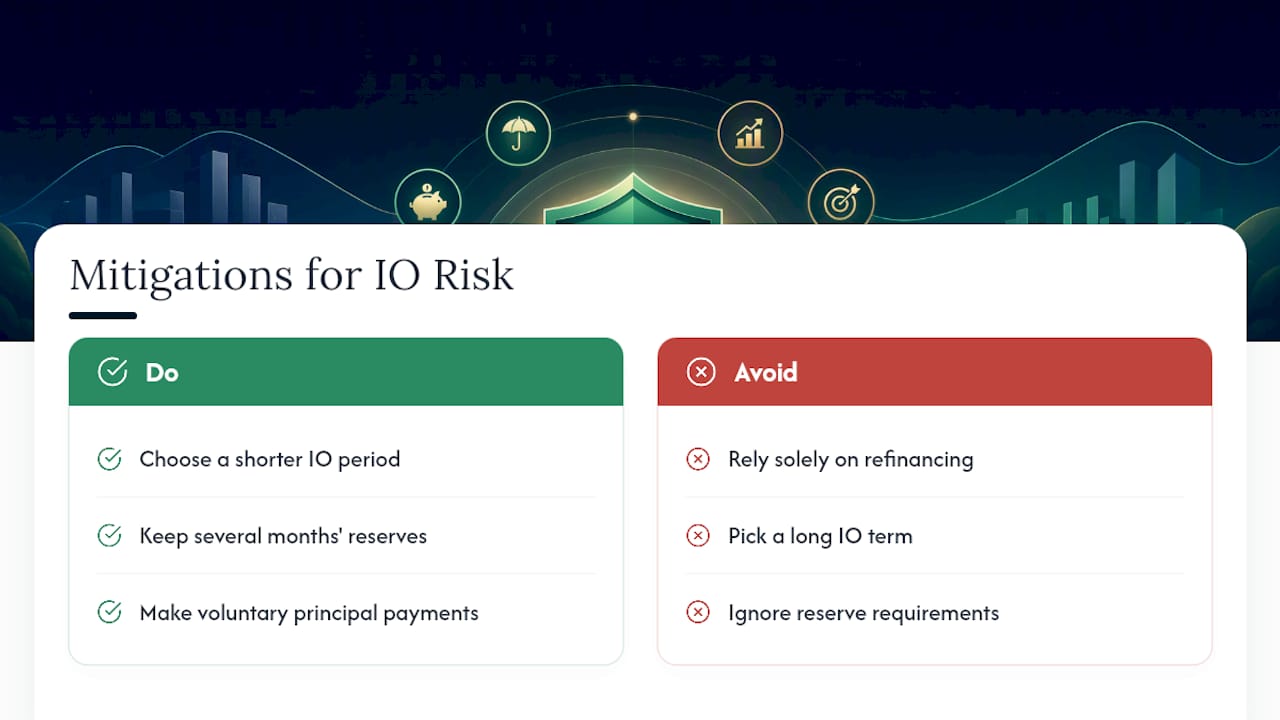
Three mitigations actually move the needle: choose a shorter IO period when possible, keep reserves that cover several months of the post-IO payment, and make voluntary principal payments whenever cash flow allows it.
If You Choose Interest-Only: A Risk-Reduction Checklist
Picking interest-only isn’t a mistake by itself. Going in without a plan for the conversion date is.
- Build reserves now. Size them to cover several months of the fully amortized payment, not just the IO payment.
- Model your worst case. Run a rate-increase scenario and decide today if you could still afford it.
- Lock in your exit plan. Decide whether you’ll sell, refinance, or let the loan convert, and write it down.
- Keep clean financial records. Lenders move faster on refinance applications when your income and asset documentation is already organized.
Pro Tip: Revisit your exit plan every year the IO period is active. Rates, income, and property values all shift, and your plan should shift with them.
Using Calculators to Avoid Over-Optimistic IO Assumptions
Running these scenarios yourself, with real loan amounts and real rates, exposes problems that gut-feel decisions miss entirely. A no-sign-up mortgage calculator lets you test payment shock in minutes instead of guessing. Model the numbers before you commit to interest-only, not after.
— Michael
Try the Investment Property Financing Calculator
Guessing at payment shock is how investors get blindsided at conversion. The Investment Property Financing Calculator from Real Estate Investor Toolkit lets you plug in your actual loan amount, rate, and IO period, no sign-up required, and see the IO payment, the post-IO amortized payment, and the total interest gap side by side.
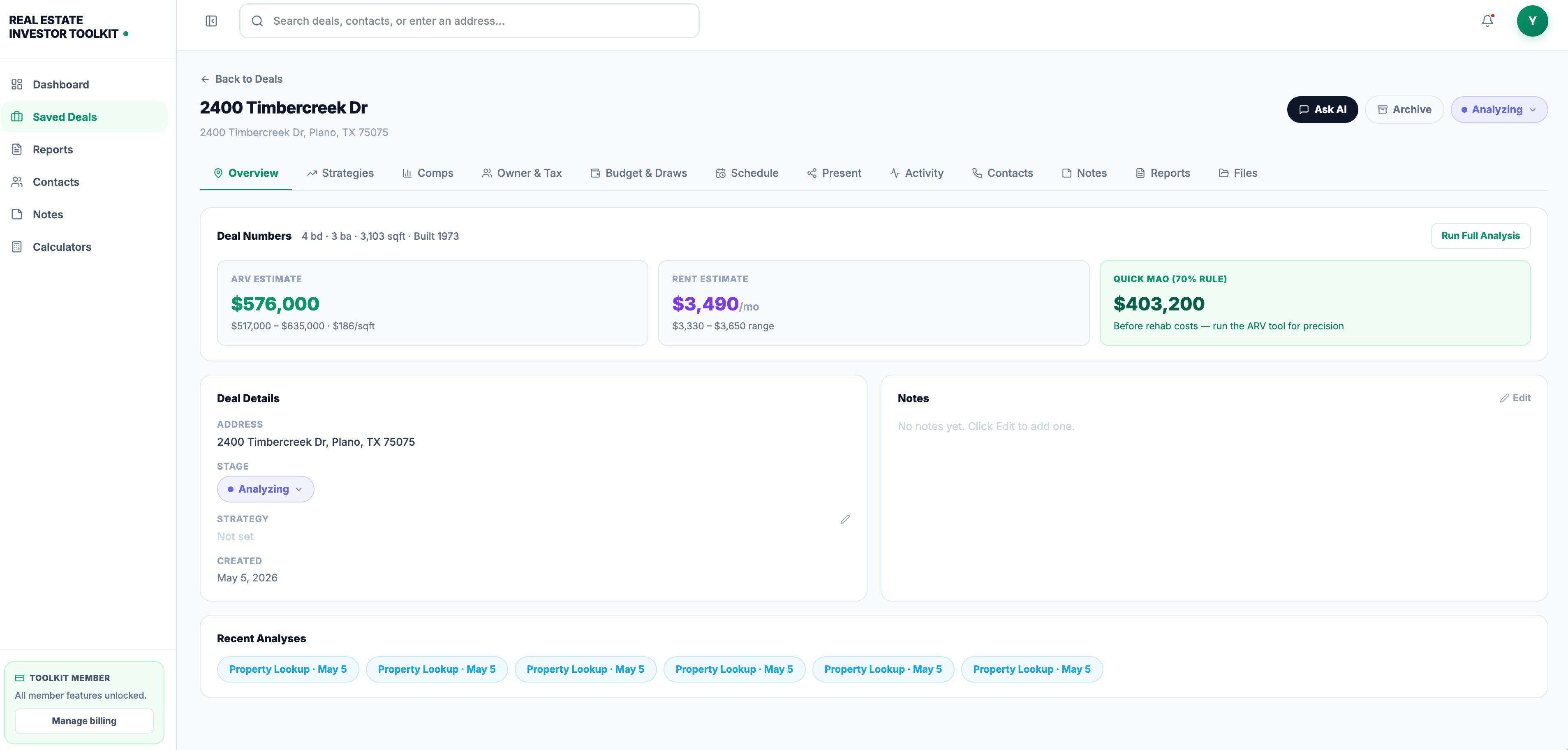
Pair it with the Rental Property Calculator to see exactly how each structure changes your monthly cash flow on a specific rental deal. Run your numbers on the Investment Property Financing Calculator before you lock in a rate, and know your post-IO payment before your lender does.
Sources
This article draws on CalculatorCafe, Investopedia, CapitalXO, Lower, and Bankrate. Model your own deal with the mortgage calculator.
This article is general information, not a substitute for advice from a qualified financial advisor. Consult a qualified financial professional about your own circumstances before acting on anything here.
- Interest Only Calculator - IO Payments - CalculatorCafe
- Interest-Only Mortgages Explained: Benefits and Risks
- Amortization vs Interest-Only (Which Costs Less Over Time?)
- Interest-only mortgages: how they work (Lower)