DCAD First Workflow for Dallas Investors to Find Comps and Get ARV in Minutes

Get MLS-quality comps by asking a local listing agent for a comparative market analysis, or by pulling sold data yourself and verifying every entry against Dallas Central Appraisal District (DCAD) records. That two-source combination beats any single portal for accuracy. Once you have at least three verified comps, run the adjusted numbers through an ARV calculator to see what the property is actually worth before you make an offer.
TL;DR:
- Cross-verify at least three to six comps from MLS, county records, or title companies to ensure accuracy before calculating value.
- Use recent sales within three to six months, filtered by size and bedroom count, to reflect current market conditions on a neighborhood level.
- Adjust each comp for differences in land size, location, condition, and square footage, dropping any with adjustments exceeding around 20% of sale price.
- When dealing with new construction or hidden sales, rely on deed records, builder sales, or title data rather than public portals alone.
- Convert verified comps into ARV and MAO figures using online calculators that incorporate adjustment figures, repair estimates, and neighborhood-specific prices.
Table of Contents
- Where to Find Real Estate Comps in Dallas
- How Do You Pull and Verify Comps Step by Step?
- How Do You Adjust Comps to Match Your Property?
- What About New Construction and Non-Disclosure Sales?
- Turning Comps Into ARV and MAO Numbers
- What I’d Tell a First-Time Dallas Comp Puller
- Turn Your Comps Into a Real Offer, Fast
- Sources
- FAQ
Where to Find Real Estate Comps in Dallas
Every source for Dallas comps trades speed for accuracy, or the reverse. Knowing which one fits your situation saves hours.
The Multiple Listing Service (MLS) is the freshest data in the market, but you cannot access it directly without a license. Ask a local agent for a CMA, or use a paid investor platform that licenses MLS feeds. If you’re evaluating one deal, a quick call to an agent for a CMA usually costs nothing and takes a day.
DCAD and the county recorder hold the official record of what actually closed. DCAD’s residential valuation process explains that its mass appraisal system, known as CAMA, is authoritative for verifying a sale but lags real-time MLS activity. Use DCAD to confirm what you found elsewhere, not to hunt for active-market pricing.
Consumer portals like Zillow, Redfin, and Realtor.com are the right starting point for a fast gut check, not the final word. Redfin’s own guidance recommends matching property type and size, filtering for sold listings, and collecting at least three comps before trusting the output. These sites often show estimated values rather than confirmed sale prices, especially in Texas, a non-disclosure state where recorded sale amounts are not always public.
A few other sources round out the picture:
- Title companies and closing agents can confirm the actual sale price on a specific transaction when public records stay silent.
- Paid investor data platforms give repeat buyers near-MLS access without a broker relationship, useful if you’re underwriting several deals a month.
- County recorder deed filings show the transfer even when the price is withheld, which at least confirms a sale happened and when.
Cross-checking two sources, one fast and one official, catches the errors that a single portal search misses.
How Do You Pull and Verify Comps Step by Step?
A repeatable process beats hunting randomly through listings. This is the sequence that works for most Dallas properties, whether you’re buying a primary residence or underwriting a flip.
- Define the subject property precisely. Note square footage, bedroom and bathroom count, lot size, year built, and condition. Vague inputs produce vague comps.
- Set your recency window. For most Dallas neighborhoods, sales within the last three to six months give the truest read on current pricing. Texas Tax Code § 23.013 allows appraisal districts in large counties like Dallas to reach back up to 36 months for market-data comparisons when recent sales are scarce, so don’t panic if you need to widen the window on a slow street.
- Search with tight filters. A workable starting point mirrors what appraisers and agents already use: sold within 3 to 6 months, square footage within 20% of the subject, and bedroom count within one. iBuyer’s step-by-step breakdown follows this same define, filter, search, verify sequence, which is worth replicating exactly.
- Pull from at least two portals and deduplicate. Zillow and Redfin often list the same closed sale with slightly different square footage or photos. Cross-reference addresses so you’re not double-counting one sale as two comps.
- Collect three to six qualifying comps minimum. Fewer than three leaves you guessing; more than six usually means your filters are too loose.
- Record five fields for each comp: sale price, sale date, data source, distance from subject, and the specific adjustments each will need.
- Verify every candidate against DCAD or deed records before you rely on it. Search by street address on DCAD’s property lookup tool to confirm the sale actually recorded and matches the price you found elsewhere.
Pro Tip: Don’t anchor your search radius to a fixed number of miles. In dense Dallas neighborhoods like Bishop Arts, a half mile might cross three different price tiers, while in sprawling suburban pockets you may need two miles to find a fair match. Match the search area to where a real buyer would actually shop, not an arbitrary circle on a map.
Skipping the verification step is the single most common mistake investors make. A comp that looks perfect on Zillow but never closed at that price, or closed months later than listed, will throw off every calculation that follows.
How Do You Adjust Comps to Match Your Property?
Raw sale prices rarely match your subject property well enough to use as-is. That’s why appraisal districts build a sales-comparison grid, a table that starts with each comp’s actual sale price and adds or subtracts value for every meaningful difference until it matches the subject property on paper.
Collin Central Appraisal District publishes a sample grid that shows exactly how this works in practice, and Dallas-area appraisers follow the same basic model. Five categories drive most adjustments:
- Land and lot size — a comp on a larger lot gets a downward adjustment to match a smaller subject, and vice versa.
- Neighborhood or location — comps just outside a stronger school zone or busier street get adjusted to reflect the difference.
- Improvement type and quality — a comp with higher-end finishes gets adjusted down before it fairly represents your subject.
- Percent-good, or condition — an older comp needing updates gets adjusted up to match a renovated subject, or the reverse.
- Living area — square footage differences get priced out using either a flat dollar-per-square-foot rate or a specific dollar adjustment per feature.
The grid finishes with an indicated value per square foot for each comp, which appraisers average or weight to land on a final number.
One adjustment size matters more than the rest: when your total adjustments on a single comp exceed roughly a moderate percentage of the sale price, that comp is too different to trust. Drop it and find a closer match instead of forcing the math to work.
What About New Construction and Non-Disclosure Sales?
Texas is a non-disclosure state, meaning sellers aren’t required to report sale prices publicly, and Dallas builders often keep new-construction pricing off MLS entirely. You still have options.
Deed transfers and DCAD snapshots capture the fact that a sale happened, along with the parcel history, even when the price itself stays hidden in the listing. Pulling the recorded instrument number from the county filing sometimes reveals the transfer amount directly.
Building permits and builder sales lists work well for new construction. Contacting the builder’s sales office directly for recent closing prices in the same subdivision often gets you real numbers that never touched a public portal.
Title and closing agents are your most direct line to a confirmed number. They processed the transaction and can often confirm a final price even when the MLS listing shows it withheld.
When no direct comp exists, lean on proxies:
- Recent list-to-close timelines in the same subdivision show how much negotiating room buyers are getting.
- Price cuts on active listings nearby hint at where the market is actually settling, even before those listings close.
Real Estate Investor Toolkit’s guide to pulling comps without MLS access walks through these workarounds in more depth if you’re underwriting in a subdivision with thin sales history.
Turning Comps Into ARV and MAO Numbers
Comps are only useful once they feed a number you can act on. After Repair Value (ARV) is the estimated sale price of the property once repairs are complete, and you calculate it by taking the indicated value per square foot from your adjusted comps and multiplying it by your subject’s square footage. Some investors prefer a trimmed mean or median across three to five comps instead of a single number, which smooths out one outlier skewing the whole estimate.

From ARV, most investors apply the standard formula for Maximum Allowable Offer (MAO): ARV multiplied by a target margin (commonly 70% to 75%), minus estimated rehab costs. This is where your comp work and your rehab estimate finally meet.
When you move to a calculator, paste in these comp-derived fields directly:
- Adjusted sale price and indicated $/sqft for each comp
- Sale date, to confirm you’re inside your recency window
- Assumed repair costs, pulled from your own walkthrough or a rehab estimator
Before you trust the output, run through a quick red-flag checklist:
- Comps older than your recency window without a documented market reason
- Net adjustments exceeding 20% on any single comp
- Fewer than three verified, cross-checked comps
- A subject property with a feature (pool, unusual layout, major foundation issue) that none of your comps share
What I’d Tell a First-Time Dallas Comp Puller
Dallas doesn’t move as one market. Oak Cliff and Lakewood can post opposite price trends in the same quarter, so treat every ZIP code as its own micro-market rather than trusting a citywide median.
The biggest mistake I see is investors pulling five comps from three different submarkets and averaging them like they’re comparable. They aren’t. Verify locally, adjust honestly, and let the numbers from your immediate neighborhood carry the most weight.
— Michael
Turn Your Comps Into a Real Offer, Fast
Once you’ve verified your comps against DCAD and adjusted them using the sales-comparison method, the slow part is over. The math that turns those numbers into a purchase decision is where most investors lose time, rebuilding the same spreadsheet formulas deal after deal. Several online platforms offer calculators free with no signup required, so you can drop in your adjusted comps and get an ARV or a maximum allowable offer in minutes instead of rebuilding a model from scratch — for example, see this przykładowy Raport Pro from IleZaMetr.
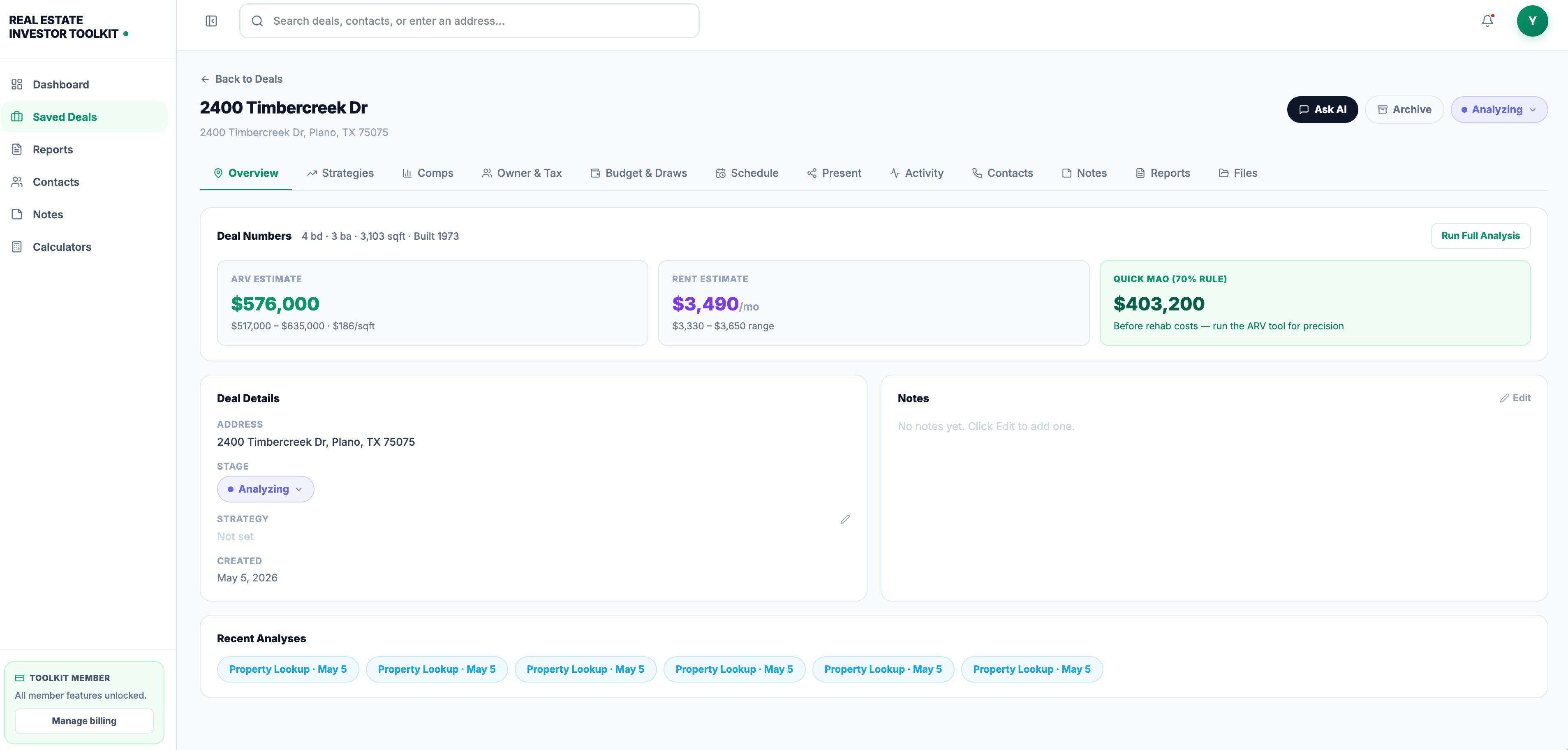
Start with the Dallas ARV Calculator to convert your comp set into an after-repair value using the same indicated $/sqft approach outlined above. Pair it with the Dallas Rehab Estimator to plug in repair costs and land on your maximum allowable offer in the same session. If you’re running multiple deals a month and want unlimited reports, saved pipelines, and owner-data lookups on top of the free tools, the full Real Estate Investor Toolkit plan runs $39.99 a month. Either way, free calculators are often ready the moment you have your comps verified.
Sources
- RESIDENTIAL PROPERTY VALUATION PROCESS — Dallas Central Appraisal District
- Comp grid models and sales-comparison approach — Collin Central Appraisal District
- How to find real estate comps in my area — Redfin
- How to Pull Comps on a House (2026 guide) — iBuyer blog
- Texas Tax Code § 23.013 — market data comparison rules
FAQ
Are House Prices Dropping in Dallas?
Dallas has shown a mixed picture through 2026, with inventory and pricing signals varying block by block rather than moving uniformly across the metro, according to a recent Dallas market update. That’s exactly why citywide averages mislead investors and why weighting your most recent, closest comps matters more in a shifting market.
What Is the 3-3-3 Rule in Real Estate?
The 3-3-3 rule isn’t a standard appraisal or comp-selection framework, and definitions vary depending on who’s using the phrase. Some investors apply it loosely to budgeting or offer timelines, but it has no fixed meaning tied to pulling or adjusting comps in Dallas.
How Do Realtors Find Comps?
Agents pull comps directly from the MLS, then narrow the list using recency, distance, and property-match filters similar to the ones described above; sold within the last three to six months, similar square footage, matching bed and bath count. They cross-check questionable sales against county records the same way a self-directed buyer would using DCAD.
Which Part of Dallas Is Best to Live In?
The right neighborhood depends entirely on your budget, commute, and lifestyle priorities, since Dallas spans dozens of distinct submarkets from historic Lakewood to newer suburban pockets. This variation is precisely why comps must be pulled neighborhood by neighborhood rather than relying on citywide data.
How Many Comps Do I Actually Need to Trust My ARV?
Three verified comps is the practical minimum, and five or six gives you a more reliable average once you trim outliers. Each one needs to be cross-checked against DCAD or deed records before you plug it into an ARV calculator.