Hard Money vs Private Money: Which Should You Use?

Hard money is technically a subset of private money. That single fact changes how you should shop for financing. AAPL defines hard money as a subset of private lending where creditworthiness is determined by the secured real estate collateral. Private money is the broader umbrella covering everything from a friend’s personal capital to a professionally managed lending fund.
The practical verdict: if you need repeatable, programmatic funding across multiple deals per year, a professional hard-money or private lending program gives you predictable terms and closing timelines. If you have a trusted relationship lender with available capital, that arrangement can be faster and cheaper on a single deal. The label matters less than the source of capital and how the lender underwrites.
Two things worth knowing before you go further:
- Professional hard-money platforms advertise 7-day closing capabilities, but new private relationships rarely match that speed on a tight timeline.
- Trade associations AAPL and NPLA have encouraged retiring the “hard money” label since around 2022 because its legacy connotations misrepresent how modern lenders actually underwrite.
Table of Contents
- What is hard money, and how has it changed?
- What is private money, and what does the range look like?
- What do hard money and private money actually share?
- Pros and cons of hard money for real estate investors
- Pros and cons of private money: relationship and fund-based tradeoffs
- How do loan terms actually compare? Rates, points, LTV, and closing speed
- When should you choose hard money vs private money?
- Risks, red flags, and U.S. licensing notes to check
- Worked example: total cost on a sample fix-and-flip
- Key Takeaways
- Why the label matters less than you think
- Run your own financing scenarios with Realestateinvestortoolkit
- Useful sources and regulators for further reading
What is hard money, and how has it changed?
The classic definition: a hard-money loan is asset-based, meaning the property is the primary collateral and the lender’s main underwriting question is whether the real estate secures the debt. Speed and premium pricing were the traditional tradeoffs. You paid more, closed fast, and the lender cared less about your credit score than about the deal’s numbers.

Modern practice has shifted. Most lenders who still use the “hard money” label now also underwrite borrower strength — your credit score, your experience on prior deals, and your exit plan. The asset-first philosophy remains, but purely asset-only underwriting is increasingly rare outside of distressed or non-performing note situations.
The most common hard-money products are fix-and-flip loans and short-term bridge loans, generally short-duration loans. Borrowers are usually investors who cannot or do not want to wait for conventional bank timelines, or whose properties do not qualify for agency financing because of condition.
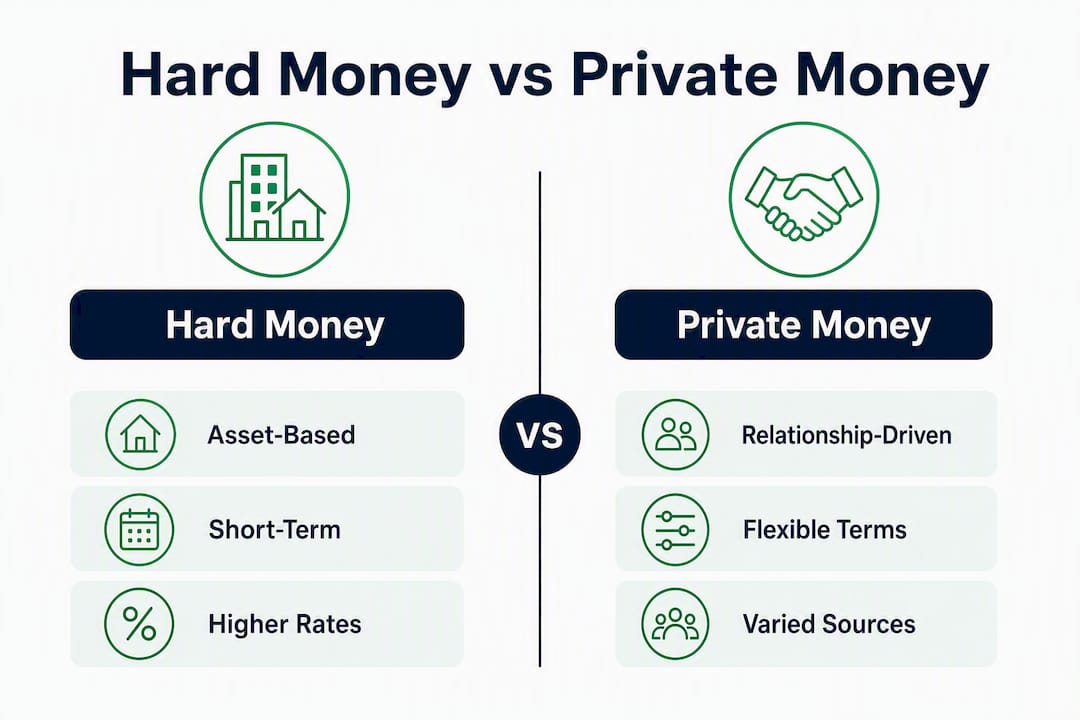
Pro Tip: When a lender calls themselves a “hard money lender,” ask two questions directly: Do you check credit and borrower experience? And where does your capital come from? The answers tell you whether you are dealing with a programmatic institutional shop, a private fund, or a single individual — and that distinction affects reliability, flexibility, and what happens if your deal hits a snag.
What is private money, and what does the range look like?
Private money is any non-depository, non-agency lending secured by real estate for a business purpose. That definition is broad by design. It covers a wide spectrum:
- Friends and family: Personal capital from someone who knows you. Terms are negotiable, documentation is often minimal, and the relationship is the underwriting.
- Individual private lenders: Accredited investors who deploy personal capital into real estate loans, often through a self-directed IRA or personal account. More formal than family, but still relationship-driven.
- Private lending companies: Professionally run shops with dedicated underwriting staff, standardized loan programs, and institutional-grade documentation. These operate more like a business than a person.
- Pooled private lending funds: Capital aggregated from multiple accredited investors, often under SEC Rule 506©. These funds have governance structures, investment committees, and defined lending criteria.
Each structure changes what you can expect. Funds and professional companies are more predictable and less likely to run out of capital mid-pipeline. A single relationship lender deploys personal capital and can cap lending suddenly when liquidity tightens or life gets complicated.
Pro Tip: Before committing a deal to a private lending fund, ask for their fund documents, a sample loan agreement, and two borrower references. A legitimate fund will provide all three without hesitation. If they stall on any of them, treat that as a signal about how they handle problems mid-deal.

What do hard money and private money actually share?
Investors often confuse the two because the overlap is real. Both share these core characteristics:
- Neither is a bank, credit union, or agency lender. Both sit outside the conventional mortgage system.
- Both use the property as primary collateral and underwrite based on asset value rather than debt-to-income ratios.
- Both can close significantly faster than a conventional bank loan when the deal and documentation are clean.
- Both are commonly used for rehab, fix-and-flip, and short-term bridge situations where conventional financing is too slow or the property does not qualify.
- Both price above conforming mortgage rates, reflecting the short-term nature, higher risk, and speed premium.
- Both use ARV (after repair value), LTV (loan-to-value), and LTC (loan-to-cost) as the core underwriting metrics.
The difference is not the product shape. It is the source of capital, the governance behind it, and how consistently the lender can perform across multiple deals.
Pros and cons of hard money for real estate investors
Hard-money programs from professional shops offer a specific set of tradeoffs that matter most when you are doing deals at volume or need certainty of close.
Advantages:
- Repeatable underwriting. Programmatic lenders have defined criteria. Once you know their box, you can pre-screen deals before submitting.
- Clear closing timelines. Professional platforms with in-house servicing can close in 7–14 days on a clean file.
- Scalability. Unlike a single relationship lender, a professional shop does not run out of capital after your second deal.
- Defined documentation requirements. You know what they need upfront, which reduces back-and-forth.
Disadvantages:
- Higher cost. Origination fees commonly run 1–4 points, and interest rates sit materially above conventional mortgages.
- Less flexibility on structure. Programmatic lenders have less room to customize draw schedules, interest reserves, or prepayment terms for your specific deal.
- LTV/ARV caps. Many programs cap total project financing at 65–75% of ARV, which limits leverage on lower-margin deals.
- Stricter documentation at institutional shops. Some larger lenders require full borrower packages that rival a bank application.
Pro Tip: On a fix-and-flip, the rate headline matters less than the total cost to exit. A lender charging 11% with 1 point and a 6-month term can be cheaper than one charging 9% with 3 points on the same loan amount. Always model the full carry cost, not just the rate.
Pros and cons of private money: relationship and fund-based tradeoffs
Private money’s range of structures creates a different risk-reward profile depending on which type you are working with.
Relationship lenders (friends, family, individual investors):
- Potentially lower cost and more flexible terms, since the relationship, not a pricing matrix, sets the deal.
- Can move extremely fast when trust is already established.
- Capital is limited and unpredictable. A personal lender can pull back at any time.
- Terms can shift late if the lender gets cold feet or needs liquidity.
Professional private lenders and funds:
- More predictable programs and capital availability than a single individual.
- Governance and documentation protect both parties.
- Slightly less flexible than a close relationship lender on deal-specific structuring.
- Fund-level governance can slow decisions if an investment committee review is required.
Risks unique to private arrangements:
- No regulatory backstop equivalent to a bank’s disclosure requirements in many states.
- Term changes after verbal agreement are more common with informal lenders.
- Draw schedule disputes on rehab loans can stall a project if the lender and borrower disagree on inspection milestones.
Pro Tip: Always get the full term sheet in writing before you put a property under contract. A relationship lender who changes terms after you’ve committed to a purchase is a deal-killer. Written terms protect both sides and signal whether the lender is serious about the deal.
How do loan terms actually compare? Rates, points, LTV, and closing speed
This is where the decision gets concrete. The table below maps the key dimensions side by side.
| Dimension | Programmatic hard-money shop | Relationship private lender | Private lending fund |
|---|---|---|---|
| Source of funds | Institutional capital or credit lines | Personal capital (individual) | Pooled accredited investor capital |
| Underwriting focus | Asset value + borrower profile | Relationship + asset value | Asset value + fund criteria |
| Typical closing speed | Days to a couple of weeks (clean file) | Days with pre-existing trust | One to three weeks including review |
| Typical interest rate | Generally above conventional rates | Negotiable; sometimes lower than hard money | Similar to programmatic shops |
| Typical origination fees | Multiple points | Up to a couple of points | Moderate points |
| Typical max LTV/ARV | Moderate to high loan-to-value caps | Negotiated case by case | Moderate to high caps |
| Loan term | Generally short term loans | Flexible | Generally short term loans |
A few points on the numbers above. Fix-and-flip lenders typically cap total project cost within a moderate portion of ARV. The investor “70% rule” is a practical deal-screening shortcut, not a lender mandate. Lenders also weigh your cash reserves and exit plan alongside the ARV math.
On reserves: first-time investors most often stall at underwriting because of insufficient cash. Lenders commonly require proof of down payment plus 3–6 months of interest reserve. That reserve requirement is not negotiable at most professional shops.
Understanding points vs. rate. One origination point equals 1% of the loan amount. On a $200,000 loan, 2 points costs $4,000 at closing. On a short-term flip, points hit harder than rate because you are not holding the loan long enough for a lower rate to offset the upfront cost. Model both together.
LTC vs. LTV explained. LTV (loan-to-value) measures the loan against the current as-is value. LTC (loan-to-cost) measures the loan against your total project cost, including purchase and rehab. Most fix-and-flip lenders use LTC for construction draws and ARV for the overall loan ceiling. Knowing which metric your lender uses changes how you structure your offer and budget.
When should you choose hard money vs private money?
The decision comes down to five factors: deal timeline, annual deal volume, capital reliability, negotiation flexibility, and price sensitivity.
Three concrete scenarios:
Scenario 1: Single fix-and-flip, relationship lender available. You have a trusted individual lender who has funded two prior deals. The property is under contract with a 21-day close. Use the relationship lender. The speed advantage is real, the cost is likely lower, and the flexibility on draw schedules is a genuine benefit on a rehab project.
Scenario 2: Scaling investor, 6+ deals per year. You need consistent capital availability and cannot afford a lender who runs dry after deal three. A programmatic hard-money shop or private lending fund is the right call. Predictability and repeatability matter more than squeezing the last half-point off the rate. The RHET DealFlow platform is built for exactly this kind of pipeline management.
Scenario 3: Emergency bridge when a refinance falls through. Your BRRRR exit plan depended on a cash-out refinance that just got denied. You need short-term capital fast. A professional hard-money shop with a clean, fast process is your best option here. A relationship lender might work if they can move quickly, but do not rely on a new private contact in this situation. Understanding cash-out refinance risks before you get to this point is the better play.
Decision flow:
- Do you have a pre-existing relationship lender with confirmed available capital? If yes, start there.
- Do you need funding for more than 3 deals per year? If yes, move to a programmatic shop or fund.
- Is your timeline under 10 days? If yes, only a relationship lender or a professional platform with in-house servicing can reliably hit that.
- Is your deal at or below 70% of ARV after all costs? If no, revisit your offer price before approaching any lender.
- Have you modeled total cost including points, interest carry, and reserves? If no, do that before you submit an application.
Risks, red flags, and U.S. licensing notes to check
Not every lender using the “private money” or “hard money” label is operating a clean shop. Here are the signals that should give you pause:
- Unclear source of funds. If a lender cannot explain where their capital comes from, that is a problem. Funds dry up mid-deal more often than borrowers expect.
- Terms changing after verbal agreement. This is the single most common complaint in private lending. Get everything in writing before you go under contract.
- Unusually high prepayment penalties. A 6-month minimum interest clause is common. A 12-month minimum on a 12-month loan is a red flag.
- No written underwriting standards. Legitimate lenders can tell you their criteria. Vague answers suggest ad hoc decision-making.
- Pressure to close without reviewing loan documents. Never skip document review, regardless of timeline pressure.
U.S. licensing notes (summary only, not legal advice). Licensing requirements for private and hard-money lenders vary by state. Some states require a mortgage broker or lender license for business-purpose real estate loans; others exempt them. Check your state’s Department of Financial Institutions or equivalent regulator. The NMLS Consumer Access database at nmlsconsumeraccess.org lets you verify whether a lender is registered. Always confirm current requirements with a licensed attorney in your state.
Pro Tip: Before wiring a deposit or signing a commitment letter, ask the lender for: (1) proof of capital or fund documents, (2) a sample loan agreement, (3) two borrower references from the past 12 months. A lender who balks at any of these is not ready to fund your deal.
Worked example: total cost on a sample fix-and-flip
A concrete scenario makes the rate-and-points math real. Here are the inputs:
- Purchase price: $150,000
- Rehab budget: $40,000
- Total project cost: $190,000
- ARV: $260,000
- LTC check: $190,000 / $260,000 ARV = 73% (within the typical 65–75% cap)
- Loan term: 12 months
| Scenario | Rate | Points | Loan amount | Interest carry (12 mo.) | Origination fee | Total borrowing cost |
|---|---|---|---|---|---|---|
| Programmatic hard-money shop | 11% | 2 points | $190,000 | — | — | — |
| Relationship private lender | 9% | 1 point | $190,000 | — | — | — |
| Private lending fund | — | 2 points | $190,000 | — | — | — |
The difference between the cheapest and most expensive scenario is $5,700 on a single deal. Across six deals per year, that gap compounds fast. The relationship lender wins on cost, but only if that capital is reliably available. If it is not, the programmatic shop’s $5,700 premium buys you certainty of close.
On exit fallback: if the property does not sell at ARV and you need to hold it as a rental, your 12-month hard-money loan becomes a problem. Model that scenario before you close. The BRRRR calculator at Realestateinvestortoolkit runs exactly this kind of hold-or-sell analysis, and the Investment Property Financing Calculator lets you stress-test rate and points combinations against your MAO.
Pro Tip: Always model a 15% ARV haircut as your exit fallback. If the deal still works at 85% of your projected ARV, you have a real margin of safety. If it doesn’t, you are speculating on the sale price, not investing.
Key Takeaways
Hard money is a subset of private money, and the choice between them hinges on deal volume, capital reliability, and total borrowing cost — not the label a lender uses.
| Point | Details |
|---|---|
| Hard money is a subset | AAPL defines hard money as a subset of private lending; focus on source of capital, not the label. |
| Total cost beats headline rate | Model origination points plus interest carry; a 2-point difference on $190,000 is — at closing. |
| Capital reliability drives the choice | Relationship lenders can be cheaper but may run dry; programmatic shops and funds offer predictable availability. |
| Reserves are non-negotiable | Most lenders require 3–6 months of interest reserve plus down payment proof before approving a loan. |
| Realestateinvestortoolkit for scenario modeling | The Investment Property Financing and BRRRR calculators let you compare total borrowing cost and exit fallback before you commit. |
Why the label matters less than you think
The “hard money vs. private money” debate is, in practice, a terminology debate more than a product debate. The more useful question is: who holds the capital, how do they make decisions, and can they perform when your deal needs to close?
What I find consistently underestimated is the cost of capital unreliability. Investors fixate on rate and points, which are real costs, but a lender who backs out at day 12 of a 14-day close costs you the deal, the earnest money, and potentially the relationship with the seller. That risk does not show up in a rate comparison.
The industry’s move away from the “hard money” label reflects something real. Modern private lenders who underwrite borrower experience and exit plans are doing better underwriting, not softer underwriting. A lender who asks about your exit plan is protecting both of you. Treat that as a green flag, not a bureaucratic hurdle.
For investors who want to run the numbers themselves rather than rely on a lender’s term sheet, the real estate investing guides at Realestateinvestortoolkit cover the full underwriting framework, from ARV estimation to BRRRR refinance modeling.
Run your own financing scenarios with Realestateinvestortoolkit
Knowing the difference between hard money and private money is step one. Step two is running your specific deal numbers before you sit across from a lender.
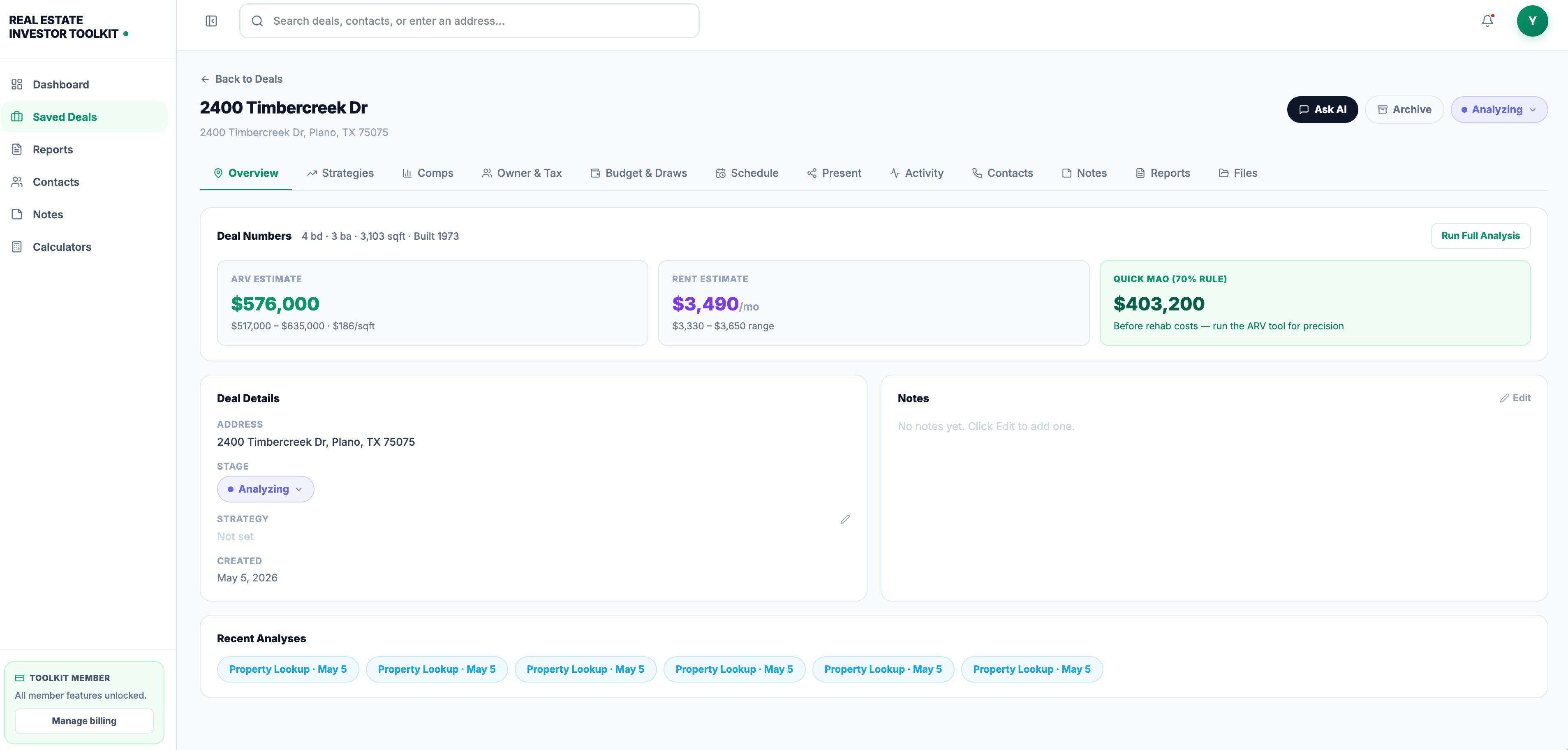
Realestateinvestortoolkit gives you free, no-sign-up calculators that make the worked example above repeatable on any deal. The Investment Property Financing Calculator lets you plug in your loan amount, rate, points, and term to see total borrowing cost in seconds. The Rehab Cost Calculator keeps your budget honest so your LTC stays inside the lender’s box. Pair those with the ARV Calculator to build a defensible after-repair value before you approach any lender. If your exit strategy includes a hold-to-rent fallback, the BRRRR and rental calculators model that scenario too. No subscription required to start. Run the numbers on your next deal now at Realestateinvestortoolkit.
Useful sources and regulators for further reading
These are the primary sources and trade associations worth bookmarking as you evaluate lenders and deals.
- AAPL (American Association of Private Lenders): The leading trade group for private and hard-money lenders. Their published position on terminology and underwriting standards is the closest thing the industry has to a governing framework. Visit aaplonline.com.
- NPLA (National Private Lenders Association): A second major trade group that has also encouraged retiring the “hard money” label and promotes professional standards among private lenders.
- NMLS Consumer Access: Verify lender registration and licensing at nmlsconsumeraccess.org. State licensing requirements vary; always check before committing to a lender.
- Consumer Financial Protection Bureau (CFPB): For foundational guidance on how points and lender credits work, the CFPB’s explainer is the clearest primary source available.
- Realestateinvestortoolkit calculators: The financing, rehab, and ARV tools are the practical next step for running the numbers covered in this guide.
This article is general information for educational purposes. It is not legal, financial, or tax advice. Confirm current licensing requirements, loan terms, and applicable regulations with a qualified attorney or financial professional before making financing decisions.
Recommended
- Cash-Out Refinance Math: When Pulling Equity Helps and When It Backfires | Mortgage Guides | Real Estate Investor Toolkit
- Which Loan Type Fits Your Situation? A Practical Mortgage Structure Guide | Mortgage Guides | Real Estate Investor Toolkit
- Light vs Medium vs Heavy Rehab: How Scope Changes the Deal Math — Real Estate Investing Guide | Real Estate Investor Toolkit
- Fixed vs ARM: Which Mortgage Structure Fits Your Timeline? | Mortgage Guides | Real Estate Investor Toolkit