Turn 60–75% Hard Money LTV Into Exact Deal Math for U.S. Investors

Most U.S. hard money lenders cap loan-to-value at roughly 60% to 75%, with the exact figure depending on how the lender values the property and how risky the collateral looks. A higher LTV lowers the cash you bring to closing but raises your rate, points, and reserve requirements, while a lower LTV gives you a safety cushion and stronger negotiating position. The Federal Reserve’s lending survey and industry data back this range, and tools like our calculators let you test both sides of the trade before you call a lender.
TL;DR:
- Hard money lenders typically cap loan-to-value at 60% to 75%, depending on property type, location, and borrower track record.
- Valuation basis varies—most commonly as-is appraised value, purchase price, or after-repair value—affecting the actual cash available.
- Higher LTV ratios usually lead to increased interest rates, points, and reserves, while lower LTVs provide more safety and negotiating power.
- Property liquidity, property type, and local market conditions significantly influence the maximum achievable LTV in real scenarios.
- Precise scenario modeling before approaching lenders helps optimize loan terms and ensures accurate understanding of cash requirements.
Table of Contents
- Typical LTV Ranges: What Drives the 60% to 75% Band
- How Lenders Calculate LTV: Valuation Basis and Term Sheet Haircuts
- How LTV Varies by Property Type and Loan Purpose
- How LTV Affects Loan Economics and Terms
- Practical Underwriting Math: LTV, LTC, and ARV Worked Examples
- How to Negotiate Better LTV and Terms
- Regulatory and Downside Risk Notes for U.S. Investors
- Impact of Borrower Creditworthiness on Achievable LTV
- Risks of High LTV Loans for Lenders and Borrowers
- Balancing Speed Against Risk When Choosing Your Leverage
- Model Your LTV Scenarios Before You Call a Lender
- FAQ
- Sources
Typical LTV Ranges: What Drives the 60% to 75% Band
When you start shopping hard money loans, the LTV range you hear most often sits between 60% and 75%. That band is not arbitrary. It reflects how much cushion a private lender wants between the loan amount and the property’s value, so a foreclosure sale still covers the debt even after fees and a quick-sale discount.
Published investor-lending guidance from Talimar Financial places typical maximums around 60% to 75% for most fix-and-flip scenarios, though the exact ceiling depends on the lender and the collateral.
An industry source indicates the average hard money LTV is around the middle of the common range, which provides a realistic benchmark when you compare term sheets. That average matters because quotes above or below it usually signal something about the deal, not just lender preference.
A few forces push the band up or down:
- Bank tightening on commercial real estate lending shifts more deal flow toward private capital, which can affect pricing without necessarily raising LTV ceilings, as explained in more detail on Fiesta Properties’ mortgage services.
- Local market liquidity matters: a property in a fast-selling suburb supports a higher LTV than one in a thin, rural market where a forced sale could take months.
- Property liquidity itself counts separately from location. A standard single-family rehab is easier to resell than a converted warehouse or a property with an unusual floor plan.
- Your track record as a borrower shifts the ceiling. A lender who has closed several deals with you and watched you execute on time will often stretch further than for a first-time borrower.
The April 2025 Senior Loan Officer Opinion Survey from the Federal Reserve reported that banks had tightened commercial real estate lending policies and lowered LTV ratios across construction and CRE categories. That tightening on the bank side often pushes more deal volume toward private and hard money lenders, which shapes pricing even when headline LTV caps stay similar.
Rare deals exceed 75% LTV, but usually only when the collateral is exceptional (a property in a hot market with strong comps) or when the borrower brings substantial equity elsewhere as additional security. On the low end, land loans, ground-up construction, and second-lien positions commonly see caps well below 60%, sometimes in the 40% to 50% range, because the collateral carries more uncertainty or sits behind another lender’s claim.
How Lenders Calculate LTV: Valuation Basis and Term Sheet Haircuts
The LTV formula itself is simple: loan amount divided by property value. The complexity comes from which “value” a lender uses, and that choice changes your usable proceeds more than the percentage itself.
Three valuation bases show up most often:
- As-is appraised value: what the property is worth today, in its current condition, based on a licensed appraisal or broker opinion.
- Purchase price: the contract price you agreed to pay, which some lenders use as a conservative proxy, especially on a straightforward acquisition with no rehab.
- After-repair value (ARV): the projected value once renovations are complete, used mainly on fix-and-flip and rehab deals where the lender wants to size the loan around the finished product rather than the distressed starting point.
This is the detail that trips up investors who compare offers by percentage alone instead of running the actual dollar math for each basis.
Beyond the valuation basis, lenders apply haircuts that reduce the cash you actually receive at closing, even when the headline LTV looks generous:
- Rehab holdbacks: funds reserved for construction draws, released only as work completes and gets inspected, rather than handed over up front.
- Escrows and reserves: cash set aside for taxes, insurance, or interest payments during the loan term.
- Origination fees and points: charged against the loan amount, which lowers your net proceeds even though the gross loan balance stays the same.
Federal supervisory guidance on qualifying CRE loan standards illustrates how conservative bank underwriting can look, with examples citing LTV limits no higher than 65% and combined LTV no higher than 70% under certain conditions. These are bank standards rather than private-lender rules, but they explain the credit backdrop that shapes why private hard money lenders step in with different valuation approaches and different risk tolerances.
Before signing a term sheet, ask the lender these questions directly:
- What valuation basis are you using: as-is, purchase price, or ARV?
- How is the rehab budget disbursed, and what is the draw schedule?
- What reserves or escrows do you require, and are they funded from loan proceeds?
- Are points charged up front, financed into the loan, or both?
- What is the maturity date, and what happens if I need an extension?
Pro Tip: Ask for the term sheet math in writing before you accept a verbal LTV quote. A percentage without the valuation basis attached tells you almost nothing about your actual cash requirement.
Our guide on financing a fix-and-flip with hard money versus conventional loans walks through how valuation basis changes your financing structure in more detail.
How LTV Varies by Property Type and Loan Purpose
LTV ceilings shift depending on what you are building, buying, or flipping. Lenders size risk differently for a straightforward rental purchase than for a ground-up construction project, and the structure of the loan changes accordingly.
- Fix-and-flip loans commonly use ARV-based LTV, often in the 65% to 75% range of projected after-repair value, because the lender is underwriting the finished product, not the distressed purchase.
- Bridge loans for stabilized or near-stabilized properties often land in a similar 65% to 75% band of as-is value, since the property already generates some income or sits close to market-ready condition.
- New construction loans typically rely on loan-to-cost (LTC) rather than LTV, capping the loan against total project cost (land plus hard and soft construction costs) rather than a finished appraised value, since there is no existing structure to appraise.
- Land loans carry some of the lowest ceilings, often 50% or less, because raw land is harder to resell quickly and offers no income stream to support debt service.
- Second-lien financing sits well below first-lien caps, frequently 10 to 15 percentage points lower on a combined basis, because the second position only recovers value after the first lien is paid off in a foreclosure.
Distressed or illiquid collateral pulls the ceiling down across every category. A property with title issues, deferred maintenance beyond normal rehab scope, or an unusual use case (a former gas station, for example) will see tighter LTV than a standard single-family or small multifamily property in good repair.
Consider the contrast between two common scenarios. These are different math problems even when the percentage looks similar on paper.
How LTV Affects Loan Economics and Terms
LTV does not just determine your loan size. It drives the price you pay for that leverage. As LTV climbs, lenders typically raise the interest rate, increase points, or require larger reserves, because they are accepting less equity cushion against the property’s value.
Industry guidance from HCS Equity links higher LTV with higher rates (commonly in the 9% to 18% range) and additional points or fees that increase total borrowing cost.
These ranges, drawn from Legal Clarity’s survey of hard money loan terms and fees, are typical bands rather than guarantees. Your actual quote depends on property type, market, and your track record as a borrower.
Hard money rates commonly run between 9% and 18%, with origination points typically ranging from 1 to 5 depending on lien position and borrower risk, according to Legal Clarity’s review of loan agreement terms. On a $200,000 loan, even a 2-point difference in origination fees means $4,000 more or less out of your proceeds at closing, which is why comparing the full term sheet matters more than comparing headline rates alone.
Reserves add another layer. Our breakdown of hard money loan costs covers how these fee structures stack up across different leverage points.
Practical Underwriting Math: LTV, LTC, and ARV Worked Examples
The fastest way to understand LTV is to run the numbers on real scenarios. Here are three common deal types, with the formulas spelled out so you can repeat the math on your own property.
Example A: Purchase-only buy-and-hold. Loan amount = $200,000 × 0.65 = $130,000. If the purchase price is also $200,000, you need $70,000 in cash plus closing costs to complete the deal.
Example B: Fix-and-flip using ARV with a rehab holdback. Say the purchase price is $150,000, the rehab budget is $40,000, and the projected ARV is $260,000. The lender funds $140,000 at closing toward the purchase and holds $42,000 back as a rehab draw, released as work completes. Your cash to close covers the $10,000 purchase-price gap plus closing costs, since the rehab is financed through the holdback rather than your own funds.

Example C: New construction emphasizing LTC. Loan amount = $400,000 × 0.75 = $300,000. You bring $100,000 in cash, released in matching proportion as the lender disburses construction draws against completed work.
Before you contact lenders, gather these values so you can move quickly:
- A recent appraisal or broker price opinion for as-is value.
- Detailed rehab budget with contractor bids, not rough estimates.
- Comparable sales supporting your projected ARV.
- A realistic exit timeline (sale or refinance) with a backup plan if the market slows.
- Your own cash reserves available beyond the minimum required at closing.
Pro Tip: Run your numbers through an ARV and rehab tool before you call a lender. Showing up with a defensible ARV estimate and a line-item rehab budget speeds up underwriting and often improves the terms you are offered.
Our guide on estimating rehab costs on investment properties walks through building a realistic budget for scenarios like Example B above.
How to Negotiate Better LTV and Terms
Lenders reward borrowers who reduce their perceived risk, and several levers are within your control before you ever submit a loan application.
- Increasing your down payment lowers the LTV you are requesting, which often unlocks a better rate or fewer points.
- Submitting a detailed rehab budget with actual contractor bids, rather than a rough estimate, signals that you have done the legwork and reduces the lender’s perceived execution risk.
- Offering additional collateral, such as equity in another property, can support a higher loan amount without raising the LTV on the subject property itself.
- Requesting a shorter maturity (six months instead of twelve, for example) can sometimes reduce pricing, since the lender’s capital is tied up for less time.
- Presenting a repeat-borrower track record, with documented past deals closed on time, is one of the strongest levers for improving both LTV and pricing on future deals.
Lenders commonly make concessions when the ask is reasonable: waiving a reserve requirement for a borrower with substantial liquid assets, or extending the draw schedule slightly for a rehab that is genuinely more complex than typical. These concessions are worth requesting when you have the documentation to back them up.
Watch for red flags during negotiation. A lender who will not specify the valuation basis in writing, who quotes unusually high origination points without explaining the fee structure, or who refuses to detail the holdback and draw mechanics before closing is a lender worth walking away from.
Pro Tip: If a lender’s quoted LTV seems unusually generous compared to the rest of the market, ask what valuation basis they are using before you celebrate. A high percentage against a low valuation can net less cash than a lower percentage against a stronger one.
Regulatory and Downside Risk Notes for U.S. Investors
Most hard money investment loans are structured as business-purpose loans rather than consumer-purpose loans, and that distinction carries real legal weight. The CFPB’s Ability-to-Repay and Qualified Mortgage rule under Regulation Z applies to consumer-purpose loans, requiring lenders to verify a borrower’s ability to repay and follow specific disclosure rules. Business-purpose loans, which cover most fix-and-flip, rental acquisition, and investment property financing, generally fall outside these requirements.
That said, the line between business-purpose and consumer-purpose is not always obvious, and getting it wrong has consequences for both lender and borrower. A few points worth keeping in mind:
- High-rate consumer loans can trigger Higher-Priced Mortgage Loan (HPML) status, which adds appraisal and disclosure requirements under CFPB rules.
- A loan secured by your primary residence, even if used for investment purposes, may be scrutinized more closely for consumer-purpose classification.
- State foreclosure and deficiency rules vary significantly, and some states allow lenders to pursue a deficiency judgment against you personally if the foreclosure sale does not cover the full loan balance.
One structural fact worth internalizing: business-purpose classification is what allows most hard money lenders to avoid Regulation Z’s full consumer protections, according to CFPB guidance, which also explains why loan documents for investment properties typically include explicit business-purpose certifications.
Before you close, check your state’s deficiency judgment rules. In states that permit deficiency judgments, a foreclosure that nets less than your loan balance can leave you personally liable for the shortfall, which is a meaningfully different risk profile than a non-recourse structure. This is worth a conversation with a real estate attorney licensed in your state, particularly on higher-LTV deals where the equity cushion is thinner.
Impact of Borrower Creditworthiness on Achievable LTV
Your credit profile and track record shift the LTV a lender is willing to offer, even on an asset-based loan. Hard money lenders focus primarily on the property, but creditworthiness still moves the needle at the margins.
A first-time borrower, or one with a thin financial cushion, more often sees offers at the lower end of that band, or faces additional conditions like higher reserves or personal guarantees.
Experience matters as much as credit score in this market. A lender who has watched you execute three successful flips on time and on budget will frequently extend more favorable LTV and pricing than your credit score alone would suggest, because execution risk, not repayment history, is the primary concern on a short-term, asset-based loan.
Liquidity also plays a role separate from credit. A borrower who can demonstrate reserves covering several months of carrying costs presents less risk of a forced, discounted sale if the project runs long, and lenders price that cushion into the LTV they are willing to extend.
Risks of High LTV Loans for Lenders and Borrowers
High leverage cuts both ways. From the lender’s side, a higher LTV means a thinner equity cushion between the loan balance and the property’s value, so even a modest valuation error or a soft resale market can push the lender’s recovery below the loan amount in a foreclosure.
From the borrower’s side, a high LTV loan leaves less room for error on your own numbers. If your ARV estimate runs optimistic, or your rehab budget overshoots, a thin equity position can turn a profitable flip into a deal that barely breaks even, or loses money once financing costs and resale fees are factored in.
The non-obvious risk sits in valuation itself. A lower LTV creates a buffer against an overstated ARV, normal appraisal variance, and the discount a property often takes in a rushed or distressed sale. Modeling a downside ARV scenario, not just your optimistic number, before you commit to a high-leverage loan is one of the more useful habits you can build as an investor.
Higher LTV loans also tend to carry higher rates and points, discussed earlier in this guide, which compounds the risk: you are borrowing more against a thinner cushion while also paying more for the privilege.
Balancing Speed Against Risk When Choosing Your Leverage
The honest answer to “how much LTV should I take” is that it depends less on what you can get approved for and more on how certain your exit is. If any of those three are shaky, a lower LTV, even at a higher cash outlay, buys you room to be wrong without losing the deal.
Newer investors should lean conservative on LTV until they have a few completed projects behind them, since execution risk and valuation risk compound when you are learning both at once. Experienced investors with a documented track record can use higher leverage more confidently, because lenders price that history into better terms, and the investor has a clearer sense of their own downside ARV.
— Michael
Model Your LTV Scenarios Before You Call a Lender
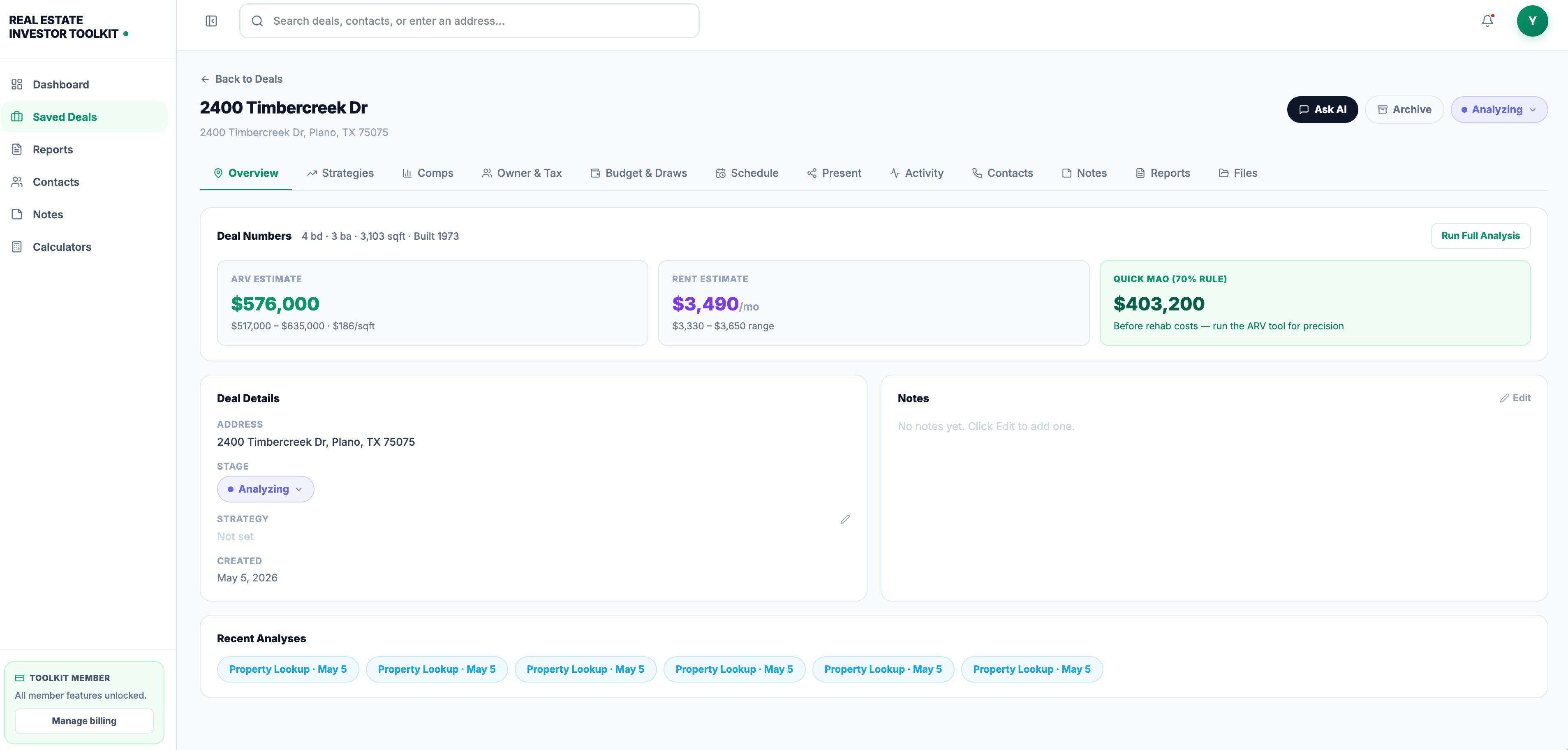
Running the numbers before you shop for financing puts you in a stronger negotiating position, and that is exactly what our free calculators are built for. Our Investment Property Financing Calculator lets you plug in purchase price, projected ARV, and target LTV to see your loan amount, monthly interest-only payment, and cash-to-close before you ever submit an application.
- Run the same deal through multiple LTV tiers to see exactly how your cash requirement and interest cost change at each level.
- Pair the financing calculator with our ARV Calculator and Rehab Cost Calculator to build a full picture before you approach a lender.
- No sign-up is required to test a scenario, so you can check the math on a deal the same day you find it.
For deals you plan to hold through a refinance, our BRRRR Calculator models the full buy, rehab, rent, refinance, repeat cycle so you can see how your initial LTV decision affects your refinance position down the line. When you are ready for unlimited reports, saved deal pipelines, and advanced property data across your whole portfolio, the Real Estate Investor Toolkit plan is $39.99 per month, and the core calculators remain free to use any time.
FAQ
Is a 67% LTV good for a hard money loan?
A 67% LTV falls within typical hard money loans, so it is generally considered a reasonable, moderate leverage position. It gives you a meaningful equity cushion while still limiting the cash you need at closing, though the “right” number ultimately depends on the valuation basis and your exit plan.
What is the maximum LTV for hard money loans?
Land, new construction, and second-lien loans typically see lower maximums, often 50% or less, because the collateral carries more uncertainty.
How do I calculate LTV for a hard money loan?
Divide the loan amount by the property’s value, then multiply by 100 to get a percentage. The tricky part is confirming which value the lender uses (as-is, purchase price, or after-repair value), since that choice changes your usable proceeds even when the stated percentage looks the same.
What is the difference between LTV and LTC in hard money lending?
LTV measures the loan against the property’s value, while LTC (loan-to-cost) measures the loan against total project cost, including purchase price and rehab or construction expenses. Construction and heavy rehab deals commonly use LTC, since there is often no existing finished structure to appraise against.
What is the 36% rule in lending?
It is not a standard used in hard money or business-purpose lending, which focuses primarily on the property’s value and the deal’s exit plan rather than the borrower’s personal debt ratios.
Sources
- Understanding loan-to-value (LTV) ratios — why it matters in hard-money lending | Talimar Financial
- Loan-to-value ratios for hard-money loans | HCS Equity
- Senior loan officer opinion survey on bank lending practices (SLOOS) — April 2025 | Federal Reserve
- Ability-to-Repay/Qualified Mortgage Rule (Regulation Z) — CFPB final rule