Hard Money Loan Costs: What Investors Must Know

Hard money loan costs typically run 8%–18% annually in interest plus 1–5 origination points upfront, with closing and transactional fees totaling roughly 3%–5% of the loan amount on most deals. A practical planning rule: budget the full closing-cost range before you sign a term sheet, then add monthly interest for your expected hold period to get a realistic total financing cost.
The four main cost buckets are:
- Interest: 8%–18% per year, depending on loan-to-value (LTV), loan-to-cost (LTC), after-repair value (ARV), and borrower risk profile
- Origination points: 1–5 points (1 point = 1% of the loan amount), with 2–3 points being the most common range
- Closing fees: underwriting, appraisal, title, escrow, recording, legal/doc prep, and wire fees
- Situational fees: extension charges, draw inspection fees, prepayment minimums, and servicing costs
What drives your rate higher or lower? LTV/LTC ratios, property type, loan position (first vs. second lien), and borrower reserves all move the needle. A first-position loan at 65% LTV on a stabilized single-family property will price near the bottom of that range. A second-position construction loan at 85% LTC will sit near the top.
Quick rule of thumb: for a 6-month flip, budget 4%–9% of the loan in total financing costs (3%–5% closing + 4%–9% annualized interest prorated for the hold). Run the exact numbers before you commit.
Key Takeaways
Hard money loan costs are predictable when you model every fee bucket before closing, not just the interest rate.
| Point | Details |
|---|---|
| Total cost range | Budget 8%–18% annually in interest plus 1–5 origination points and 3%–5% of the loan for closing costs. |
| Closing cost rule of thumb | Most deals land in the 3%–5% range; complex construction or multi-collateral loans push toward the high end. |
| Balloon and minimum-interest risk | Guaranteed minimum-interest periods of 3–6 months and extension fees of 0.5%–1.5% per period can erode quick-flip profits significantly. |
| Transparency standard | Always request a written, itemized fee worksheet and third-party invoices; verify lender licensing on NMLS Consumer Access. |
| Modeling tool | Real Estate Investor Toolkit’s financing and rehab calculators aggregate all fee inputs and test exit scenarios without requiring a sign-up. |
Table of Contents
- ## How hard money loan costs break down line by line
- How interest rates, points, and APR interact on short-term loans
- Worked examples: monthly payments, total interest, and balloon math
- Fees that only appear in certain situations
- Who pays what, when, and how to budget your cash-to-close
- Questions to ask a lender and red flags to watch for
- State licensing checks and where to verify lender legitimacy
- Calculators that help you model hard-money costs accurately
- What most investors get wrong about hard money pricing
- Real Estate Investor Toolkit makes hard-money math faster and more accurate
- Sources
## How hard money loan costs break down line by line
Every fee on a hard money term sheet falls into one of two categories: lender fees and third-party fees. Knowing which is which helps you spot what’s negotiable and what’s not.
Origination points
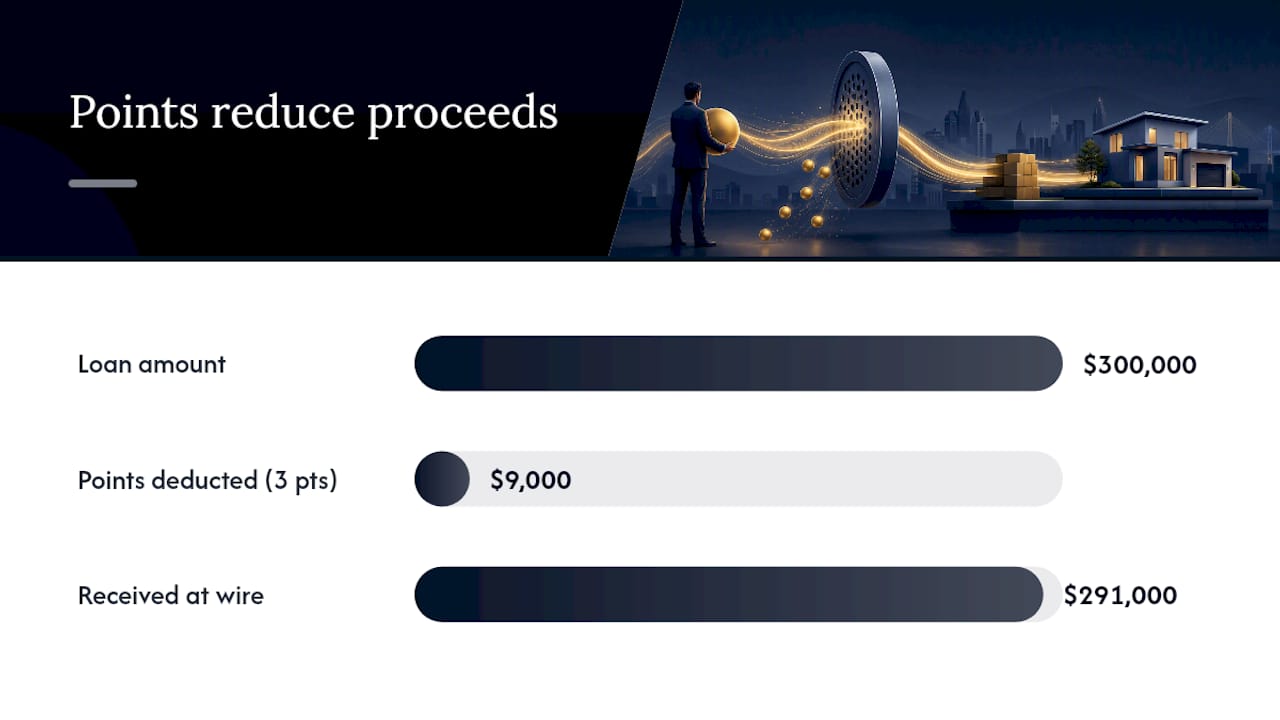
Points are the lender’s primary profit lever on short-term deals. One point equals 1% of the loan amount. On a $300,000 loan, 3 points = $9,000 due at closing. Most lenders charge 2–3 points on standard fix-and-flip loans; riskier deals or borrowers with thin track records can push that to 4–5 points.
Underwriting, processing, and doc prep
These are flat lender fees, not percentage-based. Underwriting and processing typically run $500–$1,500; legal and doc prep fees add another $300–$1,000 or more. Some lenders bundle these under a single “administrative fee” line, which is fine as long as the total is disclosed upfront.
Appraisal or BPO
A full appraisal runs $400–$900 for most residential properties. A broker price opinion (BPO) is faster and cheaper at $250–$500, but some lenders require a full appraisal for larger loans or complex properties. You pay this whether or not the deal closes.
Title, escrow, and recording
Title insurance, escrow fees, and county recording charges vary widely, totaling several hundred to a few thousand dollars depending on the state and loan size. Title fees vary significantly by geography. In some states, attorneys handle closings (attorney-state closings); in others, title companies do. Either way, request the title company’s fee schedule before closing.
Wire and courier fees
Small but real: wire fees typically run $25–$50 per transfer, and courier or overnight delivery fees add another $25–$75 when wet signatures are required.
Tax and insurance prorations
If property taxes or hazard insurance are due during the loan term, lenders often collect prorated amounts at closing. These aren’t lender profit, but they do affect your cash-to-close number.
Draw inspection fees (rehab loans)
Rehab and construction loans use draw schedules with per-draw inspection fees that commonly run $150–$500 per visit. A 6-draw rehab project at $300 per inspection adds $1,800 to your total cost before you’ve swung a hammer.
How these fees add up: a quick example
On a $300,000 hard money loan with 3 points, the math looks like this:
That 4.2% sits squarely in the 3%–5% rule-of-thumb range. Add six months of interest at 12% annually ($18,000), and your total financing cost for a 6-month hold is $30,650, or about 10.2% of the loan.
How interest rates, points, and APR interact on short-term loans
The nominal interest rate on a hard money loan is what you pay monthly. The APR folds in points and fees to show the annualized true cost. On a 12-month loan, the difference between the two is dramatic, because points are a one-time charge amortized over a very short period.
Example: A $300,000 loan at 12% interest with 2 points has a nominal rate of 12%. But those 2 points ($6,000) spread over 12 months add roughly 2% to the annualized cost, pushing the effective APR closer to 14%. Shorten the hold to 6 months and the same points double their annualized impact, pushing the effective cost even higher.
When paying more points makes sense
Some lenders offer a rate buydown: pay an extra point upfront to drop the rate by 0.25%–0.5%. On a short-term loan, this math rarely works in your favor. The monthly savings from a lower rate usually don’t offset the upfront point cost unless the hold period is long (18+ months). For a 6-month flip, take the lower points and keep cash in the deal.
Deducted vs. paid separately
Points are almost always deducted from loan proceeds at funding. If you borrow $300,000 and owe 3 points, you receive $291,000 at the wire. Third-party fees (appraisal, title, recording) are typically paid separately by the borrower, either before closing or at the closing table.
Pro Tip: Request a written fee worksheet that separates the lender’s own fees (rate, points, underwriting) from third-party charges (appraisal, title, recording). Reputable lenders provide this without hesitation. If a lender bundles everything into a single “closing cost” number and won’t break it out, that’s a red flag.
Here’s a quick decision framework for evaluating rate vs. points tradeoffs:
- Calculate total interest cost at the quoted rate for your expected hold period.
- Add the dollar cost of points to get total financing cost at Option A.
- Repeat for any alternative rate/point combination the lender offers.
- Choose the combination with the lower total financing cost for your projected hold time.
- Add a buffer: if the project runs 2 months long, recalculate with that extended hold.
Worked examples: monthly payments, total interest, and balloon math
These examples use a $300,000 loan at 12% annual interest, 3 origination points, and a 12-month term. You can adapt the inputs to your deal using the investment property financing calculator.
Step-by-step: interest-only monthly payment
- Monthly interest rate: 12% ÷ 12 = 1% per month
- Monthly payment: $300,000 × 1% = $3,000/month
- Total interest over 12 months: $3,000 × 12 = $36,000
- Origination points (3): $300,000 × 3% = $9,000 (deducted at funding)
- Total financing cost (interest + points): $36,000 + $9,000 = $45,000
- Balloon payment at month 12: $300,000 (full principal, unchanged)
Interest-only vs. amortizing P&I: the cost comparison
Most hard money loans are interest-only with a balloon at maturity. Here’s how that compares to a fully amortizing structure on the same loan:
The amortizing version barely reduces the principal balance in 12 months, so the monthly payment is only $87 higher while the balloon is nearly identical. For short-term hard money, the interest-only structure is almost always the better cash-flow choice.
Modeling the exit
Your balloon payment is due at loan maturity. Plan the exit before you close the loan:
- Sale exit: Net proceeds must cover the balloon ($300,000), selling costs (typically 6%–8% of sale price), and any remaining holding costs.
- Refinance exit: The new loan must appraise high enough to pay off the balloon. If you’re using the BRRRR method, model the refinance scenario against the stabilized value.
Holding costs beyond interest (property taxes, insurance, utilities, HOA) typically add $500–$2,000 per month depending on the property. Include these in your total project cost model. A guide on estimating holding costs can help you build that line item accurately before you close.
Fees that only appear in certain situations
Not every fee applies to every deal. These situational costs catch investors off guard most often.
Extension fees
Hard money loans commonly include extension fees of 0.5%–1.5% per extension period, typically granted in 1-month or 3-month increments. On a $300,000 loan, a 1% extension fee adds $3,000 for each period you extend. Two extensions on a project that runs over budget can add $6,000+ to your financing cost with no additional capital deployed.
Prepayment minimums and guaranteed-interest periods
Many lenders require a minimum interest payment covering 3–6 months, regardless of when you pay off the loan. If you flip a property in 90 days but the contract guarantees 6 months of interest, you owe the full 6 months. On a $300,000 loan at 12%, that’s $18,000 in interest even if you only held the loan for 3 months. Read this clause carefully before signing.
Draw inspection fees
Each draw on a rehab loan typically triggers an inspection. At $150–$500 per visit, a project with 5–6 draws can add $750–$3,000 in inspection costs alone. Budget these as a line item in your rehab cost estimate, not as an afterthought.
Servicing, payoff, and reconveyance fees
Some lenders charge a monthly loan servicing fee ($25–$75/month) separate from interest. Payoff and reconveyance fees (the administrative cost of releasing the lien when you pay off the loan) typically run $50–$250.
| Situational Fee | When It Applies | Typical Range |
|---|---|---|
| Extension fee | Project runs past maturity | 0.5%–1.5% per period |
| Prepayment minimum | Early payoff within guaranteed period | 3–6 months of interest |
| Draw inspection | Each rehab draw request | $150–$500 per visit |
| Loan servicing | Monthly, if charged separately | $25–$75/month |
| Payoff/reconveyance | At loan payoff | $50–$250 |
Who pays what, when, and how to budget your cash-to-close
Understanding the timing and collection method for each fee is as important as knowing the amounts. Responsible lenders clarify which fees are deducted from proceeds and which the borrower pays separately, and they state their refund policy for third-party fees if a deal falls through.
Fees typically deducted from loan proceeds at funding:
- Origination points
- Underwriting/processing fees (sometimes)
- Prepaid interest (first month, in some cases)
Fees typically paid by the borrower at or before closing:
- Appraisal or BPO (often paid upfront to order the report)
- Title insurance and escrow
- Recording fees
- Legal/doc prep
- Wire fees
Rolling fees into the loan
Some lenders allow you to roll closing costs into the loan balance rather than paying them out of pocket. This reduces your cash-to-close but increases your LTC ratio and the principal on which interest accrues. On a $300,000 loan with $12,000 in fees rolled in, you’re now paying 12% interest on $312,000, adding roughly $1,440 in extra interest over a 12-month hold.
Pro Tip: Before rolling fees in, check whether the higher loan balance pushes your LTC above the lender’s threshold (commonly 70%–80% of ARV). Exceeding that threshold can trigger a rate increase or require additional collateral.
Refund policy checklist — ask before you commit:
- Which third-party fees (appraisal, title) are refundable if the deal doesn’t close?
- Is the appraisal fee refundable if the property doesn’t appraise?
- Are origination points refundable if the lender can’t fund?
- Get refund policies in writing, not just verbal confirmation.
Questions to ask a lender and red flags to watch for
A good lender answers these questions without hesitation. A lender who deflects, gives vague answers, or changes numbers between the verbal quote and the written term sheet is telling you something important.
Must-ask questions before committing
- Can you provide a written, itemized fee worksheet that separates your fees from third-party charges?
- Will you provide invoices from the title company, appraiser, and any other third parties?
- What is your refund policy if the deal falls through after the appraisal is ordered?
- Does the loan include a guaranteed minimum-interest period? If so, how many months?
- What are the extension terms and fees if the project runs over schedule?
- Are any fees negotiable for repeat borrowers or larger loan volumes?
- What is the exact net proceeds amount I’ll receive at funding after all deductions?
Red flags that should make you pause
- Vague “administrative fees” exceeding a few hundred dollars with no line-item backup
- Inconsistency between the verbal quote and the written term sheet
- Mandatory minimum-interest clauses that aren’t disclosed until you ask directly
- Pressure to close quickly before you’ve received a full written fee disclosure
- No written Good Faith Estimate or equivalent itemized disclosure
Reputable lenders provide a transparent, written fee worksheet and back third-party charges with invoices on request. If a lender won’t produce one, move on.
Negotiation tips:
- Ask for a line-item breakdown of every fee before you engage further
- Compare net proceeds (not just rate) across at least two lenders
- Ask whether the lender offers repeat-client discounts on points or processing fees
- Request that any verbal commitments be confirmed in writing within 24 hours
State licensing checks and where to verify lender legitimacy
Hard money lending is regulated at the state level, and licensing requirements vary significantly. Some states require lenders to hold a mortgage broker or mortgage lender license even for commercial or investment-property loans; others have narrower exemptions for business-purpose loans.
How to verify a lender’s licensing status:
- NMLS Consumer Access is the primary U.S. database for checking a lender’s license status, entity details, and any regulatory actions. Search by company name or NMLS ID number.
- Your state’s Department of Financial Institutions (or equivalent) maintains its own license registry and complaint database. Search “[your state] mortgage lender license lookup” to find the direct link.
- The Better Business Bureau (BBB) and your state Attorney General’s consumer protection page are useful for reviewing complaint patterns, though neither is a substitute for a formal license check.
State-level fee variations to know:
- Title and escrow pricing varies widely by state. Attorney-state closings (common in the Southeast and Northeast) often have different fee structures than title-company-state closings.
- Some states cap certain lender fees or require specific disclosures for business-purpose loans. California, for example, has specific requirements under the California Finance Lenders Law (CFLL) that affect how hard money lenders must disclose costs.
- Recording fees are set by county and vary from under $100 to several hundred dollars depending on the number of pages and local fee schedules.
One-sentence caution: This article is general information, not legal advice. Consult a licensed attorney or your state’s financial regulator for guidance specific to your transaction and jurisdiction.
Calculators that help you model hard-money costs accurately
Moving from understanding costs to modeling them on a specific deal requires the right inputs. Here’s what every calculation needs:
- Loan amount (purchase price + rehab budget, or just acquisition)
- Interest rate (annual, nominal)
- Origination points (as a percentage)
- Loan term (months)
- Draw schedule (for rehab loans: number of draws, timing, amounts)
- Per-draw inspection fee
- Expected hold time (may differ from loan term)
- Projected sale or refinance price
- Holding costs (taxes, insurance, utilities per month)
How to model a deal step by step
- Add closing costs using the line-item ranges from this guide (or your lender’s written estimate).
- Enter your rehab budget and draw schedule into a rehab cost calculator to estimate draw inspection fees and construction-period interest.
- Add monthly holding costs (taxes, insurance, utilities) for the full expected hold period.
- Subtract total financing costs and selling costs from your projected sale price to get estimated net proceeds.
- Run a sensitivity test: what happens if the hold extends by 2 months? What if the sale price comes in 5% below projection?
Real Estate Investor Toolkit’s free investment property calculators let you run these scenarios without signing up, so you can stress-test multiple lender term sheets side by side before committing to one.
Pro Tip: Always run at least two hold-time scenarios: your base case and a version that’s 60 days longer. Extension fees and extra interest on a delayed project are the most common reasons a deal’s actual return falls short of the pro forma.
What most investors get wrong about hard money pricing
Hard money pricing is not just the interest rate. The rate is the headline, but the points, the guaranteed minimum-interest clause, and the extension fees are where deals quietly lose their spread.
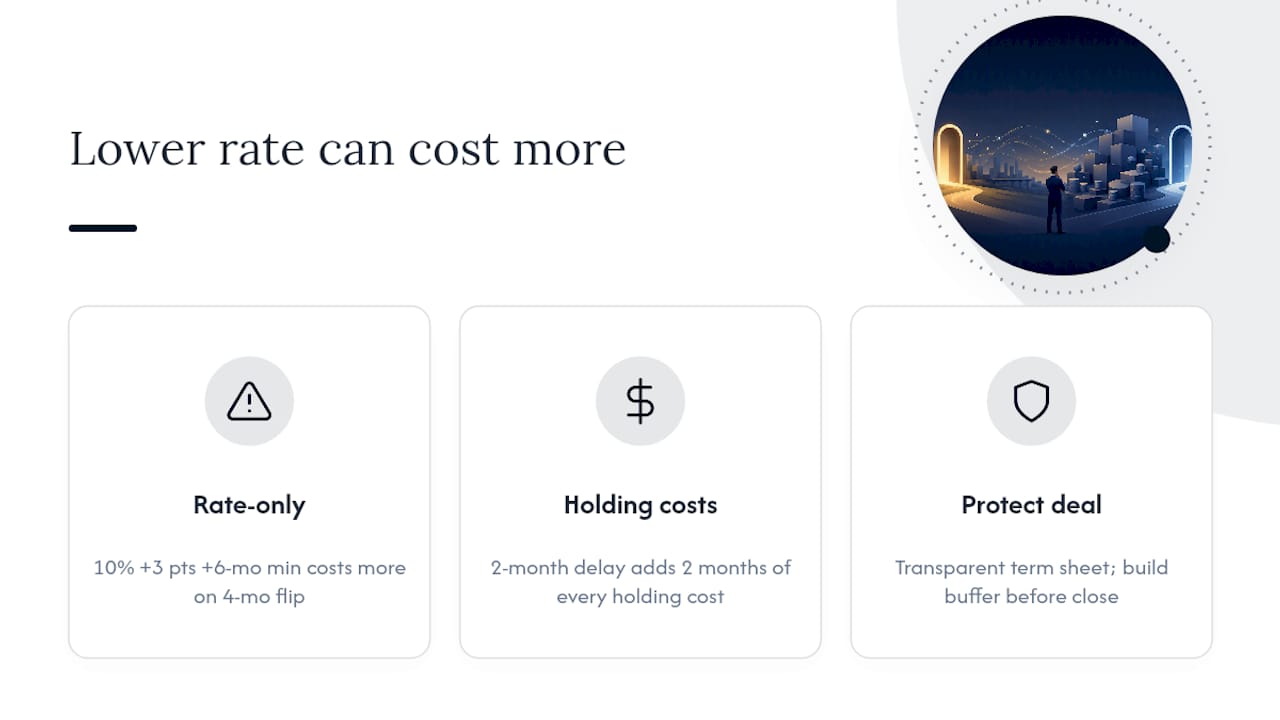
The most common mistake I see is investors comparing lenders on rate alone. A lender offering 10% with 3 points and a 6-month minimum-interest guarantee will cost more on a 4-month flip than a lender offering 12% with 1 point and no minimum. The math is straightforward, but investors skip it because the lower rate feels like the better deal.
The second mistake is underbudgeting holding costs. Taxes, insurance, and utilities are not financing costs, so they don’t show up on the lender’s term sheet. But they’re real cash out the door every month, and they compound the cost of a delayed exit. A project that runs 2 months over schedule doesn’t just add 2 months of interest; it adds 2 months of every holding cost line item simultaneously.
The most reliable way to protect your deal spread is a transparent term sheet combined with conservative hold-time assumptions. If the deal only works at your base-case timeline, it probably doesn’t work. Build in the buffer before you close, not after.
Real Estate Investor Toolkit makes hard-money math faster and more accurate
Modeling hard money loan costs by hand is doable, but it’s slow and error-prone when you’re comparing multiple lender quotes on a tight timeline.
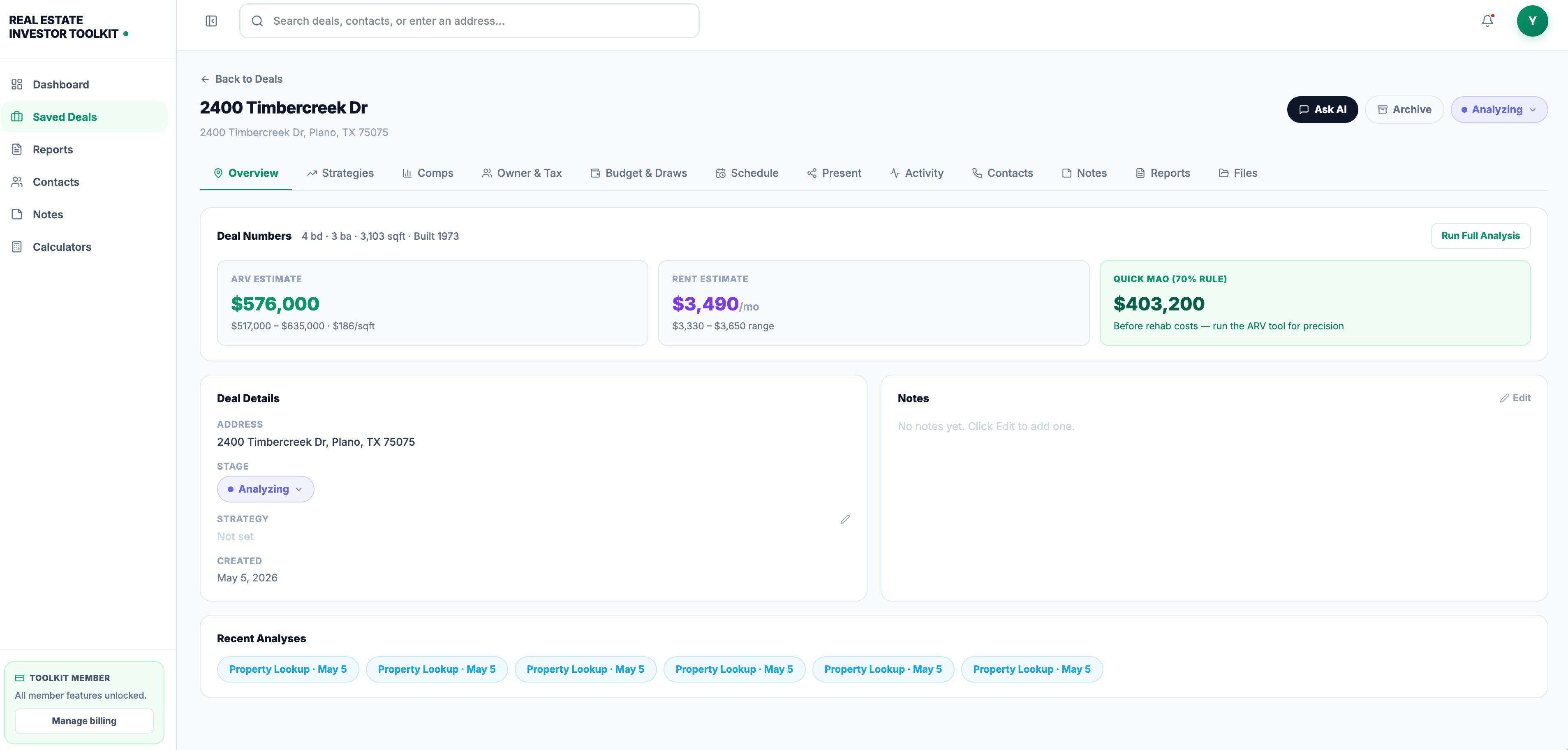
Real Estate Investor Toolkit’s investment property financing calculator accepts loan amount, rate, points, term, and hold time, then aggregates all fees into a total project cost and net-proceeds figure. Pair it with the rehab cost calculator to fold draw schedules and inspection fees into the same model. Both tools are free to use with no account required. Run your lender’s term sheet through the calculator, adjust the hold time by 60 days, and you’ll know in minutes whether the deal holds up under stress. Start modeling your next deal at Real Estate Investor Toolkit now.
Sources
These sources were used to compile cost ranges, fee structures, and verification guidance in this guide:
- The Complete Guide to Hard Money Loan Fees in California - Crescent Lenders
- Closing Costs in Hard Money Lending: What’s Included and How to Plan - Lendingbeeinc
- Nmlsconsumeraccess
This article is general information, not a substitute for advice from a qualified financial advisor. Consult a qualified financial professional about your own circumstances before acting on anything here.
Recommended
- How to Finance a Fix-and-Flip: Hard Money vs Conventional — Real Estate Investing Guide | Real Estate Investor Toolkit
- Cash-Out Refinance Math: When Pulling Equity Helps and When It Backfires | Mortgage Guides | Real Estate Investor Toolkit
- How to Estimate Holding Costs Before They Kill the Flip Spread — Real Estate Investing Guide | Real Estate Investor Toolkit