Florida Wholesaling Laws: What Is Legal and What Is Not

Wholesaling is legal in Florida when you act as a principal: you sign the purchase contract in your own name and assign your own rights in that contract to an end buyer. It stops being legal when you act as an unlicensed broker, meaning you market or negotiate someone else’s property for pay. Florida has no statute called a “wholesaling law,” so the rules come from the state’s real estate licensing chapter. Before you sign anything, run your numbers on a free ARV and MAO calculator, so you know the deal works at a price you can legally and profitably assign.
This guide is general information for investors, not legal advice. For your own contracts, a Florida real estate attorney is the right person to review them.
TL;DR
- Assigning a contract you hold as a principal buyer is legal in Florida. Brokering a property you do not own or control, for compensation, requires a license.
- Unlicensed brokerage is a third-degree felony under section 475.42, and fee agreements with unlicensed brokers are unenforceable.
- Advertise your contract rights, not the house itself, and disclose your role to both seller and buyer.
- Check the contract’s assignability clause before you sign, and use a separate assignment document.
- Florida passed no wholesaling-specific law in 2025 or 2026, but confirm the current statute text before each deal.
Table of Contents
- Is wholesaling legal in Florida?
- The rule that matters: principal or broker
- What happens if you cross the line
- What you can advertise
- Contract terms and disclosures
- Before you sign: a checklist for first-time wholesalers
- Doing the math at each step
- Assignment versus double closing
- Have the rules changed recently?
- Our perspective
- Run the deal before you sign the contract
- FAQ
- Sources
Is wholesaling legal in Florida?
Yes. Florida treats the activity under Chapter 475 of the Florida Statutes, the real estate licensing law. Assignment wholesaling is legal under the principal-buyer exemption: the wholesaler signs the contract, gains an equitable interest in the property (the buyer’s right to complete the purchase and receive title), and sells that right to a cash buyer.
The statute itself is where the line sits. Section 475.01 defines a broker as someone who, for compensation, negotiates or procures buyers for others. Section 475.011 exempts people selling, exchanging or leasing their own property. A wholesaler lives in the gap between those two sections, and the facts of each deal decide which side of the gap the wholesaler is on.
That is why two investors using the same business model can have very different legal exposure. One signs a real contract, holds a real interest, and sells it. The other collects a fee for finding a buyer for a house they never had any right to.

The rule that matters: principal or broker
Ask yourself one question for every deal: am I selling something I own, or am I being paid to find a buyer for something someone else owns?
| Principal (assignment) | Broker (license required) | |
|---|---|---|
| What you hold | A signed, enforceable purchase contract in your name | No contract, or only a verbal understanding |
| What you sell | Your equitable interest in the contract | The seller’s property |
| Who pays you | The end buyer, from the spread you negotiated | A fee for matching a buyer to someone else’s property |
| Seller knows your role | Yes, disclosed in the contract | Often not |
| Florida position | Within the owner exemption in 475.011 | Brokerage under 475.01 |
The exemption depends on a bona fide interest. A contract with no real obligation behind it, or one you cannot actually perform or assign, weakens your claim to be a principal. Florida’s statute also says that a contract or option not supported by substantial consideration can be treated as a void device, according to one Florida land-law summary of the statute. Treat your own contract as real: sign it intending to close or to assign it properly.
What happens if you cross the line
The penalties are the reason Florida deserves its own guide.
- Criminal exposure. Under section 475.42(1)(a), acting as a broker or sales associate without a valid, active license is a third-degree felony.
- Unenforceable fees. Section 475.41 makes compensation agreements for unlicensed brokerage invalid, so you cannot sue to collect a fee for brokering.
- A presumption against you. Section 475.43 presumes a person acted as a broker when they advertised real estate whose title they did not hold at the time. You can rebut it, but you start on the back foot.
None of these are theoretical risks for people who follow the principal model. They matter because a wholesaler’s marketing, paperwork and fee structure are what a regulator or a seller’s attorney looks at first.
What you can advertise
This is the most common place for new wholesalers to slip. In Florida, you advertise your contractual interest, not the property.
An attorney’s guide to Florida assignment contracts says marketing should be limited to the investor’s contractual interest, because representing the underlying property for a fee without a license can amount to unlicensed brokerage. In practice:
Safer wording
- “Investor selling its rights under a purchase contract.”
- “Equitable interest in a contract to purchase a property, sold subject to the terms of the contract.”
- Your name or entity as the contracting party, with your role clear.
Wording to avoid
- “For sale” language for a house you only have an unsigned conversation about.
- Listing details that make it look like you are the owner or the listing agent.
- Promising a seller you will “find a buyer” for a commission.
Florida’s statute also treats false or misleading advertising as unlawful, and anyone advertising real estate services for others is presumed to be acting as a broker under Chapter 475. Keep ads factual, and put your contract in place before any marketing goes out.
Contract terms and disclosures
Florida wholesalers work with the purchase contract, an assignment document and a title company. Each piece has to carry the right terms.
According to the attorney guidance cited above, contracts should address assignability, deposits, inspection periods and closing details, with all interests and compensation disclosed so every party understands the deal. For a wholesaler that means:
- Disclose that you are a principal. The seller should know you are buying for investment and may assign the contract.
- Disclose your compensation. The end buyer should see the assignment fee in the assignment paperwork or closing statement.
- Be specific about the deposit. Who holds it, how much, and when it is refundable. Our guide to earnest money in wholesaling walks through how much, who pays and who holds it.
- Put the inspection period in writing. It is your exit if the numbers or the condition do not hold up.
- Set a closing date you can meet. Your end buyer needs time to fund, and you need time to find them.
Before you sign: a checklist for first-time wholesalers
- Read the assignability clause. Many Florida residential purchase forms include a section with choices about whether assignment is allowed and whether the original buyer remains liable. Florida Realtors advises checking whether paragraph 7 permits assignment and whether you stay liable after assigning. If the form bars assignment, you need the seller’s written consent or a different structure.
- Confirm the contract is enforceable. Signatures, a legal description, a price and consideration all need to be in place. Whether a contract can be assigned depends on its specific terms, so confirm that it explicitly allows assignment or at least does not prohibit it.
- Use a separate assignment document. Do not rewrite the purchase contract. The assignment transfers your rights, states your fee and names the end buyer.
- Understand recording limits. Under Florida Statute 696.02, an assignment of a purchase contract is not entitled to recording unless the underlying contract has been recorded or is entitled to be recorded.
- Line up the closing agent early. Confirm the title company is experienced with and willing to close assignment transactions. Understanding how a title company differs from an attorney at closing and what contract terms affect your assignment rights helps you ask the right questions before the deal is in motion.
- Run the numbers before you commit. A contract you cannot assign at a profit is a liability, not an asset.
Doing the math at each step
Legal structure and deal math are linked. Your assignment fee comes from the gap between the price you locked in and the most an end buyer can pay. If your contract price is too high, you have no spread, no buyer and no exit.
Here is a worked example. Say a Florida house has an after repair value (ARV, the expected sale price after renovation) of $300,000, and an investor buyer needs repairs of $40,000. A common wholesaler benchmark is the 70% rule: multiply ARV by 0.70, subtract repairs. That gives $300,000 × 0.70 − $40,000 = $170,000, the maximum allowable offer (MAO) for that end buyer. If you contract at $155,000, your spread is $15,000 before closing costs, which is the room for your assignment fee. The percentage is a rule of thumb, not a Florida requirement, so investors adjust it by market and by their own return targets.

The weak points are the inputs. Overestimated ARV and underestimated repairs are the errors that kill spreads. Our ARV calculator and rehab cost calculator are designed for exactly those two inputs, and the free tools need no sign-up. The wholesale offer formula guide shows how assignment fee and MAO fit together, and the MAO explainer covers the definitions.
If you want the full picture on how an assignment affects who gets paid, our article on how assignment contracts work and how to avoid double payment adds detail.
Assignment versus double closing
Florida wholesalers also use double closing: you buy the property, then sell it to your end buyer, often on the same day. Because you take title, the principal status is unambiguous. The tradeoffs are practical: two sets of closing costs and, usually, funds to close the first purchase (sometimes transactional funding). Whichever route you choose, the same discipline applies: real contract, real interest, honest disclosure, and a title company that knows the process. Match the route to the deal’s spread, since a thin spread may not absorb a second set of costs.
Have the rules changed recently?
Not for wholesaling specifically. A review of the statute and legislative activity found that no Florida wholesaling-specific law was enacted in 2025 or 2026, and the relevant Chapter 475 sections were unchanged across those editions. Another summary notes that no bills in the 2026 session directly regulated wholesale transactions.
Laws can change, so read the current text of Chapter 475 on the Florida Senate site and have an attorney confirm it before a large deal. Our investor guides cover the deal-analysis side of the business.
Our perspective
Legal risk and deal risk are the same risk seen from two sides. The wholesalers who get into trouble are rarely the ones with a clean contract and a real spread. They are the ones who locked up a house at a price no buyer would pay, then felt pressure to push the paperwork to make it work.
That is why we build calculators for the part before the contract: ARV, rehab estimates and maximum allowable offer. If the numbers say the spread is there, you can sign as a principal with confidence. If they say it is not, you have lost nothing.
Our free tools need no sign-up, so you can test a deal in minutes. For investors running several deals, the paid plan adds unlimited reports, saved deal pipelines, owner and absentee owner data and an AI assistant for deal insights in one place.
Michael
Run the deal before you sign the contract
The Real Estate Investor Toolkit gives you free calculators for ARV, maximum allowable offer and rehab costs with no sign-up. When you are ready to run more deals, the full toolkit is $39.99 per month and includes unlimited reports, saved deal pipelines, advanced property data and AI chat insights.
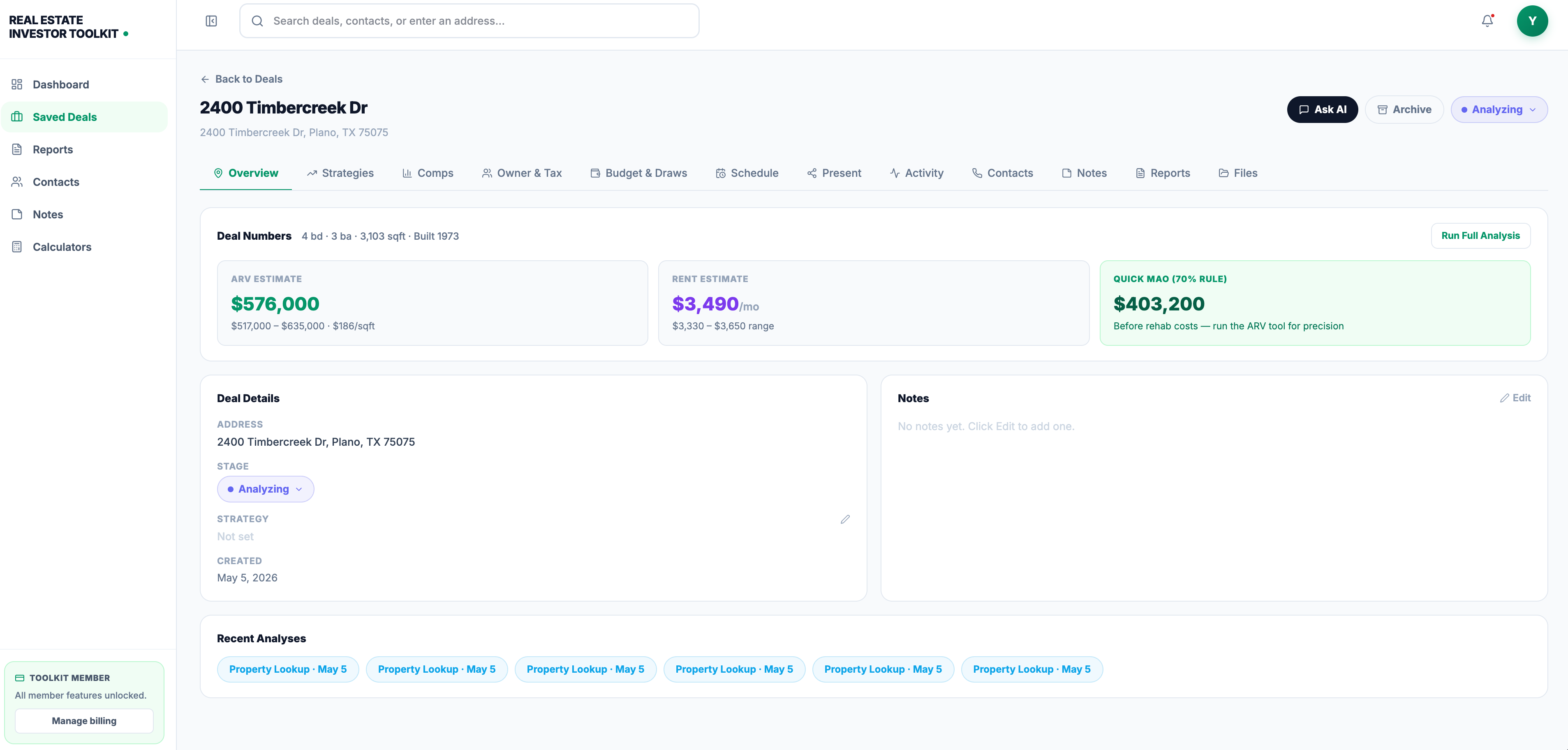
Start with the free tools, or see what the paid plan adds.
FAQ
Do I need a real estate license to wholesale in Florida?
Not if you act as a principal buyer and assign your own contract rights. A license is required if your activity amounts to brokerage, such as negotiating or marketing a property for someone else for compensation. If you are unsure which side a deal falls on, ask a Florida real estate attorney before you sign.
What is the penalty for unlicensed wholesaling in Florida?
Operating as a broker without an active license is a third-degree felony under section 475.42. Under section 475.41, a fee agreement for unlicensed brokerage is also invalid, so you could not enforce payment.
Can I advertise a house I have under contract?
Advertise your contractual rights, not the property. Describe what you are selling as an assignable interest in a purchase contract, and make sure you hold a signed contract first. Section 475.43 presumes a broker when someone advertises property whose title they do not hold.
Does Florida require me to disclose that I am a wholesaler?
The statutes do not contain a wholesaling disclosure rule, but disclosure is the standard way to show you are acting as a principal. State your role and your compensation in the contract and assignment documents so the seller and end buyer both understand the deal.
Sources
- Chapter 475, 2026 Florida Statutes, The Florida Senate
- Understanding Assignability of Contract, Florida Realtors
- Is Wholesaling Real Estate Legal In Florida? (2026)
- Is wholesaling legal in Florida?, Entrusted Capital
- Florida Wholesaling and Assignment Contracts, Attorney Shah
- Assignment vs Double Close in Florida, Libera CG
- Is Wholesaling Real Estate Legal in Florida? 2026 Laws
- Title company vs attorney: 5 questions to vet closing help