Flood Zone Analysis for Real Estate Investors: A Deal Checklist

A flood zone analysis tells you three things before you make an offer: which FEMA zone the property sits in, what that zone does to your insurance and financing costs, and how much of that cost belongs in your numbers. Run it before you finalize your ARV, your rehab budget and your maximum allowable offer (MAO), because a flood zone can change all three. Our free calculators at Real Estate Investor Toolkit let you rerun a deal with the flood costs added, and they require no sign-up.
TL;DR
- Look up the address in FEMA’s Flood Map Service Center and record the zone, the base flood elevation (where shown) and the map’s effective date.
- Zone A and Zone AE are both 1%-annual-chance areas. AE has a mapped base flood elevation, and A generally does not.
- A mortgage on a property in a high-risk zone generally requires flood insurance, so price it as a real operating cost.
- Get an address-specific insurance quote. Do not underwrite on the seller’s current premium.
- Rerun ARV, rehab and MAO with the flood costs included before you offer.
Table of Contents
- What a flood zone analysis covers
- Step 1: Look up the address on FEMA’s map
- Step 2: Read the zone
- Step 3: Confirm the map is current
- Step 4: Gather property-level elevation and history
- Step 5: Price the insurance, not the seller’s premium
- Step 6: Put the flood costs into your numbers
- A worked example
- Where this goes wrong
- Our perspective
- Run the flood-adjusted numbers
- FAQ
- Sources
What a flood zone analysis covers
For an investor, a flood zone analysis is a short due diligence routine. You identify the zone, confirm the map is current, learn what the property’s elevation means, and convert the findings into dollars. It is not an engineering study. It is the set of checks that keeps a good-looking spread from turning into a bad hold.
FEMA maps show how likely an area is to flood and how a property relates to the highest-risk areas. FEMA also states that flooding can occur outside those areas and that no zone is risk-free. A map reading is a starting point, not a clean bill of health.

Step 1: Look up the address on FEMA’s map
FEMA’s Flood Map Service Center (MSC) is the official online source for National Flood Insurance Program flood-hazard maps. The steps:
- Enter the property address in the MSC’s Address Search. This finds the current effective map for that location.
- View the result and print a FIRMette, a small printable section of the Flood Insurance Rate Map (FIRM). FEMA says the FIRMette uses the effective FIRM plus any map revision letters issued since.
- Use Search All Products if you want the wider range of map and risk products for the location.
- Save the FIRMette to the deal file.
Where it goes wrong: investors screenshot a third-party listing site’s flood label and skip the official map. Pull the FIRMette so your file shows the zone, the panel and the effective date, which is what a lender or insurer will be looking at.
Step 2: Read the zone
The base flood is a flood with a 1% chance of being equaled or exceeded in any year, also called the 100-year flood. Zones in this high-risk category are called Special Flood Hazard Areas (SFHAs).
| Zone | What it means for your deal |
|---|---|
| A | 1%-annual-chance flood area. FEMA notes this carries about a 26% chance of flooding over a 30-year mortgage. Detailed studies are not performed, so no depth or base flood elevation is shown. |
| AE | The same base floodplain, but base flood elevations are provided. |
| Shaded X | Moderate-risk area outside the 1% zone, covering the 0.2%-annual-chance flood. |
Which is worse, A or AE?
The flood hazard is the same 1% event in both. The difference is information. In AE you can compare the base flood elevation to the building’s lowest floor. In Zone A you have no mapped elevation, so you will need an elevation certificate or a surveyor’s work to learn where the building sits. Expect more uncertainty, and more diligence time, in an A zone.
Zone X is not zero risk
FEMA says its maps do not establish that a specific property is free of flood risk, and that flooding remains possible outside SFHAs. The CFPB adds that flood insurance may be worth considering even outside designated high-risk zones. If you invest in Florida or the Gulf region, check heavy-rain and storm-surge exposure on every deal, whatever the zone says.
Step 3: Confirm the map is current
Maps change. FEMA’s map-change guidance says an updated map can alter flood-zone classifications and insurance requirements. On the MSC, check the map’s “Changes to this FIRM” products for revisions, amendments and revalidations. Write down the effective date next to the zone.
A property that is about to be remapped into a high-risk zone, or out of one, changes your insurance assumptions and your exit buyer’s financing. Record what you find, then confirm it with the insurer’s quote.
Step 4: Gather property-level elevation and history
The zone is an area label. Your numbers depend on the building. Collect:
- The base flood elevation, if the zone shows one.
- The lowest-floor elevation of the building, ideally from an existing elevation certificate. Ask the seller for one.
- Flood and water-intrusion history, grading and drainage around the house, and signs of past water damage.
This approach matches practitioner guidance for investors, which suggests recording the effective map, zone, base flood elevation and lowest-floor elevation, then getting an insurance quote. These are good habits, not federal requirements.
FEMA lists factors that go into flood rating, including distance from a flooding source, river overflow, storm surge, coastal erosion, heavy rainfall, property elevation and rebuilding cost. Two houses on the same street and in the same zone can price very differently.
Step 5: Price the insurance, not the seller’s premium
This is where flood zone analysis changes your return.
The CFPB explains that a mortgage on a home in a designated SFHA generally requires flood insurance, on top of standard homeowners coverage. It also notes that a new owner may pay more than the seller, because annual rate-increase limits may protect the current owner. Lenders must check whether a building securing a loan is in an SFHA, as Farm Credit Administration guidance describes for the loans it covers.
So the process is:
- Ask for the seller’s current policy and elevation certificate, for reference only.
- Get a fresh quote for your ownership, your intended use (flip, rental) and the building’s actual elevation. Request both a National Flood Insurance Program quote and a private-market quote.
- Put the quoted annual premium in your underwriting.
Policy forms are also evolving. A February 2024 Federal Register notice proposed a new NFIP Homeowner Flood Form for one-to-four-family homes, and Congress has a pending NFIP reauthorization bill (H.R. 5484). Both are proposals, so ask the insurer which terms apply to your quote.
Step 6: Put the flood costs into your numbers
Flood exposure touches each part of a deal. Here is where to adjust.
ARV
Your after repair value is what the finished house sells for, like pricing a meal after buying the ingredients. Buyers in the same flood zone face the same insurance bills, so use comps from comparable zones and elevations. A comp on high ground a few blocks away may not be a fair match for an AE property. Our ARV calculator helps you test your value against comparable sales.
Rehab budget
If the house has had water intrusion, scope the work conservatively: drywall, flooring, insulation, mold remediation, electrical and HVAC placement. Mitigation such as grading, drainage and raising mechanical equipment adds line items. Our rehab cost calculator and rehab cost guide walk through how to build a line-by-line estimate.
MAO for wholesalers
The maximum allowable offer is the most you can pay and still hit your margin. Flood insurance, added repair scope and a longer sale timeline all come out of it. If you assign contracts, your end buyer will run the same math, so a flood-zone property with unpriced insurance leaves less room for your fee. See how MAO works and the wholesale offer formula.
Rental cash flow and financing
For a landlord, the flood premium is a recurring expense that cuts net operating income. Enter it in the rental property calculator before you look at cap rate and cash-on-cash return. For BRRRR deals (buy, rehab, rent, refinance, repeat), the refinance lender will require coverage in a high-risk zone, so use the BRRRR calculator with the real premium. Lender underwriting is covered in how lenders evaluate your mortgage, and the financing calculator lets you test loan scenarios.
A worked example
This is an illustration with made-up figures, not a quote. Say a flip has an ARV of $300,000, a rehab budget of $45,000 and a target profit and costs package of $60,000 using a simple formula where MAO equals ARV minus rehab minus costs and profit. That gives an MAO of $195,000.

Now the insurance quote comes in, the survey shows the lowest floor sits below the base flood elevation, and you add $8,000 for drainage and mechanical work. Rehab becomes $53,000. If you also hold the property for a few extra months because buyers need time to line up coverage, add those carrying costs. At $53,000 rehab and the same other inputs, MAO drops to $187,000. The flood analysis moved your offer by $8,000 before any holding costs. Seeing it before you sign beats finding it at closing.
Where this goes wrong
- Relying on a listing portal’s flood label instead of the FIRMette.
- Assuming Zone X means no insurance is worth pricing.
- Underwriting the seller’s premium.
- Treating Zone A like AE and skipping the elevation work.
- Using comps from higher ground for a low-lying house.
If you are buying a house that has already flooded and may sell it as-is later, a guide to selling flood-damaged houses shows how exit buyers view these properties, which helps you plan an exit before you buy.
Our perspective
Most investors we talk to about flood risk make the same mistake: they treat it as an insurance line item checked after the offer. We think it belongs at the front of the deal, next to ARV and rehab, because it moves both.
That is why our platform keeps the pieces together. The free calculators need no sign-up, so you can test a deal with and without a flood premium in a few minutes. When you are working a pipeline, the paid plan adds unlimited reports, saved deals, property data and an AI deal advisor in one place, instead of juggling separate subscriptions.
Run the numbers on the flood-adjusted version first. The deals that still work are the ones worth your time.
Michael
Run the flood-adjusted numbers
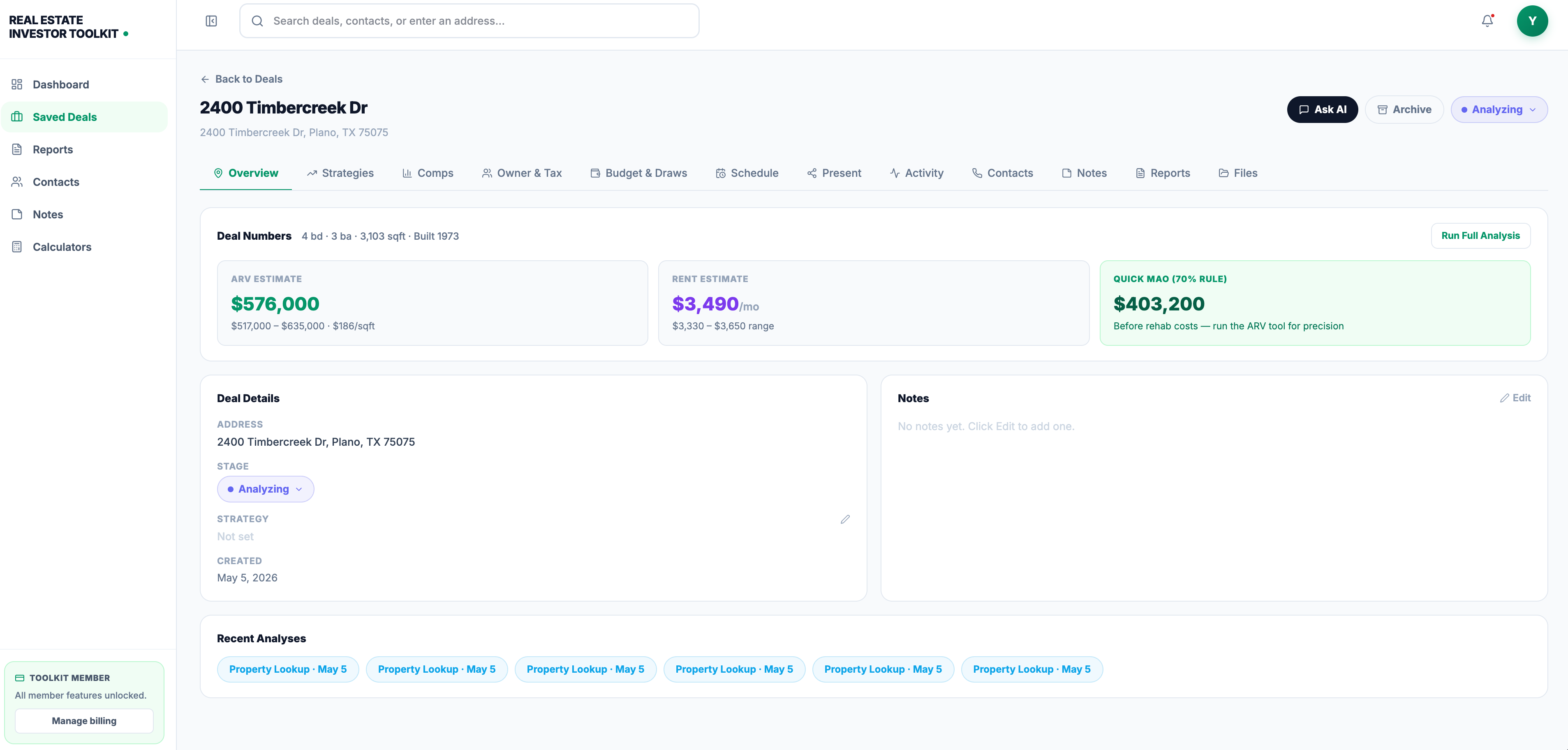
Start with the free tools, which need no sign-up, to test ARV, rehab, MAO and rental cash flow with your flood costs included. If you analyze deals every week, the Real Estate Investor Toolkit plan is $39.99 per month and includes unlimited reports, saved deal pipelines, advanced property data, owner details and AI chat insights.
FAQ
How do I find a property’s flood zone?
Enter the address in FEMA’s Flood Map Service Center and use Address Search to find the current effective map. Print a FIRMette for your file. It shows the zone and the map details a lender will see.
Is Zone AE worse than Zone A?
The flood hazard is the same 1%-annual-chance event. AE comes with a mapped base flood elevation, which lets you compare it to the building’s lowest floor. Zone A has no mapped elevation, so you need an elevation certificate or survey to know how the house sits.
Do I need flood insurance on an investment property?
A mortgage on a property in a designated high-risk zone generally requires it. Outside those zones it may still be worth pricing, since flooding can happen anywhere. Get a quote for your own ownership before you set your offer.
Does a flood zone change my ARV?
It can. Buyers pay for the same insurance costs, so match comps by flood zone and elevation where you can. Then check the result against your rehab budget and MAO.
Sources
- Flood Maps | FEMA.gov
- How to Print a FIRMette and Download a FIRMPanel (FEMA)
- FEMA NFIP Terminology Index
- Know Your Flood Risk: Homeowners, Renters or Business (FEMA)
- Map Changes and Flood Insurance: What Property Owners Need to Know (FEMA)
- CFPB: What questions should I ask about flood and disaster risk
- Flood insurance | Farm Credit Administration
- The Coastal Georgia Investor’s Flood Zone and Insurance Primer
- Federal Register: NFIP Standard Flood Insurance Policy Homeowner Flood Form
- H.R.5484 - 119th Congress
- Sell a Flood Damaged House Fast