How to Find Absentee Owners: Records, Filters and Verification

You find absentee owners by comparing two addresses on every parcel: the property’s physical (situs) address and the mailing address where the owner receives the tax bill. When they differ, the owner probably does not live there. You can run that comparison yourself with county assessor data or save the work with a property data platform. Either way, verify each lead against deed records before you spend money on mail or calls.
This guide walks through both routes, the records that matter, the checks that keep your list clean, and the legal rules that apply when you start contacting people.
TL;DR
- An absentee owner is a property owner whose tax mailing address differs from the property address. It is a mechanical flag, not proof of an investor or landlord.
- The raw material is county assessor and recorder data. Some counties sell owner mailing lists, and some online tools hide owner names.
- Tax rolls lag behind sales, so confirm ownership through the deed chain and parcel number before outreach.
- Follow the Telemarketing Sales Rule and local absentee-owner ordinances when you contact owners.
- Score every lead with your numbers (ARV, rehab, MAO) before you buy a list or send a single letter.
Table of Contents
- What an absentee owner is, and what the flag does not tell you
- Where the ownership data lives
- Method 1: Build the list from county records
- Method 2: Use a property data platform
- Verify before you contact anyone
- Narrow the list to owners worth contacting
- Rules to follow when you reach out
- Our perspective
- Try it on a real lead
- Common mistakes to avoid
- FAQ
- Sources
What an absentee owner is, and what the flag does not tell you
An absentee owner is someone who owns a property but receives the tax bill somewhere else. The test is simple: the situs address of the parcel does not match the taxpayer mailing address held by the county assessor. Scout Data describes the flag the same way, and it makes a point worth remembering: the flag is a mechanical test. It does not tell you whether the owner is an investor, a landlord or a family that moved.
That matters because “absentee” covers very different people:
- Landlords who rent the property out and live elsewhere.
- Heirs who inherited a house and never moved in.
- Owners of second homes or vacation properties.
- Relocated owners who kept the house after a job change.
- Owners of vacant or neglected properties, which often overlap with distressed leads.
A mailing-address mismatch can indicate a rental, second home or investment property, as the Center for Community Progress notes in its guidance on locating owners. Your job is to sort those groups, because a tired landlord and a grieving heir need very different conversations.
Where the ownership data lives
Three public offices hold most of what you need. Knowing which one answers which question saves hours.
| Office | What it holds | What you use it for |
|---|---|---|
| County assessor | Owner name, situs address, mailing address, parcel number, owner-occupancy information | Spotting address mismatches and building the first list |
| Recorder or Register of Deeds | Recorded deeds and the official ownership chain | Confirming who actually owns the property today |
| Treasurer or tax collector | Tax bills, payment status, mailing address changes | Checking for delinquency and the address the bill goes to |
The Center for Community Progress explains that the assessor’s office holds taxpayer information that helps determine owner-occupancy, while the Recorder or Register of Deeds holds the official ownership records. It also notes that commercial providers aggregate and organize local sources for purchase. That last point is the fork in the road: do the work yourself from the counties, or pay someone who already did it.
Method 1: Build the list from county records
Doing it yourself costs time rather than money, and it teaches you your market. Here is the process.
- Pick a tight target area. One ZIP code, a subdivision or a few neighborhoods. A small area keeps the list workable and the verification realistic.
- Find out what your county offers. Start on the assessor’s website. Look for “data requests,” “parcel information” or “mailing lists.”
- Request or download the owner data. Ask for parcel number, situs address, owner name and mailing address in a spreadsheet-friendly format.
- Filter for mismatches. Compare the situs address to the mailing address. Keep rows where they differ.
- Remove noise. Drop banks, government entities, homeowners associations and obvious data errors.
- Tag the leads. Mark out-of-state mailing addresses, in-state but out-of-county addresses, and local mismatches separately.
What counties actually provide
Practices vary widely by county, so check yours first. Some counties sell custom lists. Camden County, Missouri, for example, offers property-owner mailing lists for a subdivision, another geographic area or the entire county, with the price depending on the information requested.
Others deliberately limit what their websites show. El Dorado County, California states that its online tools do not display owner names alongside parcel numbers or addresses. Owner information there comes through public inspection of the assessment roll or recorded documents. The same page points to a third-party service that offers business-grade subscriptions for large or complex lookups and frequent data refreshes.
So the pattern is: small counties may sell you a list for a modest fee, bigger ones may push you toward bulk data requests or a licensed data service, and some require an in-person or formal request. Call the assessor and ask one question: “How do I get owner names and mailing addresses for a set of parcels?”
Do the math on your time
A manual pull works well for one or two counties you know. It gets slow when you cover several counties with different formats, or when you need to refresh the list monthly. If you work Florida or the Dallas-Fort Worth area, for example, you may be dealing with multiple appraisal districts or county offices, each with its own export format. That is the point where many investors switch to a platform.
Method 2: Use a property data platform
Commercial platforms collect assessor and recorder data from many counties, standardize it and let you filter by occupancy. You draw an area, filter for owner-occupied status or absentee status, and export the matches. This is faster and easier to refresh, but you are paying for convenience, and the quality depends on how recently the provider updated each county.
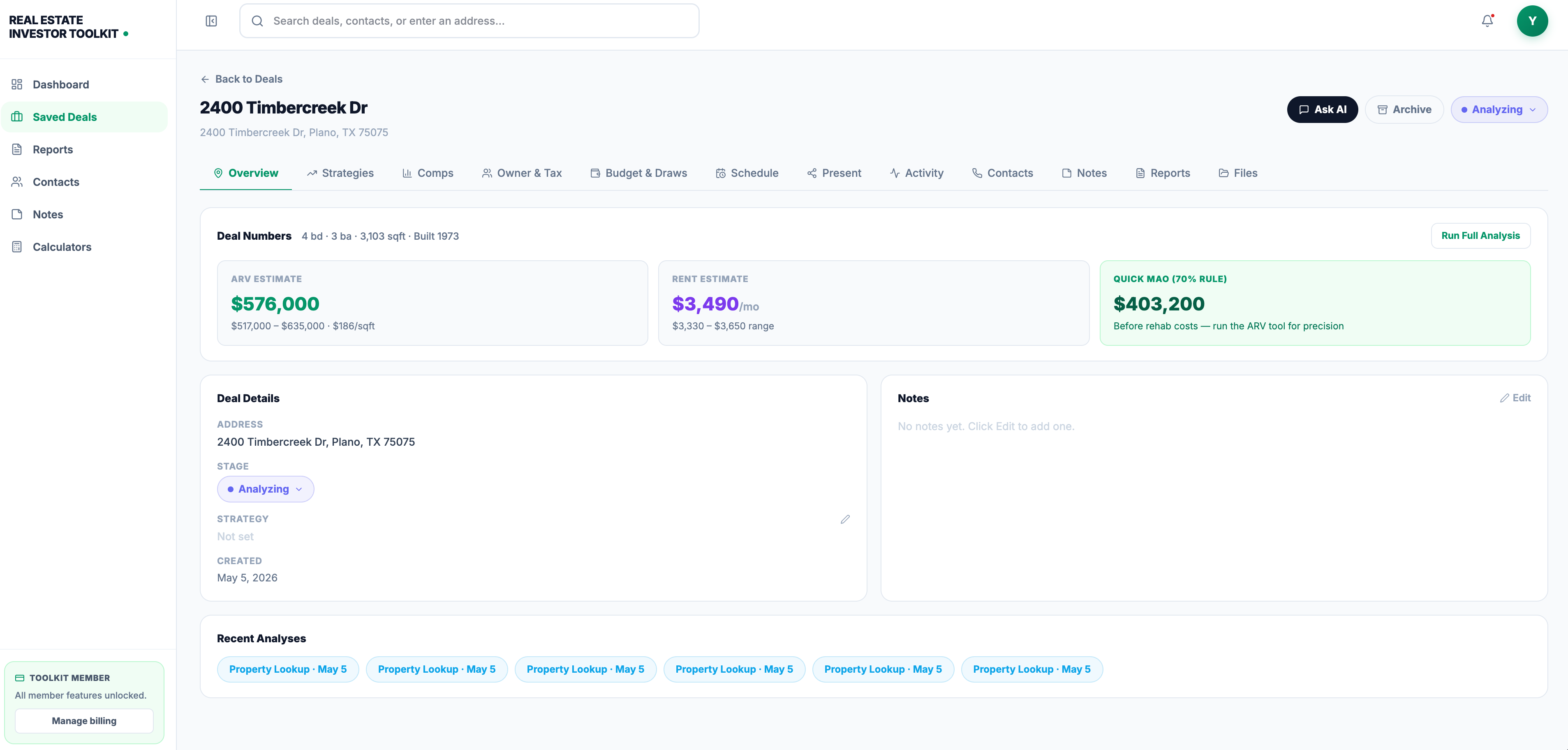
We built the Real Estate Investor Toolkit so that this step sits next to the analysis steps. Paid plans include owner and absentee owner identification, property data reports and saved deal pipelines in one place, so the lead does not leave your workflow before you know whether it pencils out. The free calculators need no sign-up, which means you can test a deal on a lead before you pay for anything.
Whichever route you choose, judge a data source by these questions:
- How often does it refresh each county?
- Does it show the mailing address and the situs address side by side?
- Can you filter by owner type, out-of-state status and ownership length?
- Can you export, or save leads to a pipeline?
- Does it let you trace back to the recorded deed when something looks off?
Verify before you contact anyone
A raw absentee list is a list of suspects, not a list of sellers. Three kinds of errors show up again and again.

Stale ownership. Tax rolls often lag after a transfer. A property sold six months ago may still show the old owner. The fix is to check the deed index at the Recorder or Register of Deeds and match the parcel identifier (APN) to the latest recorded transfer.
Mailing address quirks. A mismatch can come from a tax-escrow servicer, a trust, an LLC’s registered agent or a typo. Those are not the same as an owner living in another city. Look at the owner name: an individual with a distant address is a different lead from a company with a P.O. box.
Undeliverable mail. Before a mailing, standardize addresses so the post office can deliver them. Scout Data suggests using CASS to standardize addresses and DPV to check that USPS can deliver to the exact address point. That is a mailing-house or software step, and it prevents wasted postage.
If you want a structured way to confirm ownership and spot red flags, a property due diligence checklist walks through tracing deed transfers and matching parcel identifiers. Pair that with our guide on reading a property data report, which shows what to look at on each record.
A quick verification routine
- Pull the parcel from the assessor and note the owner, situs address and mailing address.
- Search the recorder’s index by parcel number or owner name and find the most recent deed.
- Confirm the grantee on that deed matches the assessor’s owner. If not, the roll is behind.
- Check the tax collector for delinquency or liens.
- Look at the property itself: a drive-by or a street-level photo shows whether it looks lived in.
- Record what you found in your pipeline, so you never verify the same parcel twice.
Vacant-looking houses make strong overlap leads, and our walkthrough on how to find vacant houses covers that angle. For a broader view of sourcing, see how to find off-market investment properties.
Narrow the list to owners worth contacting
A full absentee list in a mid-size county can run into the thousands. You do not mail all of them. Filter in layers:
- Out-of-state mailing address. Owners farther away often have less attachment and more management friction.
- Length of ownership. Long-held properties tend to carry more equity, which gives you room on price.
- Property condition signals. Code violations, overgrown lots or boarded windows suggest an owner who is not managing the asset.
- Tax status. Delinquent taxes can point to a motivated owner, though they also point to a title problem you need to check. Our piece on preforeclosure lead analysis shows how to confirm county details first.
- Property type and price range. Match your buy box. A fix-and-flip investor and a buy-and-hold landlord want different houses.
Then run numbers on the best twenty or thirty. Use the ARV calculator to estimate after repair value, the rehab cost calculator for the work, and our guide to what MAO means to set a ceiling for your offer. If the numbers do not work at a realistic price, the owner’s status does not matter.
Rules to follow when you reach out
Finding the owner is the easy half. Contacting them lawfully is the other half.
Calls and texts
The Federal Trade Commission’s Telemarketing Sales Rule guidance says telemarketers may not call numbers on the National Do Not Call Registry, and that calling lists must be scrubbed against the registry at least every 31 days. The same page says consumer calls made in response to a direct-mail solicitation are generally exempt, provided the mailing clearly, conspicuously and truthfully makes the required disclosures. That is one reason many investors lead with a letter. If you plan to cold call, talk to an attorney about how the rule and your state’s laws apply to you.

Local absentee-owner ordinances
Some cities regulate absentee owners directly, and the rules affect both your leads and your own properties once you buy. In San Antonio, an absentee owner of a one- or two-family dwelling who lives outside Bexar County must register after a second code violation within 12 months and name a local property manager or agent. Check your city’s code enforcement department for similar registration rules.
Tax bills still reach the owner
Absentee owners remain responsible for their taxes. Sutter County, California tells property owners they must make sure taxes are paid even if no bill arrives, and that they must notify the Assessor’s Office of mailing-address changes. When an owner moves and never updates the address, the mailing address on your list can be wrong, which is another reason to verify.
Our perspective
Most investors we talk to do not have a lead problem. They have a sorting problem. A county file or a purchased list can hand you thousands of absentee names in an afternoon, and then the real work starts: which of these houses can you actually buy at a price that works?
We built the Toolkit around that second question. We think the best order is to pick a tight area, pull the owner and occupancy data, verify the top leads against the deed record, and run ARV, rehab and MAO before you send anything. That order keeps postage and calling time on deals that can pencil.
It is also why we put owner and absentee owner identification, property data reports, saved pipelines and an AI deal advisor into one plan, next to free calculators that need no sign-up. A single workflow means a lead moves from “absentee flag” to “offer number” without a pile of exports and extra subscriptions.
Michael
Try it on a real lead
Start with the free calculators: no sign-up, no card. Take one absentee lead from your list, estimate its value with the ARV tool, price the work and see what you can offer. When you are ready to pull absentee owner data, run property reports and track leads in a pipeline, the Real Estate Investor Toolkit plan is $39.99 per month.
See the free tools or review the plan and pricing. If you are new to evaluating a deal end to end, our guide on how to analyze your first deal is a good place to begin.
Common mistakes to avoid
- Treating every mismatch as a motivated seller. The flag only says the addresses differ.
- Buying a huge list before testing a small one. Mail 100 verified leads, measure responses, then scale.
- Skipping the deed check. A lagging tax roll sends your letter to the previous owner.
- Ignoring your own numbers. A distant owner and a low price still lose money if rehab is underestimated.
- Forgetting follow-up. One letter rarely does it. Plan a sequence and track every touch in one place.
- Overlooking zoning and use limits. Confirm what the property can legally become, using a zoning due diligence checklist.
FAQ
Is it legal to look up who owns a property?
Yes. Assessor and recorder records are public in the United States, though what each county puts online varies. Some counties, such as El Dorado County, do not show owner names with parcel numbers on their web tools, and you may need to inspect the assessment roll or recorded documents instead.
Can I find absentee owners for free?
Often, yes, at the county level. Many assessor and recorder offices let you search parcels, and some publish downloadable data. Pulling a whole area is slower by hand, and some counties charge for custom owner mailing lists, so expect to trade time for money.
What is the difference between an absentee owner and an out-of-state owner?
An absentee owner has a mailing address that differs from the property address, even if it is across town. An out-of-state owner is a subset whose mailing address is in another state. Investors often prioritize out-of-state owners, but the narrower group is not automatically more motivated.
How do I know the owner on my list is current?
Compare the assessor’s owner against the latest deed at the recorder or Register of Deeds, using the parcel number. Tax rolls can lag after a sale, so a mismatch between the two means the deed is the better record.
Should I call or mail absentee owners?
Mail is usually the simpler place to start. The FTC says calls from consumers responding to a compliant direct-mail piece are generally exempt from the Telemarketing Sales Rule. If you do call, scrub your list against the National Do Not Call Registry and confirm state rules with an attorney.
Sources
- How to Find Absentee Owners, Scout Data
- Locating Owners of Vacant and Abandoned Properties, Center for Community Progress
- Real Estate Parcel Information, Camden County, Missouri
- Property Data and Information Requests, El Dorado County
- Frequently Asked Questions, Sutter County Treasurer-Tax Collector
- Complying with the Telemarketing Sales Rule, Federal Trade Commission
- Absentee Owner, City of San Antonio
- 6 Essential Checks for Property Due Diligence