Earnest Money in Wholesaling: How Much, Who Pays, Who Holds It

In a wholesale deal, earnest money is the good-faith deposit you, the wholesaler, put down when the seller signs your purchase contract. It shows you are serious while you find an end buyer. It is not a down payment, it is usually credited toward the price if the deal closes, and whether you get it back depends entirely on the wording of your contract. The rest of this guide covers how much to offer, who should hold it, and how to write terms that keep it safe.
TL;DR
- Earnest money is a good-faith deposit, not a down payment. The National Association of REALTORS® describes it as money held in escrow until closing or until a dispute is resolved.
- Off-market wholesale deposits are often flat amounts of roughly $500 to $5,000, while retail deals through agents commonly use a percentage of the price. Both are market practice, not law.
- Your contract controls the amount, the holder, the deadlines and what happens if closing fails. Name a title company or attorney as the holder.
- Protect the deposit with an inspection or due diligence contingency, an assignment clause, and a written release procedure.
- State rules differ. Some states now regulate wholesaling directly, so check yours before you sign.
Table of Contents
- What earnest money means in a wholesale deal
- How much earnest money wholesalers put down
- Who pays and who holds the deposit
- When you get it back and when you lose it
- Contract terms that protect your deposit
- State rules you should check first
- How to keep the deposit small and the deal solid
- Our perspective
- Check the numbers before you commit a deposit
- FAQ
- Sources
What earnest money means in a wholesale deal
Think of a wholesale deal as reserving ingredients for a meal someone else will eat. You tie up the property with a contract, then hand it to a buyer who closes. Earnest money is the small deposit that makes the seller take your reservation seriously.
The NAR consumer guide defines it as a good-faith deposit that shows genuine intent to close, held in escrow rather than paid to the seller outright. It is separate from a down payment. In a wholesale deal, the wholesaler typically provides the deposit when signing the seller contract, and it is generally credited toward the purchase price if the deal closes.
One point trips up new wholesalers: a deposit is not always legally required. In Florida, for example, the Florida Realtors preparation manual for the standard residential contract notes that a deposit is not required to make a binding sale and purchase contract. If you do agree to one, the parties can decide who holds it, and the deadlines in the contract still bind you.
How much earnest money wholesalers put down
There is no national standard. Here is what the published guidance shows.
| Deal type | Typical deposit | What drives it |
|---|---|---|
| Off-market wholesale contract | Flat amount, often about $500 to $5,000 | Negotiation, seller motivation, local market |
| Retail purchase through an agent | Commonly 1% to 3% of price | Agent and market custom |
| Competitive residential market | Commonly 1% to 10% per NAR | Competition, contingencies, seller preference |
The flat-amount range comes from a September 2026 wholesaling guide, which also reports the 1% to 3% retail figure and stresses these are market practices. The broader 1% to 10% range comes from the NAR guide, which adds that the amount depends on how competitive the market is, the down payment, contingencies and what the seller prefers.
What decides your number
- Seller motivation. A seller facing a deadline often accepts a small deposit if your closing timeline is credible.
- Your closing window. A longer inspection period asks the seller to wait, so a larger deposit can balance that.
- Property price. A flat $1,000 on a $120,000 house reads differently than on a $450,000 one.
- Your buyer list. The stronger your list, the less risk the deposit carries, which is why many wholesalers line up buyers before they commit money.
A quick worked example
Suppose the after repair value is $240,000, rehab is $40,000, and you apply the common 70% rule. Your maximum allowable offer is $240,000 × 0.70 − $40,000 = $128,000, before your fee. If your assignment fee target is $10,000, your contract price should land at or below $118,000. A $2,000 deposit is under 2% of that price, and it is only at risk if you cannot find a buyer inside your contingency window. Run your own numbers with our wholesale offer formula guide and the MAO explainer.

Who pays and who holds the deposit
The wholesaler usually puts down the original deposit under the contract with the seller. When you assign the contract, the end buyer typically steps in. An Illinois law firm notes that the assignment documents should say whether the deposit is released to the wholesaler or credited to the end buyer at closing.
That leaves two common setups:
- The buyer reimburses you. The buyer pays you back the deposit at assignment, then the original deposit stays in escrow and is credited at closing.
- The buyer funds a new deposit. The buyer deposits money with the title company or attorney, and your original deposit is refunded or applied according to the assignment.
Either way, write it down in both documents. Our guide on avoiding double payment when assigning contracts walks through the mechanics.
Pick a neutral holder
The North Carolina Real Estate Commission explains that buyers often prefer agents or attorneys to hold deposits because they must place the money in a trust or escrow account. For wholesalers, the practical version is simple: use a title company or real estate attorney as the escrow holder. Never hand cash to the seller or keep it in your own account.
When you get it back and when you lose it
The NAR guide says a buyer may get the deposit back if the seller ends the sale or a contingency in the contract cannot be resolved. The seller may keep it if the buyer waives contingencies, misses deadlines or abandons the deal.
For wholesalers, the risk is clear. Forbes Advisor notes that a wholesaler may lose the deposit if unable to find another buyer, depending on the contract. The North Carolina Real Estate Commission adds that the contract, not a universal rule, decides what happens to the deposit when closing fails, and that missing a required payment can itself be a breach.

Do you lose earnest money during due diligence?
Often not, if you cancel inside the window and follow the contract’s notice rules. After the window closes, the deposit is typically at risk. That is why the length of your due diligence period matters as much as the deposit amount.
Contract terms that protect your deposit
Guidance from deposit specialists boils down to precise language, a named holder, tracked contingency deadlines and an agreed release procedure. Apply that to a wholesale contract:
- Name the holder. Title company or attorney, with the business name in the contract.
- Set a due diligence period. Give yourself enough days to market the deal, and state that you can cancel for any reason inside it with a full refund.
- Add an assignment clause. The contract must allow assignment or a designee, so you can transfer your position.
- Write the deposit deadline. Missing it can be a breach, so put the date on your calendar.
- Define the release. State who must sign for funds to move and what happens in a dispute.
- Mirror it in the assignment. Spell out reimbursement, credit and release.
When a deal does fall through, it helps to know where else the property could go. A nationwide off-market buyer network is one place investors look for off-market properties and buyers, and the sooner you ask, the more of your due diligence period remains.
State rules you should check first
Wholesaling is regulated differently from state to state, and the rules can reach your deposit directly.
- Iowa: a person must be a licensed broker or represented by one to wholesale. If disclosure requirements are missed, the seller or buyer may cancel before closing without penalty and keep any earnest money the wholesaler paid.
- Oklahoma: effective November 1, 2025, wholesalers must give written disclosure of intent to resell and deposit earnest money in an Oklahoma FDIC-insured bank.
- Florida: a deposit is optional for a binding contract, and the parties choose who holds it, per the Florida Realtors manual cited above.
If you wholesale in Florida or the Dallas–Fort Worth area, confirm current licensing and disclosure rules with your state real estate commission or a local real estate attorney before you sign. Rules change, and an attorney can review your contract template once and save you from repeating a mistake.
How to keep the deposit small and the deal solid
The safest deposit is one you only risk after the numbers work. Before you sign:
- Pull comps and confirm your ARV. In states where sale prices are not public, our guide to pulling comps in non-disclosure states helps you avoid fooling yourself.
- Estimate repairs with a rehab cost estimate.
- Compute your offer with the ARV vs MAO breakdown so your spread survives a buyer’s negotiation.
- Contact buyers before you put money down, even if only to gauge interest in the price range.
New to deal analysis? Start with how to analyze your first deal.
Our perspective
Most lost deposits we hear about trace back to the same cause: the deposit went down before the numbers were checked. A wholesaler guessed the ARV, guessed the repairs, signed, and then found that buyers would not pay the assignment price.
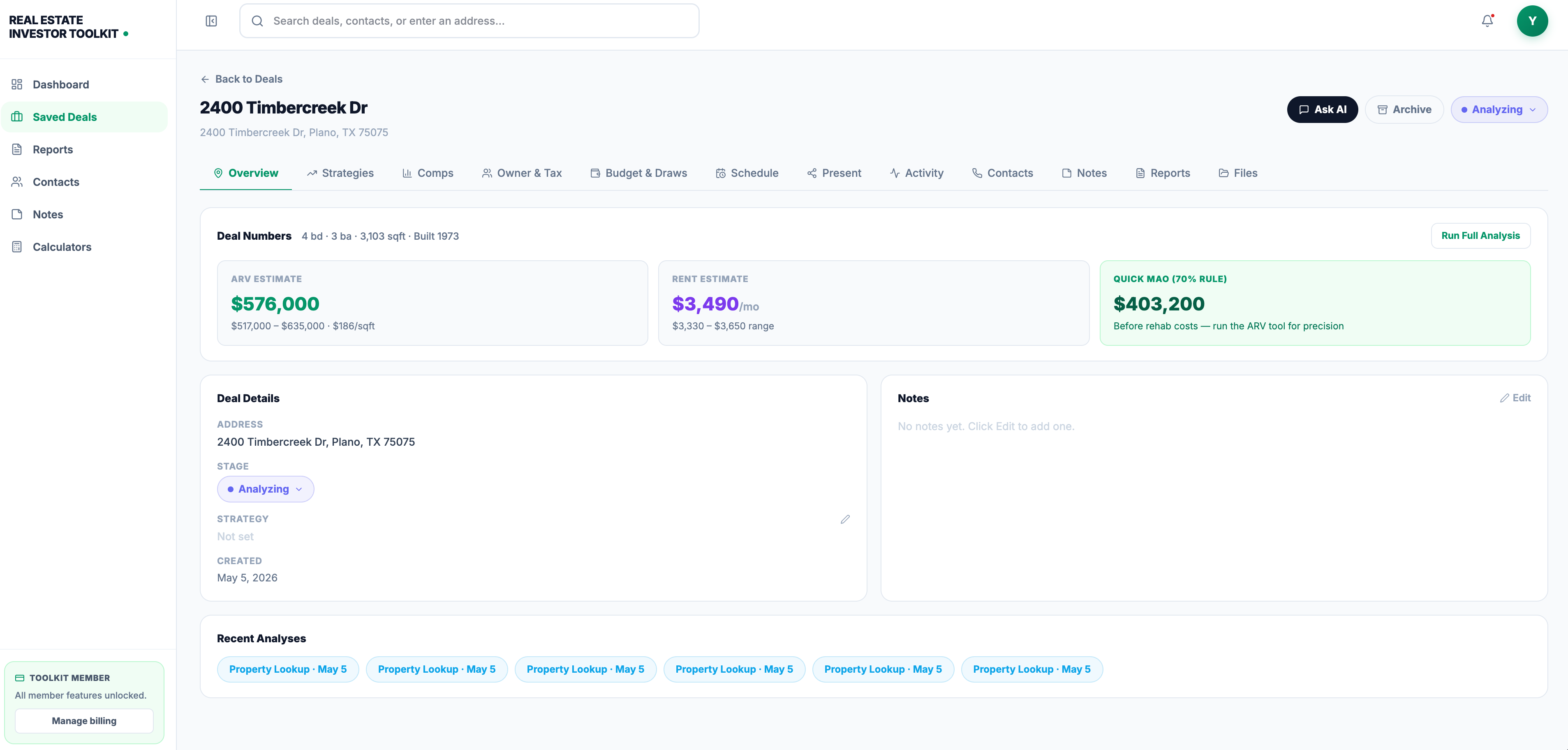
That is why we built the free calculators to work without a sign-up. You can run an ARV, a rehab estimate and a maximum allowable offer in a few minutes, before you commit a dollar of earnest money. When you are ready to go deeper, the paid plan adds unlimited reports, saved deal pipelines and owner data, so your deposits go into deals you have already stress-tested.
Treat the deposit as the last step of your analysis, not the first step of your hope.
Michael
Check the numbers before you commit a deposit
Our free tools let you test a deal in minutes with no account. Start with the ARV calculator and the rehab cost calculator, or see everything on the free tools page. If you want unlimited reports, saved pipelines and AI deal insights, the full toolkit is $39.99 per month on the pricing page.
FAQ
Should a wholesaler give earnest money at all?
Many wholesalers keep it small or negotiate a nominal amount, and some sellers accept one. A deposit is not always required for a binding contract, as the Florida guidance shows. A modest deposit with a solid due diligence period is a common way to look serious without carrying much risk.
Who pays the wholesaler in real estate?
The end buyer pays the wholesaler’s assignment fee at closing, usually through the title company or attorney. The fee is the gap between your contract price and what the buyer pays. Your assignment agreement should state the amount.
What is the 70% rule in wholesaling?
It is a rule of thumb: your maximum offer is about 70% of the after repair value minus repair costs. Wholesalers then subtract their fee. Our wholesale offer formula guide shows the steps.
Can the end buyer replace my earnest money?
Yes, commonly. The buyer either reimburses you or funds a new deposit with the title company. The documents should say whether your deposit is released to you or credited to the buyer at closing.
Sources
- NAR Consumer Guide: Escrow and Earnest Money
- North Carolina Real Estate Commission: Earnest Money Deposits
- Florida Realtors CRSP-15 Preparation Manual
- Iowa Code 543B.6A
- Oklahoma Real Estate Commission: Wholesaling Resource
- Forbes Advisor: Wholesale Real Estate
- Wholesale Real Estate Contracts in Illinois
- Earnest Money Deposit Wholesaling: How Much EMD
- What is Earnest Money in Wholesaling?
- How to hold and release a deposit in a transaction