Deal Triage Process: How to Screen Real Estate Leads Fast

A deal triage process is a short, staged screen that sorts every lead into pass, pause or pursue before you spend hours on it. You collect a few facts, run rough numbers on ARV (after-repair value), rehab and your maximum offer, and write down what you could not verify. Our free calculators run those numbers without a sign-up, so a lead can be screened in minutes instead of an evening.
TL;DR
- Triage decides whether a deal deserves more time. It does not decide whether to buy.
- Work in five stages: basic facts, comps and ARV, rehab, offer or cash flow, then a pass, pause or pursue call.
- Keep estimates separate from confirmed numbers, and write down the source and date of every comp.
- Set stop conditions before you start, so a weak lead ends early.
- Wholesalers, flippers and landlords use the same stages with different final math.
Table of Contents
- What deal triage means for an investor
- The five-stage deal triage process
- Flag the unknowns that can kill a deal later
- Common triage mistakes
- Build a repeatable routine
- Where our toolkit fits
- Our perspective
- FAQ
- Sources
What deal triage means for an investor
The word comes from medicine, where triage sorts patients by urgency. In real estate the idea is the same, but the thing you are sorting is your own time. Most leads are not worth a full underwriting. Triage finds the few that are.
One published guide describes deal review as staged decisions rather than a single yes or no calculation: gather basic facts first, verify value and condition step by step, and only then decide whether the evidence supports your strategy. A separate first-pass screening method from an investment firm says the point of a quick screen is to decide whether a deal merits more time, not to make the final investment decision.
That framing protects first-time investors in particular. The costly mistakes tend to come from falling in love with a lead before the numbers are tested: overpaying because the ARV was optimistic, or under-budgeting rehab because nobody walked the house. A triage routine puts the cheap checks first.
One published wholesaling guide estimates that its desktop-analysis stage filters out roughly 80 to 85% of leads as not hot, leaving 15 to 20% for comps packages and appointments. Treat that as one operator’s estimate, not a benchmark for your market. The lesson holds: most leads should end early.
The five-stage deal triage process

The stages below run from cheapest to most expensive. Stop at the first stage that fails.
Stage 1: Capture the basics and set your stop conditions
Before any math, record what you know. A deal review guide lists the essentials: address and property type, seller context and timing, access and observed condition, asking price and terms, comparable-sale evidence, a plausible exit, and unresolved items such as title, permits, utilities, insurance and taxes.
The same guide asks five questions of an initial screen: is the opportunity specific, can you assess it, does it fit a plausible strategy, is there a testable reason to look further, and can you name the stop conditions? Stop conditions are the facts that end the deal. Write them down now, for example:
- The ARV cannot be supported by at least a few recent sales nearby.
- The asking price is above your maximum offer by more than the seller will move.
- The property cannot be accessed or inspected within your timeline.
- A title, zoning or permit problem you cannot price.
Writing stop conditions first stops you from moving the goalposts when a deal looks exciting.
Stage 2: Verify comps and estimate ARV
ARV is what the property should sell for after the planned repairs. Think of it as the price of the finished meal: the house you buy is the ingredients, and the repaired house is what you serve.
Every number downstream depends on it, so this stage deserves the most care. The practice recommended in the research is simple: revisit recent comparable sales, compare like with like, explain your adjustments instead of picking only the highest sale, and keep the source and date for each comp. Note differences in location, size, layout, condition and sale timing.
A workable first pass:
- Pull recent sold properties close to the subject, similar in size, bed and bath count, and age.
- Discard comps that sold in a different condition tier than your finished product. A fully renovated sale only supports a renovated ARV.
- Adjust for real differences, such as an extra bedroom or a larger lot, and write the reason beside each adjustment.
- Choose a range, then underwrite at the conservative end.
Our ARV calculator is built for this step. It works from verified comps and market data, and the free tools need no sign-up. If you are a wholesaler in Dallas-Fort Worth, where you are often handing a buyer an ARV they will test themselves, a documented comp set is what makes your number credible.
Stage 3: Estimate rehab and add a contingency
The second most common error after an inflated ARV is a thin rehab budget. In triage you cannot get contractor bids on every lead, so build a rough scope instead: roof, HVAC, kitchen, baths, flooring, paint, exterior and any visible structural or water signs. Price each line, then add a contingency line for what you will find behind the walls.
Keep estimates separate from confirmed costs. The deal review guide makes the same point: label a number as an estimate until a bid or an invoice confirms it, and pass or pause if the assumptions cannot be supported.
Our rehab cost calculator turns a scope into a budget in one pass, and the rehab cost guide walks through how to build the scope line by line. Seasoned flippers can use the calculator as a consistency check: the same scope should produce the same logic on every deal, which makes your pass rate comparable from one lead to the next.
Stage 4: Run the offer or cash flow math
This is where your strategy decides the formula.
Wholesalers and flippers: maximum allowable offer. MAO is the highest price you can pay and still hit your profit target. Many investors start from a percentage of ARV, subtract rehab, and, for wholesalers, subtract the assignment fee. Our MAO guide explains the formula, and the wholesale offer formula shows where the assignment fee fits. If you want to know which inputs move the offer and which only measure value, read ARV vs MAO.
A worked example, using made-up numbers:
| Input | Amount |
|---|---|
| Conservative ARV | $240,000 |
| Percentage of ARV applied | 70% |
| ARV x 70% | $168,000 |
| Rehab, contingency included | $35,000 |
| MAO before any assignment fee | $133,000 |
| Seller asking price | $150,000 |
The asking price is $17,000 above the MAO. That is a pause or a pass unless the seller has room to move or your rehab estimate is too high. You learned that in a few minutes, before any phone call with a contractor.
Landlords: cash flow. The sequence is gross rent, minus vacancy to get effective gross income, minus operating expenses to get net operating income (NOI), minus debt service to get cash flow. The same guide notes that management, maintenance and capital reserves still matter to your cash flow even when a lender’s debt service coverage test leaves them out. Do not skip them in triage.
An illustration with made-up numbers:
| Line | Monthly |
|---|---|
| Gross rent | $1,800 |
| Vacancy allowance (5%) | $90 |
| Effective gross income | $1,710 |
| Operating expenses, including reserves | $600 |
| NOI | $1,110 |
| Mortgage payment | $900 |
| Cash flow | $210 |
The rental property calculator returns cash flow, cap rate and return on one screen, and the rental analysis guide explains how to read them. To test the financing side, use the investment property financing calculator. If you plan to refinance after a rehab, add the BRRRR calculator and read about refinance risk before you commit.
For larger rental properties, a quick screen can also divide NOI by the prevailing cap rate for comparable properties. A first-pass screening method treats an indicated value at or above the asking price as a reason to keep underwriting, and a materially lower value as grounds to screen the deal out.
Stage 5: Decide pass, pause or pursue
End every triage with one of three labels and a one-line reason:
- Pass: a stop condition was hit, or the numbers fail by a wide margin.
- Pause: the numbers could work, but a key assumption is unverified, or the price is just above your MAO. Set a follow-up date.
- Pursue: the numbers work at conservative inputs. Order bids, an inspection and a title review.
The pause label matters. Sellers change their minds, and a documented pause lets you re-run the lead in minutes when the price drops.
Flag the unknowns that can kill a deal later
A good triage does not pretend to settle everything. It lists what is still open. Title, permits, zoning, insurance and taxes are the usual items.
If you buy in Florida, a title search is an early flag, because liens or ownership problems can change what you are able to buy. This Florida title search overview explains what a search covers and why it matters at closing. For zoning questions that affect your plan, such as an extra unit or a change of use, our zoning due diligence checklist lists the items to confirm.
Insurance belongs in the rental screen too, because premiums feed directly into the expense line. This guide to landlord insurance coverage maps the parts of a policy so you can budget it realistically before you rely on an NOI figure.
Local conditions matter as well. If you work in Dallas-Fort Worth or Florida, remember that national averages hide local differences. A federal report on single-family rental ownership examined Dallas-Fort Worth and Jacksonville among six metro areas, using county assessor and Census Bureau data. Use sources like those, and your own sold data, to check what is happening in your submarket instead of relying on a headline number.
Common triage mistakes
- Using the highest comp. Pick the comps that match the finished condition, and explain your adjustments.
- Treating a seller’s or broker’s numbers as facts. Underwriting guidance stresses verifying actual operations first and writing down the evidence behind each assumption.
- Skipping the contingency. A rehab number with no buffer is an optimistic number.
- Letting a good story replace the math. If you wrote stop conditions, enforce them.
- Treating triage as the final answer. It earns a deal more time. Full underwriting still follows.
If this is your first deal, how to analyze your first deal takes the pursue stage step by step.
Build a repeatable routine
Speed comes from using the same inputs every time. A simple routine:
- Keep one template with the basics, stop conditions and the three labels.
- Run ARV, rehab and MAO or cash flow in that order.
- Save the comps and the date you pulled them.
- Log the result, including passes, so you can see which lead sources produce deals.
That log is where a paid workflow earns its keep. Rows in a spreadsheet get stale. A saved pipeline does not.
Where our toolkit fits
The free calculators cover each stage above: ARV, rehab, MAO, rental cash flow, financing and BRRRR modeling, with no sign-up. When you are screening more than a few leads a week, the paid plan adds unlimited reports, saved deal pipelines, advanced property data, owner and absentee owner details and an AI assistant for deal insights, in one subscription that replaces several separate tools. The Real Estate Investor Toolkit plan is $39.99 per month.
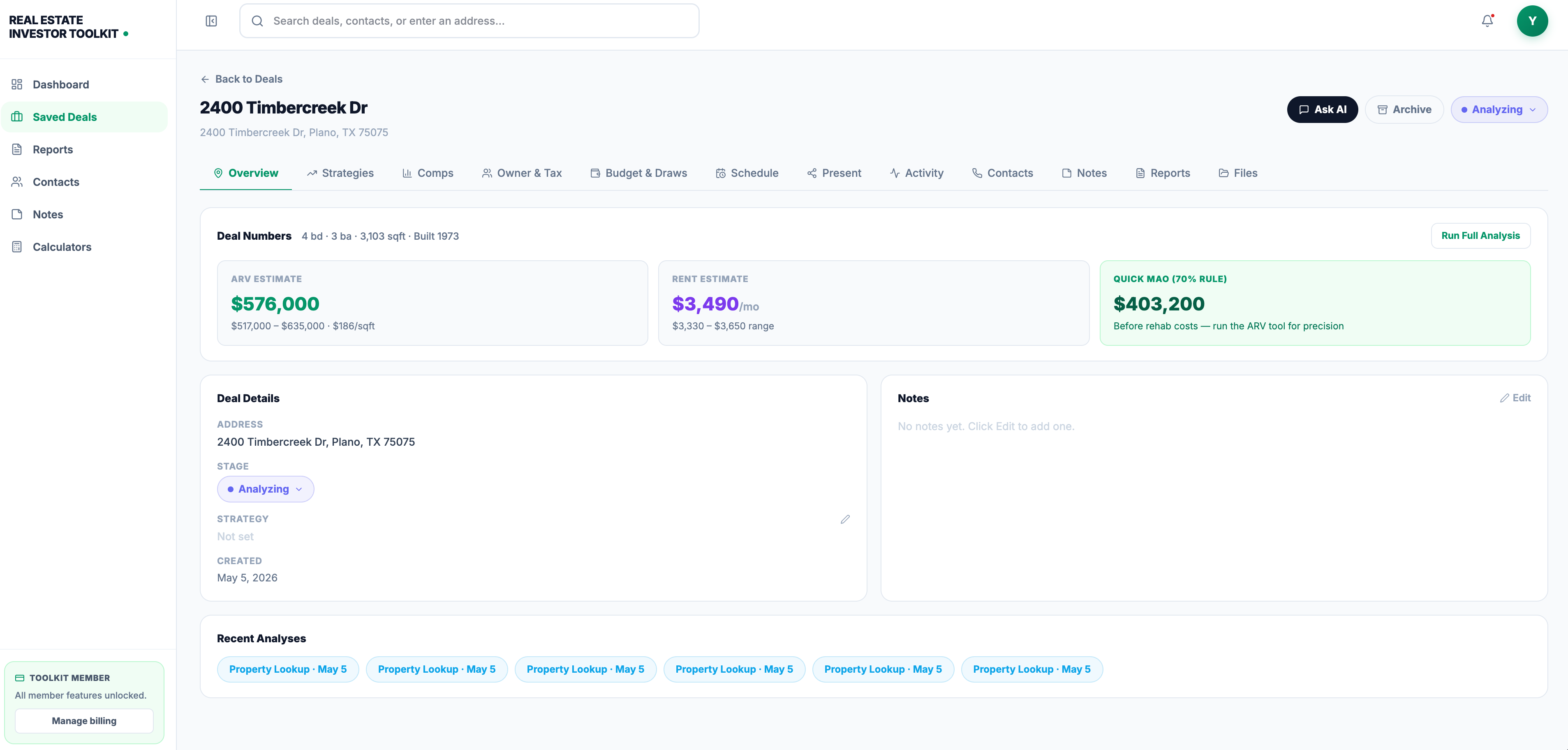
Start with the free tools on your next lead, then move to the plan when your pipeline outgrows one-off analyses. The DealFlow platform is where saved deals live.
Our perspective
Triage is a discipline of order. The cheapest facts come first, the expensive ones come last, and every number carries a source and a date.
We built our calculators around that order. ARV comes before rehab, rehab comes before the offer, and the offer comes before any phone call to a seller. When the same inputs go into every deal, a pass is not a mood, it is a result you can compare next week.
The investors who avoid costly mistakes are rarely the ones with the cleverest formula. They are the ones who can open a lead, get a defensible ARV, a rehab range and an offer ceiling in minutes, and walk away when the numbers say so. One place for all of it, with no sign-up to start, is how we think that should work.
Michael
FAQ
What does a deal triage process mean?
It is a quick, staged review that decides whether a lead deserves more time. You gather basic facts, test value and costs roughly, and label the deal pass, pause or pursue. It is not the final investment decision.
How long should deal triage take?
A first screen can take minutes when your inputs are ready. A five-minute screening method for income property is built around that idea. Comps and rehab take longer on distressed or unusual properties, so give the extra stages extra time only for leads that pass the first.
What should I check first on a new lead?
Check the basics and your stop conditions: address, property type, condition, asking price and terms, the seller’s timing and whether you can access the home. Then pull comps. If you cannot support an ARV, the lead stops there.
Is the process different for wholesalers, flippers and landlords?
The stages are the same. Wholesalers end on MAO with an assignment fee, flippers on MAO with their own profit target, and landlords on cash flow, cap rate and return. Our calculators map to each of those endings.
Sources
- Real Estate Deal Review Process: From Lead to Decision
- How We Screen a Real Estate Investment in 5 Minutes or Less
- Analyzing Deals
- Proforma for Rental Property: What Sellers Leave Out
- Deal analysis, start to finish
- GAO-26-108675, Rental Housing: Institutional Investor report