Deal Pipeline Management for Real Estate Investors

Effective deal pipeline management means treating your pipeline as an execution system, not a storage list. Each stage maps to a verifiable buyer or seller action, and a deal only advances when that action is documented. High-performing investors define stages by customer milestones and enforce entry/exit criteria so stage movement predicts outcomes rather than just reflecting rep optimism. Tools like Realestateinvestortoolkit support this with saved pipelines, ARV and rehab calculators, and AI deal insights built around the BRRRR method and other investment motions. Gartner research confirms that organizations prioritizing pipeline quality are roughly twice as likely to exceed acquisition expectations.
Core elements of a well-run pipeline:
- Strategy-specific pipelines for each investment motion (wholesale, fix-and-flip, BRRRR)
- 3–7 stages per pipeline, each tied to a measurable exit criterion
- Buyer-action stage gates that require documented proof before advancing
- Enforced hygiene with weekly reviews and stale-deal alerts
- Stage-to-stage conversion tracking to locate bottlenecks and forecast accurately
Table of Contents
- Why does your pipeline architecture need to match your strategy?
- What do the right pipeline stages look like for each strategy?
- Which KPIs should you track to forecast deals accurately?
- What should you automate and what should stay human?
- How do you set up and run your pipeline day to day?
- What mistakes kill pipeline accuracy and how do you fix them?
- Ready-to-copy pipeline templates and sample timelines
- Key Takeaways
- Why the pipeline-as-execution-system idea actually matters
- Realestateinvestortoolkit puts your pipeline to work
- Useful sources
Why does your pipeline architecture need to match your strategy?
Mixing wholesaling and buy-and-hold deals in one pipeline destroys your metrics. Separate pipelines by investment motion because each requires different stages, conversion benchmarks, and financing criteria. A wholesale deal might close within a few weeks; a BRRRR deal typically runs several months through rehab, lease-up, and refinance. Blending them produces meaningless average cycle times and unreliable win rates.
Three distinct motions deserve their own workspace:
- Wholesale (rapid-turn): Short cycle, disposition-focused, key KPIs are assignment fee per deal and days-to-contract.
- Fix-and-flip (mid-cycle): Rehab scope drives timeline; track rehab cost variance, ARV delta, and holding-cost burn.
- BRRRR/buy-and-hold (long-cycle): Refinance readiness and stabilized cash flow are the terminal gates; track loan-to-value at refi and cash-on-cash return.
Use one workspace per motion and a shared reporting layer for portfolio-level views. Pipeline structure is the single most consequential architectural decision you make, and conflating motions produces theatrical stage movement rather than reality.
Pro Tip: Split an existing pipeline when you see more than 25% variance in average cycle time between deal types, or a greater than 20-point difference in win rate. Either signal means your metrics are averaging out two different businesses.
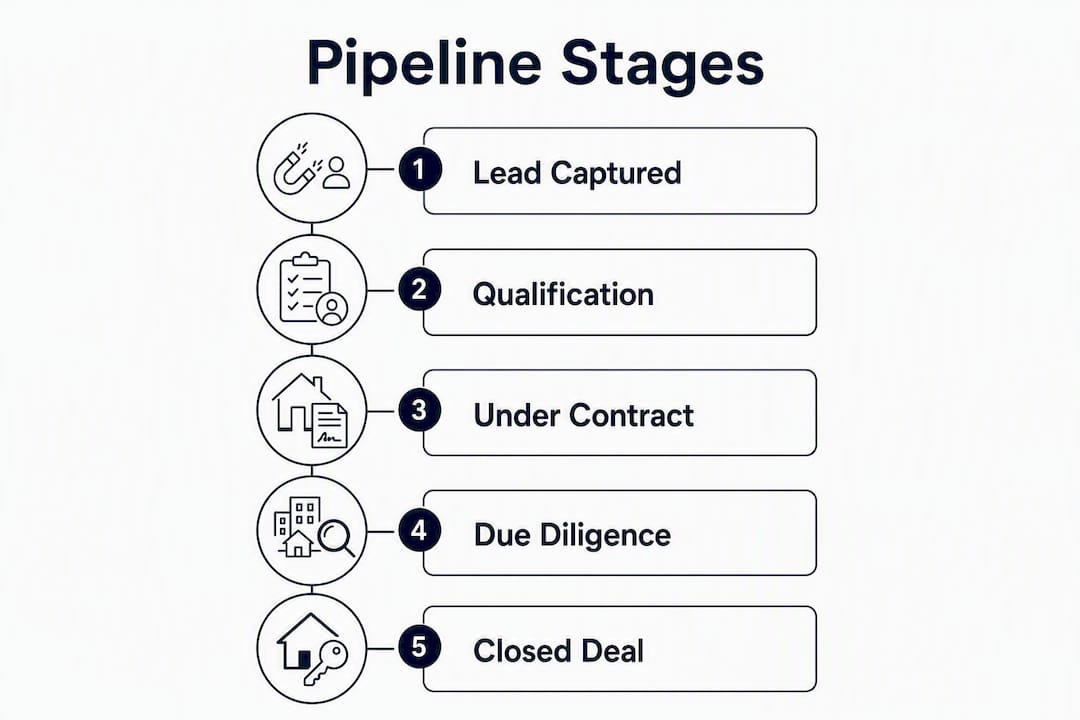
What do the right pipeline stages look like for each strategy?
Limit each pipeline to a handful of stages and attach a verifiable exit criterion to every one. Fewer than three stages fails to capture real progression; more than seven creates rigidity that doesn’t match deal fluidity. Each stage must represent an observable buyer action or a verified event, not a rep’s internal assessment.

Wholesale pipeline template
| Stage | Entry Criterion | Rep Action | Exit Criterion | Probability | Typical Days |
|---|---|---|---|---|---|
| Lead Captured | Seller inquiry received | Qualify motivation and timeline | Seller confirms distress or urgency | 10% | 1–2 |
| Qualified | Motivation confirmed | Run ARV and MAO | MAO calculated, seller in range | 25% | 2–5 |
| Under Contract | LOI accepted | Order title search | Signed purchase agreement | — | 3–7 |
| Buyer Marketing | Contract executed | Send to buyer list | Proof of funds received | — | 5–10 |
| Closed | Buyer committed | Coordinate closing | Assignment fee collected | — | 1–3 |
BRRRR / fix-and-flip pipeline template
| Stage | Entry Criterion | Rep Action | Exit Criterion | Probability | Typical Days |
|---|---|---|---|---|---|
| Lead Captured | Property identified | Verify ownership and motivation | Seller contact confirmed | 10% | 1–3 |
| Qualified | ARV range established | Pull comps, estimate rehab | Rehab estimate finalized | 20% | 3–7 |
| Under Contract | Offer accepted | Complete due diligence | Title search clear, inspection done | — | 7–14 |
| Rehab Active | Purchase closed | Manage contractor | Certificate of occupancy issued | — | — |
| Lease/Stabilize | Rehab complete | Market and screen tenants | Lease signed | — | 14–27 |
| Refinance Ready | Lease active | Order appraisal | Proof of appraised value at target LTV | — | 14–27 |
| Closed/Refi | Appraisal confirmed | Execute refinance | Cash-out proceeds received | — | 14–27 |
Customize stage names and probability weights to your local market. If your actual win rate from Qualified to Closed is 35%, set your probabilities accordingly rather than using generic defaults. Consistently track win rates from Qualified onward for each pipeline motion.
Which KPIs should you track to forecast deals accurately?
A short, focused set of metrics beats a sprawling dashboard. Track these:
- Stage-to-stage conversion rate: Percentage of deals advancing from one stage to the next.
- Time-in-stage: Average days a deal spends at each stage; spikes reveal bottlenecks.
- Pipeline velocity: (Number of deals × average deal value × win rate) ÷ average cycle length.
- Probability-weighted pipeline value: Sum of (deal value × stage probability) across all active deals.
- Pipeline coverage ratio: Target 1 ÷ win rate, with a buffer. A 25% win rate means you need 4× your revenue target in qualified pipeline.
Statistic callout: Track recent conversion rates. A low Discovery-to-Qualified conversion signals a qualification problem rather than a sourcing issue. Fix the gate before adding more leads.
For deal scoring, combine objective inputs into a numeric priority score: ARV delta (difference between your ARV and the asking price), rehab estimate confidence (high/medium/low), title risk flags, and source quality (referral vs. cold list). Deals with a high ARV delta, confirmed rehab scope, and clean title move to the top of your working list. Use the ARV calculator to anchor your ARV delta calculation with verified comps before assigning a score.
Exclude deals from your forecast when no buyer action has occurred in the last 14 days or when the close date has drifted more than twice.
What should you automate and what should stay human?
Automate the routine; keep judgment human. Consistent execution improves when activity capture is automated and cadences live inside the rep’s workflow.
Automate these tasks:
- Task creation triggered on stage entry (e.g., “Order title search” fires when a deal enters Under Contract)
- Auto-tagging by deal type (wholesale, flip, BRRRR) on import
- Stale-deal alerts when no buyer action is logged in 14 days
- Scheduled follow-up reminders at defined intervals
- ARV and comps data pulled from property-data integrations
Keep these decisions human:
- Final offer approval and MAO sign-off
- Proposal wording and seller communication tone
- Closing decisions and assignment fee negotiations
Tool features to require when evaluating deal tracking software:
- Required-field validation before stage advance
- Saved pipelines per investment motion
- Custom deal scoring fields
- Bulk stage-change protections (prevent mass moves without review)
- Activity logging with timestamps
- Property-data and comps integrations
- AI deal insights for scoring and risk flags
Pro Tip: Use automated “stage-lock” validations that require a proof-of-action file or timestamped confirmation before any deal advances. This one rule eliminates most pipeline hygiene problems.
How do you set up and run your pipeline day to day?
Implementation checklist
- Map your active investment motions (wholesale, flip, BRRRR).
- Build stage templates for each motion using the tables above.
- Create required-field validation rules for each stage gate.
- Import active deals into the correct pipeline with accurate current stages.
- Set up deal scoring fields (ARV delta, rehab confidence, source quality).
- Configure dashboards: one per motion plus a portfolio rollup.
Roles and ownership
- Sourcing: Owns lead capture and initial qualification.
- Disposition: Owns buyer marketing and assignment in wholesale; contractor management in flip/BRRRR.
- Pipeline hygiene: One person runs the weekly review (10–20 minutes per pipeline).
- Monthly review: Owner or team lead runs stage-conversion analysis and adjusts probability weights.
Daily and weekly cadence
- Daily: Work from a “what to act on today” view filtered by stage age and priority score.
- Weekly hygiene: Review deals with no activity in 14 days, mismatched close dates, and missing exit criteria. A shared definition of “qualified” in your CRM, reviewed weekly, produces a predictable pipeline and enables accurate stage-to-stage conversion tracking.
- Monthly: Calculate rolling 90-day conversion rates per stage, identify the weakest conversion, and address it before adding volume.
What mistakes kill pipeline accuracy and how do you fix them?
Most pipeline problems trace back to a handful of repeatable errors:
- Mixing strategies in one pipeline: Averages out metrics that should be separate. Fix: create one pipeline per motion.
- Too many stages: More than seven stages creates confusion and false precision. Fix: consolidate to 3–7 meaningful stages with real exit criteria.
- Missing buyer-action gates: Deals advance on rep optimism, not evidence. Fix: require a documented buyer action (signed LOI, proof of funds, lease) before any stage move.
- Not tracking stage-to-stage conversion: You can’t fix what you don’t measure. Fix: calculate conversion rates over a rolling 90-day window and review monthly.
- Ignoring stage age: Old deals inflate your pipeline value. Fix: flag any deal with no activity in 14 days and either re-engage or remove it.
Recalculate your pipeline coverage ratio using your actual win rate after applying these fixes. If your win rate is 20%, you need five times your target in qualified pipeline, not two or three times.
Pro Tip: After one month of applying fixes, freeze your stage definitions for a full quarter. Measure whether conversion rates improve before you tune again. Constant stage changes make it impossible to compare periods.
Ready-to-copy pipeline templates and sample timelines
Wholesale pipeline: sample timeline
| Stage | Average Days | Key Deliverable |
|---|---|---|
| Lead Captured | 1–2 | Seller motivation confirmed |
| Qualified | 2–5 | MAO calculated, ARV verified |
| Under Contract | 3–7 | Signed purchase agreement |
| Buyer Marketing | 5–10 | Proof of funds received |
| Closed | 1–3 | Assignment fee collected |
Total typical cycle: 12–27 days. Deals that stall in Buyer Marketing beyond 10 days usually signal a pricing or buyer-list problem, not a title issue.
BRRRR pipeline: sample timeline
| Stage | Average Days | Key Deliverable |
|---|---|---|
| Lead Captured | 1–3 | Ownership and motivation verified |
| Qualified | 3–7 | Rehab estimate finalized, ARV confirmed |
| Under Contract | 7–14 | Title clear, inspection complete |
| Rehab Active | — | Certificate of occupancy |
| Lease/Stabilize | 14–27 | Lease signed |
| Refinance Ready | 14–27 | Appraisal at target LTV |
| Closed/Refi | 14–27 | Cash-out proceeds received |
Total typical cycle: 83–186 days. Use the BRRRR calculator to model refinance timing and confirm your target LTV before the deal enters Rehab Active. For BRRRR-specific refinance risk, the BRRRR refinance risk guide covers the contingency checks worth building into your stage gate.
Suggested required fields per deal record
- Property address and APN
- ARV (verified with comps date)
- Rehab estimate (low/mid/high with confidence rating)
- Source (referral, direct mail, MLS, driving for dollars)
- Assigned pipeline and current stage
- Next action and due date
- Close date (updated at each stage)
Adapting templates to your market
- In fast-moving markets, compress Buyer Marketing to 3–5 days and tighten your buyer-list pre-qualification.
- In non-disclosure states, add a comps-verification step at Qualified and document your source. The non-disclosure state comps guide explains how to pull reliable ARV inputs without MLS access.
- For heavy rehabs, split Rehab Active into two sub-stages (Demo/Rough-In and Finish Work) to catch cost overruns earlier. The rehab scope guide breaks down how scope changes the deal math.
- Adjust probability weights after 90 days of real data. Monitor your market’s actual stage-to-stage conversion rates; adjust probability weights after 90 days of real data for accuracy.
Key Takeaways
A strategy-specific pipeline with enforced buyer-action gates and rolling conversion tracking is the single most reliable path to accurate forecasting and faster deal cycles.
| Point | Details |
|---|---|
| Split pipelines by strategy | Wholesale, fix-and-flip, and BRRRR each need separate stages, KPIs, and probability weights. |
| Enforce buyer-action gates | Require documented proof (signed LOI, proof of funds, lease) before any deal advances a stage. |
| Track rolling conversion rates | Calculate stage-to-stage conversion over 90 days; if the Discovery-to-Qualified conversion falls below 30%, it signals a qualification problem. |
| Automate hygiene, not judgment | Automate stale-deal alerts and task creation; keep offer approvals and closing decisions human. |
| Realestateinvestortoolkit | Provides saved pipelines per motion, ARV/rehab calculators, and AI deal insights to run this system without a spreadsheet. |
Why the pipeline-as-execution-system idea actually matters
Most investors I talk with have a pipeline. What they don’t have is a system. There’s a real difference. A list of deals with stage labels is just organized hope. An execution system has gates, and gates have teeth.
The conventional wisdom says the fix is more leads. Add more to the top of the funnel and something will shake loose at the bottom. That’s almost always wrong. The bottleneck is almost never volume. It’s a qualification gate that doesn’t exist, or a stage that advances on a phone call rather than a signed document. Fix the gate, and the same lead volume produces twice the closed deals.
The strategy-specific pipeline idea gets dismissed as overhead by solo investors. It isn’t. Running wholesale and BRRRR deals through the same pipeline is like tracking sprint times and marathon times in the same column and wondering why your average is useless. The metrics stop meaning anything. You can’t coach yourself on a metric that’s averaging two different games.
The other thing worth saying: automation is not a substitute for hygiene discipline. Tools that auto-advance deals or auto-score without human review create a false sense of control. The best use of automation is removing friction from the tasks that don’t require judgment, so you spend your time on the ones that do.
Realestateinvestortoolkit puts your pipeline to work
Running a pipeline the right way requires accurate numbers at every gate. Realestateinvestortoolkit gives you the calculators and deal-tracking tools to make that happen without a spreadsheet or a complex CRM setup.
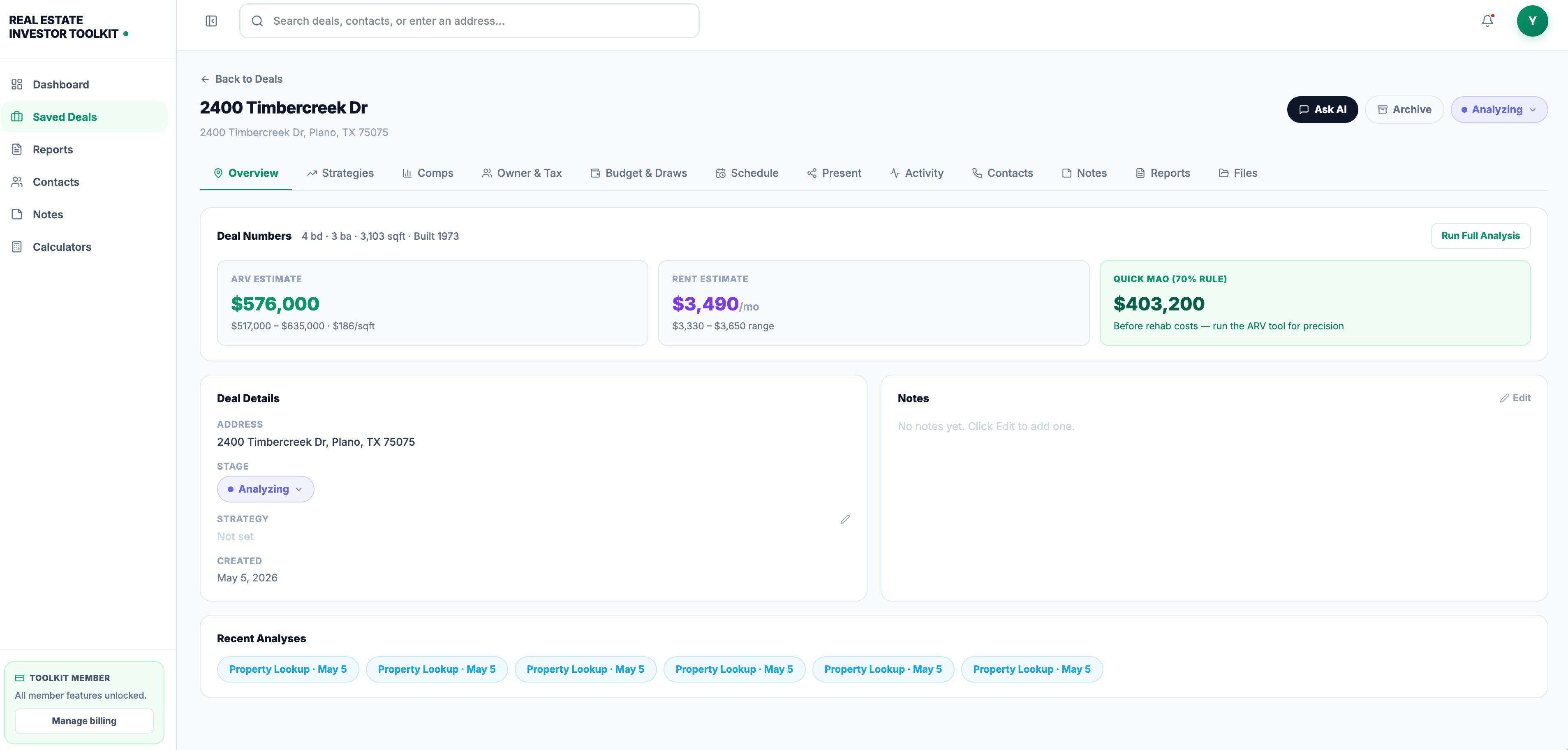
The ARV calculator and rehab cost calculator feed directly into your stage exit criteria, so your Qualified gate is backed by verified market data, not a gut estimate. The DealFlow saved-pipeline feature lets you run separate workspaces for wholesale and BRRRR deals, each with its own stages and scoring fields. AI deal insights flag stalled opportunities and surface prioritization signals without requiring manual review. Core calculators are free with no sign-up required. Start with a free ARV or rehab estimate on your next deal, then explore the full toolkit to set up your pipeline the right way.
Useful sources
Implementation tools (calculators and pipeline features):
- ARV Calculator — After Repair Value Estimator — Verify ARV inputs for stage exit criteria and deal scoring.
- Rehab Cost Calculator — Finalize rehab estimates required at the Qualified gate.
- BRRRR Calculator — Model refinance timing and LTV for BRRRR pipeline stages.
- DealFlow — Investor Platform — Saved pipelines per investment motion with deal tracking.
Conceptual reading (pipeline theory and strategy):
- Gartner: Sales Pipeline Guide — Pipeline quality and revenue tech stack recommendations.
- Pipedrive: Sales Pipeline Fundamental Stages — Stage design and buyer-action milestone framework.
- Gangly: How to Build a Sales Pipeline — Stage enforcement, sourcing prioritization, and conversion thresholds.
- Sambandh: The Sales Pipeline Guide — Strategy-specific pipeline architecture and 3–7 stage guidance.
- Conquer: Pipeline Generation Strategy — Weekly outreach motions, hygiene routines, and execution-layer recommendations.
Recommended
- Real Estate Investor Toolkit — Free Investment Property Calculators
- How to Find Off-Market Investment Properties — Real Estate Investing Guide | Real Estate Investor Toolkit
- Pricing — Full Property Analysis Reports | Real Estate Investor Toolkit
- RHET DealFlow — Investor Platform | Real Estate Investor Toolkit