Stop Losing Money: 5 Step Deal Kill Criteria for Investors

Kill criteria are pre-determined, measurable signals or states that trigger stopping a project or deal before more time or money goes in. Setting them in advance reduces the biased, emotional continuation that keeps people in bad deals long after the evidence has turned. Below are the exact components, templates, and a worked example you can copy today.
TL;DR:
- Clear kill criteria must include a specific measurable signal or state, a designated owner, and a deadline to ensure timely and enforceable decisions.
- Pre-committing to kill thresholds and publicly sharing them significantly increases the likelihood of acting when necessary, reducing emotional biases.
- Using numeric or binary thresholds for signals, such as a DSCR below 1.10 or losses exceeding a set amount, provides objective stopping points.
- Regular review of kill reasons and thresholds helps calibrate decision rules, preventing too many unnecessary kills or overlooked failures.
- Applying multi-gate screening frameworks with predefined thresholds at each stage minimizes wasted effort and improves deal quality over time.
Table of Contents
- What kill criteria are and how they differ from success metrics
- Why preset kill criteria matter
- Core components checklist: what every kill criterion must include
- Templates and short examples you can copy today
- How to set and implement kill criteria: a 5-step action plan
- Monitoring, calibration, and learning from your kills
- Common pitfalls and fixes
- Applying kill criteria to deal screening: a worked example
- Balancing discipline and optionality
- Tools that make numeric kill criteria easier to enforce
- Sources
- FAQ
What kill criteria are and how they differ from success metrics
A kill criterion is a rule you write before you’re emotionally invested, one that tells you exactly when to stop. Annie Duke describes this as setting pre-committed signals or turnaround times in advance, specifically to raise the odds that you quit when quitting is the rational move. That framing matters because it separates the decision from the moment you’re actually living through it, when judgment tends to be worst.
Kill criteria are not the same as success metrics or scoring models, and mixing them up is a common mistake. A scoring model ranks options against each other. Kill criteria don’t rank anything: they trigger a hard stop, full stop, no ranking involved.
- Success metrics answer “how good is this compared to other options?”
- Kill criteria answer “has this crossed a line we agreed would end it?”
- Scoring models rank imperfect opportunities against each other, while kill criteria give a binary or near-binary stop signal, a distinction SponsorBeast’s comparison draws out clearly.
Kill criteria typically live in one of three places in a process: the initial screening stage, where they filter out weak candidates fast; a pre-mortem session, where you write down what would prove the plan wrong; or a decision record, where the rule and its trigger conditions are documented for later reference. Each placement serves a different purpose, but all three exist to take the decision out of the heat of the moment and put it on paper ahead of time.
Why preset kill criteria matter
The behavioral case for kill criteria comes down to three predictable traps: sunk-cost bias, where you keep paying because you’ve already paid; loss aversion, where the pain of admitting a loss outweighs the relief of stopping it; and identity entanglement, where quitting feels like admitting you were wrong about yourself, not just the deal. All three push you toward continuing something that a clear-eyed observer would end.
Pre-commitment and public accountability substantially increase follow-through on kill decisions, according to Annie Duke’s research on quitting. Deciding the rule before you’re attached to the outcome, and telling someone else what that rule is, makes it far more likely you’ll actually act on it when the moment arrives.
There’s also an operational payoff. Gate-based deal screening frameworks recommend killing at the cheapest possible stage, before anyone sinks hours into a detailed underwrite, which protects scarce decision time for the handful of deals that deserve it. A written kill also creates an audit trail: a record of why something ended, which is useful the next time a similar deal shows up.

Core components checklist: what every kill criterion must include
A kill criterion that’s missing any of these pieces tends to get argued around instead of enforced. Treat this as a checklist, not a suggestion.
- Signal or state, never both. A signal is an event (a missed milestone, a failed test). A state is a condition that persists (cash flow below a threshold for two consecutive months). Pick one per rule; mixing them creates ambiguity about when the clock starts.
- An observable metric with a numeric or binary threshold. “Underperforming” is not a threshold. “DSCR below 1.10” is.
- A named owner who can call the kill. Someone specific, not “the team,” has to be authorized to pull the trigger.
- An accountability partner. A second person who knows the rule and will ask the hard question when the owner hesitates.
- The evidence required and where it’s logged. Specify what proof triggers the rule and which document or spreadsheet holds the record.
- A deadline or turnaround time. A date by which the signal or state must resolve one way or the other.
- A decision cadence. How often the criterion gets checked, weekly, monthly, or at fixed milestones.
- A defined consequence and next step. What happens immediately after the kill: who gets notified, what gets shut down, and what the handoff looks like.
Pro Tip: Write the kill criterion as a single sentence that names the metric, the number, the owner, and the date, then read it back to someone outside the project; if they can’t tell you exactly what would trigger it, rewrite it.
Templates and short examples you can copy today
Ready-made kill criteria are more useful than abstract advice, so here are four you can adapt directly. Each pairs a fill-in-the-blank structure with a short worked version.
Personal project. “If [milestone] is not reached by [date], and [owner] confirms no viable path exists, the project ends.” Example: if the manuscript isn’t at 50,000 words by March 1, and the author confirms no realistic path to finishing exists, the project is shelved.
Investing. “If losses exceed [percent or dollar amount], or [turnaround time] passes without [recovery signal], exit the position.” This pairs a numeric stop-loss with a timeline, the two-part structure Annie Duke recommends using as separate, paired criteria rather than one blended rule.
Tiering avoids discarding a test that’s borderline rather than clearly dead.
Hiring probation. “If [milestone] is not met by [day 30/60/90], with evidence logged in [document], employment ends.” Tie each milestone to something observable, not a general impression.
| Context | Trigger type | Example threshold |
|---|---|---|
| Personal project | Deadline + owner sign-off | Milestone missed by fixed date |
| Investing | Stop-loss + turnaround time | Loss percentage or elapsed time |
| Product experiment | Tiered metric | Conversion rate bands |
| Hiring probation | Milestone + evidence | Performance check at 30/60/90 days |
How to set and implement kill criteria: a 5-step action plan
Writing a rule is easy. Making it stick under pressure takes a process, and that process has five steps.
- Run a pre-mortem. Before you commit, write down what would have to be true for this to fail, and name the assumptions you’re least sure of. This is where most kill criteria come from: the weakest assumption becomes the metric you watch.
- Choose measurable signals and thresholds. Turn each risky assumption into a number or a binary state, using the signal-versus-state distinction from the checklist above.
- Assign an owner and an accountability partner. One person calls the kill, one person is authorized to push back if the owner hesitates or rationalizes.
- Document the rule. Write the evidence standard, where it’s stored, and who gets notified when the trigger fires. A rule that lives only in someone’s head isn’t a rule.
- Rehearse the decision meeting. Set a calendar date before the deal even starts, not after problems appear, so the checkpoint isn’t something you have to remember to schedule under stress.
Pro Tip: Put the kill criteria review on the calendar the same day you commit to the deal, not the day you start worrying about it.
Monitoring, calibration, and learning from your kills
A kill criterion isn’t finished once it’s written; it needs a feedback loop, or it drifts into either irrelevance or paralysis. SponsorBeast’s operational guidance recommends requiring a one-line kill reason saved wherever deal records already live, then aggregating those reasons periodically to catch calibration problems.
Every kill should log at minimum:
- Date the kill was triggered.
- Owner who made the call.
- Evidence that met the threshold.
- Action taken immediately afterward.
Review cadence matters as much as the log itself. A quarterly review, or a review after every kill if volume is low, lets you spot patterns: are you killing too many deals that later turn out fine, or too few deals that later blow up? Both are signs your thresholds need adjusting, not that the practice itself is wrong. If almost everything survives your criteria, they’re too loose. If almost nothing does, and good opportunities are getting discarded over assumptions that later prove wrong, they’re too tight. Simple analytics on where deals die in your pipeline, and whether that pattern matches your actual strategy or buy box, tell you which direction to move.
Common pitfalls and fixes
Most kill criteria fail for the same handful of reasons, and each has a straightforward fix.
- Vague language and missing owners. “If things don’t improve” isn’t a rule. Fix it by naming the metric, the number, and the person authorized to act.
- Emotional override in the moment. The person closest to a deal is the worst judge of when to kill it. Fix it with an accountability partner and a public commitment made before the emotional stakes rise.
- Overfitting thresholds to one bad example. A single failed deal shouldn’t rewrite your whole rule set. Use watch and pursue tiers, and calibrate gradually across multiple outcomes.
- No audit trail. Without a logged reason, you can’t tell later whether the kill was justified. Fix it by requiring a one-line reason stored with the deal record every time.
Applying kill criteria to deal screening: a worked example
A practical way to see kill criteria in action is through a three-gate screening model, the structure SFAI Labs describes for killing deals at the cheapest possible stage instead of burning meeting time on ones that were never viable.
- Gate 1, structural knockouts. Fast, binary checks: wrong asset class, wrong market, seller unwilling to negotiate. Kill here costs minutes.
- Gate 2, economics screen. Numeric thresholds decide the outcome: a cap rate floor, a DSCR minimum around 1.10 to 1.20, a maximum price per unit for the market. Deals get a Kill, Watch, or Pursue verdict rather than a strict pass or fail, which keeps borderline deals alive long enough to check the one input that might change the answer.
- Gate 3, human judgment. Only deals that survive Gates 1 and 2 get a full underwrite, where qualitative factors, negotiation dynamics, and financing structure get real attention.
Running Gate 2 by hand invites arithmetic errors and false precision, the kind VC screening research shows even experienced evaluators fall into when relying on quick heuristics under time pressure. A rental property calculator that checks cash flow, cap rate, and ROI against your preset thresholds in seconds gives you a consistent Gate 2 read every time, and a place to log the number that triggered the verdict. That’s a numeric aid, not a replacement for the judgment applied at Gate 3.
Balancing discipline and optionality
Rules save you from your worst moments, but rigid rules applied without judgment can kill a good deal that’s only wrong under a single bad assumption. I bend a kill criterion only when I can name the specific assumption that changed, write down why the exception exists, and revisit it after the fact to see whether the exception was justified or just a rationalization wearing a disguise. That kind of limited, documented exception protocol beats ad-hoc overrides, because it keeps the discipline intact while leaving room for the rare case that deserves a second look.
— Michael
Tools that make numeric kill criteria easier to enforce
Writing the threshold is the easy part. Checking it fast, consistently, and without arithmetic mistakes is where most people slip. There are free calculators available online that can run Gate 2 numbers in seconds, using verified comps and market data instead of a hand-built spreadsheet.
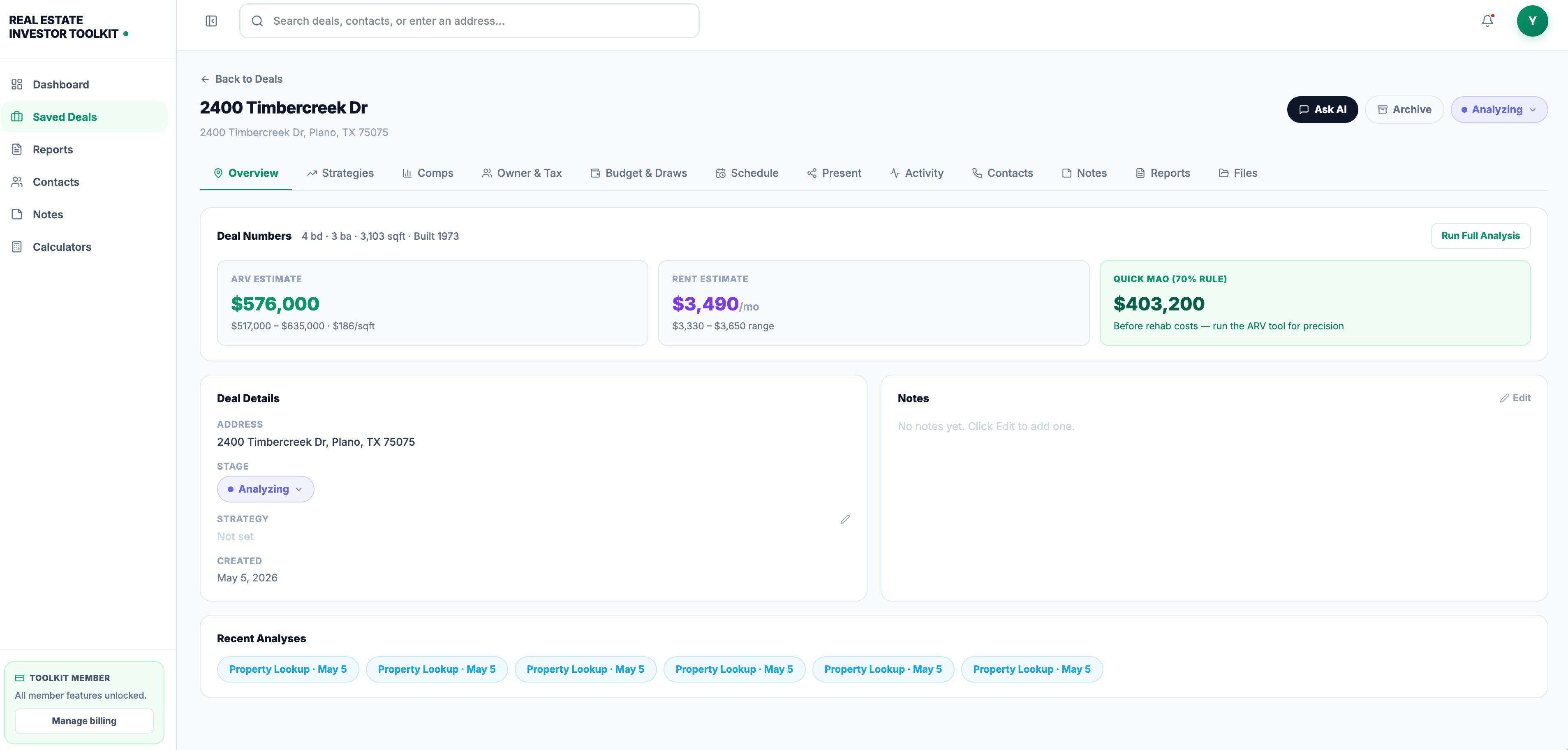
None of that replaces the judgment you apply at Gate 3, but it removes the manual error that creeps into economics screens done under time pressure. The free tools require no sign-up, and if you’re screening deals often enough to want saved pipelines and unlimited reports, the Real Estate Investor Toolkit plan runs $39.99 per month. Start with the free calculators and see how a firm Gate 2 number changes how fast you can say no.
Sources
- Knowing when to quit with world poker champion Annie Duke (podcast transcript)
- The Deal Screening Framework: kill deals in minutes, not meetings | SFAI Labs
- VC deal evaluation study (screening and criteria analysis)
FAQ
What does kill criteria mean?
Kill criteria are pre-set, measurable signals or conditions that trigger stopping a project or deal, decided before you’re emotionally attached to the outcome. They act as a hard stop rather than a ranking tool, telling you exactly when to walk away instead of just how good an option looks compared to others.
What are the elements of good decision making?
Strong decisions generally rest on a clear question, defined criteria, reliable evidence, a named owner, a deadline, and a review step to check whether the outcome matched expectations. Kill criteria borrow this same structure: a metric, a threshold, an owner, and a deadline, all set before the decision has to be made under pressure.
What are examples of decision criteria?
Common decision criteria include cost, time to completion, risk level, and measurable performance thresholds like a minimum cap rate or a maximum price per unit in a property deal. In a kill-criteria context, the criterion also needs a threshold number and an owner authorized to act on it, not just a general category to weigh.
What criteria are used in decision-making?
Decision-making criteria typically combine quantitative measures, such as cost, return, or a numeric threshold like DSCR, with qualitative factors like risk tolerance and strategic fit. For a kill criterion specifically, the working parts are a signal or state, a metric with a threshold, a named owner, an evidence standard, and a deadline.
How is a kill criterion different from a scoring model?
A scoring model ranks multiple options against each other to find the best one, while a kill criterion issues a hard stop when a preset threshold is crossed. SponsorBeast’s comparison notes that both are useful, but they answer different questions: one ranks, the other ends.