Deal Analysis Checklist: What to Verify Before You Close

BLUF: The moment you sign a contract, calendar four deadlines and pull five document groups. The deadlines are your inspection contingency expiry, financing contingency expiry, title objection deadline, and closing date. The document groups are quality of earnings (QoE) or trailing financials, title commitment and ALTA survey, certified rent roll with estoppels, a property condition assessment (PCA) or Phase I environmental report, and insurance and litigation history.
Order the PCA, survey, and estoppels the same day you sign. These have the longest lead times and the least flexibility, and they gate everything else on your deal analysis checklist.
- Calendar all four contingency dates before you request a single document
- Request the five priority document groups on day one, not week two
- Order third-party reports (PCA, survey, Phase I) immediately, since lead times often exceed your inspection window
A well-organized data room delivered upfront can save 15 to 30 days off your total timeline and cuts the odds of a late-stage re-trade.
TL;DR:
- Order all long-lead reports, including PCA, survey, and Phase I environmental, immediately upon signing to avoid delays and gate other due diligence steps.
- Calendar all four critical deadlines from the start and track findings weekly to ensure timely completion and avoid missing inspection, financing, or title objection dates.
- Focus on customer concentration above 30 percent, material title exceptions, and significant environmental issues as key red flags that can trigger renegotiations or extensions.
- Use valuation calculators to quickly translate inspection findings, contractor bids, and rent roll discrepancies into negotiable numbers before negotiations.
- Conduct cross-workstream analysis during diligence to prevent ordinary risks like roof repairs or title issues from slipping through, minimizing surprises post-close.
Table of Contents
- Why a Deal Analysis Checklist Matters
- Core Checklist by Workstream
- The Commercial Real Estate Checklist
- How to Manage Your Contingency Deadlines
- How to Prioritize Findings and Spot Red Flags
- Using Calculators and Templates to Speed the Work
- Integration and Operational Considerations After Closing
- Assessing Risk Beyond the Obvious Red Flags
- A Practitioner’s Take on Checklist Discipline
- Run Your Numbers Before You Negotiate
- Key Takeaways
- Sources
Why a Deal Analysis Checklist Matters
Due diligence is decision support. It tests what a seller tells you against what the documents and data actually show, and a deal analysis checklist exists to make sure nothing gets skipped under deadline pressure.
A complete review runs across roughly ten parallel workstreams: financial, legal, commercial, tax, human resources, intellectual property, operations, IT and cybersecurity, environmental, and real estate. Skip one, and you inherit whatever risk was hiding in it.
Mid-market transactions typically take 30 to 90 days from signed letter of intent to closing, with third-party fees commonly running tens or hundreds of thousands of dollars depending on deal size and complexity. That range covers quality-of-earnings reports, environmental assessments, surveys, and legal review.
Each workstream answers a different question:
- Financial confirms the earnings and cash flow are real, not adjusted
- Legal confirms you’re buying what you think you’re buying, free of hidden claims
- Commercial confirms the customer base and revenue will survive the transition
- Tax confirms structure and history won’t create surprise liabilities
- Real estate and environmental confirm the physical asset matches its description
Financial due diligence alone commonly breaks into seven sub-workstreams, with QoE consuming the largest share of effort. Budget several weeks for that piece alone on a middle-market deal.
Core Checklist by Workstream
This is the operational core of your investment analysis checklist. Work through each category methodically, and don’t let a friendly seller relationship substitute for a document.
1. Financial due diligence
- General ledger export covering the trailing three to five years
- Audited or compiled financial statements for the same period
- Trailing twelve months (T-12) profit and loss statement
- Bank statements matching the financial period under review
- Accounts receivable and accounts payable aging schedules
- Working capital support and normalization schedules
- QoE scope items: revenue recognition, add-backs, one-time items
Working capital and QoE are where most valuation disputes originate, since sellers routinely present adjusted EBITDA that strips out expenses a buyer will actually have to keep paying.
2. Legal and contracts
Request corporate formation documents, capitalization tables, and board minutes going back at least three years. Pull every material contract, including customer agreements, supplier terms, and leases, and flag any change-of-control clauses that could trigger termination or consent requirements at closing. Build a litigation schedule covering pending, threatened, and settled claims. A single unresolved lawsuit with uncapped damages can restructure an entire deal’s indemnity terms.
3. Operational and commercial
Customer concentration is the single biggest hidden risk in a small or mid-size business. Pull the top ten customer contracts, calculate what percentage of revenue they represent, and review churn metrics over the last two years. Reference checks with key customers, done carefully and often through the seller, tell you things the numbers won’t.
4. Tax
Collect three to five years of federal and state tax returns, plus documentation of any prior audits or disputes. Structure matters here: an asset deal and a stock deal carry very different after-tax consequences, and this affects your actual return more than almost any other line item.
5. IT and cybersecurity
Request a system inventory, backup and disaster recovery documentation, and breach history for the past three years. A company with no documented security controls is a company you’ll need to invest in immediately post-close, and that cost belongs in your model now, not as a surprise later.
6. Environmental and physical
A Phase I environmental site assessment is standard on any real estate or industrial deal. If Phase I turns up evidence of contamination (old fuel storage, prior industrial use, adjacent contaminated sites) it triggers a Phase II, which adds real time and real cost. A PCA typically covers roof condition, HVAC age and remaining life, structural issues, and code compliance items.

Cross-border deals or those touching regulated industries may also trigger CFIUS or antitrust review, which adds its own timeline outside the standard workstreams above.
The Commercial Real Estate Checklist
Property deals run their own version of this due diligence checklist real estate investors rely on, and it maps almost item for item to your underwriting model.
Rent roll versus estoppel. The seller’s certified rent roll tells you what they claim tenants owe and occupy. The estoppel certificate, signed by each tenant, confirms what’s actually true, including rent amount, lease term, security deposit, and any side agreements or disputes. When the two don’t match, the estoppel wins, and any gap becomes a repricing conversation.

Title commitment and ALTA survey. The title commitment lists exceptions such as easements, liens, and encroachments. An ALTA/NSPS survey shows those exceptions on the ground, and a survey that reveals an encroaching structure or an access easement running through your planned parking area has real operational consequences, not just legal ones.
Environmental triggers. A Phase I that flags a former gas station next door, or a dry cleaner in the building’s history, pushes you into Phase II soil and groundwater testing, which can add several weeks and meaningful cost to your timeline.
Inspections into bids. Turn every physical finding into a real number. A roof inspector’s estimate is a starting point; three independent contractor bids for the same scope of work give you a credible number you can bring to the negotiating table, backed by an insurance quote when the finding affects coverage.
Pro Tip: Separate every physical finding into three buckets: immediate capital needs, deferred capital on a 24 month horizon, and cosmetic items. Only the first two belong in a repricing request. Sellers will push back hard on cosmetic items, and they’re right to.
How to Manage Your Contingency Deadlines
Your purchase evaluation guide is worthless if you miss the dates that give it teeth. Contingency deadlines expire whether or not your reports have arrived.
- Day one: extract and calendar the inspection contingency expiry, financing contingency expiry, title objection deadline, and closing date directly from the signed contract
- Day one to three: order every long-lead third-party report: PCA, ALTA survey, Phase I, and QoE engagement
- Week one: confirm receipt and initial timelines from each vendor; flag anything that won’t land before your contingency expires
- Ongoing: track findings against deadlines weekly, not just at the end
Typical CRE diligence periods run 30 to 60 days, extending past 90 for complex assets or anything requiring Phase II environmental work. Report lead times, not your own analysis speed, are usually the real gating factor.
If a report is delayed through no fault of your own, request a written extension immediately and tie it to a specific, documented reason. A verbal understanding with a seller’s agent means nothing once a deadline passes.
How to Prioritize Findings and Spot Red Flags
Not every finding deserves the same response, and treating a minor issue like a deal killer burns goodwill you’ll need later. Build a simple triage: proceed, reprice, require seller cure, extend, or walk.
Recurring thresholds worth watching:
- Customer concentration above 30% of revenue in a single account
- Material title exceptions that restrict use or create ongoing liability
- Unpermitted structural work discovered during inspection
- Environmental concerns significant enough to trigger Phase II
- Working capital shortfalls versus what the QoE report supports
Document everything. Three independent contractor bids and a formal insurance quote turn a vague concern into a number a seller can’t easily dismiss. If a roof needs $40,000 in repairs across three bids, that’s a repricing conversation, not an argument about whether the roof “seems fine.”
Pro Tip: When a finding crosses one of these thresholds, don’t lead with an ultimatum. Lead with the documentation. Sellers negotiate against numbers far more easily than they negotiate against a buyer’s opinion.
Using Calculators and Templates to Speed the Work
Your checklist tells you what to verify. Real Estate Investor Toolkit’s calculators help you turn what you find into numbers you can actually negotiate on.
- Feed inspection scope into the rehab cost calculator to convert contractor bids into a defensible repricing figure
- Run rent roll and estoppel data through the rental property calculator to confirm NOI assumptions match reality
- Check comparable sales and rents with the comps analyzer before accepting the seller’s market narrative
- Keep a diligence matrix and findings log so every item has an owner and a deadline
The gap between a seller’s proforma and a normalized operating statement is where most repricing leverage actually lives. A calculator won’t find that gap for you, but it will tell you exactly how much it’s worth once you do.
Integration and Operational Considerations After Closing
Diligence doesn’t end at the closing table. What you found in the data room becomes your first ninety days of operational work, and treating it otherwise wastes the entire process.
Build a transition plan before you close, not after. If your IT review flagged a company running on outdated systems with no documented backup process, that’s day-one work, not a someday project. If customer concentration analysis showed 40% of revenue tied to three accounts, your retention plan for those relationships needs to exist before the seller’s name comes off the door.
Staffing carries its own risk. Key employees who stayed through the sale process out of loyalty to the seller may not stay through a transition to new ownership. Identify which roles are critical to near-term operations and have retention conversations, formal or informal, before closing rather than after.
For real estate specifically, integration means executing on the capital plan your inspections built. If your PCA identified $150,000 in deferred maintenance, that work needs a schedule and a budget line, not a vague intention. Estoppels that revealed below-market leases become your leasing strategy for renewal dates already on the calendar.
The sellers who prepare for this well, running a clean sell-side QoE and organizing their data room in advance, tend to close at better multiples with fewer indemnity carve-outs. The inverse is just as true for buyers: the ones who plan integration during diligence, not after, close with fewer unpleasant surprises in month two.
Assessing Risk Beyond the Obvious Red Flags
Document-level red flags are the easy risks to catch. Market and sector risk require a different kind of judgment, and they’re easier to miss because nothing in the data room flags them directly.
Ask what happens to this deal if the sector faces a downturn. A business with strong current financials in a cyclical industry, construction supply, discretionary retail, or hospitality, carries risk that trailing three-year financials won’t fully reveal if you bought near a cycle peak. Look at how the business performed during the last downturn, not just its recent growth.
For real estate, market risk means understanding what’s actually driving current rents and occupancy. A submarket experiencing temporary supply constraints, a single large employer expansion, or a short-term regulatory quirk can inflate current performance in ways that won’t persist. Compare your target asset’s rent growth and occupancy trends against the broader submarket over a full cycle, not just the last two years.
Regulatory and competitive risk deserve their own line item. A business dependent on a specific zoning classification, a favorable tax treatment, or a regulatory gap can lose that advantage with a single legislative change. None of this shows up as a red flag in a document. It shows up only if you ask the question directly and research the sector’s trajectory independent of the seller’s narrative.
A Practitioner’s Take on Checklist Discipline
A rushed diligence review once nearly let a six figure roof replacement slide through unflagged, simply because nobody had indexed the PCA against the rent roll early enough to cross-reference the two. That kind of miss is exactly what a checklist exists to prevent, and it’s rarely the exotic risks that cause the damage. It’s the ordinary ones nobody assigned to a specific person.
For solo investors, a single-page checklist you personally own works fine. For sponsors managing multiple stakeholders, assign each workstream to a specific person with a specific deadline, and review the data room index weekly.
— Michael
Run Your Numbers Before You Negotiate
Real Estate Investor Toolkit gives you a faster way to convert what your inspections and financial review turn up into numbers you can actually take into a repricing conversation, without waiting on a separate consultant to build a model from scratch.
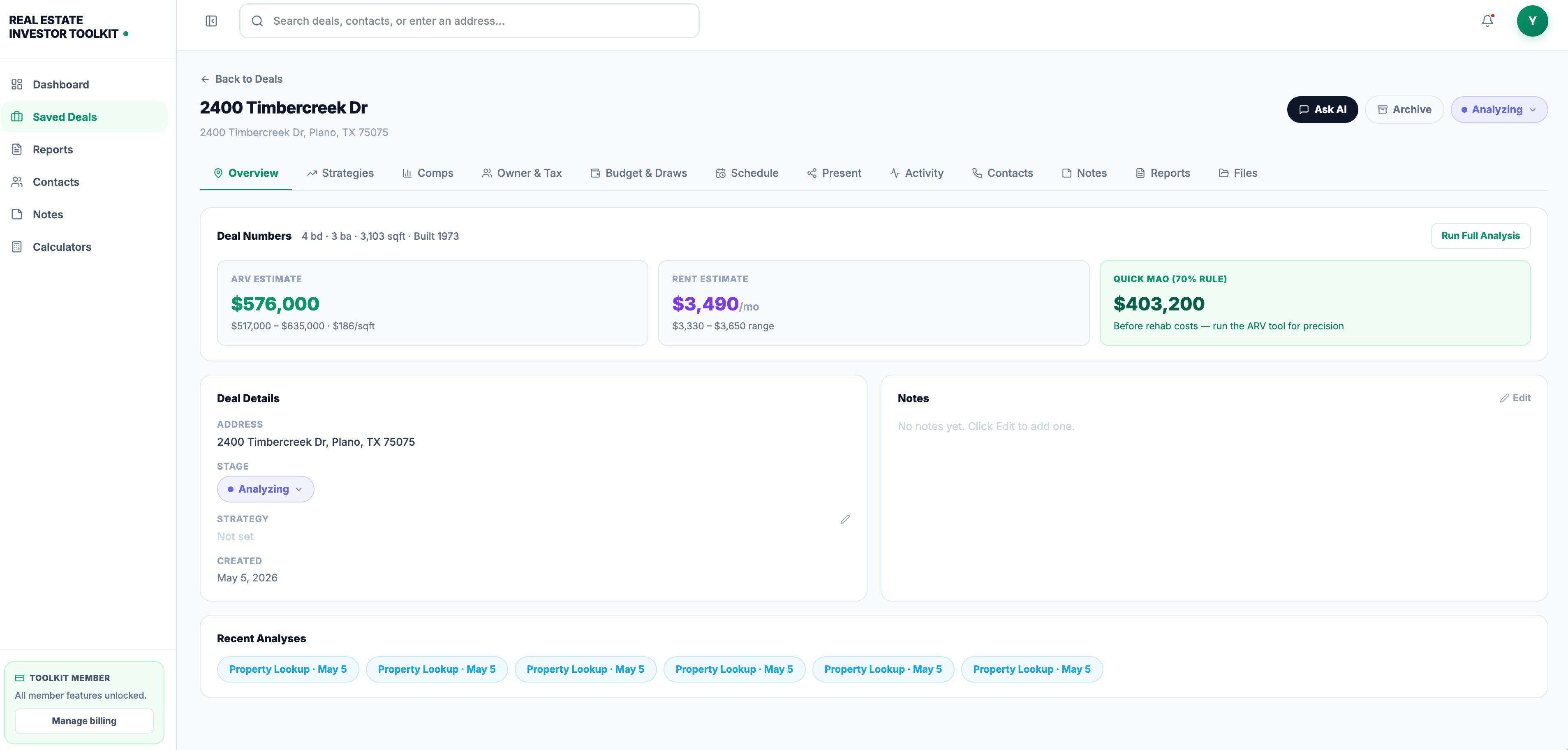
Once your PCA or contractor bids come back, plug the scope directly into the rehab cost calculator to see how findings move your offer price. If your rent roll and estoppels don’t line up cleanly, the rental property calculator will show you exactly how a lower verified NOI changes your return. Both calculators are free to use with no sign-up required, and if you’re running multiple deals through diligence at once, check the pricing page for saved deal pipelines and advanced property reports. Start with the property in front of you and see what the numbers actually say before you go back to the seller.
Key Takeaways
A disciplined deal analysis checklist works because it converts contract deadlines and document gaps into concrete, negotiable numbers before contingencies expire.
| Point | Details |
|---|---|
| Calendar four deadlines immediately | Inspection, financing, title objection, and closing dates go on a shared calendar the day you sign. |
| Order long-lead reports first | PCA, ALTA survey, Phase I, and QoE take the longest, so request them before anything else. |
| Convert findings into bids | Three contractor bids and an insurance quote turn vague concerns into negotiable repricing numbers. |
| Watch concentration and title issues | Customer concentration above 30% and material title exceptions are recurring red-flag thresholds. |
| Use calculators to verify assumptions | Real Estate Investor Toolkit’s rehab and rental calculators turn inspection scope and rent rolls into underwriting-ready figures. |
Sources
- Mergers and Acquisitions Due Diligence Checklist (2026) - CT Acquisitions
- Financial Due Diligence: How to Do It Properly + Checklist - DealRoom
- Real Estate Due Diligence Checklist: What to Verify Before You Close | Real Estate Investing Edge
Recommended
- Real Estate Investor Toolkit — Free Investment Property Calculators
- How to Analyze Your First Real Estate Deal, Step by Step — Real Estate Investing Guide | Real Estate Investor Toolkit
- Real Estate Comps Analyzer — Comparable Sales Tool | Real Estate Investor Toolkit
- How to Pull Comps in Non-Disclosure States Without Fooling Yourself — Real Estate Investing Guide | Real Estate Investor Toolkit