Dallas MAO Calculation: Formula, Examples and Common Errors

Your maximum allowable offer (MAO) on a Dallas property is the ARV you can defend, minus repairs, minus your costs and profit. Get the ARV and the repair number right and the rest is arithmetic. We built the free Dallas calculators on our site so you can run those inputs in minutes, with no sign-up. This guide shows the math behind them, step by step, so you can check any deal yourself.
MAO is the highest price an investor can pay and still cover costs and hit a target return, according to AmeriSave’s glossary. It is a ceiling, not a guarantee of profit. The same method works in Fort Worth, Arlington, Denton or anywhere in Florida. Only the comps and the repair costs change.
TL;DR
- MAO = the most you can pay and still make your target profit. ARV (after repair value) is an input, not your offer.
- The 70% rule: MAO = (ARV × 0.70) − repairs. The itemized method subtracts holding, selling and profit line by line.
- Wholesalers also subtract their assignment fee. Flippers subtract holding, selling and profit.
- In Dallas, ARV comes from recent sold comps close to the property. Renovated sales and as-is sales must be kept apart.
- Run both methods and use the lower number as your cap.
Table of Contents
- What MAO means and how it differs from ARV
- Step 1: Estimate the Dallas ARV from sold comps
- Step 2: Estimate rehab costs
- Step 3: Choose your MAO formula
- Worked examples side by side
- Step 4: Add the costs people forget
- Common mistakes that inflate your offer
- Our perspective
- Run your Dallas numbers
- FAQ
- Sources
What MAO means and how it differs from ARV
ARV is what the home should sell for after repairs. MAO is what you can pay today. A simple analogy: ARV is the price of the finished meal, and MAO is how much you can spend on ingredients and cooking before the meal stops being worth making.
AmeriSave describes ARV as an input to the offer calculation, not the offer itself. If you want the longer version, our guide on ARV vs MAO explains which numbers change your offer and which only measure value.
Step 1: Estimate the Dallas ARV from sold comps
Comps are comparable properties that have recently sold. They are the evidence behind your ARV, and in Dallas they decide whether the whole deal works.
What a good comp looks like
Dallas investors typically pull sales of similar renovated homes nearby, ideally in the same subdivision, and match square footage, age, build style, lot size and condition. Pena Real Estate notes that comps can swing dramatically from street to street in areas such as Bishop Arts or older Pleasant Grove. A comp two miles away can mislead you.
Practical filters from the research:
- Texas Signals suggests comps within 0.5 miles sold in the last 90 days, averaging the top 3 to 5.
- Foreclosure Engine suggests 3 to 6 sold comps within 0.5 miles and 90 days, matched within 10% on size and 10 years on age, with a 5% buffer in cooling markets.
- MG Property Partners pulled six months of sold MLS comps within about half a mile for a Dallas underwrite.
The tighter window is better in a fast market. Widen it only when too few homes have sold.
A Dallas ARV example
In that May 2026 Dallas underwrite, 11 sold comps between 950 and 1,400 square feet were sorted into renovated and as-is sales. Renovated homes averaged $193 per square foot and as-is homes $137. For a 1,182 sq ft house, the ARV was 1,182 × $193 = $228,126.
The key move is the split. A renovated comp tells you the finished value. An as-is comp tells you what a buyer pays for the same house in poor condition. Mixing them drags your ARV down or, worse, inflates the offer.
Our Dallas ARV calculator is built for this step, and it is free to use without an account. Working in a neighboring market? There are versions for Fort Worth and Denton. If you are new to the term, start with what ARV is.
ARV also matters if you finance the deal, because lenders often size loans against it. Here is a plain explanation of how ARV sets loan amounts.

Step 2: Estimate rehab costs
The repair number is where most first-time investors lose money. A rough guess feels fast, but a $15,000 miss comes straight out of your profit.
Start with a per-square-foot tier, finish with a line-item budget
For a first pass, Texas Signals gives repair tiers of $10 to $25 per square foot for cosmetic work, $25 to $50 for moderate work and $50 to $100 or more for heavy rehab.
Then build a property-specific budget. AmeriSave advises getting at least three contractor bids, because repairs can range from cosmetic updates to major systems or structural work.
The Dallas deal from earlier shows what a line-item budget looks like. The total was $61,000:
| Item | Cost |
|---|---|
| HVAC | $7,200 |
| Roof | $11,400 |
| Windows | $6,800 |
| Kitchen and bath | $22,000 |
| Flooring | $9,400 |
| Paint and exterior | $4,200 |
That total works out to about $51.61 per square foot on 1,182 sq ft, which falls in the heavy tier. A per-foot guess of the cosmetic tier would have missed by tens of thousands.
Our Dallas rehab estimator and the rehab cost calculator turn a scope of work into a total you can drop into the MAO formula. Our guide on how to estimate rehab costs covers what to walk through at the property.
Step 3: Choose your MAO formula
The right formula depends on your exit. Here are the three most common.
The 70% rule
The shortcut is MAO = (ARV × 0.70) − repairs. The 30% haircut is meant to cover closing costs, holding costs and profit. AmeriSave calls it a guideline, not a law, and the percentage can be adjusted for local numbers and risk.
Chase gives a worked example: ($320,000 × 0.7) − $30,000 repairs − $10,000 fixed costs = $184,000.
The itemized flip formula
The more precise version is MAO = ARV − repairs − holding costs − selling costs − profit. Pena Real Estate describes this as the common Dallas approach, with profit margin usually 10% to 20% depending on risk and neighborhood. Holding costs are taxes, utilities, interest and insurance during the project. Selling costs are agent commissions, closing costs and staging.
The wholesale formula
A wholesaler does not renovate, so the formula swaps profit and holding for an assignment fee, the fee you earn for passing the contract to an end buyer. The standard form is MAO = ARV × 0.70 − repairs − assignment fee. Texas Signals’ example: ARV $300,000, 70% is $210,000, minus $40,000 repairs, minus a $15,000 fee, leaves $155,000.
Our guide to calculating a wholesale offer goes deeper on fees and the end buyer’s math.
Worked examples side by side

The Dallas flip
Using the ARV and repairs above, MG Property Partners subtracted an 18% investor spread of $41,040. The math: $228,000 − $61,000 − $41,040 = $125,960. They offered $126,000, it was accepted, and the deal closed in 9 days.
The 70% rule versus itemized costs
Foreclosure Engine runs one $300,000 ARV deal both ways:
| Line | Amount |
|---|---|
| ARV | $300,000 |
| Repairs | −$45,000 |
| Holding (6 months at 1.5% of ARV per month) | −$9,000 |
| Selling (8%) | −$24,000 |
| Profit (10%) | −$30,000 |
| Acquisition costs | −$3,000 |
| Itemized MAO | $189,000 |
The 70% rule on the same deal gives $165,000. Their advice is to run both and cap your offer at the lower number. That habit protects you when real costs are higher than a template assumes, and it shows how much room you have to negotiate when they are lower.
Step 4: Add the costs people forget
A clean formula still fails if the inputs are thin. Check these before you send an offer:
- Holding costs for the real timeline. Include mortgage or loan payments, taxes, insurance and utilities for every month the property is not sold.
- Closing costs on both ends. AmeriSave’s guidance is to include closing costs on purchase and sale.
- A contingency. Add extra for surprises behind walls, under floors and in old systems.
- Financing. Interest, points and loan fees change the math. Test them in the Dallas financing calculator.
- Market direction. In a cooling market, trim your ARV, as in the 5% buffer above.
Common mistakes that inflate your offer
- Using an automated estimate as your ARV. MG Property Partners’ team rejects automated valuation models because they cannot tell renovated comps from as-is comps, the distinction that drives the cash offer.
- Comping too wide. Pulling sales from other subdivisions can erase the street-to-street differences described above.
- Mixing renovated and as-is sales. Keep two groups and use the renovated group for ARV.
- Guessing repairs. Use a tier for screening and bids for the final number.
- Treating 70% as a law. It is a starting point. Check it against itemized costs.
- Forgetting your exit. A wholesale offer, a flip offer and a rental offer need different formulas. For a rental or BRRRR (buy, rehab, rent, refinance, repeat) deal, test cash flow in the Dallas rental analysis and the Dallas BRRRR calculator.
Our perspective
Most bad offers we hear about come from one of two inputs: an ARV pulled from the wrong comps, or a repair number that was a hunch. The formula is the easy part.
That is why we built the calculators as a chain. You estimate ARV with comps, size the rehab, then bring both into your offer math, and you can do the first pass without creating an account.
When you are ready to move beyond one-off analyses, a single plan covers unlimited reports, saved deal pipelines, owner and absentee owner data and an AI assistant for deal insights, so you are not stitching together separate subscriptions.
Michael
Run your Dallas numbers
Start with the free tools: the ARV, rehab and financing calculators need no sign-up. If you analyze deals every week and want unlimited reports, saved deal pipelines, advanced property data, owner-occupancy details and AI chat insights, the Real Estate Investor Toolkit plan is $39.99 per month.
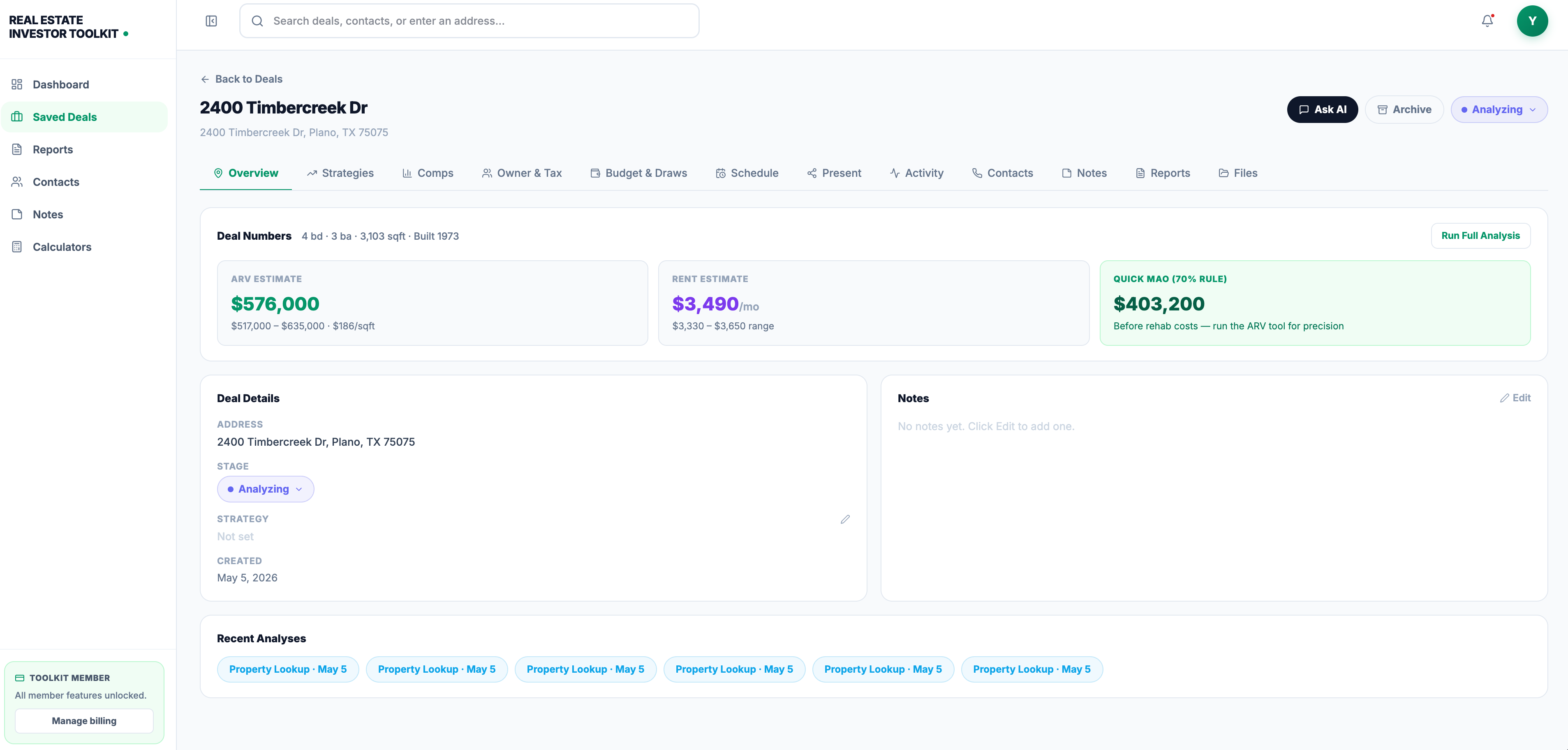
For a bigger picture of strategies, our investing guides cover MAO, BRRRR and rehab in plain language, including what MAO is.
FAQ
Is the 70% rule accurate for Dallas?
It is a quick screen, not a verdict. The 30% haircut is meant to cover closing, holding and profit, and it should be adjusted for local numbers and risk. Run the itemized version too and cap your offer at the lower figure.
Should wholesalers subtract their fee from MAO?
Yes. A wholesaler’s MAO is ARV × 0.70 minus repairs minus the assignment fee, so the end buyer still has room for profit. In the Texas example above, a $15,000 fee takes MAO from $170,000 to $155,000.
How many comps do I need for a Dallas ARV?
The sources above range from three to six close, recent sales, with 11 used in the larger Dallas underwrite. Prioritize closeness, recency and matching condition over raw count.
Does this MAO method work in Florida?
The formulas are the same, since they come from deal math, not location. Your comps, repair costs and holding costs will differ, so pull local sold data before you apply them.
Sources
- MAO in Real Estate: What It Means and How to Calculate It (AmeriSave)
- Understanding MAO in Real Estate (Chase)
- Understanding ARV: How Dallas Investors Evaluate Flip Opportunities (Pena Real Estate)
- We Ran the Comps on 3 Dallas Properties (MG Property Partners)
- Texas Wholesale Real Estate: The Complete Beginner’s Guide (Texas Signals)
- Investment Math and Rules of Thumb (Foreclosure Engine)
- ARV Loans Explained (Sizzle Capital Group)