ChatGPT for Real Estate Investing: What It Does Well and Where Deals Need Real Data

ChatGPT is useful for real estate investing when you use it to organize a deal, explain a formula or draft a message. It is not a source of comps, rents or rehab prices. The numbers that decide your offer should come from verified sales data and a calculator that runs the math the same way every time. That is the split we build around: use the chatbot for thinking, and use free deal calculators for the figures you will put your money behind.
This guide is for first-time investors, flippers, wholesalers and landlords, including those working Florida and Dallas-Fort Worth. It shows where ChatGPT saves time, where it quietly goes wrong, and how to build a workflow that keeps the first from turning into the second.
TL;DR
- ChatGPT is a good explainer and organizer: it can walk you through cap rate, cash-on-cash return and MAO, and structure a due diligence list.
- It cannot see live sales data. In one agent’s test, its comps included a 2022 sale, a different neighborhood and a house that did not exist in the records.
- ARV, rehab cost and MAO are the three numbers that set your offer. Feed them verified comps and a fixed formula, not a chatbot’s recall.
- Rental prompts often leave out vacancy, management, maintenance and reserves unless you ask for each line.
- A simple rule works: ChatGPT explains, verified data and calculators decide, and local records confirm.
Table of Contents
- What ChatGPT does well for investors
- Where ChatGPT breaks: the numbers that set your offer
- A workflow that keeps the speed and removes the risk
- ARV: the number you cannot let a chatbot guess
- Rehab costs: scope first, then price
- MAO for wholesalers: let the formula be fixed
- Rental cash flow: ask for every line item
- Taxes and financing: explain, then confirm
- Florida and DFW: what to confirm locally
- Common mistakes to avoid
- Promo: one place for the numbers
- Our view
- FAQ
- Sources
What ChatGPT does well for investors
A general chatbot is strongest at language and structure. Investors report using it to narrow candidate markets by population growth, job expansion and migration, to calculate ROI, cap rates and cash flows from numbers you paste in, to review contracts and summarize inspection reports, and to draft outreach emails and tenant messages. Gatsby Investment’s guide to AI in real estate investing lists these uses, and the same page says AI should not make the investment decision, predict market performance, replace inspections or due diligence, or stand in for legal and financial professionals.
For a first-time investor, the most valuable use is education. Ask it to explain the difference between cap rate (annual net operating income divided by price) and cash-on-cash return (annual cash flow divided by the cash you actually invested). Ask it to quiz you. Ask what a debt service coverage ratio (DSCR) is and why a lender cares. These are stable concepts, and a patient explanation at 11 p.m. is genuinely helpful.
It also does well with the paperwork around a deal:
- Turning a seller’s rambling voicemail transcript into a list of facts and open questions.
- Drafting a follow-up text to a motivated seller.
- Summarizing a long inspection report into a punch list by trade.
- Building a due diligence checklist for a property type you have not bought before.
None of those tasks needs a live number. That is why they work.
Where ChatGPT breaks: the numbers that set your offer
The trouble starts when the chatbot is asked for facts that live in a database. KDS Development’s comparison of ChatGPT and Google for investors notes that without live browsing the tool cannot supply current submarket cap rates, vacancy rates or today’s SOFR (the benchmark rate many loans are priced from), and it lacks granular submarket, zoning and neighborhood-crime insight. The same article frames the division of labor as Google for verification and ChatGPT for explanation.
The sharpest example is comps. A Texas-style test is easy to picture, and one realtor ran it on a home with a known value. ChatGPT returned a $580,000 to $620,000 range and said it was based on recent comparable sales. When the agent asked for the comps, one had sold in 2022, one was in a different neighborhood and one could not be found in the MLS or parcel records. A proper comparative market analysis built on three closed sales within 90 days and half a mile came in at $680,000 to $695,000. That is a gap of $60,000 to $75,000 on a single house.
Now put that gap into a flip. If your ARV is off by $60,000 and you use a 70% rule, your maximum offer moves by $42,000. That is the difference between a deal with margin and a deal that eats your cash reserves.

Why the answer sounds so confident
A chatbot writes fluent, well-formatted answers whether or not the underlying number is real. A made-up comp looks just like a real one. This is why the habit matters more than the tool: any figure that sets a price, a rent or a budget needs a source you can open.
A workflow that keeps the speed and removes the risk
Here is a routine that uses ChatGPT where it is strong and hands the numbers to data.
- Frame the deal in ChatGPT. Paste what you know (address, beds, baths, square footage, seller situation) and ask for a list of what you still need to find out. Ask it to flag missing underwriting inputs.
- Pull comps from real sales records. Use closed sales, not asking prices, and keep them recent and close. Our guide on how to pull real estate comps for investment properties walks through it.
- Run ARV, rehab and MAO in a calculator. The formulas should not change between runs.
- Use ChatGPT to stress-test. Give it your finished numbers and ask which assumptions the deal is most sensitive to.
- Confirm locally. Taxes, insurance, zoning, permits and the contract get checked with the people and offices that own those records.
Prompts that force honesty
If you do use a chatbot on a deal, build the skeptic into the prompt. Practitioners recommend a few habits:
- Require a source link and publication date for every market claim, and page or clause references for every document point. PlotDaily’s commercial real estate prompt guide recommends ending with a list of assumptions, contradictions and items that need human confirmation.
- Ask for a table of every number with its value, its source and a VERIFIED or UNVERIFIED label, then a list of missing inputs and where each should be checked.
- Run a separate stress-test prompt that names the most sensitive assumptions and labels local figures as needing verification instead of stating them as fact.
The point of these prompts is to make the chatbot expose gaps. Coursiv’s workflow guide takes the same view: AI can surface missing inputs and give you a repeatable underwriting skeleton, while primary records and licensed professionals validate the facts before an offer.
ARV: the number you cannot let a chatbot guess
After repair value (ARV) is what the property should sell for once the work is finished. Think of it as the price of the finished meal: you buy the ingredients (the house and the repairs) and the ARV is what the meal sells for. It comes from recent sales of similar nearby homes, adjusted for size, condition and features.
Two things make ARV hard for a chatbot:
- It needs closed sales from the last few months, within a tight radius. A general model has no live feed of them.
- It needs adjustments. A comp with a finished basement or a pool is not worth the same as your subject property, and the size of that adjustment comes from your local market.
A workable standard is three to five closed comps, the closer and more recent the better. Our guides on the sales comparison approach and on running comps with an appraisal-style process show how to choose and adjust them. Our ARV calculator is built to work from verified comps and market data, so the value you carry into your offer rests on real sales instead of a recalled range.
If you work Texas, our Austin ARV calculator shows how a market-specific page handles the same inputs. Whatever the market, the rule is the same: if you cannot open each comp in the records, do not use it.
Rehab costs: scope first, then price
Flippers lose money on rehab estimates more often than on any other line. The mistakes are familiar: a lump-sum guess per square foot, a missed roof, a forgotten permit, and no contingency. ChatGPT can help you build a scope of work and a room-by-room checklist from your walkthrough notes. It cannot tell you what a roof costs from a crew in Tampa or Fort Worth this month.
Pricing needs local data and, in the end, contractor bids. Contractors are adopting software for takeoffs and bids as well, as in this overview of AI construction estimating, which is one more reason to compare your budget line by line against a written bid before you close.
The practical sequence:
- Walk the property and write down every system: roof, HVAC, plumbing, electrical, foundation, windows, kitchen, baths, flooring, paint, exterior and landscaping.
- Use ChatGPT to turn your notes into an organized scope, and to flag items people commonly forget.
- Price the scope in a rehab calculator. Our rehab cost calculator is made for fix-and-flip analysis, and our guide to estimating rehab costs explains how to add contingency.
- Replace the estimate with bids as soon as the deal is under serious consideration.
The goal is a number you can defend. A scope written by a chatbot and priced by a spreadsheet you trust beats a number that only sounds plausible.
MAO for wholesalers: let the formula be fixed
Maximum allowable offer (MAO) is the most you can pay and still leave room for holding costs, closing costs and profit. The common screening rule is 70% of ARV minus estimated repairs. The 30% cushion is there to absorb those costs and the margin.
A worked example:
- ARV: $300,000
- 70% of ARV: $210,000
- Estimated repairs: $45,000
- MAO: $210,000 minus $45,000 = $165,000
ChatGPT can explain this correctly, and it can do the arithmetic when you give it the inputs. The risk is not the multiplication. It is the two inputs above the line. Change ARV by $20,000 and MAO moves by $14,000. Change repairs by $15,000 and MAO moves by $15,000. A wholesaler in DFW assigning a contract needs both numbers to hold up in front of an end buyer, who will run their own comps.
The 70% rule is a screen, not a law. It can be too generous in a hot market and too strict in a slow one. Our guide on when the 70% rule works and when it breaks covers what to use instead, what MAO means in plain terms, and how to build a wholesale offer with an assignment fee. If you want to see how ARV and MAO relate, read ARV vs MAO.
Rental cash flow: ask for every line item
Landlords often turn to ChatGPT to run a cash flow quickly. The weak point is what is left out. According to Coursiv, rental prompts commonly omit management, vacancy, maintenance and capital reserve expenses unless you request every line. A model that counts only mortgage, taxes and insurance will make almost any rental look profitable.
A complete monthly picture includes:
- Mortgage principal and interest
- Property taxes and insurance
- Vacancy allowance
- Property management, even if you self-manage today
- Repairs and maintenance
- Capital reserves for roof, HVAC and appliances
- HOA dues and utilities you cover
This is also why quick screens mislead. A property can pass the 1 percent rule and still fail once expenses are counted, which we explain in our piece on the 1 percent rule and the 45% rule. Run your numbers through our rental property calculator for cash flow, cap rate and return, and use our investment property financing calculator to compare loan scenarios. If you are doing a buy, rehab, rent, refinance strategy, the BRRRR calculator keeps the refinance math tied to ARV.
One more point from the comps side: sales comps support value, while rental comps benchmark income. Do not use one to answer the other’s question.
Taxes and financing: explain, then confirm
ChatGPT can explain tax concepts well. KDS Development says it can walk through 1031 exchange mechanics, including the 45-day identification window and 180-day closing deadline, the 27.5-year straight-line depreciation schedule for residential rentals, the 25% maximum rate on depreciation recapture, and the 3.8% net investment income tax thresholds of $200,000 for single filers and $250,000 for married filing jointly. The same source warns that it can misstate figures if its training data was wrong or the rules changed after its knowledge cutoff, so tax numbers belong with a CPA or the IRS before you act.
Use the chatbot to learn the vocabulary and prepare your questions. Then bring those questions to your CPA.
Florida and DFW: what to confirm locally
Local markets are where generic answers fail most. Florida investors deal with insurance quotes that can swing a rental’s numbers. Texas investors in DFW deal with property tax bills that vary by county and by year. A chatbot’s general statement about either is a starting point, not an input.
Coursiv’s recommended checks map neatly onto a local to-do list:
| Item | Confirm with |
|---|---|
| Price and comps | An agent or appraiser |
| Property taxes | The county assessor |
| Insurance | A written quote from an underwriter |
| Loan terms | The lender’s term sheet |
| Rents | Executed leases or local property managers |
| Zoning and permits | The municipal office |
| Contracts | A real estate attorney |
Treat this table as the last step of every deal. The earlier steps narrow the field so you only spend time on these confirmations for properties that pencil out.
Common mistakes to avoid
- Trusting a range with no sources. If the answer cannot name closed sales you can look up, it is not an ARV.
- Asking for current listings. A general chatbot is not a listing feed.
- Skipping expense lines. Add every one, every time.
- Pasting confidential seller details carelessly. Keep personal information out of prompts you would not want stored.
- Using a memo number without checking it. If ChatGPT drafted an investor memo with a statistic in it, verify it before it leaves your desk.
Promo: one place for the numbers
When you are ready to move from explanations to figures, our free tools need no sign-up, so you can run an ARV, a rehab budget or a cash flow in a few minutes. The paid plan, Real Estate Investor Toolkit at $39.99 per month, adds unlimited reports, saved deal pipelines, advanced property data, owner and absentee owner details, and an AI chat advisor for deal insights, all in one plan.
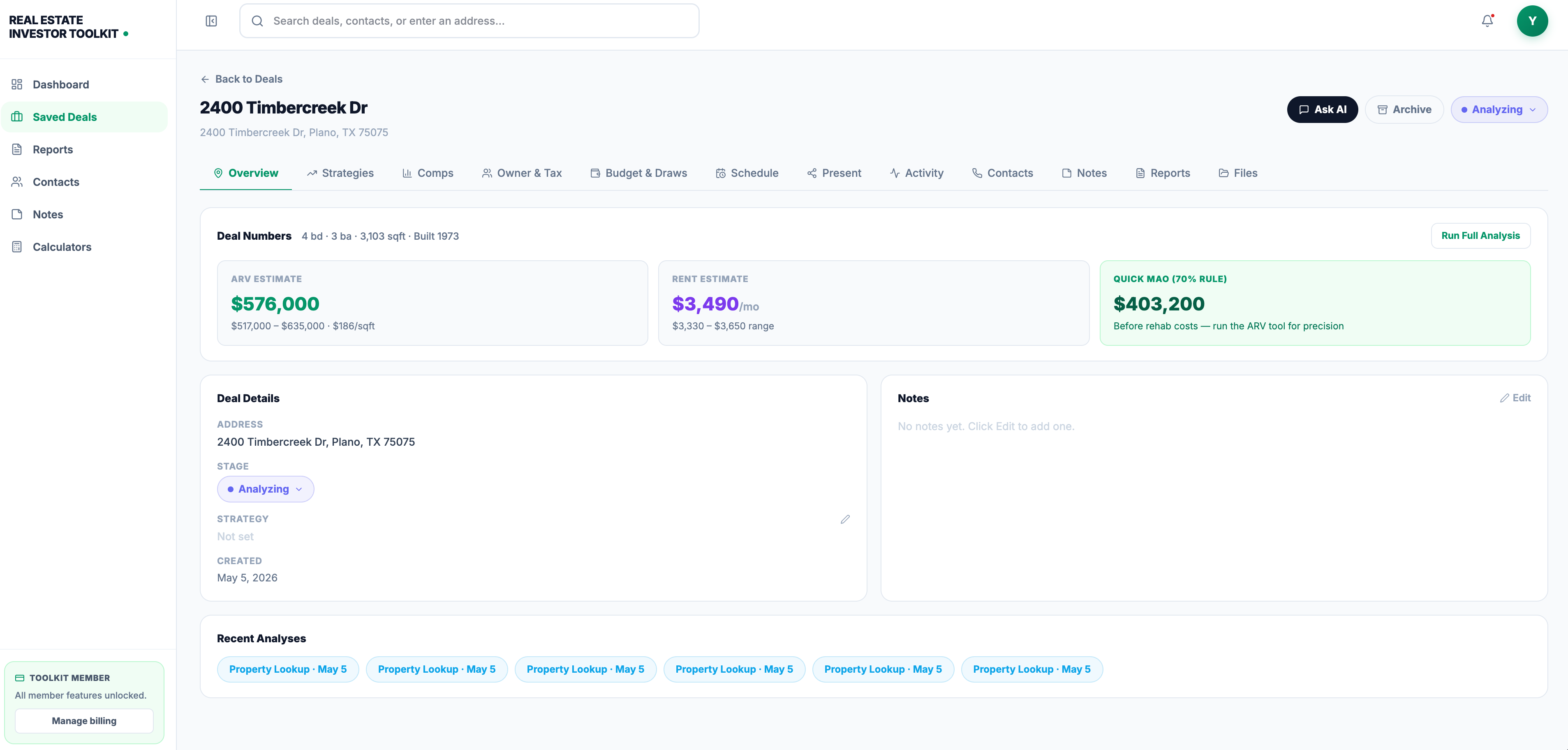
Start with the free tools and move to the plan when your pipeline outgrows one-off analyses.
Our view
We built the Toolkit because deals go wrong at the same three numbers: ARV, rehab and the offer price. A chatbot is a great way to understand those numbers, but it is the wrong place to get them.
Our approach is simple. Use AI to think, and use verified comps, market data and fixed formulas to decide. Our calculators give you the same math every time, from the first-time investor checking a single house to the wholesaler screening a list. Our paid plan keeps the whole workflow in one place: reports, saved deals, owner data and an AI deal advisor, so you are not stitching together separate subscriptions.
If you take one habit from this guide, make it this: never let an unsourced number set your price.
Michael
FAQ
Can ChatGPT help with real estate investing analysis?
Yes, for explaining metrics, structuring a deal file and doing arithmetic on numbers you provide. It can compute cap rate, cash-on-cash return and DSCR from pasted financials. The inputs still need to come from verified sources.
Can ChatGPT find comps or estimate ARV?
It should not be your comp source. In a realtor’s test, the comps it cited included an old sale, one from another neighborhood and one that could not be found in the records, and its value was far below a real analysis. Pull closed sales from real records and run them through an ARV calculator.
Is there a ChatGPT built for real estate?
There are custom GPTs and prompt libraries aimed at investors, but the question that matters is where the data comes from. Our paid plan includes an AI chat advisor alongside property data and reports, so the insights sit next to the numbers they are based on.
Can I use ChatGPT to calculate my maximum allowable offer?
Yes, as long as you give it the formula and verified inputs. With a $300,000 ARV and $45,000 in repairs, the 70% rule gives $165,000. The risk sits in the ARV and repair inputs, so confirm those first.
Sources
- How to Use AI in Real Estate Investing (Gatsby Investment)
- ChatGPT vs Google for Real Estate Investing (KDS Development)
- ChatGPT Said My House Was Worth $X. A Realtor Tested It. (Neuhaus Realty Group)
- 50 ChatGPT Prompts for Commercial Real Estate Brokers (PlotDaily)
- AI for Real Estate Investors: Deal Workflows (Coursiv)