Run 3 Tax Scenarios First: Capital Gains for U.S. House Flips

Most flip profit gets taxed as ordinary income, not capital gains, because the IRS treats active flippers as dealers running a business. A true one-off flip held more than a year, where you can document investment intent, may qualify for the 0%, 15%, or 20% long-term capital gains rates instead. Add state income tax, and a handful of legal mitigations like the QBI deduction or converting to a rental can soften the hit.
TL;DR:
- Flippers are classified as dealers or investors based on multiple factors, with dealer status subjecting profits to ordinary income and self-employment tax.
- Long-term capital gains rates apply only if the property is held over a year with documented investor intent, but short-term gains are taxed as ordinary income regardless of classification.
- Strategies like converting flips to rentals or electing S-corp status can reduce tax burdens, but some options like Section 1031 exchanges are unavailable for dealer inventory.
- State income taxes can significantly change after-tax profits, especially in states with high rates or that tax capital gains as ordinary income.
- Proper documentation of intent, accurate basis calculation, and scenario modeling with CPA guidance are essential to optimize flip tax outcomes.
Table of Contents
- Dealer vs. Investor: How the IRS Classifies Your Flip
- Ordinary Income, Capital Gains, and the Self-Employment Tax Layer
- Calculating Your Taxable Profit: Basis, Deductions, and a Real Example
- Legal Ways to Reduce What You Owe
- Don’t Forget State Taxes in Your Math
- Common Mistakes That Cost Flippers Money
- Modeling Tax Outcomes Before You Buy
- A Conservative Baseline Beats an Optimistic One
- Model Your After-Tax Numbers Before You Bid
- Sources
Dealer vs. Investor: How the IRS Classifies Your Flip
The dealer versus investor question decides everything else about your tax bill. The IRS doesn’t use a single test here. It weighs several factors together, and no one factor is automatically decisive.
The main things examiners look at:
- Frequency of sales — one flip a decade looks different from four a year.
- Primary purpose at purchase — did you buy intending to resell quickly, or to hold and rent?
- Improvements and resale prep — heavy rehab work aimed at a quick sale signals dealer activity.
- Advertising and businesslike conduct — MLS listings, contractor invoices, and a formal business plan all point toward dealer status.
- Time held — short holding periods support dealer classification; longer ones support investor treatment.
Get classified as a dealer, and your profit becomes ordinary income subject to self-employment tax, with losses deductible in full against other income. Get classified as an investor, and you might access capital gains rates, but your losses face the $3,000 annual deduction cap that applies to capital losses. Dealer status also closes the door on 1031 exchanges and installment sale deferral, since both require property held for investment rather than resale to customers. Keep your acquisition notes, any written business plan, lease agreements if you convert a flip to a rental, capital improvement receipts, and advertising records. That paper trail is what actually holds up if the IRS asks.
Ordinary Income, Capital Gains, and the Self-Employment Tax Layer
Short-term capital gains, meaning any asset held one year or less, get taxed at your ordinary income rate no matter your classification. Long-term capital gains require both a holding period past one year and investor status, and they unlock the preferential 0%, 15%, or 20% federal rates depending on your income.
For dealers, the math looks like this:
- Federal ordinary rates for 2026 run from 10% up to 37%, based on your bracket.
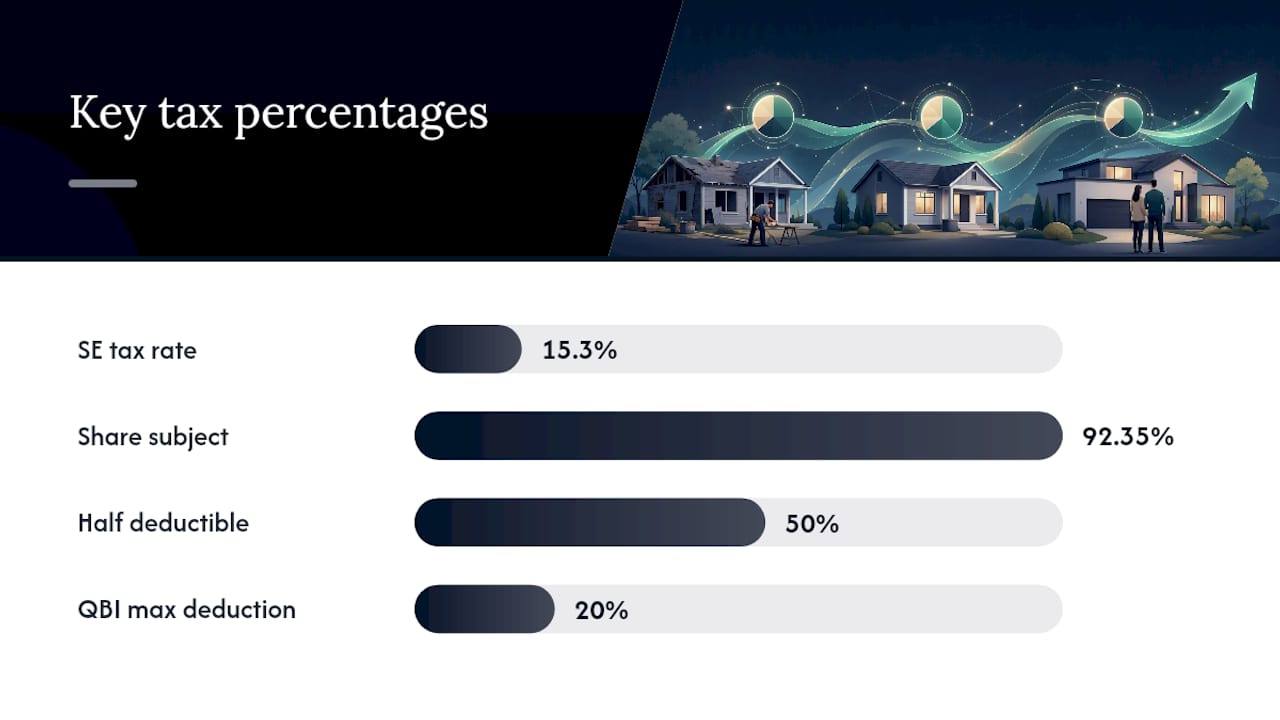
- Self-employment tax adds roughly 15.3%, applied to about 92.35% of your net flip profit.
- Only the Social Security portion of that 15.3% has an annual wage base cap; the Medicare portion keeps applying regardless of income.
That’s before state tax.
Half of your self-employment tax is deductible when calculating adjusted gross income, which softens the blow slightly but doesn’t erase it. The Qualified Business Income deduction can shave up to 20% off the income-tax portion for eligible pass-through filers, but it does nothing for the self-employment tax piece, since that runs on a separate calculation track entirely.
Calculating Your Taxable Profit: Basis, Deductions, and a Real Example
Your taxable gain starts with adjusted basis, not just purchase price. Here’s the sequence:
- Start with purchase price, then add capital improvements (new roof, kitchen remodel, foundation work) and certain acquisition costs like title fees and recording charges.
- Separate repairs from improvements. Routine repairs that maintain the property, like patching drywall or fixing a leaky faucet, are typically deductible as current expenses. Improvements that add value or extend useful life get capitalized into basis instead.
- Subtract qualifying selling costs from your sale price: real estate commissions, settlement fees, title insurance, and prorated property taxes all reduce your net proceeds.
- Calculate the gain: net sale proceeds minus adjusted basis equals your taxable profit.
A worked example: you buy a flip for $180,000, capitalize $45,000 in rehab, and pay $8,000 in acquisition costs. Your adjusted basis is $233,000. You sell for $290,000 and pay $18,000 in commissions and closing costs, leaving net proceeds of $272,000. Your taxable gain is $39,000. As dealer income, that $39,000 faces ordinary rates plus roughly $5,510 in self-employment tax before state tax even enters the picture.
Legal Ways to Reduce What You Owe
You can’t eliminate flip taxes, but a few strategies genuinely move the needle if your timeline and documentation support them.
- 1031 exchanges and installment sales are usually off the table for dealer inventory, since Section 1031 requires property held for investment or business use, not property held primarily for resale to customers.
- Converting to a rental before selling, then holding past one year with genuine lease activity, can shift a flip toward long-term capital gains treatment. It requires real tenants, real rent, and real time, not a token thirty-day listing.
- Moving in yourself can trigger the Section 121 exclusion, sheltering up to $250,000 ($500,000 if married filing jointly) of gain, but only after living there 2 of the last 5 years, which rarely fits a flipper’s timeline.
- Electing S-corp status lets you split income between reasonable payroll wages and distributions, since only the payroll portion faces self-employment tax.
- The QBI deduction can cut up to 20% off qualifying pass-through business income, though it doesn’t touch self-employment tax.
Pro Tip: Run your S-corp payroll split by an actual payroll service or CPA before filing. Pay yourself too little relative to distributions, and the IRS can reclassify the whole thing as unreasonable compensation, wiping out the savings and adding penalties.
Don’t Forget State Taxes in Your Math
Federal tax layers are only half the story. State income tax ranges from 0% in states like Texas and Florida to top marginal rates well above 10% in others, and that swing changes your after-tax profit dramatically on the same deal.
Some states tax capital gains at the same rate as ordinary income, erasing any federal rate advantage you’d otherwise get from long-term treatment. Others layer on local surtaxes for higher earners. Check your state’s specific guidance or run the numbers with a CPA before assuming a flip pencils out, and model your deal both with and without state tax so you see the real spread. Local market commentary can also flag state-specific quirks worth double-checking before you underwrite.
Common Mistakes That Cost Flippers Money
A few recurring errors show up again and again in flip tax filings, and most are avoidable with better habits.
- Skipping documentation of intent — no lease records, inconsistent bookkeeping, no business plan on file if you’re claiming investor status.
- Mixing up repairs and capital improvements, which throws off your adjusted basis and can trigger an amended return.
- Modeling gross profit instead of net profit, forgetting that self-employment tax eats into dealer income before you see a dime.
- Overstating rehab deductions or missing legitimate ones like the QBI deduction entirely.
- Losing track of holding costs like insurance, utilities, and loan interest, which affects both your basis and your realistic profit margin.
Modeling Tax Outcomes Before You Buy
Run your numbers through a rehab cost estimator before you make an offer, not after. Capture purchase price, capitalized rehab, holding costs, selling costs, projected sale price, and your state.
The workflow: adjusted basis, then net proceeds, then taxable gain, then apply federal ordinary or capital gains rates, self-employment tax if applicable, and state tax. Compare that against a rental property model to see if holding longer changes your outcome. Save every scenario and bring the printouts to your CPA. Calculators model numbers. They don’t file your return.

A Conservative Baseline Beats an Optimistic One
Underwrite every flip assuming dealer treatment unless you have documented investor intent. That conservative overlay lowers your maximum allowable offer but protects your margin. Run at least three tax scenarios, then confirm the final numbers with a CPA before closing.
— Michael
Model Your After-Tax Numbers Before You Bid
There are online tools available that can help you see how tax treatment changes your bottom line before you’re locked into a deal. Instead of estimating rehab costs, holding costs, and resale numbers separately and guessing how taxes eat into the spread, run them together and see your real after-tax profit range in minutes.
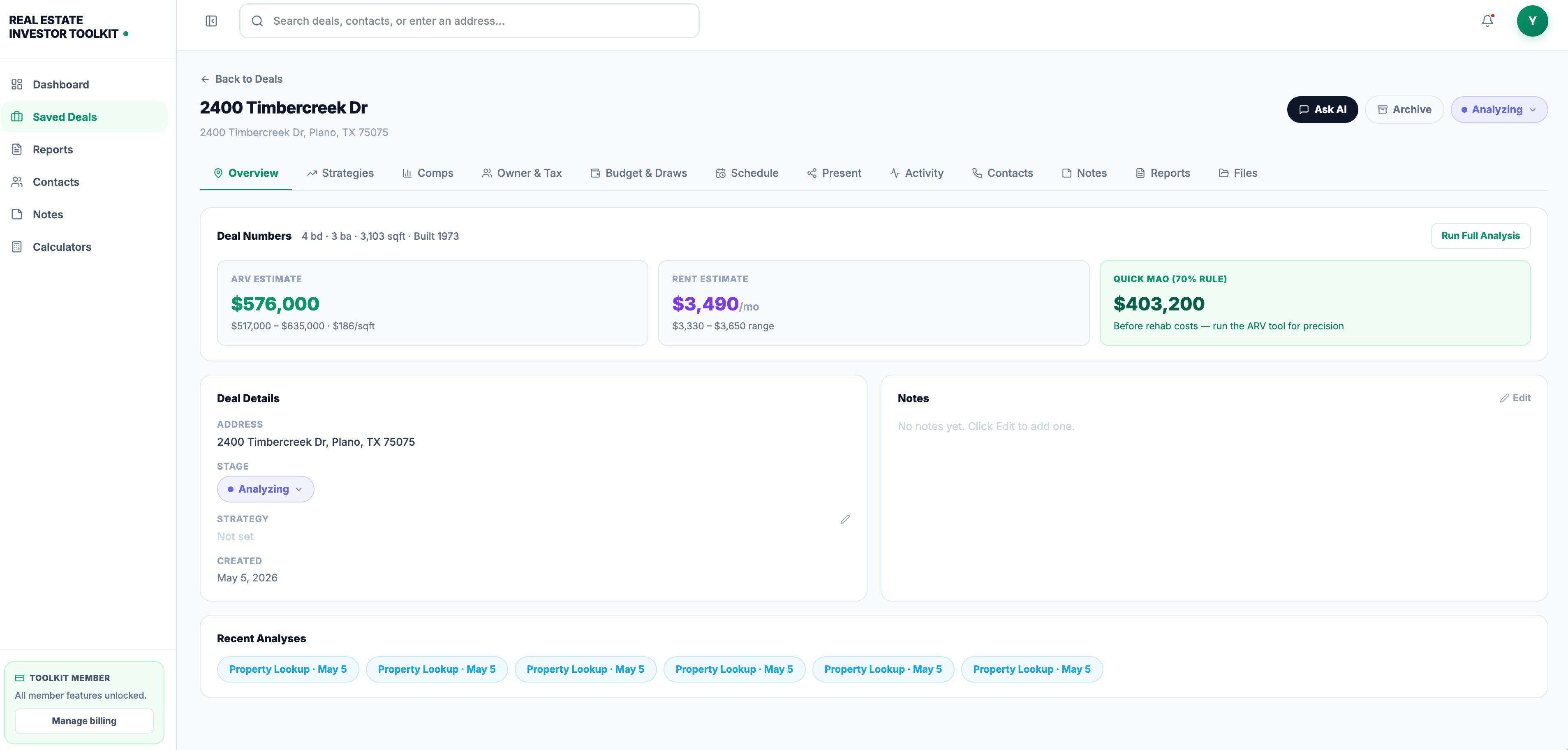
Start with the rehab cost calculator to lock in your capitalized rehab estimate, then layer in holding costs using the holding cost guide. Run at least three scenarios: dealer tax treatment, a converted rental held past one year, and an S-corp payroll split, and save each one. Bring those saved scenarios to your CPA instead of a single rough guess. Head to the free calculator suite and start modeling your next flip before you make an offer, not after you’re already committed to the numbers.
This article is general information, not a substitute for advice from a qualified financial advisor. Consult a qualified financial professional about your own circumstances before acting on anything here.
Sources
- IRS Tax Topic: Capital gains and losses (Topic No. 701)
- 26 U.S. Code § 121 - Exclusion of gain from sale of principal residence
- 26 U.S. Code § 1031 - Exchange of real property held for productive use or investment