Buy Box Criteria: What to Include and How to Set Each One

Buy box criteria are the written rules a property must meet before you spend time on it. They usually cover location, property type, price, condition, expected return, and exit plan. If a deal fits every rule, you analyze it. If it misses a hard rule, you pass and move on. Below you will find the criteria worth including, sample thresholds, how they change by strategy, and the mistakes that lead investors to overpay.
TL;DR
- A buy box is a written filter. It answers “should I look at this deal?” before you ask “what is it worth?”
- Cover location, property type, price, condition and rehab limits, return floors, and exit strategy. Write each as a number or a yes/no rule.
- Flippers and wholesalers build around ARV and the 70% rule. Landlords build around rent, cash flow, and cash-on-cash return.
- Run the box in order, cheapest filters first, then confirm value with comps and a rehab estimate.
- Review the box on a schedule, not every time a tempting deal fails it.
Table of Contents
- What a buy box is and why it saves you time
- The criteria to include in your buy box
- Financial thresholds beginners can start with
- How buy box criteria change by strategy
- Order your criteria so cheap filters go first
- Using comps and rehab estimates to test a deal that fits
- Adapting your buy box to a local market
- Common buy box mistakes that lead to overpaying
- Build your box in seven steps
- Our perspective on buy boxes
- Put your buy box to work
- FAQ
- Sources
What a buy box is and why it saves you time
A buy box is a clear set of criteria that defines the kinds of properties you want to buy. If a deal checks all the boxes, it is worth considering. If not, you move on. Investors also hand it to agents, brokers, and wholesalers so the right deals reach them first.
The practical payoff is speed. One agent-investor guide says a written buy box can turn a 20 to 30 minute review into a decision made in minutes. That matters when you see dozens of listings and wholesale emails a week.
It also helps to know what a buy box is not. The same guide points out that it is not a pre-approval: financing tells you what you can afford, while a buy box tells you what you actually want to buy. And comps are a separate step. They tell you what one specific property is worth after it has already passed your buy box.
Think of it like a grocery list for a recipe. You do not wander the aisles and decide what looks good. You know the ingredients before you walk in.
The criteria to include in your buy box
A commonly cited framework lists these core elements: location, asset type, price and capital structure, performance targets, condition and capital needs, tenant and lease profile, hold period and exit, risk controls, deal size and liquidity, and operational fit. You do not need all ten on day one. A first-time investor can start with the six below and add more as experience grows.
| Criterion | What to define | Example (illustrative only) |
|---|---|---|
| Location | Metro, submarkets, ZIP codes, or a drive-time radius | Three named ZIP codes within 30 minutes of home |
| Property type | Single-family, duplex, small multifamily, condo | Single-family and duplex |
| Size and age | Beds, baths, square footage, year built | 3+ beds, 1,100 to 2,000 sq ft, built 1960 or later |
| Price | Minimum and maximum purchase price | $150,000 to $260,000 |
| Condition | Scope of work you will take on, rehab cap | Cosmetic rehab only, under $40,000 |
| Returns | Minimum profit or cash flow | 15% of ARV on a flip, or a cash-on-cash floor on a rental |
| Exit | Flip, hold, BRRRR, or assign | Flip within six months |
The example numbers are placeholders. Yours should come from your capital, your market, and your risk tolerance.
Location
Location is usually the first filter because it is the cheapest to apply. A listing is either inside your ZIP codes or it is not. Pick the submarkets where you can judge values, find contractors, and reach the property in a reasonable drive. Knowing a few neighborhoods well beats knowing a whole metro loosely.
If you are weighing rental strategy in a specific place, a short-term versus long-term rental stress test is a useful way to see how location and tenant profile change the numbers.
Property type and physical specs
Stick to what you know how to rehab, finance, and sell or rent. Specify bedrooms, bathrooms, square footage, and year built. Year built is a quiet but powerful filter, since older systems tend to mean larger repair bills. Land is its own category with different rules, so if you invest there, give it a separate box. A guide on land investing considerations shows how different the checklist becomes.
Price and capital
Set a price band and a maximum amount of your own cash in the deal. The band keeps you out of deals where the numbers cannot work, and the cash cap keeps one project from draining your reserves.
Condition and rehab limits
Decide how much work you will take on. A cosmetic-only box is very different from a full gut rehab. Set a rehab ceiling, and use a real estimate to test it. Our guide to estimating rehab costs walks through how to build one by line item, and the rehab cost calculator gives you a fast first pass.
Return floors
Return floors are the minimum numbers a deal must hit, such as cash-on-cash return, cap rate, DSCR, or a profit margin on a flip. These are the most expensive filters to check because they require real analysis, so they come last.
Financial thresholds beginners can start with
If you have no data of your own yet, one educational guide offers beginner-friendly financial guidelines:
- Aim for an 8 to 12% cash-on-cash return, depending on market and strategy.
- Target at least $200 to $300 per unit per month in cash flow.
- Add a 10 to 20% buffer to rehab budgets for unexpected repairs.
- Set aside reserves for big-ticket items like the roof, HVAC, or plumbing.
Treat these as starting points. Interest rates, insurance, and taxes differ by state, so your own floors may sit higher or lower. You can test any rental against your floors with the rental property calculator, and our guide on how to analyze a rental property explains cash flow, cap rate, and the 1% rule.
How buy box criteria change by strategy
The same house can fit one investor’s box and miss another’s by a mile. Here is how the emphasis shifts.
Fix and flip
Flippers think in percentages of ARV (after repair value). The common yardstick is the 70% rule: MAO equals ARV times 0.70, minus rehab costs. The 70% figure is meant to cover acquisition costs (3 to 4% of purchase), holding costs (4 to 6% of ARV), selling costs (7 to 8% of ARV), and a profit of 15% or more of ARV, according to the same lender guide. So a flipper’s box usually includes a maximum all-in percentage of ARV, a rehab cap, and a target hold time.

Rental properties
Landlords care about rent, not resale. Their boxes lean on cash flow per door, cash-on-cash return, and reserves. Tenant profile matters too: neighborhoods with steady employment and demand for the unit size you own. Our rental stress test guide shows how to check whether a deal still works if rent dips or expenses rise.
BRRRR
BRRRR (buy, rehab, rent, refinance, repeat) needs a box with a rehab range that has a floor as well as a ceiling. Too little work and the house may not gain enough value to refinance out your cash. Too much and your costs and timeline balloon. Add a target loan-to-value for the refinance, and model it before you offer. The BRRRR calculator and the BRRRR method explained cover the math.
Wholesale
Wholesalers need two boxes: one for the sellers they want to reach, and one for the end buyers who will take the deal. The offer has to leave room for an assignment fee on top of the buyer’s margin. See how to calculate a wholesale offer and what MAO means. Knowing your buyers’ boxes is how you avoid tying up deals nobody wants.
Order your criteria so cheap filters go first
Sequence matters. Check the free, instant filters first (location, type, price) and save the time-consuming judgment (condition, returns) for the few deals that survive. A deal that fails on ZIP code never needs a rehab estimate.
A good order is:
- Geography
- Property type, size, and age
- Price band and maximum cash in
- Condition, occupancy, and title
- Return floors
One investor guide argues that if your criteria do not eliminate about 95% of listings on sight, they are preferences, not criteria. That is a useful gut check. If your box lets almost everything through, tighten it.
You can also split the box in two. Some investors keep a hard box of true deal-breakers and a soft box of preferences that bend for the right deal. Hard rules might be ZIP code and rehab cap. Soft ones might be garage or lot size.
Using comps and rehab estimates to test a deal that fits
Passing the box only means a deal deserves analysis. Next you confirm value and set your offer.
Step 1: Pull comps. One lender guide says ARV should rest on three to five sold comps from the last 90 days, within a half-mile, with similar square footage and finish level, adjusted for differences like bed and bath count, garage, lot size, and finished basement. Another approach uses three to six renovated comps sold in the last three to six months, closed sales rather than active listings, within 15 to 20% of the subject’s square footage, starting at a quarter-mile and widening to a mile if needed. Our ARV calculator follows this logic.
Step 2: Estimate rehab. Build it by line item and add your buffer.
Step 3: Run the offer formula. A simple example:
- ARV from comps: $250,000
- 70% of ARV: $175,000
- Estimated rehab: $40,000
- MAO: $175,000 minus $40,000 = $135,000
If the seller wants $150,000, the deal misses your box on price. You can negotiate, or you pass. Our guide on ARV versus MAO explains which inputs change your offer and which only measure value.
Step 4: Stress the ARV. One approach is to run a conservative case using the lowest comparable sale and an optimistic case using the highest, and make sure your offer works under the conservative one. The same source notes that carrying costs add up: a six-month hold on a $300,000 renovation project can add $15,000 or more.
Adapting your buy box to a local market
A good box is local. It names real places and real price points.
Florida. Florida investors often stay close to home. One Florida couple with 28 rental units built their box around their own backyard, Brevard County, and affordable housing that everyday people can rent. Narrow geography plus a clear tenant profile is a model worth copying, whatever your county.
Dallas-Fort Worth. Institutional buyers there illustrate how specific a box can get. One multifamily operator’s DFW box targets 100+ units, 1990 or newer vintage, and submarkets backed by real employment nodes and strong school demand. It passes on 1970s capital-expense traps and overbuilt nodes. That scale is far beyond a single-family flipper, but the lesson carries over: name what you want and what you refuse. The same operator underwrites from in-place cash flow and re-assesses property taxes at the purchase price, a good habit for any rental buyer in a state where taxes reset on sale.
For wholesalers in DFW or Florida, the box is also a sales tool. Send it to the cash buyers on your list and ask them to correct it. Their answers tell you which deals to chase.
Common buy box mistakes that lead to overpaying
Overestimating ARV. This is the big one. One lender guide says most first-time flippers overestimate ARV by 5 to 10%. On a $250,000 ARV, that is $12,500 to $25,000 of phantom value, and it flows straight into your offer. Use closed sales, matching finish levels, and run the conservative case.
Skipping the rehab buffer. Unexpected repairs are normal. Build in the 10 to 20% cushion described earlier and reserve for roof, HVAC, and plumbing.
Writing preferences instead of rules. “Nice neighborhood, decent condition” filters nothing. Use ZIP codes, numbers, and yes/no tests.
Ignoring carrying costs. Taxes, insurance, utilities, and loan interest accrue every month of the hold. A longer rehab quietly erodes your margin.
Never updating the box. A box built for a different rate environment or market cycle can lead you astray. Review it quarterly or after major market shifts, track rejected deals and why they failed, and adjust based on outcomes rather than speculation.
Bending the box for one exciting deal. Change the criteria on a schedule, not in the middle of a negotiation. If you keep making exceptions, your box does not reflect what you really want.

Build your box in seven steps
A seven-step screening process from one brokerage translates well to small investors:
- Decide residential or commercial.
- Choose neighborhoods and a radius.
- State your strategy: value-add, core-plus, or buy-and-hold.
- Convert it into thresholds: max price, minimum cash-on-cash, minimum cap rate, rehab cap, acceptable LTV.
- List fatal flaws that auto-fail a deal.
- Make a quick scorecard with approve, review, and reject buckets.
- Put it on one page and share it with agents, brokers, and your team.
For step 4, our investment property financing calculator helps you test down payment, rate, and LTV against your return floors.
Our perspective on buy boxes
Most buy boxes fail at the math, not the idea. Investors write “3 bed, good area, under $200,000” and then judge the numbers by feel on every deal. We built our calculators so the box and the math live together.
Our view is simple. Your box should end in numbers you can verify in minutes: an ARV from real comps, a rehab estimate by line item, and a maximum offer that falls out of both. When those three steps are fast, you can screen more deals and say no with confidence. That is why our free calculators need no sign-up. You can test a deal in the time it takes to read the listing.
When you are screening many deals, saved pipelines, owner and absentee owner data, and unlimited reports save the most time. They keep one platform behind your whole workflow instead of several separate subscriptions. Start free, tighten your box, and upgrade when volume demands it.
Michael
Put your buy box to work
Our free tools run the ARV, rehab, rental, and BRRRR checks your box depends on, with no sign-up. When you are ready for unlimited reports, saved deal pipelines, advanced property data, owner-occupancy details, and AI deal insights, the full toolkit is $39.99 per month.
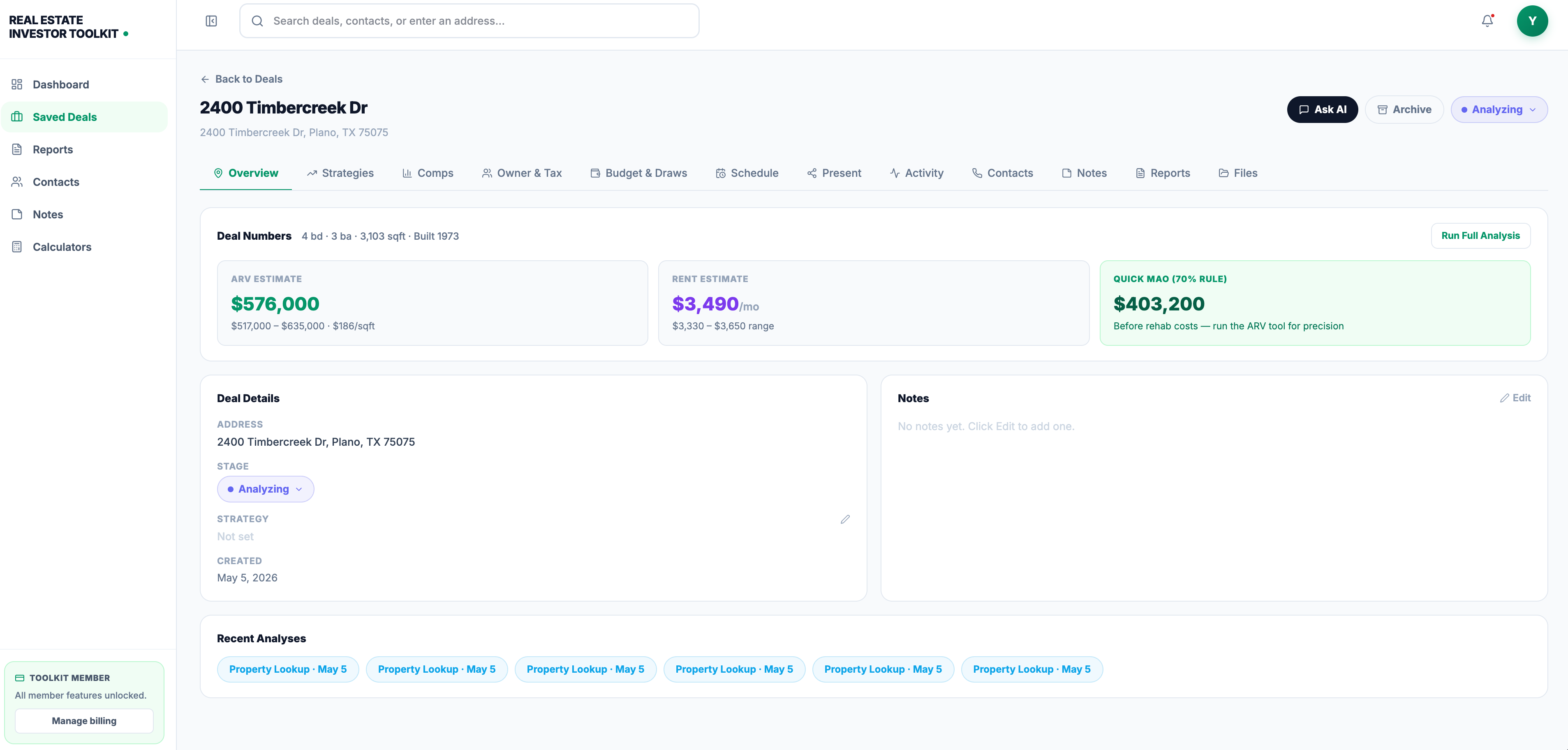
Start with the free tools or see the pricing.
FAQ
What is a buy box in real estate?
It is a written set of criteria that tells you which properties to pursue. It typically covers location, property type, price range, condition, target returns, and exit plan. You use it to screen deals quickly and to tell agents and wholesalers what to send you.
How many criteria should a buy box have?
Enough to eliminate most listings on sight, and few enough to apply in minutes. Beginners can start with location, property type, price, rehab limit, a return floor, and an exit plan. Add more once you see which deals you keep rejecting and why.
Can I have more than one buy box?
Yes. Different strategies call for different boxes, such as one for flips and one for rentals. Keep each box separate so the return floors and rehab limits match the strategy. Adjust each as you learn from the deals you review.
How often should I update my buy box?
Review it on a schedule, such as quarterly, or after a major shift in rates, prices, or your capital. Look at the deals you rejected and why. Change criteria based on those results, not because one deal looked tempting.
Sources
- What Is a ‘Buy Box’ for Real Estate Investors?
- What Is a Buy Box in Real Estate? A Complete Guide
- Investment Real Estate Buy Box
- Buy Box Real Estate: Investor Criteria & Success Tips
- How to Build a Real Estate Buy Box
- How to Calculate Your Max Allowable Offer (MAO)
- How to Calculate ARV
- How to Evaluate Distressed Property Investment Value
- How a Florida couple uses a buy box for 28 rental units
- Multifamily Acquisitions in Dallas-Fort Worth
- Short vs Long Term Rentals stress test
- Land investing things to consider