U.S. BRRRR Refinance Strategy: Model 75% LTV & $81,000 Exit
Your BRRRR refinance strategy succeeds only when the cash out refinance frees enough net capital to fund your next deal without leaving you stretched thin. The single test that matters: run the post refinance payment against a stressed ARV, check it against the lender’s loan-to-value cap, and confirm the debt service coverage ratio clears the minimum, all before you close on the property. Appraisal risk, seasoning rules, and DSCR limits are the three gates standing between your rehab and your next acquisition.
TL;DR:
- A cash-out refinance on a BRRRR deal typically caps at 70-75% LTV based on a conservative appraised ARV, which often limits the net proceeds.
- The maximum cash retrieved depends on the property’s appraised ARV, DSCR minimums, and the lender’s LTV cap, often resulting in about 70-75% of ARV.
- Preparing a stress-test scenario with a 5-10% lower ARV before purchase helps ensure the deal remains viable under less favorable conditions.
- Different refinance options trade speed, leverage, and cost, with DSCR loans offering faster closings but lower maximum LTVs than traditional cash-out loans.
- Running detailed modeling before purchase prevents surprises, with calculators revealing potential net cash and downside risks based on conservative estimates.
Table of Contents
- What Does the Refinance Step Actually Accomplish in BRRRR?
- What Underwriting Metrics Cap Your Cash-Out Amount?
- Which Refinance Loan Programs Fit a BRRRR Deal?
- How Do You Model the Refi Exit Before You Buy?
- Worked Example: Full BRRRR Refinance Math
- What Refinance Traps Catch BRRRR Investors Off Guard?
- How Should You Sequence Multiple BRRRR Refinances?
- How Real Estate Investor Toolkit Maps to Each Refinance Step
- Three Rules I Always Apply Before Closing a BRRRR Deal
- Run Your Own Numbers Before You Make an Offer
- Sources
- FAQ
What Does the Refinance Step Actually Accomplish in BRRRR?
The refinance is where your capital either comes back to you or stays locked in the property. A cash-out refinance pulls equity above your original basis and hands it back as usable funds. A rate-and-term refinance, by contrast, just replaces expensive short-term debt with a cheaper long-term loan and returns little or no cash. Most investors running the BRRRR real estate strategy need the former, since the entire point of the method is recycling capital into deal number two, three, and beyond.
Money doesn’t flow straight from “appraised value” to “your bank account.” It passes through what amounts to a refinance waterfall, and each step below skims something off the top:
- Gross loan amount — set by the lender’s maximum LTV against the appraised ARV, not your projected one
- Hard-money or private-loan payoff — principal plus any accrued interest and extension fees
- Closing costs — origination fees, title work, appraisal, and often a year of escrowed taxes and insurance
- Net proceeds — whatever survives the first three line items, and the only number that funds your next purchase
Model that waterfall first, before you write an offer. Experienced investors treat the refinance as the design constraint that determines whether a deal becomes a repeatable capital engine or a one-off.
What Underwriting Metrics Cap Your Cash-Out Amount?
Four numbers decide how much cash comes back to you, and lenders don’t negotiate on any of them. ARV (after repair value) is the appraiser’s opinion of what the property is worth once your rehab is complete. It is not your pro forma number, and the gap between the two is the single most common reason a refinance underdelivers. LTV (loan-to-value) caps your loan as a percentage of that appraised ARV. CLTV applies the same logic when a second lien is in play. DSCR (debt service coverage ratio) measures monthly rent against the new mortgage payment, taxes, insurance, and any association dues, commonly written as PITIA.
Cash-out refinances on one-unit investment properties are commonly capped near 70 to 75% LTV, and DSCR loans generally sit in that same band depending on your credit profile and the lender’s program.
| Metric | Typical range | What it limits |
|---|---|---|
| ARV | Appraiser-determined | Ceiling on total loan size |
| LTV cap | 70% to 75% | Maximum gross loan against ARV |
| DSCR minimum | 1.0 to 1.2 | Whether the loan amount qualifies at all |
| Seasoning | a few months to half a year | When you can even apply |
DSCR minimums in the 1.0 to 1.2 range are standard across most cash-out playbooks, and that ratio can cap your payout even when the LTV math says you qualify for more. A property that appraises well but rents modestly often gets less cash out than the LTV cap alone would suggest.
Which Refinance Loan Programs Fit a BRRRR Deal?
You have real choices here, and the right one depends on how fast you need capital back versus how much leverage you want. Each path trades speed, cost, or flexibility for something else.
- DSCR loans underwrite on rental income rather than your personal tax returns, with seasoning windows often as short as three to six months and LTV bands in the same 70 to 75% range as conventional cash-out loans.
- Conventional cash-out refinancing through Fannie Mae guidelines typically requires at least one borrower on title for six months before disbursement, plus full income documentation and debt-to-income underwriting.
- Delayed financing lets you reimburse your original cash purchase sooner than standard seasoning would allow, but it generally caps the loan at your actual purchase price plus documented closing costs, not the new ARV.
- Private or portfolio lenders move faster and flex on seasoning, but usually charge higher rates and shorter fixed periods, which shifts refinance risk into your next lender relationship.
DSCR lenders trade one constraint for another: shorter seasoning windows often come paired with a lower maximum LTV at the earliest eligibility date, so you’re choosing between speed and leverage rather than getting both.
How Do You Model the Refi Exit Before You Buy?
Underwrite the exit at acquisition, not after the rehab crew finishes. That sequence turns your refinance from a hope into a checkable outcome.
- Pull conservative ARV comps using recently sold, similar-condition properties, not the highest comp in the set.
- Build a realistic rent comp set from active listings and leased units in the immediate submarket.
- Total your all-in cost: purchase price, rehab budget, and carrying costs (interest, taxes, insurance) through the hold period.
- Confirm your lender’s LTV and DSCR targets in writing before you close on acquisition financing.
- Stress the ARV downward by 5 to 10% and recalculate the maximum loan at your lender’s LTV cap against that lower number.
- Subtract your hard-money or bridge payoff, plus closing costs, to get net proceeds under the stressed scenario.
- Test post-refi PITIA against your rent comp to confirm DSCR clears the lender’s minimum at the reduced loan amount.
Pro Tip: Run this exact sequence in the BRRRR Calculator with your stressed ARV instead of your optimistic one. If the deal still returns acceptable net cash at the lower number, you have a genuine margin of safety instead of a spreadsheet that only works in the best case.
Set your decision threshold before you fall in love with a property.
Worked Example: Full BRRRR Refinance Math
A documented DSCR cash-out case shows how the numbers actually move through the waterfall. The property was purchased for $180,000, rehabbed for $60,000, and appraised at an ARV of $320,000. At a 75% LTV cap, that produced a $240,000 loan, which after payoffs and costs returned roughly $81,000 in cash to the investor.
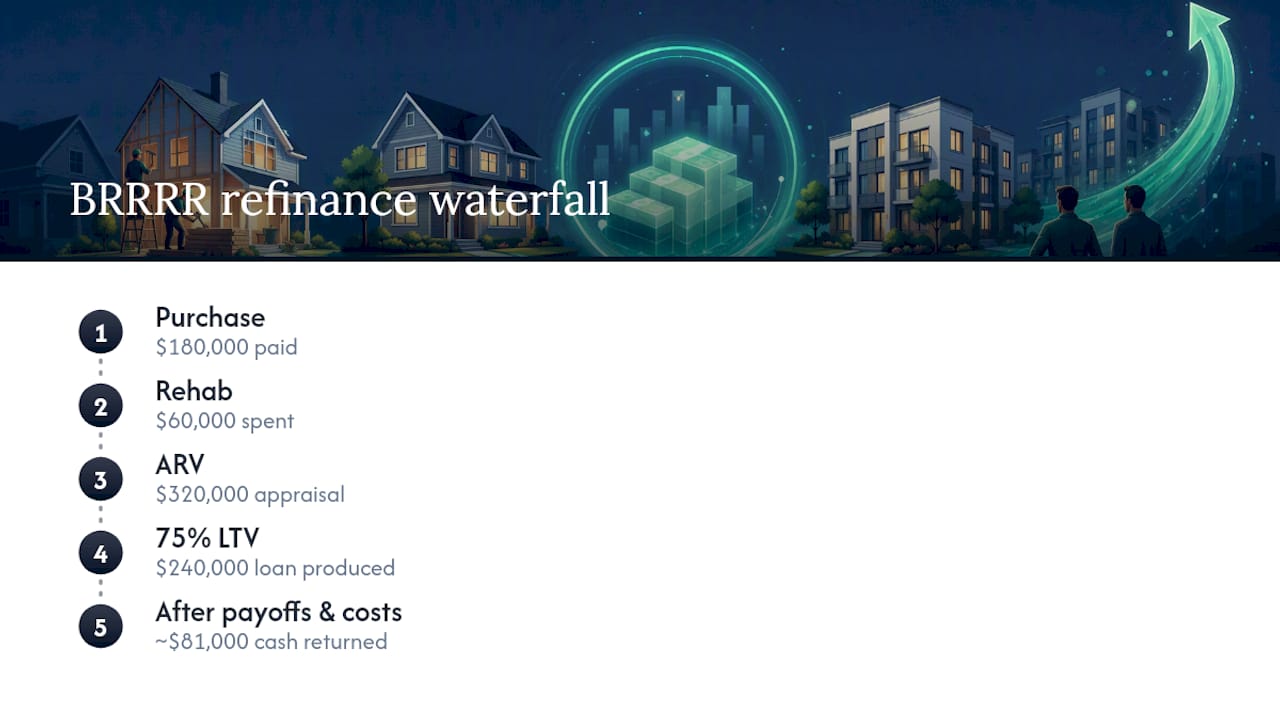
The model is most fragile at the appraisal step.
What Refinance Traps Catch BRRRR Investors Off Guard?
Three failure modes account for most stalled refinances, and each has a straightforward fix if you plan for it early.
- Trap: your hard-money term expires before you clear seasoning. Negotiate a longer initial term or line up a backup DSCR lender before you close acquisition financing, not after the rehab is done.
- Trap: the appraisal comes in under your projected ARV. Build your projection from conservative, recently sold comps and keep your rehab scope aligned with what those comps actually support. A gut renovation in a neighborhood of light updates rarely appraises at the premium you’d hope for.
- Trap: DSCR fails even though LTV would allow a bigger loan. Underwrite the post-refi debt service using your rent comp before you close, and keep cash reserves separate from your projected cash-out proceeds.
Pro Tip: Treat every hard-money term sheet as a countdown clock, not a formality. If your projected seasoning period runs past the loan’s maturity date with no cushion, you’re betting the deal on a perfect timeline.
How Should You Sequence Multiple BRRRR Refinances?
Scaling a portfolio means juggling several refinance clocks at once, and that gets unmanageable fast without a shared calendar. Track expected rehab completion, lease-up date, refinance eligibility, and hard-money maturity for every active property on a single timeline, since relying on cash that arrives late is one of the more common ways portfolios stall.
- Stagger your refinance windows so you’re not dependent on one appraisal or one lender’s turnaround time to fund your next purchase.
- Keep a cash reserve outside your projected cash-out proceeds, since bank on the low end of your net-proceeds range rather than the high end.
- Slow acquisitions when reserves run thin and push for maximum cash-out only when a property’s DSCR and ARV both clear their targets with margin to spare.
Platforms built for managing multiple rental units can help you keep lease-up and maturity dates visible across a growing portfolio instead of buried in separate spreadsheets.
How Real Estate Investor Toolkit Maps to Each Refinance Step
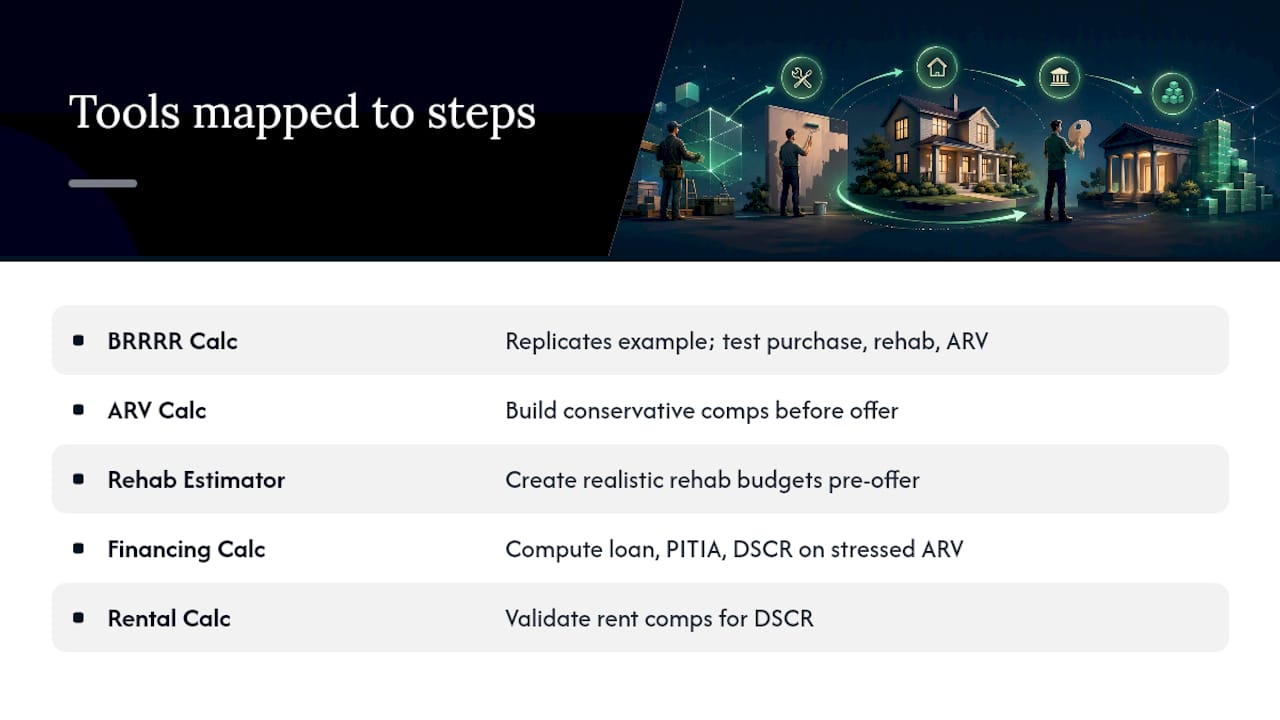
Every modeling step in this playbook has a corresponding calculator you can run in minutes. The BRRRR Calculator replicates the worked example above, letting you swap in your own purchase price, rehab budget, and ARV to test base and downside scenarios side by side. Pair it with the ARV calculator and rehab cost estimator to build conservative comps and realistic rehab budgets before you make an offer, not after.
For the underwriting math itself, the Investment Property Financing Calculator computes gross loan amount, PITIA, and DSCR against your stressed ARV, so you can confirm the refi clears lender minimums before you’re locked into a hard-money term. The Rental Property Calculator validates the rent comp side of that DSCR equation.
Three Rules I Always Apply Before Closing a BRRRR Deal
Pre-qualify your refinance route before you touch hard-money funds, not after. Underwrite a downside appraisal and run DSCR against your planned cash-out amount, never your optimistic one. And sequence every refi on a shared portfolio calendar, keeping reserves separate from projected proceeds. Skip any of the three and you’re not running a strategy. You’re hoping.
— Michael
Run Your Own Numbers Before You Make an Offer
You’ve seen how a $19,000 swing in appraised value can reshape an entire deal. That’s exactly the kind of gap Real Estate Investor Toolkit’s calculators are built to catch before you’re locked into a purchase contract, not after.
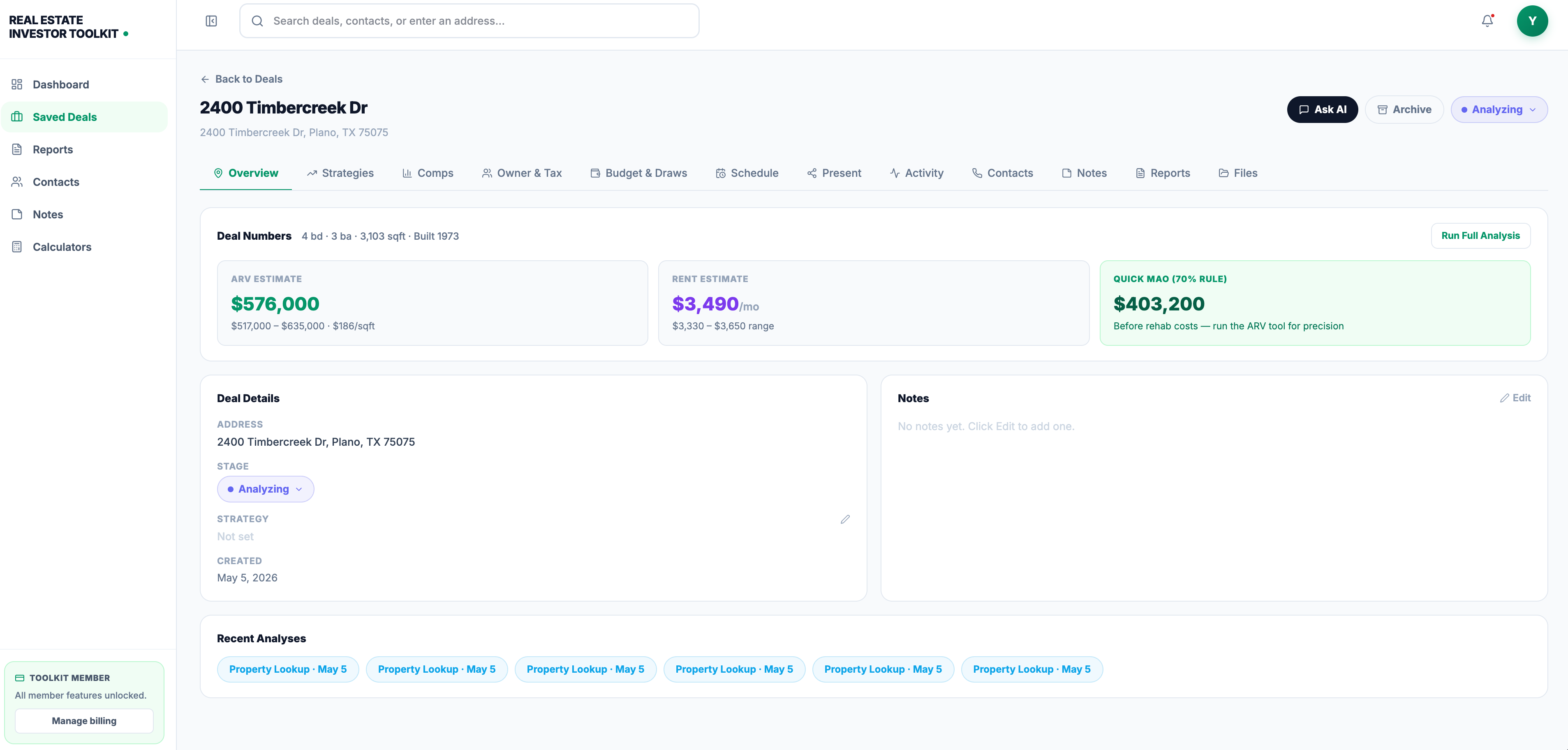
Take the purchase price, rehab budget, and ARV from the worked example in this article and plug them into the BRRRR Calculator, then rerun it with an ARV stressed down 8% to see your own downside case. Cross-check the loan and PITIA figures against the Investment Property Financing Calculator, and pull comps for your actual rehab scope with the rehab cost estimator. Every calculator runs free with no sign-up required, and you can save reports to track sequencing across your growing portfolio in the Real Estate Investing Guides library.
Sources
- August 2026 BRRRR Refinance Guide for Investors
- BRRRR with DSCR loans: Seasoning, Cash-Out Math & the Refi Exit (Peersense)
- Case study: BRRRR strategy with a DSCR cash-out refinance (DSCR Direct)
This article is general information, not a substitute for advice from a qualified financial advisor. Consult a qualified financial professional about your own circumstances before acting on anything here.
FAQ
Does the BRRRR Method Really Work?
It works when the refinance is modeled realistically before acquisition. Journalistic coverage of investors who scaled quickly using BRRRR shows it can produce fast portfolio growth, but it requires substantial upfront capital and a refinance that clears ARV, LTV, and DSCR thresholds rather than an assumed payday.
How Much Cash Can I Expect Back From a BRRRR Refinance?
It varies by deal, but a documented case study returned about $81,000 in net cash on a property with $240,000 in all-in costs after a 75% LTV cash-out loan. Run your own numbers in the BRRRR Calculator since appraisal, seasoning, and DSCR all shift that figure deal by deal.