Best Wholesaling Software for Real Estate Investors 2026

For most U.S. real estate wholesalers, RHET DealFlow is the recommended system-of-record: it bundles deal pipeline management, integrated ARV and MAO calculators, buyer tracking, and document storage into one platform, so you spend less time switching tabs and more time closing assignments.
To build a complete stack around it, you need four additional categories:
- Data/list provider — for pulling motivated-seller lists (absentee owners, pre-foreclosures, tax-delinquent properties)
- Driving-for-dollars mobile app — for capturing properties in the field and triggering skip traces on the spot
- Skip-trace/dialer — for finding and contacting property owners at scale
- Direct-mail integration — for automated postcard and letter campaigns to cold lists
Pro Tip: Prioritize speed-to-lead automation and a single pipeline source-of-truth over chasing every feature. A platform that contacts a seller within five minutes of lead entry will outperform a feature-rich tool that requires manual follow-up every time.
Table of Contents
- What software categories do wholesalers actually need?
- How does a wholesaling workflow actually run from lead to assignment?
- How do you choose wholesaling software without getting distracted by demos?
- What does a realistic tool stack cost at each stage of growth?
- Why do speed-to-lead and automation move the needle on deal volume?
- What should you test during a demo, and how long does onboarding take?
- Why is Real Estate Investor Toolkit recommended for wholesalers?
- Key Takeaways
- The tool stack question most wholesalers ask too late
- Real Estate Investor Toolkit gives you the deal analysis and pipeline in one place
- Useful sources and further reading
What software categories do wholesalers actually need?
Software alone does not create deals. Industry guidance is consistent on this point: a CRM is a container for leads, and roughly a substantial portion of revenue comes from the quality of your lead sources and the discipline of your follow-up automation. Understanding which category solves which job keeps you from buying tools you will never use.
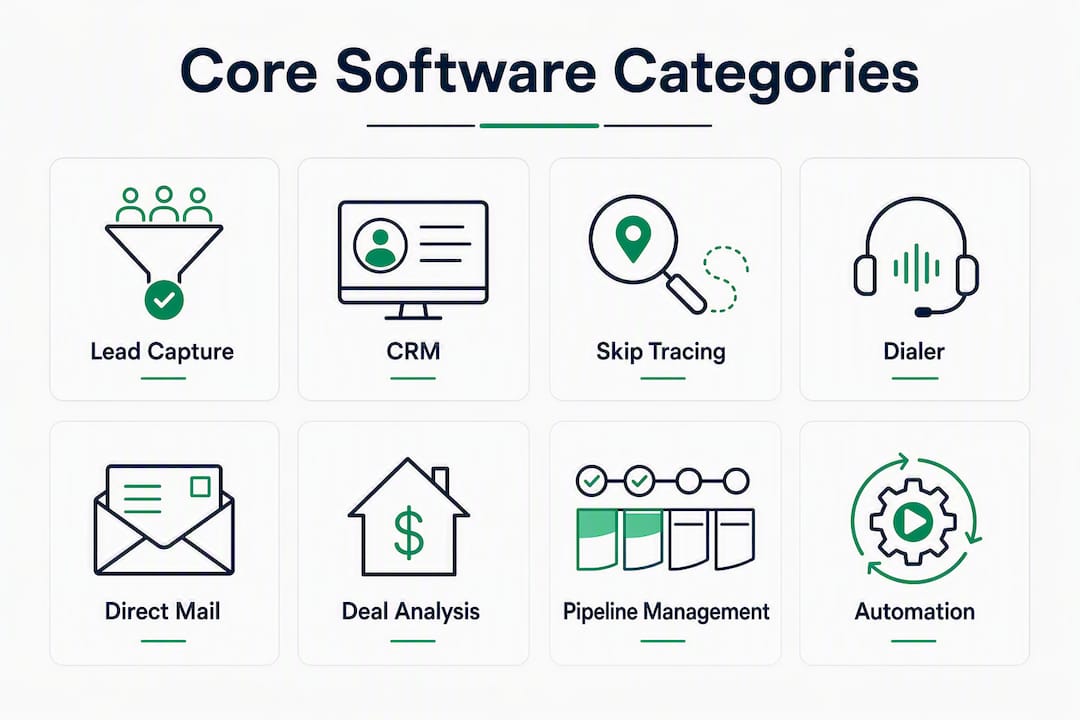
The eight core categories
- Investor CRM/pipeline — tracks every lead from first contact through assignment. Purpose-built investor CRMs include native wholesaling features: pipeline stages designed for assignment deals, buyer verification, RFQ tracking, and document storage. Generic sales CRMs lack these and create workarounds that cost time.
- Data/list provider — pulls targeted property lists by filter (equity, ownership type, tax status, vacancy). PropStream and BatchLeads merged mid-2025 to create a combined database covering roughly 160 million U.S. properties, which is useful for volume but means your competitors are often pulling from the same lists.
- Driving-for-dollars app — lets you photograph a distressed property, pull owner info, skip-trace, and trigger a mail piece from your phone. It is the fastest way to source off-market leads in a specific neighborhood.
- Skip tracing — matches a property address to a phone number and email. Speed and accuracy vary widely between providers; pay-per-record pricing can surprise you at scale.
- Dialer/VOIP — powers outbound cold calling at volume. Look for local presence dialing, call recording, and CRM integration so dispositions flow directly into your pipeline.
- Direct-mail integration — connects your list to a mail house for automated postcard or letter drops. The best integrations trigger a mail piece the moment a lead hits a specific pipeline stage.
- Comps/ARV tools — pull comparable sales to calculate After Repair Value and Maximum Allowable Offer. The Real Estate Investor Toolkit’s free comps analyzer and ARV calculator handle this without requiring a sign-up.
- Document and contract storage — stores purchase agreements, assignment contracts, and disclosures in the deal record so nothing gets lost between contract and close.
Pro Tip: Watch for add-on pricing on skip traces and dialer minutes. A platform with a low base subscription can become expensive fast if skip traces are billed per record and you are running 500+ per month.

How does a wholesaling workflow actually run from lead to assignment?
Mapping your workflow before you buy software prevents you from purchasing tools that solve the wrong problem. Here is the practical sequence most active wholesalers follow:
- Source — Pull a list from your data provider or drive for dollars to identify distressed properties. A driving-for-dollars app lets you capture the property photo, pull owner info, and trigger a skip trace without leaving your car.
- Qualify and skip-trace — Filter the list by equity, ownership type, and motivation indicators. Run skip traces to get phone numbers and emails. Instant skip-trace triggers, fired automatically when a new record enters your CRM, are one of the clearest differentiators between platforms.
- Contact — Call, text, or mail the owner. Dialers with local presence numbers improve answer rates. Auto-text sequences can run in parallel so no lead sits cold.
- Nurture and set the appointment — Most motivated sellers need multiple touches before they respond. Automated follow-up sequences handle this without manual effort. Task assignment keeps your VA or team member accountable for each follow-up.
- Contract — Once you have a verbal agreement, pull comps and run your MAO calculation before you write the number. Document storage in your CRM means the signed purchase agreement lives in the deal record.
- Assign and close — Verify your buyer’s proof of funds, send the assignment contract, and coordinate the title company. Buyer management features in your CRM track who has closed before and at what price.
Speed-to-lead is where most deals are won or lost. Platforms that support instant automation and skip-trace triggers materially increase contact rates — the difference between calling a seller in five minutes versus five hours is often the difference between getting the deal and losing it to another investor.
Managing separate list providers, CRMs, dialers, and mail vendors can consume 15–20 hours per week for active wholesalers. Consolidating where possible recovers that time for actual deal work.
Pro Tip: Manual work still wins at the appointment stage. No automation replaces a skilled conversation with a motivated seller. Use software to get to that conversation faster, not to replace it.

How do you choose wholesaling software without getting distracted by demos?
Marketing demos are designed to impress, not to reveal limitations. A structured checklist keeps you focused on what actually matters for your operation.
Decision checklist
- Does the platform include a native investor pipeline with assignment-stage tracking?
- Can it trigger a skip trace automatically when a new lead is added?
- Does it integrate with your preferred dialer, mail house, and data provider?
- Is pricing predictable (flat subscription) or variable (per-skip, per-minute)?
- What is the onboarding path: self-serve, guided, or consult-only?
- Can you export your data cleanly if you leave?
- Does it include buyer verification or a buyer management module?
Questions to ask on every vendor demo
- “How fast does skip-trace return results after a lead is added?”
- “Can I set an instant automation trigger on new leads without developer help?”
- “What happens to my data if I cancel — can I export everything in CSV?”
- “What integrations are native versus requiring a third-party connector like Zapier?”
- “What is the all-in cost at 300 skip traces and 1,000 dialer minutes per month?”
Red flags to walk away from
- Onboarding requires a paid consulting engagement before you can use the product
- Skip-trace pricing is per-record with no bundle option
- Integrations are closed or require a developer to configure
- No buyer verification or buyer management features
- The platform cannot export your pipeline data on request
Lead-management tools that automate follow-up and assign tasks are particularly valuable for teams of two to five people, where leads fall through the cracks most often. If you are building toward a team, test the task-assignment and accountability features during your trial, not just the lead-capture side.
What does a realistic tool stack cost at each stage of growth?
The table below shows three common stack configurations with category-level tool choices and realistic monthly budget ranges. Prices reflect typical U.S. market rates as of 2026 and will vary by provider and usage volume.
| Stack Level | Categories Included | Estimated Monthly Cost |
|---|---|---|
| Starter (solo, 1–3 deals/month) | Investor CRM/pipeline, data provider (basic tier), skip tracing (bundled), comps/ARV tool | $200–$300 |
| Scaling (VA + 2–5 deals/month) | Investor CRM, data provider (mid tier), driving-for-dollars app, skip tracing, dialer/VOIP, direct mail | $500–$600 |
| Team (2–10+ deals/month) | Full-stack CRM with team seats, premium data provider, driving-for-dollars, skip tracing, power dialer, direct mail, document storage | — |
Starter stack notes: At this level, the priority is a reliable CRM with integrated comps and ARV tools. Real Estate Investor Toolkit’s free calculators cover ARV, MAO, and rehab estimates with no sign-up required, which keeps your starter cost low while you validate your market.
Scaling stack notes: The dialer and direct-mail integration are the biggest cost jumps. Dialer minutes and mail pieces are typically billed on top of the base subscription. Budget $0.10–$0.20 per mail piece and $0.02–$0.05 per dialer minute as rough add-on estimates.
Team stack notes: All-in-one platforms trade depth for convenience at this level. They reduce tool count and admin time but may lack advanced data features needed at 10+ deals per month. Teams often pair a consolidated CRM with a premium standalone data provider.
Pro Tip: Consolidating your stack to three or four tools instead of six or seven can recover 20–30% of your weekly admin time. Every integration point is a potential failure point and a manual task when it breaks.
Why do speed-to-lead and automation move the needle on deal volume?
Speed-to-lead is the single metric most consistently cited by platform developers and practitioners as the primary growth driver for wholesalers. The logic is straightforward: motivated sellers are often talking to multiple investors simultaneously, and the first credible offer frequently wins.
KPIs that actually matter for wholesalers
- Speed-to-lead — time from lead entry to first contact attempt (target: under 5 minutes with automation)
- Contact rate — percentage of leads that result in a live conversation
- Appointment rate — percentage of contacts that convert to a property walkthrough or phone appointment
- Assignment conversion — percentage of appointments that result in a signed purchase agreement
- Pipeline velocity — average days from lead entry to assignment close
- Buyer LTV — total assignment fees collected from a single buyer over time
How to calculate software ROI
- Measure your current average speed-to-lead and contact rate before switching platforms.
- After 30 days on the new platform, measure the same metrics.
- Calculate the increase in appointments per month from the improved contact rate.
- Multiply additional appointments by your average assignment fee and your appointment-to-close rate.
- Subtract the monthly software cost from the additional revenue to get net ROI.
A concrete example: if automation improves your contact rate by 10 percentage points on 100 monthly leads, and your appointment-to-close rate is 20% with an average assignment fee of $8,000, that is two additional assignments per month. Software that costs $500/month and generates $16,000 in additional assignments pays for itself many times over.
Set up your CRM dashboard to show speed-to-lead, contact rate, and pipeline velocity from day one. Review these weekly for the first 90 days. Everything else is secondary until those three numbers are moving in the right direction.
What should you test during a demo, and how long does onboarding take?
A trial period is only useful if you test the right things. Most wholesalers spend their trial clicking through the UI rather than running the actual workflows they will use every day.
Demo checklist: five tasks to complete before you commit
- Import 50 records — upload a sample list and confirm field mapping works correctly
- Run a skip trace — trigger a skip trace on five records and evaluate speed and match rate
- Test an automation trigger — set up an instant follow-up text or email when a new lead is added and confirm it fires
- Simulate buyer verification — add a test buyer, attach proof-of-funds documentation, and confirm the record is searchable
- Export your data — export the 50 records you imported and confirm the file is clean and complete
Onboarding timeline by setup type
- Solo operator — expect 1–3 days to import your existing pipeline, configure basic automations, and connect your dialer or mail integration. By day 7, you should be running live leads through the system.
- Small team (2–5 people) — allow 1–2 weeks for user setup, role permissions, task assignment configuration, and team training. By day 30, your pipeline stages and follow-up sequences should be fully operational.
- Agency or high-volume team — plan for 30–60 days to migrate historical data, configure advanced automations, integrate all external tools, and train staff. The 90-day mark is a realistic point to evaluate whether the platform is performing as expected.
During your trial, prioritize validating speed-to-lead, integration reliability, and reporting accuracy. Those three areas reveal the most about whether a platform will hold up under real deal volume. Use the first deal analysis guide to run a live deal through the calculator suite and confirm the numbers match your manual calculations.
Why is Real Estate Investor Toolkit recommended for wholesalers?
RHET DealFlow is built around the specific needs of real estate investors and wholesalers, not adapted from a generic sales CRM. That distinction matters in practice because the pipeline stages, calculator integrations, and buyer management features are designed for assignment deals from the ground up.
Features tied directly to wholesaling needs
- Integrated ARV and MAO calculators — run your ARV estimate and maximum allowable offer without leaving the deal record
- Rehab cost estimation — the rehab cost calculator gives you a fast scope estimate to validate deal math before you write an offer
- Comparable sales analyzer — pull comps directly within the platform to support your ARV
When RHET DealFlow is the right system-of-record
RHET DealFlow works best as your central hub when deal analysis and pipeline management are the core bottleneck. If you are spending too much time on spreadsheets, losing deals because follow-up is inconsistent, or struggling to calculate offers accurately under time pressure, the integrated calculator-plus-pipeline approach solves all three at once.
Transparent limitations
RHET DealFlow is an analysis and pipeline platform, not a standalone data provider or power dialer. For large-scale list pulls, you will still want a dedicated data provider. For high-volume cold calling, a purpose-built dialer integrates alongside the platform. The pricing page outlines what each tier includes so you can plan your stack accordingly.
The most common mistake wholesalers make is buying a dialer or a data provider first and treating the CRM as an afterthought. Your pipeline is where every lead either converts or disappears. Build the system-of-record first, then layer in the outreach tools around it.
Pro Tip: Start with the free calculators at Real Estate Investor Toolkit to validate your deal math on a live deal before you set up your full pipeline. If the ARV and MAO numbers match your market knowledge, the platform is calibrated correctly for your area.
Key Takeaways
The most effective wholesaling software stack pairs a purpose-built investor CRM with a data provider, skip-trace tool, and direct-mail integration, with speed-to-lead automation as the primary performance metric.
| Point | Details |
|---|---|
| CRM is the foundation | Build your pipeline first; lead sources and automation layer on top of a reliable system-of-record. |
| Speed-to-lead drives conversions | Contacting a motivated seller quickly after lead entry materially increases your contact and appointment rates. |
| Stack costs scale with volume | Starter stacks cost a few hundred dollars per month; team-level stacks with dialers and direct mail generally cost several times more monthly. |
| Test before you commit | Import 50 records, run a skip trace, and trigger an automation during your trial to validate core claims before paying. |
| Real Estate Investor Toolkit | RHET DealFlow provides integrated ARV, MAO, rehab calculators, and deal pipeline management as the recommended system-of-record for wholesalers. |
The tool stack question most wholesalers ask too late
Most wholesalers I see struggle with the same problem: they buy a dialer or a data subscription first because those feel like the active, revenue-generating tools, and they treat the CRM as something to figure out later. That sequencing is backwards, and it costs deals.
A dialer without a pipeline is just a phone. A list without a follow-up system is just a spreadsheet. The CRM is where every lead either gets worked or gets forgotten, and the wholesalers who close consistently are the ones who built that system first and then added outreach tools around it.
The other thing worth saying plainly: software does not make you a better negotiator or a better deal analyst. What it does is remove the friction between finding a lead and getting to the conversation where your skills actually matter. That is the only ROI argument that holds up. If a platform is not measurably reducing the time between lead entry and first contact, it is not earning its subscription cost.
For most solo operators and small teams in the U.S., the integrated approach that RHET DealFlow represents, where your deal math and your pipeline live in the same place, is the most practical starting point. Add a data provider and a dialer when your volume justifies the cost. Do not build a six-tool stack before you have closed your first five deals.
Real Estate Investor Toolkit gives you the deal analysis and pipeline in one place
Wholesalers who spend hours on spreadsheets and disconnected tools lose deals to investors who can run the numbers and move fast. Real Estate Investor Toolkit closes that gap with integrated ARV, MAO, and rehab calculators built directly into a deal pipeline, so your offer math and your lead tracking live in the same place.
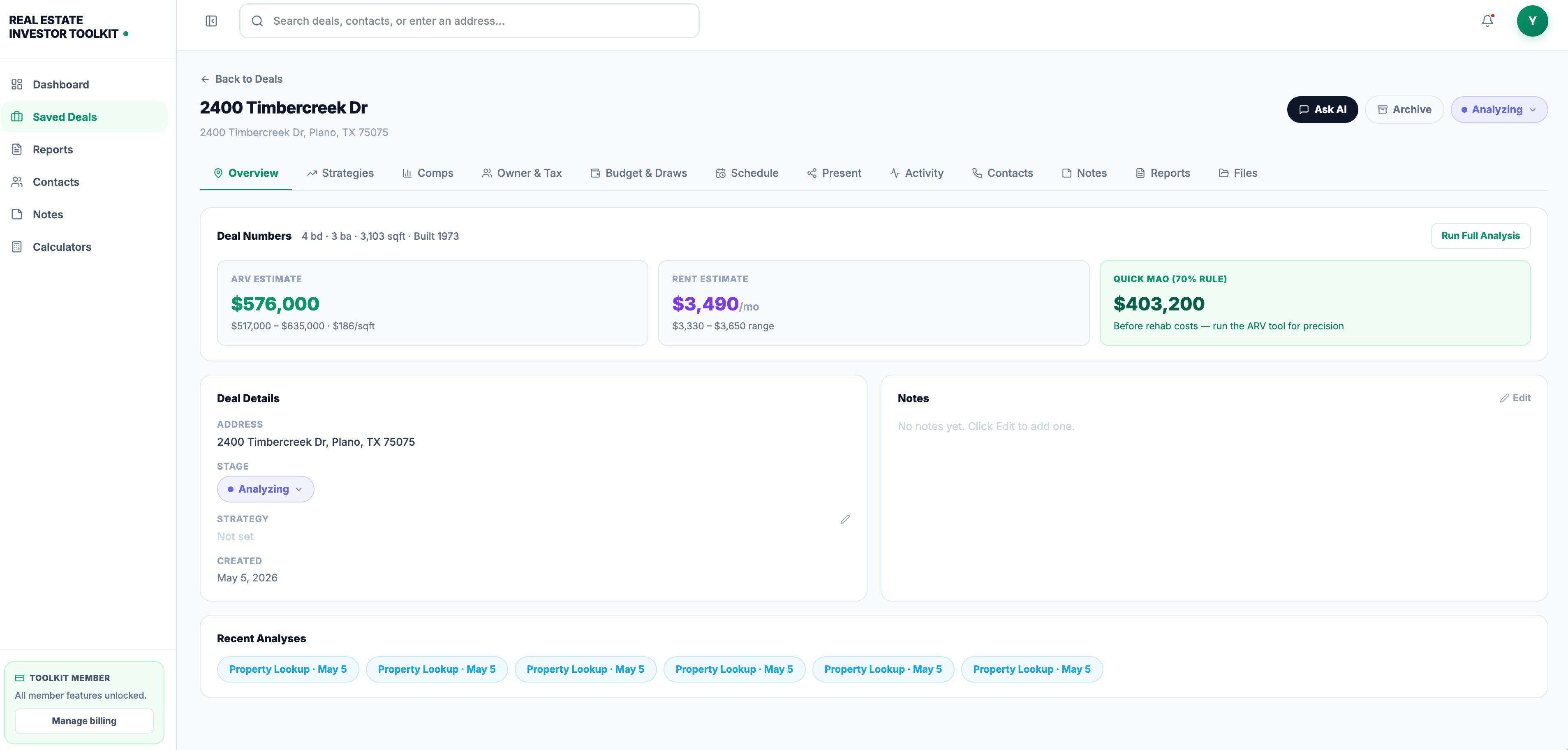
The RHET DealFlow platform gives you assignment-stage pipeline tracking, buyer management, document storage, and the full calculator suite, including the rehab cost estimator and comparable sales analyzer, without requiring a separate underwriting tool. Free calculators are available with no sign-up, so you can validate the deal math on a live deal before you commit to a paid plan. Paid tiers add unlimited reports, saved pipelines, and advanced property data. Visit the investing guides and frameworks library to run the demo checklist on a real deal and see how the platform fits your workflow.
Useful sources and further reading
The sources below back the claims in this article and offer additional depth for wholesalers who want to go further on specific topics.
- RHET DealFlow — Investor Platform | Real Estate Investor Toolkit — the publisher’s pipeline platform; start here to explore the deal stages, calculator integrations, and buyer management features discussed throughout this article.
- Real Estate Investor Toolkit — Free Investment Property Calculators — free ARV, MAO, and rehab tools with no sign-up required; use these to validate deal math during your trial checklist.
- How to Calculate a Wholesale Offer (Assignment Fee + MAO) — step-by-step guide to the MAO formula; useful when configuring your offer calculation workflow inside any CRM.
- How to Analyze Your First Real Estate Deal — a practical walkthrough for running a deal through the full analysis stack; use this as your trial validation task.
Run the five-task demo checklist from the onboarding section on RHET DealFlow, or start with the free calculators to test the deal analysis layer before you evaluate the full pipeline platform.