Investors: Run Base, 5% and 10% Down ARV Scenarios in a Down Market

In a falling market, treat every ARV as a range, not a number, and reconcile toward its lower end. Support that number with documented time adjustments, at least two market-movement methods (paired sales plus an HPI, for example), and a widened contingency buffer.
TL;DR:
- Use at least two market-movement methods, such as paired sales and a local home price index, to verify adjustments in a declining market.
- Reconcile ARV toward the lower end of the range and produce scenarios with 5% and 10% reductions for a conservative estimate.
- Base your maximum offer on the lower-end ARV, factoring in longer holding times, higher contingencies, and volatile local material costs.
- Avoid relying on comps with unadjusted concessions or distressed sales without thorough motivation and marketing exposure analysis.
- Confirm your comps and adjustments with documented evidence, especially if the sale conditions are atypical or show zero time change.
Table of Contents
- How Do Appraisers Measure ARVs in a Declining Market?
- What Is the ARV Workflow for a Falling Market?
- How Should You Budget Rehab and Set Your Maximum Offer?
- When Should You Walk Away From a Deal?
- How Investor Calculators Support Conservative ARV Planning
- Disciplined Underwriting Beats Hope in a Down Market
- Get a Conservative ARV Number Before You Make an Offer
- Sources
- FAQ
How Do Appraisers Measure ARVs in a Declining Market?
A market-condition adjustment, often called a time adjustment, accounts for the gap between when a comparable sale went under contract and today. Fannie Mae’s Selling Guide requires appraisers to analyze that gap for every comp and to back any adjustment with real evidence, not intuition. This matters more in a downturn because a comp that closed six months ago may already reflect a price level the market has since dropped below.
Freddie Mac tells appraisers to base their market trend on at least 12 months of data, then apply four main techniques to quantify the shift:
- Paired sales: comparing two nearly identical properties sold at different times to isolate the price change.
- Grouped sales: averaging price movement across a cluster of similar sales rather than relying on one pair.
- Repeat sales: tracking the same property resold twice to measure appreciation or depreciation directly.
- Regression and local home price indices (HPIs): statistical models that smooth out noise across a larger dataset.
Each comp can get a positive, negative, or zero adjustment depending on its own contract date and condition, regardless of what the 12-month trend shows overall. That is the detail wholesalers miss most often. The strongest support for any adjustment combines two of these methods, such as a local HPI reading confirmed by two or three paired sales in the same zip code. A single data point, no matter how clean, is thin evidence in a market that is still moving; an external perspective on measuring market movement and adjusting values can provide a useful methodological comparison when discussing alternative data sources.
What Is the ARV Workflow for a Falling Market?
Sparse data is the defining problem in a downturn, so your process needs to be tighter than it would be in a stable market. Follow this sequence on every deal:
- Define the micro-market first. Pull comps from a tight radius, a 90 to 120 day window, and the same property type and quality band. Widening the radius to find more comps usually dilutes accuracy instead of improving it.
- Pull contract dates, not just closing dates. Flag any sale with concessions, seller credits, or unusual financing terms. Freddie Mac warns that unadjusted concessions can inflate a comp’s apparent value and hide the downward pressure you actually need to see.
- Investigate anything that looks distressed. A short sale or foreclosure is not automatically excluded, but the Appraisal Institute says you need to understand the seller’s motivation and marketing exposure time before deciding whether to use it as-is, adjust it, or set it aside.
- Derive your time adjustment two ways. Cross-check a local HPI reading against paired or grouped sales. If the two methods disagree by more than a few points, lean toward the more conservative figure.
- Reconcile to a range, then bias low. Produce a base ARV, then a minus 5% and minus 10% scenario, and treat the lower band as your working number for underwriting.
How Should You Budget Rehab and Set Your Maximum Offer?
An uncertain ARV should never be paired with a tight rehab budget. Pad unit costs on finishes and systems where local material or labor pricing has been volatile, and add a dedicated contingency line rather than folding it into “miscellaneous.”

Your maximum allowable offer (MAO) calculation should run off the reconciled lower-end ARV, not the midpoint, and it should assume longer holding costs and a longer marketing period than you’d budget in a rising market. Extended days on market translate directly into extra loan interest, taxes, insurance, and utilities, all of which erode margin before you ever list the property.
Three mistakes show up constantly in declining-market rehabs:
- Using rehab comps from a hot-market year instead of current material and labor pricing.
- Skipping a permit and inspection check that later forces change orders.
- Assuming a fast sale timeline because that’s what worked eighteen months ago.
Stress-test your rehab budget the same way you stress-test ARV. If it doesn’t, your offer is too high.
If the deal still works there, you have a genuine cushion, not a hopeful one.*
When Should You Walk Away From a Deal?
Set hard rules before you’re emotionally attached to a property, because declining markets punish optimism fast. If that clearance doesn’t exist at the lower end of your ARV range, the deal isn’t ready to sign, even if it looks fine at the midpoint.
Watch for these warning signs before you accept a comp set or an appraisal’s conclusions:
- A high share of recent sales in the area are distressed, short sales, or foreclosures without adjustment.
- A comp shows a $0 time adjustment with no explanation of why the market held flat when local data suggests otherwise.
- Marketing times on recent comps are stretching out, a signal that demand is softening faster than closed prices show.
- Concessions or seller credits appear on multiple comps without being backed out of the sale price.
Fannie Mae’s guidance is explicit that a $0 adjustment still requires documented support. If a comp set can’t explain why no time adjustment applies, treat that ARV as unreliable until someone can.
How Investor Calculators Support Conservative ARV Planning
The workflow above maps cleanly onto a tool sequence: pull comps, calculate ARV, estimate rehab, then check your MAO. Real Estate Investor Toolkit’s comps analyzer lets you flag distressed and concession-heavy sales before they distort your baseline, and the ARV calculator makes it fast to run your base, minus 5%, and minus 10% scenarios side by side instead of rebuilding a spreadsheet for each one.
Some markets, including Mobile, Alabama and Mesa, Arizona, have dedicated regional ARV calculators built around local market data, which helps when comp scarcity makes a generic national tool feel too broad.
Distressed sale activity has climbed through 2025 and into 2026, with more metros reporting outright price declines rather than just slower appreciation. That trend is exactly why saving your scenario outputs matters: a documented range beats a single confident number when you’re negotiating a purchase or defending your offer to a lender.
- No sign-up is required to run the core calculators.
- Save multiple scenario outputs for the same property to compare before you commit.
- Pair the rehab estimator with your ARV range rather than pricing rehab in isolation.
Disciplined Underwriting Beats Hope in a Down Market
Conservative reconciliation and scenario testing aren’t extra steps for cautious investors. Anyone who’s underwritten deals through a market turn learns the same lesson: the appraisal number is a starting point, not a promise.
If you take one thing from this guide, make it this: never accept a $0 time adjustment or a single-comp ARV without asking what evidence backs it. That habit alone will save you from more bad deals than any spreadsheet formula.
— Michael
Get a Conservative ARV Number Before You Make an Offer
Some platforms replace the guesswork of a hand-built spreadsheet with calculators built specifically for this workflow: pull comps, flag distressed sales, calculate a scenario-tested ARV, then check your rehab budget and MAO against it, all without juggling multiple subscriptions.
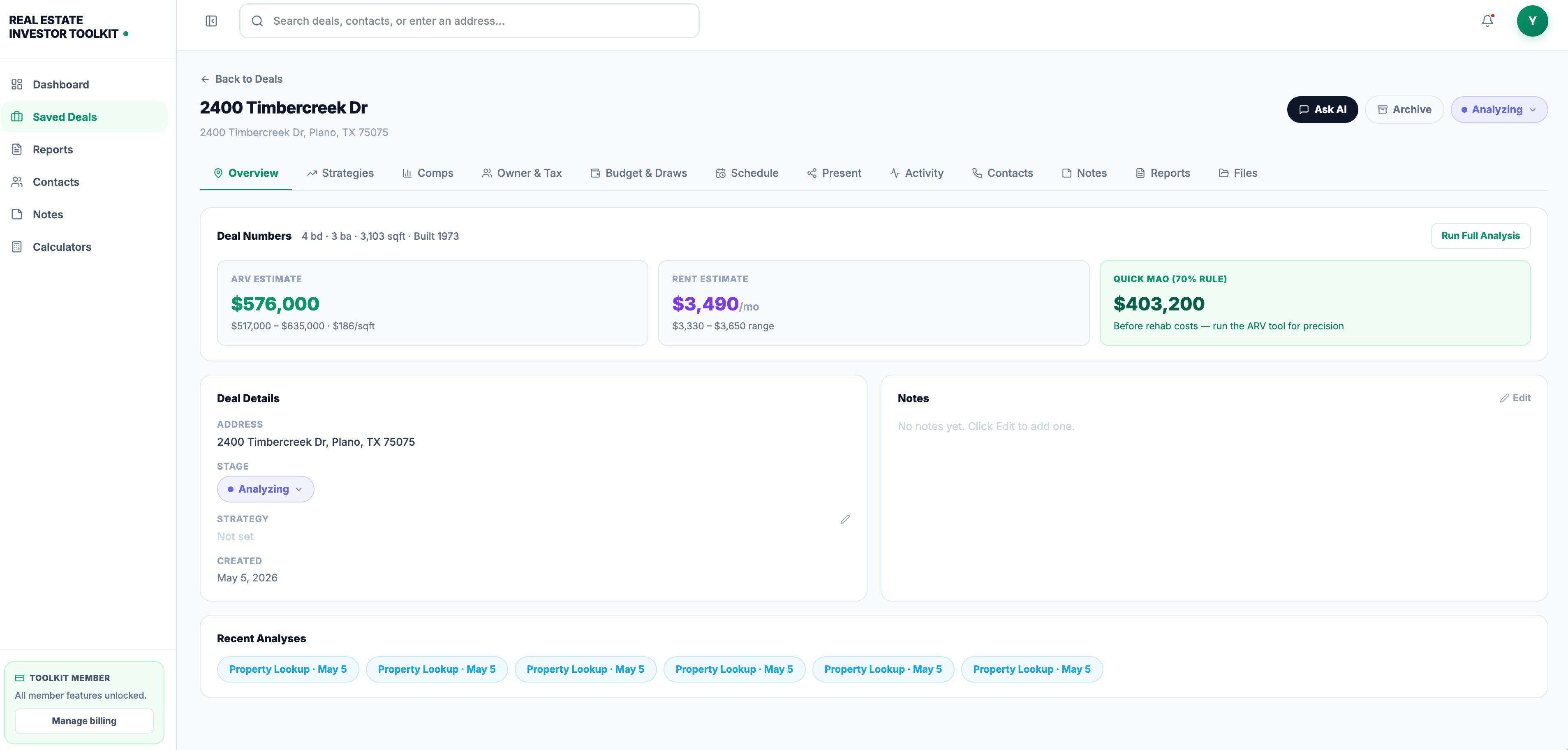
The ARV calculator lets you run base, minus 5%, and minus 10% scenarios in minutes, and the rehab cost calculator helps you stress-test contingency against those same downside cases. Every core tool is free to use with no sign-up required, so you can test a deal the moment it hits your desk. When you’re ready for unlimited reports, saved deal pipelines, and AI-assisted deal insights, the Real Estate Investor Toolkit plan runs $39.99 per month.
Sources
- Adjustments to Comparable Sales | Fannie Mae
- Neighborhoods, Market Areas and Market Conditions for Lenders - Freddie Mac Single-Family
- Guide notes — Appraisal Institute (Comparable selection in a declining market)
- Appraiser update — March 2026 | Fannie Mae
FAQ
What Does It Mean to Reconcile ARV to the Lower End?
It means picking a final value near the bottom of your indicated range instead of the midpoint or top. Freddie Mac’s guidance recommends this in declining markets because closed sales lag current pricing pressure that hasn’t shown up in the data yet.
How Do You Handle a Comp That Was a Foreclosure or Short Sale?
Investigate the sale’s circumstances, including marketing time and seller motivation, before deciding to use it. The Appraisal Institute notes distressed sales aren’t automatically excluded, but they often need adjustment or added explanation before they support your ARV.
Why Would a Comp Get a $0 Time Adjustment?
A $0 adjustment means the appraiser or analyst concluded prices held flat between the comp’s contract date and today. That conclusion still needs documented support; Fannie Mae’s 2026 guidance treats an unsupported $0 adjustment as unacceptable.
What Does Real Estate Investor Toolkit Cost?
The core calculators, including ARV, rehab, and comps tools, are free with no sign-up required. The full Real Estate Investor Toolkit plan, which adds unlimited reports, saved pipelines, and AI deal insights, costs $39.99 per month.
How Many Comps Do You Need in a Declining Market?
There’s no fixed number, but relying on a single comp or a single method is risky when prices are moving. Cross-checking a local HPI against two or three paired or grouped sales gives you sturdier support than any one data point alone.