ARV vs. Purchase Price: Which Number Should Drive Your Offer?

After-repair value sets the ceiling on what a rehabbed property is worth. Purchase price is simply what you pay to get in the door. The number that actually governs your offer is neither one alone. It’s the gap between them, tested through the maximum allowable offer (MAO) formula:
MAO = (ARV × 0.70) − estimated repair costs
If your purchase price sits comfortably below that MAO once you’ve layered in soft costs and holding costs, you have room to profit. If it doesn’t, no amount of optimism about the neighborhood fixes the math.
- ARV answers “what will this be worth when I’m done?”
- Purchase price answers “what do I have to pay to start?”
- MAO is the bridge that tells you whether the gap between those two numbers is wide enough to work with.
Key Takeaways
ARV sets the ceiling on a deal’s value while the purchase price is the cost that determines whether the gap between them leaves room for profit.
| Point | Details |
|---|---|
| ARV is a forecast, not a fact | Base it on comparable sold properties matched to your finished renovation scope, not the property’s current condition. |
| Use the MAO formula to test offers | Calculate (ARV × 0.70) − repair costs, then compare the result against the asking price. |
| Build a range, underwrite conservatively | Pull three to five comps, calculate low, mid, and high ARV, and use the low end for your math. |
| Budget beyond hard costs | Add soft costs, holding costs, and a contingency of 10 to 20% depending on rehab scope. |
| Verify before you offer | Real Estate Investor Toolkit’s free ARV, rehab, and comps calculators let you rebuild this entire worked example with current market data before you submit a bid. |
Table of Contents
- ARV vs Purchase Price: Definitions Every Investor Needs Straight
- How to Calculate ARV Step by Step
- Turning ARV Into a Maximum Allowable Offer
- Budgeting the Costs That Sit Between ARV and Profit
- Where ARV-Based Math Falls Apart
- Your Pre-Offer Checklist
- Where Calculators Fit Into ARV Accuracy
- A Habit Worth Building Into Every Deal
- Run the Numbers Before You Make an Offer
- Sources
ARV vs Purchase Price: Definitions Every Investor Needs Straight
After-repair value (ARV) is the projected market value of a property once your renovation scope is complete. It’s a forecast, built from comparable sold properties, not a fact you can look up. Purchase price is the fixed, known dollar amount you agree to pay the seller today, as-is, before you touch a hammer.
Confusing the two is where a lot of new investors lose money. As-is value describes what the property would fetch in its current, unrenovated condition. Market value is a broader term appraisers and agents use for a property’s worth under normal conditions. ARV is different because it’s project-specific: it only makes sense in the context of a defined renovation scope. Change the scope, change the ARV.
Here’s who leans on ARV and why it matters to each of them:
- Flippers use ARV to reverse-engineer a maximum offer before they ever call the seller.
- Wholesalers use ARV to justify the assignment fee they’re charging a flipper on the back end.
- Rehab lenders rely on projected post-repair valuation to underwrite renovation loans, including HUD’s FHA 203(k) program, which bases loan sizing on where the property will land, not where it sits today.
Purchase price, meanwhile, is just cost basis. It’s the anchor everything else gets measured against, but it tells you nothing about profitability on its own.
How to Calculate ARV Step by Step
Calculating ARV is not guesswork if you follow a repeatable process. BiggerPockets and other practitioner guides converge on the same core method: the sales comparison approach, built from real closed sales rather than list prices or automated valuation models.
- Pull comps within a tight radius, ideally under half a mile in urban areas or up to a mile in rural markets, sold within the last three to six months. Older sales don’t reflect current buyer demand.
- Match the finished condition, not the current condition. A comp should resemble what your property will look like after your renovation scope, not before. If you’re doing a full kitchen and bath gut, don’t compare against houses with dated 1990s finishes.
- Calculate price per square foot for each comp by dividing sale price by finished square footage, then average across three to five comps to smooth out outliers.
- Adjust for differences in bed/bath count, lot size, garage, and finish tier. A comp with a pool or a finished basement your subject lacks needs a downward adjustment; missing a bedroom needs the reverse.
- Build a range, not a single number. Calculate a low, mid, and high ARV, then underwrite to the conservative end. HouseCanary and other data providers emphasize this range-based approach specifically because a single comp can mislead you.
- Cross-check with a second source. MLS access, county recorder data, or a dedicated comps tool should roughly agree. Large discrepancies mean one of your comp sets is flawed.
Pro Tip: Never accept someone else’s ARV at face value, whether it comes from a wholesaler’s flyer or a seller’s agent. Re-run the comps yourself. A seller motivated to close has every incentive to hand you an inflated number, and a five-minute independent check with a tool like the Real Estate Comps Analyzer can save you from a five-figure mistake.
Your data sources matter here. MLS access gives you the most reliable sold-comp data, county recorder sites confirm actual closing prices, and dedicated ARV calculators let you cross-reference multiple comp sets quickly without a license.
Turning ARV Into a Maximum Allowable Offer
Once you have a defensible ARV, the 70% rule converts it into an actual purchase ceiling. The formula is simple: MAO = (ARV × 0.70) − repair costs. The 30% haircut off ARV exists to cover your profit margin plus the costs the formula doesn’t explicitly list, including closing costs, holding costs, financing fees, and the agent commission you’ll pay on the eventual sale.
That 70% figure isn’t fixed in stone. In hot markets with fast absorption and low competition for buyers, some investors push to a higher percentage of ARV in hotter markets, accepting thinner margins in exchange for a faster exit.
Here’s how the math plays out on an actual house:
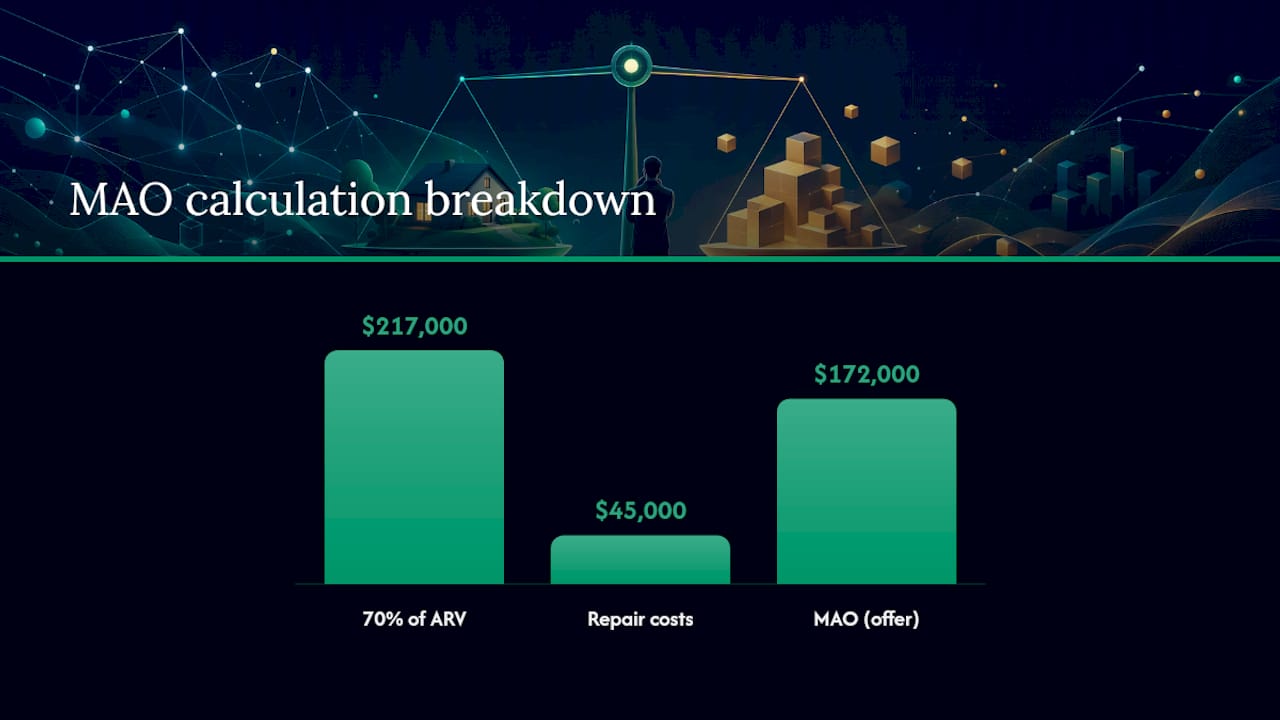
- You pull comps and land on an ARV range of $310,000 to $330,000. You underwrite to the conservative $310,000.
- You multiply: $310,000 × 0.70 = $217,000.
- Your contractor bid comes in at $45,000 for repairs.
- MAO = $217,000 − $45,000 = $172,000.
- The seller is asking $175,000. That’s $3,000 over your MAO, meaning the deal only works if you can negotiate the price down or find at least $3,000 in cost savings elsewhere.
A $172,000 MAO against a $175,000 ask isn’t automatically dead. It’s a signal to negotiate, not necessarily a signal to walk. Where it becomes dead is if the seller won’t budge and your repair bid is already conservative.
Beyond the headline formula, remember that MAO doesn’t capture everything. Closing costs, real estate commissions on the resale, and loan origination fees all still need to fit inside that 30% buffer, which is exactly why padding your repair estimate with a contingency matters more than shaving a percentage point off the rule itself.
Budgeting the Costs That Sit Between ARV and Profit
Getting ARV right only helps if your cost side of the ledger is equally honest. Rehab budgeting breaks into three buckets, and conflating them is a common way flippers underprice a deal.
Hard costs cover materials and labor: flooring, cabinets, roofing, HVAC, framing. Soft costs cover the paperwork side: permits, architectural or engineering fees, inspections, and insurance during construction. Holding costs are the ongoing bills you pay just because you own the property: loan interest, property taxes, utilities, and insurance premiums that accrue every month the house sits unsold.

Scope the job with a real contractor bid, not a per-square-foot rule of thumb pulled from a forum post. Renovation cost trends shift year to year with material and labor pricing, which means a rule of thumb from two years ago may already be stale.
Contingency reserves should scale with the scope:
- Light rehab (cosmetic only, paint and flooring): 10% contingency.
- Medium rehab (kitchen, baths, some systems work): 15% contingency.
- Heavy rehab (structural, full systems replacement, additions): 20% or more.
Pro Tip: Get your contractor bid before you make an offer, not after. A bid that arrives post-closing has zero negotiating leverage attached to it. A rehab cost calculator can give you a sanity-check range while you wait on formal quotes.
Permits and lender inputs matter most on heavier scopes. If you’re financing through a renovation loan, your lender will want a scope of work and a licensed contractor attached before releasing draw funds. Skipping that step to save time often costs more time later.
Where ARV-Based Math Falls Apart
A handful of mistakes account for most of the losses investors trace back to bad ARV math.
- Trusting automated valuation models over comps. Algorithmic estimates don’t know your renovation scope and routinely miss by tens of thousands of dollars on distressed properties.
- Anchoring to a single outlier comp that closed high because of a bidding war, then treating it as representative of the whole market.
- Ignoring market timing. A comp that sold eight months ago in a rising market may already understate current value; one that sold eight months ago in a cooling market may overstate it.
- Underestimating scope creep. Hidden electrical, plumbing, or foundation issues surface mid-project on nearly every rehab, which is exactly what contingency reserves exist to absorb.
- Assuming your ARV will match the lender’s appraisal. The CFPB notes that lender appraisals are independent, formal valuations, and they can land below your ARV even when your comps were sound. An appraisal shortfall can stall financing or force you to bring more cash to the deal than planned.
Building in a conservative ARV from the start is your best defense against most of this list.
Your Pre-Offer Checklist
Before you submit a number to a seller, run this sequence:
- Pull three to five recent, tightly matched comps and calculate a conservative ARV, weighted toward the low end of your range.
- Get at least one contractor bid for repairs, then add your contingency and soft costs on top.
- Calculate your MAO using (ARV × 0.70) − repairs, and compare it directly against the asking price.
- Watch for red flags: an ARV built on a single comp, a seller pushing you toward their own inflated valuation, or an asking price that’s already above your MAO with no room to negotiate.
If the purchase price clears your MAO with margin to spare, move forward. If it doesn’t, negotiate, walk, or find real savings in the rehab scope before you sign anything.
Where Calculators Fit Into ARV Accuracy
Manual comp-pulling and spreadsheet math work, but they’re slow and error-prone under deadline pressure. A dedicated ARV calculator applies the comp-adjustment logic consistently every time, which matters most when you’re evaluating three properties in one weekend.
- ARV calculators turn raw comp data into a defensible range in minutes.
- Rehab cost estimators replace guesswork with itemized hard and soft cost projections.
- Comps analyzers surface recent, matched sales so you’re not manually digging through county records.
Together, these tools shrink the gap between a rushed guess and a number you’d defend to a lender.
A Habit Worth Building Into Every Deal
The most common underwriting mistake isn’t bad math. It’s picking an optimistic ARV and never checking it against a second source. Investors who consistently profit tend to share one habit: they pick a conservative ARV, then verify it against at least two independent comp pulls or an agent’s opinion before they ever submit an offer.
That discipline costs an extra fifteen minutes per deal. It’s cheap insurance against the alternative, which is discovering your real ARV three months into a renovation you can no longer walk away from. Run the worked example from this article through your own numbers using the ARV vs MAO guide and see where your next deal actually lands.
— Michael
Run the Numbers Before You Make an Offer
Real Estate Investor Toolkit gets you a defensible ARV in minutes, not hours, with no sign-up wall standing between you and the calculator when a seller wants an answer today.
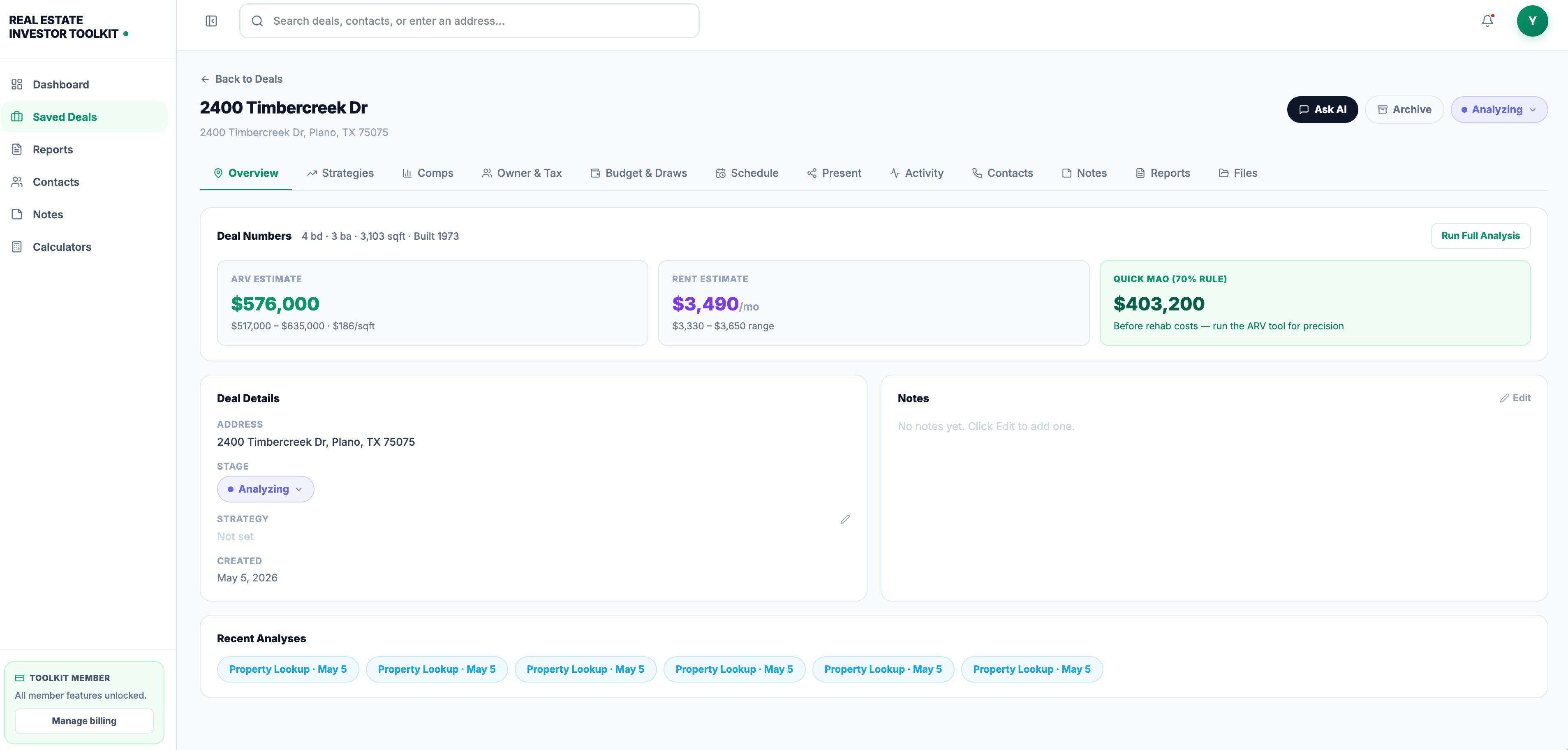
You can reproduce every calculation in this article right now. Start with the ARV calculator to build your comp-based value range, plug your contractor bid into the rehab cost estimator to nail down hard and soft costs, then cross-check your comp set against the comps analyzer before you commit to a number. Each tool pulls current market data so your MAO reflects what’s actually selling nearby, not a stale estimate from a forum thread. If you’re financing through a renovation loan or planning a BRRRR exit, the same comp data feeds directly into your offer strategy. Pull your comps, calculate your MAO, and see whether the asking price on your next deal actually clears the bar.
Sources
- HUD — FHA 203(k) rehab loans
- How To Calculate After-Repair Value (ARV) In Real Estate | BiggerPockets
Recommended
- ARV vs MAO: What Changes Your Offer and What Just Measures Value — Real Estate Investing Guide | Real Estate Investor Toolkit
- What Is ARV (After Repair Value)? — Real Estate Investing Guide | Real Estate Investor Toolkit
- ARV Calculator — After Repair Value Estimator | Real Estate Investor Toolkit
- Austin ARV Calculator for Real Estate Investors | Real Estate Investor Toolkit